
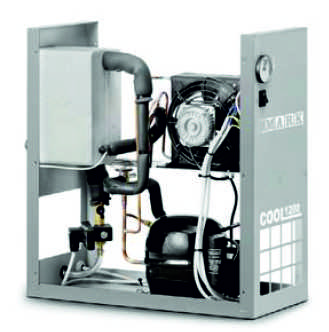
Refrigeration dryers remove moisture from the compressed air by lowering the temperature of the air below the level of the pressure dew point, as a rule +3°C or +5°C, using a refrigerant and the exchange of thermal energy. The compressed air is completely rid of moisture for operating temperatures above the value of the dew point used. The advantages of refrigeration dryers are the low price and no air consumed for operation. The disadvantages are then the relatively low level of the dew point, the need for electrical energy for the running of the fan, the control system and the refrigerant compressor, and further the need to ensure effective ventilation. Despite these disadvantages, refrigeration dryers are the most used way of drying air. Before refrigeration dryers it is advisable to put a cyclone separator to reduce energy consumption and further a filtration system to prevent the entry of contaminants into the device.
Description of the function of the refrigeration dryerThe warm compressed air enters the evaporator, where it comes into indirect contact with the refrigerant. Here its temperature falls below the set value of the dew point, whereby massive condensation of water occurs. This is separated by means of a cyclone separator and drained by an electric valve. The refrigerant is enclosed in a refrigerant circuit and is driven by a compressor. After leaving the evaporator it is heated and needs to be cooled by means of a fan before re-entering the refrigerant compressor. The quantity of refrigerant is regulated by means of a valve with the assistance of temperature detection. |
 |
Adsorption dryers
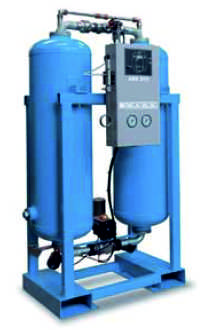
In adsorption dryers the moisture of the air is bound during flow to the adsorption material, where it adheres to its surface or in its pores. It is a drying by a chemical route without the need to change the temperature, and the value of the dew point thus depends only on the drying material used and is as a rule equal to -40°C or -70°C. The advantage of adsorption dryers is precisely the achievement of very low values of the dew point, which allows the most effective removal of moisture and the possibility, for example, of outdoor installation of the air piping in winter conditions. The disadvantages are on the one hand the high acquisition price and especially the significant increase
of operating costs due to the relatively large consumption (up to around 20%) of the entering air for the regeneration of the towers. Before adsorption dryers a single- or two-stage filtration system must be put to prevent the entry of contaminants into the device. In terms of maintenance they require regular replacement of the charges with adsorption material.
 |
 |
Description of the function of the adsorption dryer
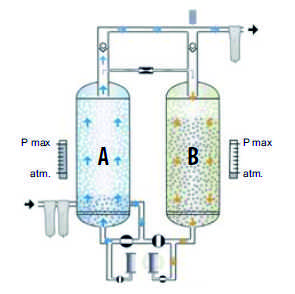
The compressed air comes through the filtration system into tower A, which is filled with adsorption material with which the air comes into contact. The adsorption material attracts to its surface and into its pores the molecules of water and the cleaned air heads to the outlet. After a certain time (as a rule several minutes) the adsorption material is already so saturated with moisture from the air that it is not capable of further adsorption. At this moment, by means of a valve system, the flow
of the inlet air is switched to the second tower B. Meanwhile, in tower A so-called regeneration takes place, in which on the one hand the pressure is released from tower A into the atmosphere through a silencer and carries with it the water, which without pressure is not retained in the adsorption material, and at the same time the tower is blown through with a small stream of air rid of moisture from tower B. After a further moment in time or if regeneration of the tower is detected, the valve system is switched over again.