
Safety valves for compressed air
Introduction: The use of compressed air
Compressed air is one of the most widespread media for transmitting energy in industry and workshop practice. It is used in many sectors thanks to its safety (no sparking) and versatility. Typical applications of compressed air include:
- Pneumatic tools and machines: Driving drills, impact wrenches, breakers, spray guns and the like, where the air provides high output and reliability.
- Automation and manufacturing: Actuating pneumatic cylinders, valves and robotic elements on production lines; compressed air provides fast, precise movement of mechanisms.
- Transport and automotive: Filling and inflating tyres, air brakes on lorries or trains, suspension and other systems using compressed air.
- Cleaning and maintenance: Blowing off dirt, sandblasting surfaces, cleaning equipment with an air jet; also drying products in industry.
- Special applications: Breathing apparatus (diving cylinders, healthcare), pressure sprayers, or conveying bulk materials with pneumatic conveyors.
Compressed air is, in short, crucial in modern industry and, thanks to compressors, a relatively easily available source of energy. For its use to be safe, however, every pressure system must be fitted with the appropriate protective elements – above all a safety valve.
The function and importance of safety valves in compressed air systems
A safety valve is a key protective fitting that protects the system against dangerous overpressure. As soon as the pressure in the system exceeds the set safe value, the safety valve opens automatically and releases the excess compressed air into the surrounding atmosphere. Once the pressure falls back into the normal range, the valve closes again. Through this simple principle the valve ensures that pressure in vessels and pipework does not exceed the design limit and that no damage to equipment or danger to operators occurs. Safety valves work purely mechanically (most often by means of a spring pressing on a closing disc) – no external power supply or control is needed for them to function, which increases the reliability of the whole system.
The importance of a safety valve in a compressed air system: It is the last line of protection should other control elements fail. A compressor's pressure switch or regulator may fail, for example; without a safety valve the compressor would then keep raising the pressure in the receiver, which can lead to the vessel bursting with serious consequences. A correctly chosen and set safety valve forestalls this risk – it releases the overpressure automatically and thereby protects not only the equipment itself but also the surrounding staff and equipment. For these reasons safety valves are required by the relevant regulations for operating pressure equipment and are subject to strict standards.
#ShowMore#
Specific features of safety valves intended for air
Materials and construction
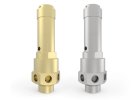
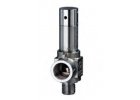
Safety valves for air are most often made of brass (left) or stainless steel (right), with all critical parts designed for resistance to pressure and corrosion. The brass version (often MS58 brass, sometimes nickel-plated) is very widespread for ordinary applications thanks to good resistance to moisture and sufficient strength. Stainless steel (grade 1.4404, for example) is used on valves for higher pressures or more demanding environments – the advantage of stainless valves is higher corrosion resistance and thermal resistance. The internal seal is usually of durable rubber (NBR, FKM/Viton) or PTFE, depending on the required temperature and pressure of the medium.
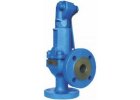
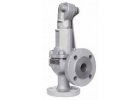
In construction these are usually direct-acting spring valves: the spring presses on the closing element and thus calibrates the opening pressure. Small and medium safety valves for air are made as threaded – with a male thread to screw into a vessel or pipe. Typical thread sizes include G 1/4", 3/8", 1/2", 3/4", 1" up to roughly 2" (DN8–DN50). For large flows or industrial applications flanged valves are also supplied – these have connecting flanges to standardised DN sizes (commonly DN15, DN20, DN50 and larger). The threaded version covers most needs in ordinary compressed air systems (compressors, workshop distribution), while flanged valves find use on large air receivers or central distribution systems with high flow.
Typical pressures and certifications
Safety valves for compressed air are made in various pressure ranges according to the needs of the application. They are most often set between ~5 and 16 bar (corresponding to the usual pressures of compressor systems – a compressor with a working pressure of 8 bar has a safety valve around 10 bar, for example). There are, however, also special versions for very low pressures (single-digit bar) or, conversely, for higher pressures of tens of bar. Typical products cover a range of about 0.2 to 50 bar, and every valve is set to a specific opening pressure at the works and fitted with a seal against unauthorised interference with the setting. That ensures the valve will respond exactly at the specified pressure and cannot easily be reset by mistake.
In terms of certification, a safety valve must meet the requirements of the standards for pressure equipment. Within the EU these valves fall under Directive PED 2014/68/EU, which is usually confirmed by CE marking on the valve's plate. Reputable makers additionally have their valves tested and certified by independent test houses – you will often encounter TÜV certificates (the German technical inspection body) or other equivalents. Certification guarantees that the valve has passed the pressure test for the given opening pressure and has a stated flow capacity. Every safety valve should be supplied with a setting report and a certificate confirming its operating properties. The valves in our range, for instance, come already set to the required pressure, sealed and supplied with the necessary certificates – so the customer can install them safely in their equipment right away.
What to watch out for when choosing a safety valve
When choosing a safety valve for a specific system, several fundamental parameters must be taken into account:
-
Connection: Make sure the valve you choose has the right type and size of connection. For smaller compressors and receivers it will generally be a thread (G 1/2" for a domestic compressor tank, for example). Check also whether the thread is tapered (R) or parallel (G) and whether the valve needs a sealing washer or seals on the taper itself. On larger equipment, where the valve might be flanged, verify the flange size and type to the standard.
- Set pressure: Every safety valve is calibrated to a particular opening (set) pressure – this pressure must match the requirements of your system. The set value should be higher than the normal working pressure, but lower than or equal to the maximum allowable pressure of the vessel or system. If a pressure vessel is rated at a maximum of 11 bar, for instance, a valve opening at around 10–11 bar is usually chosen. An incorrectly chosen pressure would either open the valve too soon (preventing the working pressure being reached) or too late (which is already dangerous).
- Flow capacity: A very important parameter is the valve's flow rate (capacity) – how much air the valve is able to release at the given overpressure. This figure is usually given in m³/h or l/min for a particular pressure. It is essential that the capacity of the safety valve exceeds the output of the compressor or the maximum possible inflow of air into the protected vessel. Only then can the valve genuinely reduce the pressure when it opens; if the valve were too „small“ (with insufficient flow), it might not keep up with releasing pressure and the pressure would keep rising. Manufacturers state certified flow figures – compare these with the output of your compressor (a compressor delivering 300 l/min will require a valve with a flow of at least 0.3 m³/min at the given pressure).
- Other aspects: Consider the temperature of the medium and the surroundings – standard safety valves for air work in the usual temperature range (-20 °C to +80 °C or more with a Viton seal, for example). If you have an environment with extreme temperatures, or the valve will sit on a hot pipe, check the valve's maximum temperature. Make sure too that the valve suits the medium: most safety valves for compressed air also handle other non-aggressive gases (nitrogen, CO₂, argon and so on), but they are not intended for steam, oxygen or liquids unless the maker explicitly says so. Specialised valve versions exist for every medium. Not least, make sure the valve has the necessary approval and documentation – particularly where it is part of a pressure assembly subject to inspection.
Recommended use, advantages and limits of safety valves for air
Where and how to use them correctly: A safety valve should be installed on every pressure vessel or closed circuit with compressed air where pressure may rise above the safe limit. It is typically mounted directly on the compressor receiver (usually in the upper part of the vessel, where the air is dry), or on the main distribution pipe after the compressor. On more extensive systems there may be several valves – on each separate branch with its own compressor or supply, for instance. It is recommended to fit the valve vertically (per the maker's instructions) and where, on opening, it will not endanger operators with escaping air or particles. If the discharged air needs to be led out of the room or the noise damped, an exhaust pipe or silencer can be connected to the valve (where the design permits).
Advantages: Safety valves for compressed air are simple, fast-responding and very reliable devices. They work entirely automatically – opening happens purely through the pressure itself, with no need for electricity or other intervention. A quality valve responds repeatedly and accurately to excess pressure over many cycles. Thanks to durable materials (brass, stainless steel) it needs minimal maintenance and resists corrosion caused by moisture in the air. A correctly sized valve provides safety certainty – operators and owners alike can rest assured that the system is protected against an overpressure incident.
Limits and cautions: A safety valve is not a pressure regulator – it should not intervene in operation under normal conditions. If it opens frequently, that indicates a problem (too high a compressor output relative to demand, or an incorrectly set working pressure, for example) and the situation should be addressed by adjusting the system. The valve is designed as an emergency element; continuous blow-off could lead to wear or pressure fluctuation in the system. Another limit is that ordinary safety valves for air are not intended for other media unless the maker says so – for flammable or toxic gases, oxygen, steam or liquids, special safety valves designed for the purpose must be used. Safety valves for air usually do not have the high temperature resistance of steam valves and are not oil- or oxygen-degreased like valves for oxygen. Always choose the valve according to the medium and conditions, therefore. For compressed air and inert gases, however, these devices do their job excellently and are essential equipment on every compressor or pressure station.
Related categories and further information
For a complete overview of all types of safety valve visit the main Safety valves category, where you will find versions for various media (air, steam, water and others) and various designs. Besides compressed air we also offer special safety valves for other gases – safety valves for nitrogen or other safety valves for inert gases, for example. So if you need a safety valve for a different medium, you can choose a product adapted to that gas. All the safety valves we supply are of professional quality, certified (CE, TÜV) and ready to increase the safety of your compressed air equipment.
Summary: Safety valves intended for compressed air systems are an irreplaceable safety element. They protect compressors, pressure vessels and whole distribution systems against a dangerous excess of pressure by automatically releasing surplus air when needed. When choosing a suitable valve, pay attention to the correct pressure, flow, connection and certification – only then will your pneumatic system be not only efficient but also as safe as possible.
-
 Safety valves 06C02; standard for compressed air
-
Relief valves 6217; full lift for compressed air
-
Safety valves 6370; for water, oil and diesel
-
Relief valves 6380-95; for saturated steam and nitrogen
-
Relief valves 6383-6012; in stainless steel with thread
-
Relief valves 6121; flanged cast iron
-
Safety valves 6127; flanged stainless steel
.jpg)
Product sorting
List of products


