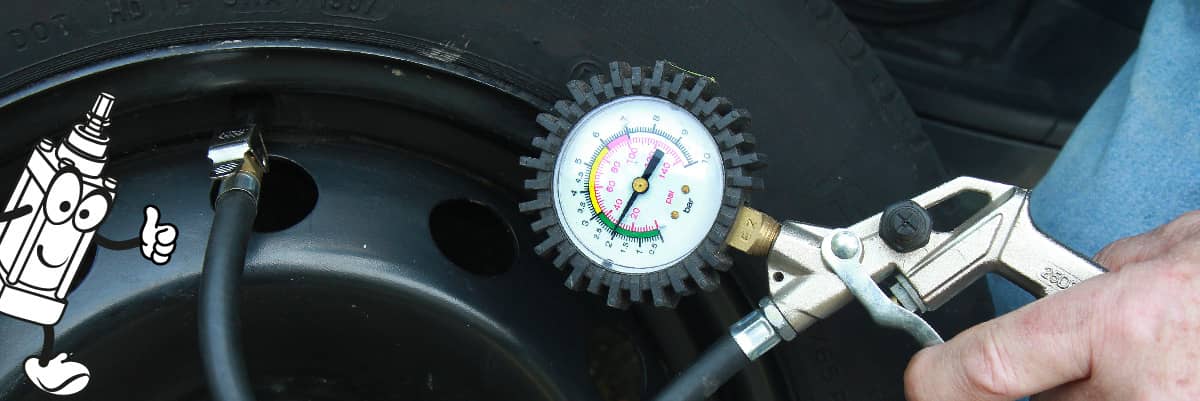

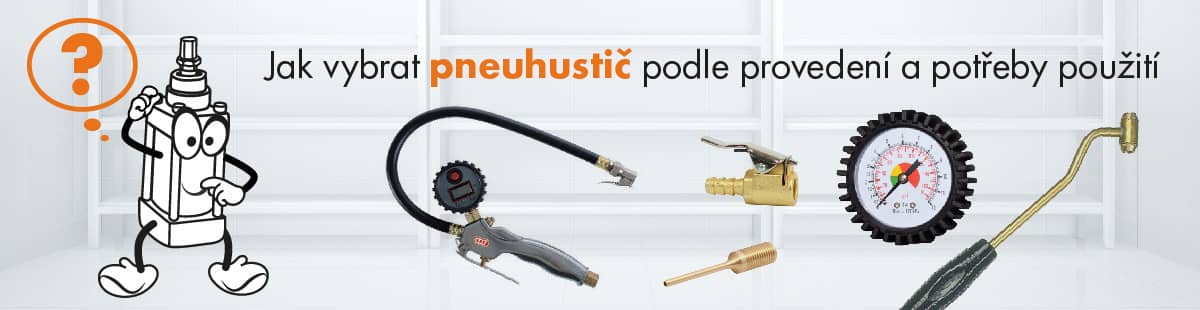
At first glance it may seem that there is nothing to inflating tyres. In many cases it is obvious that the opposite is true, because it has happened to us several times that a customer returned an inflator or wanted to exchange it for another one, because the original did not suit their needs and applications. That is why we have put together this article, which will help you choose the right inflator for topping up all kinds of wheels or balls.
When you are looking for a reliable tool for topping up the pressure in the tyres of cars, bicycles or motorcycles, or even aircraft, and you do not feel like pumping manually with a hand pump or a foot pump, you will probably always come across inflating with a compressor. Just as topping up is done at petrol stations at a stand with an enclosed compressor. Because the hoses with the valve chuck are stolen fairly often at these places, they are replaced with all the cheaper solutions that do not threaten the station operator's budget. As you have surely noticed yourself, part of the compressed air then usually escapes around the metal chuck with an accompanying hiss, because the grip is not tight. And your inflating at home or at work will look exactly the same if you skimp on the inflator or do not choose the right type. What is more, the role of correctly inflated tyres is crucial in questions of safety. Every driver knows that for a vehicle to work well, the tyres have to be in good condition and at the correct pressure.
Hose and valve chuck (clamping)
Let us go straight to the heart of the matter when choosing. One parameter definitely worth watching is the length of the hose. Consider whether you want to kneel or stand while inflating. Some hoses are only 30 cm long, for example, while other manufacturers offer versions a whole metre long. With branded inflators it is also possible to buy hoses of various lengths as you please. A manufacturer who does not cut corners uses rubber, because it is flexible, especially at low temperatures. Other brands use PVC, which is cheaper but stiffens in the cold, so such a hose is difficult to use and handle. The hose connection is in most cases made with a G1/4" thread.
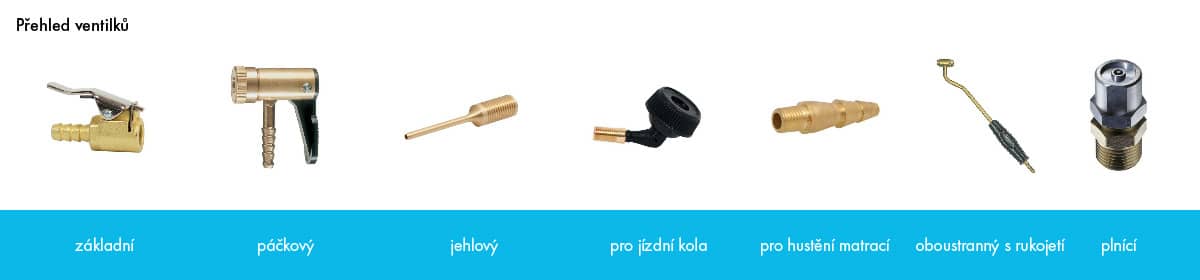
The valve chuck itself, however, need not be the same. Its tightness can vary more than the user might expect. If it matters to you and you do not want to risk losses of compressed air, we always recommend buying a chuck with a double clamp. Ordinary levers on the side of the chuck with an inner beak often do not work quite perfectly, because it is easy to attach them to the tyre valve in the wrong position. That is a common phenomenon precisely with the solutions at petrol stations. A popular variant that it would be a pity not to mention is also the chuck attached to the hose at an angle of 90 degrees with a lever on the face. Here a lot depends on the internal design and the seal used. The last commonly used solution is an end with a handle and a metal extension of the valve connector, which we press against the tyre valve with our own strength. No clamping chuck or fastening system is used at all, everything depends on the care of the operator.
Pressure gauges

How precise does your application need to be? Do you require exact pressures, or do small deviations not matter? The pressure gauges fitted to inflators are not always the same and not always equally accurate. But first, let us have a little quiz!
A gauge with what range should be used if you need a pressure of 40 psi in the tyre?
- 15 psi
- 40 psi
- 60 psi
- 150 psi
If you said B, then you answered... incorrectly! The answer is C and here is why:
- 15 psi – Here it is obvious that there is no point in using such a gauge. It will not read a pressure of 40 psi and you will destroy it.
- 40 psi – The maximum value on the gauge is 40 psi. You never want to have the "needle" stuck at the maximum, because you risk damaging the gauge.
- 60 psi - This gives you a good reserve for measuring and an excellent accuracy tolerance.
- 150 psi - You can use this gauge too, but because of the large scale you sacrifice accuracy.
The accuracy tolerance is based on a percentage of the gauge's maximum pressure.
If the accuracy tolerance of the gauge is +/- 2%, then a 150 psi gauge is accurate to (+/- 2% of 150 psi).
@KATEGORIE@(/pneuhustice-a-prislusenstvi/)(20,random)(slider)
General recommendation for choosing the gauge scale:
- Low-pressure tyres (trolley, bicycle, sack truck) - scale 15 to 60 psi
- Medium-pressure tyres (passenger cars and light trucks) - scale 60 to 100 psi
- High-pressure tyres (heavy trucks, trailers) - scale 150 to 200 psi
* some gauges are also available in a calibrated version approved by the Czech Metrology Institute ČMI (certification of the whole inflator is then suitable above all where an absolutely precise pressure is needed – for example for aircraft and racing vehicles)
If you inflate tyres regularly and in an environment where faster wear can occur (for example in a tyre shop), it is also worth making sure the gauge is resistant to impacts and rough handling. Manufacturers therefore like to use rubber protection. And anyone who wants to go even further can buy an inflator with a digital gauge straight away. For example, the versions from the company EWO stand out with high accuracy - 0,08 bar and values displayed in steps of 0,05 bar.
Inflating options
Among inflators there is also one big difference in the way the inflating itself works. A number of cheaper versions only work in on – off mode, more expensive versions offer a gradual ramp-up. It depends on the design of the valve inside the construction of the inflator. Lever mechanisms can offer one more function - pressing halfway means deflating, full pressing means inflating.