

At first glance it may seem that choosing a blow gun is completely straightforward and that you cannot go wrong. But thinking that all blow guns are the same or similar would be a big mistake. And that is exactly why we come across unsuitably chosen types of guns at many workplaces – types whose use can often endanger the people working nearby or the operator holding the blow gun.
It is precisely because of the mistaken belief that individual types of blow guns do not differ in any fundamental way that this article was written, to help you choose the right model for your application. The fact that the models can be quite different is illustrated by the price range of the individual guns in our shop. Simple plastic models start at the very bottom of the price scale, forged models reach the 2000 Kč mark. But do they all blow the same way and do they have the same compressed air consumption?
Design
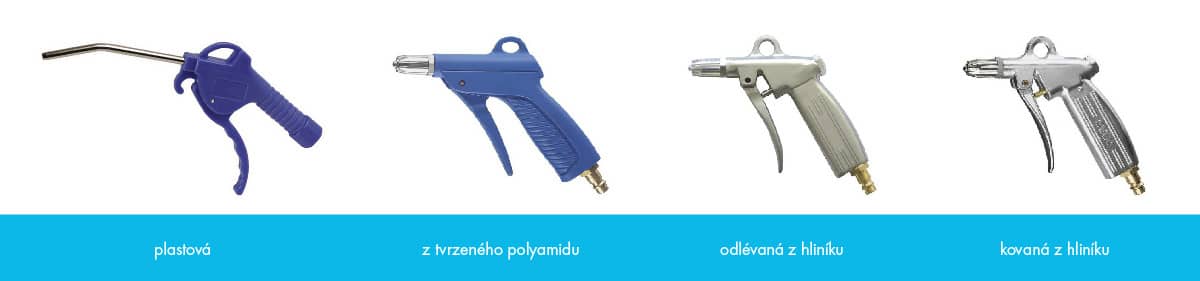
Three designs of guns are the most common on the market. The body is either plastic (for example hardened polyamide), aluminium casting or forged aluminium (maximum quality and durability). Steel is not used in this case, because it would have a negative effect on the weight of the gun. This metal is used only for some components that, on the contrary, have to be as durable as possible if the gun falls from the workbench onto the floor, or generally if it is handled roughly. We are talking mainly about the nozzle and the lever, whose damage would affect the overall function of the gun.
Some people may feel that a plastic design looks like a children's toy, but in some cases it has many advantages. There are applications or areas where unfavourable temperatures are a limiting factor. If the body of the gun were aluminium, the alloy could give an unprotected hand a nasty burn, or on the contrary feel unpleasantly cold. Occupational safety rules, as you surely know, do not recommend or outright forbid wearing gloves in many production areas, because they could get caught – for instance in a lathe spindle or a milling cutter. In such cases it is worth considering a plastic product, especially if it is exposed to unfavourable temperatures that limit operator comfort.
A plastic gun will of course not guarantee such a long service life, especially if it is not handled with care. In a home workshop that is hardly an issue, but as soon as it is used in a production hall where, for example, castings are blown free of chips and the poorly hung gun often falls to the floor, the plastic version should automatically be ruled out. At least the workers will not constantly have to go to their supervisors and ask for new guns. Let us stay with blowing away chips for a moment in the following chapter.

Blow gun nozzles
If you stick strictly to the lowest price when choosing a blow gun, you may deprive yourself of the option of an interchangeable nozzle. The very cheapest models only have a pressed-in metal extension that works as a simple nozzle without any possibility of regulation. As you might guess, guns with a replaceable nozzle are much more practical. By changing the nozzle you can change the shape of the jet, but also reduce noise or protect yourself against flying debris.
Types of nozzles:
- basic nozzle (centrally placed opening, even jet)
- extended nozzle (straight or bent end, suitable for blowing dirt out of hard-to-reach openings – commonly from holes and pockets left after milling)
- safety nozzle with an air shield (side drillings split the jet and create a protective air shield that prevents small particles from flying towards the operator, increases air consumption)
- silenced nozzle (inside there is a special insert of wound/sintered bronze that separates and slows down part of the air stream in order to reduce noise from 90 down to 70 dB)
- nozzle with regulation (allows the ideal flow to be set for particular applications, thus reducing the cost of compressed air consumption)
- flat nozzle (for process blowing in industrial applications, the stream is divided into several channels ending in a flat tip, most often made of plastic)
- injector nozzle (a nozzle with extreme performance thanks to drawing in and entraining air from the surrounding atmosphere into the air stream from the gun. The suction effect then produces a much greater air flow)
@KATEGORIE@(/ofukovaci-pistole-trysky/)(15,random)(slider)
Levers and regulation of blowing power
A common bad habit at many workplaces is an unnecessarily high air pressure for blow guns. That is the case when you can literally feel the gun pushing back against your hand as you press the lever. With such symptoms it can happen that instead of being blown away, the dirt is literally scattered around the whole workshop or driven into very inaccessible places. Fortunately there are several ways to regulate the blowing. One of them is a gun with a potentiometer/regulator. You will recognise these types immediately – they have a built-in rotary potentiometer in line with the lever piston. It is usually placed above the handle. Because workshops often save money in the wrong places, the most widely used guns are, despite the advantages of a regulator, ordinary blow guns working on the on-off principle, i.e. without a gradual ramp-up – they either do not blow at all, or they blow at full stream.
How else can blowing power be regulated?
Another unfortunate effect of unsuitably high pressure is of course the consumption of compressed air and the extra costs connected with it. If neither the gun nor the nozzle has a regulator of its own, the situation can be solved in one more elegant way. All you need to do is connect a regulator to the inlet of the blow gun. It ensures a constant outlet pressure and can, over time, save a great deal of money that would otherwise flow out through the nozzle. Every regulator states the maximum pressure that may enter it and what the constant pressure at the outlet is (given as the working pressure).
Occupational safety of blow guns and alternatives
The blow gun is a simple device that can just as simply injure the operator or the people working nearby. Everywhere that dirt is blown away under pressure, the operator should wear goggles or a face shield and everyone nearby should be warned that blowing is taking place. Correctly set pressure is what should prevent mechanical debris from being scattered over a wide area where a chip could endanger someone. The risk is also reduced by safety nozzles or by fitting a deflector between the nozzle and the gun. Extended nozzles can have a deflector too. If the risks are still too high, it is worth considering the use of a brush instead of a blow gun, or any other manual cleaning method. It may be time-consuming, but it creates no risk.