

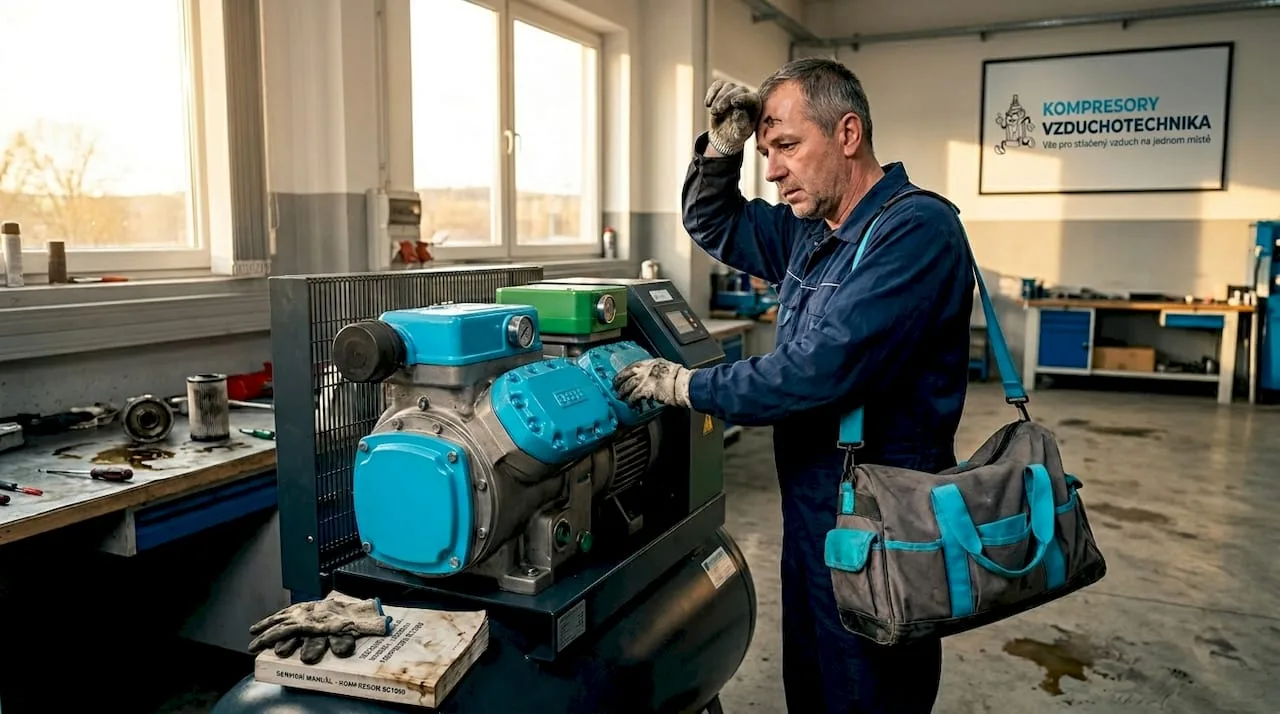
TL;DR:
- Maintenance-free compressors do not require a regular change of oil, but still need a basic check.
- They are suitable for occasional use, mobile work and environments with sensitive air.
- They are unsuitable for continuous industrial operation or a high load.
Many craftsmen and technicians assume that a maintenance-free compressor means a device which after purchase requires no care. This assumption is inaccurate and in professional operation can lead to premature damage to the machine or to unexpected outages. The term maintenance-free describes a specific design solution, not the absolute absence of any operation. This article explains what the designation really means, what the real advantages are and where the limits of usability lie. Professionals in automotive and construction will thus get the overview needed for the right decision when choosing a compressor.
Contents
- What the term maintenance-free compressor means
- Advantages of maintenance-free compressors for professionals
- Disadvantages and limits of maintenance-free compressors
- When and for whom a maintenance-free compressor makes sense
- Practical experience: what long-term practice with maintenance-free compressors shows
- Choosing and buying a maintenance-free as well as a professional compressor without worries
- Most frequent questions
Key findings
| Point | Details |
|---|---|
| The real meaning of the term | A maintenance-free compressor means simplified maintenance, not complete freedom from maintenance. |
| It suits mobile use | It is ideal for quick jobs in the field and for smaller workshops, but not for a continuous load. |
| Know the limits and the right use | In intensive operation it wears out faster and can be noisier than an oil model. |
What the term maintenance-free compressor means
The designation maintenance-free compressor (in English an oil-free compressor) is used in practice for machines which do not require a regular change of compressor oil. The basic design difference lies in the fact that the pistons or screw rotors are fitted with special coatings or bearings with a permanent filling of lubricant. This removes the need to follow the level of oil, change oil filters and dispose of used oil.
In terms of design maintenance-free models most often occur as piston compressors with teflon or composite rings. The bearings in these machines are designed for longer intervals without direct attention. Manufacturers nevertheless state recommended intervals of checking in the technical documentation, for example cleaning the air filter, checking the seals or a visual inspection of the whole machine.
Typical properties of maintenance-free compressors:
- No need for a change of compressor oil
- Bearings with a long-term filling of lubricant
- Air without oil vapours suitable for sensitive applications (painting, the food industry)
- Lower weight thanks to the absence of an oil filling and cooling circuits
- Shorter preparation before starting
The most widespread misconception in practice runs like this: “I will buy a maintenance-free compressor and will not have to look after it for years." This idea leads users to neglect even the basic checks which the manufacturer explicitly recommends. The result tends to be a clogged air filter, overheating or premature wear of the bearings. As the guide How to choose a compressor states, maintenance-free compressors are not suitable for long-term continuous operation.
Another important fact is that the designation maintenance-free is sometimes used also for screw compressors with extended service intervals. These machines still require a change of air filters and separators and a check of the cooling system, only less often than standard models. A professional must always read the technical data sheet of the specific product, not rely only on the marketing designation.
An overview of the most frequent mistakes with compressors shows that neglecting basic maintenance is among the main causes of premature faults even with machines designated as maintenance-free. A regular visual check, cleaning of the filters and following the operating temperature are minimum requirements which cannot be left out without risk.
Professional tip: Before buying always ask for the service manual of the specific model. If the manufacturer states intervals of checking longer than 500 operating hours, it is a genuinely low-maintenance model. If the intervals are shorter, it is rather a standard machine with a marketing designation.
Advantages of maintenance-free compressors for professionals
Maintenance-free compressors bring in practice several specific advantages which you will appreciate especially in mobile deployment or in environments where the cleanliness of the air is key.
Immediate readiness to start is the first practical advantage. With an oil compressor one has to count at low temperatures on a longer run-up or preheating. A maintenance-free machine can be started immediately without preparatory actions. For a service technician who arrives at the customer and needs to start work quickly, this property is fundamental.
Cleanliness of the output air is the second key advantage. The air from a maintenance-free compressor does not contain oil vapours which could contaminate a painted surface or pneumatic tools sensitive to oil. In car repair shops where painting or work on brake systems is done, this property is a technical requirement, not just an advantage.

Lower demands on the operator during mobile deployment is the third advantage. A craftsman who transports a compressor between various building sites or workplaces does not have to deal with a leak of oil during transport, checking the level of oil on site or the disposal of used oil. A maintenance-free compressor can be transported in any position without a risk of contamination.
An overview of the advantages of maintenance-free compressors:
- Immediate start without preparation
- Air without oil vapours
- Easy transport and mobile deployment
- Lower risk of operator errors during operation
- No costs for oil and oil filters
As the guide How to choose a compressor states, maintenance-free compressors simplify operation and save time thanks to minimal service requirements. This saving shows itself in practice especially with technicians who serve several workplaces and cannot devote time to the regular maintenance of an oil machine.
From the point of view of long-term operating costs maintenance-free compressors are advantageous in specific applications with intermittent operation. The costs of oil, oil filters and service work with a standard piston compressor amount to hundreds of crowns a year. With a maintenance-free model these costs are eliminated, even though the purchase price tends to be slightly higher.
The possibilities of the energy saving with a compressor are described in more detail in a separate overview, which also includes a comparison of the operating costs of various types of machine.
Professional tip: If you work in automotive and carry out painting or work with brake fluids, a maintenance-free compressor is the technically correct choice. Contamination of the air with oil can cause defects of the paint or damage to the brake system, which are costly to repair.
Disadvantages and limits of maintenance-free compressors
Alongside advantages maintenance-free compressors also have clearly defined limits. Knowing them before investing is just as important as knowing the advantages.
Higher noise level is the first disadvantage which surprises many users in practice. Maintenance-free piston compressors work without an oil filling, which in oil models dampens the noise of the mechanical parts. The result is a higher operating noise, typically 5 to 10 dB(A) more than with a comparable oil machine. In enclosed workshops or when working near customers this property can be problematic.
Limited service life in demanding operation is the second fundamental limit. Under intensive load maintenance-free compressors have a shorter service life than oil models. Bearings and pistons without ongoing lubrication with oil wear out faster in continuous operation. In a workshop where the compressor runs eight or more hours a day, this property is fundamental for the decision.
“A maintenance-free compressor is not a replacement for an oil machine in demanding industrial operation. It is a specialised solution for specific applications with intermittent operation and a requirement for cleanliness of the air."
Comparison table: maintenance-free vs. oil compressor
| Parameter | Maintenance-free compressor | Oil compressor |
|---|---|---|
| Noise level | Higher (typically 70 to 85 dB) | Lower (typically 60 to 75 dB) |
| Service life in heavy operation | Shorter | Longer |
| Cleanliness of the output air | Without oil vapours | Requires an oil separator |
| Operating costs (oil) | None | Regular change of oil |
| Suitability for continuous operation | No | Yes |
| Purchase price | Slightly higher | Standard |
| Transportability | Easy | Limited (risk of a leak of oil) |

For applications with continuous operation or high demands on output it is appropriate to consider a two-stage compressor for efficiency, which offers a higher output and a longer service life under continuous load.
Another limit is the limited output at high pressure. Maintenance-free piston compressors are designed for pressures up to 8 to 10 bar. Applications requiring a higher pressure or a large flow of air are the domain of oil or screw machines. An overview of the advantages of an electric compressor shows where electrically driven machines are the most advantageous from the point of view of overall efficiency.
An independent comparison of the types of compressor confirms that the choice of the right type depends primarily on the character of the operation, not on the marketing designation of the machine.
When and for whom a maintenance-free compressor makes sense
After clarifying the advantages and the limits comes the key question: for whom and when is a maintenance-free compressor really the right choice?
Recommended applications and professions:
- Car repair shops with painting and work on brake systems
- Mobile service technicians working at several workplaces
- Small workshops with intermittent operation (less than 4 hours a day)
- Construction firms using pneumatic tools during field work
- Workshops with a requirement for cleanliness of the air without oil vapours
Unsuitable applications:
- Large industrial centres with continuous operation
- Plants with 24/7 shifts and a high consumption of air
- Applications requiring a pressure above 10 bar
- Workshops with several pneumatic tools working at the same time
Decision table: maintenance-free or oil?
| Type of operation | Recommended type of compressor |
|---|---|
| Painting, brake systems | Maintenance-free |
| Mobile service, field work | Maintenance-free |
| Small workshop, intermittent operation | Maintenance-free |
| Industrial production, continuous operation | Oil or screw |
| Large workshop, several tools at the same time | Oil or screw |
| High pressure above 10 bar | Oil or screw |
As the decision table states, for occasional use a maintenance-free compressor is the right choice, for industry an oil one. This boundary is fundamental for the right decision.
A specific example from practice: a car repair shop with one painting station and intermittent painting operation (2 to 3 hours a day) is an ideal user of a maintenance-free compressor. Conversely a body shop with five workplaces and an eight-hour shift needs an oil or screw machine with a higher output and a longer service life.
Another specific example is a construction firm carrying out field work with a pneumatic hammer or drill. The transportability and immediate readiness of a maintenance-free compressor are key here. The compressor is transported in a van, started without preparation and after finishing the work stored without a risk of a leak of oil.
An overview of the available company services for compressors and information about energy efficiency in operation will help in planning the overall operating costs for a specific type of operation.
Practical experience: what long-term practice with maintenance-free compressors shows
From long-term observation of the operation of maintenance-free compressors in various environments several recurring patterns emerge. The theory of freedom from maintenance runs in practice into the reality of demanding operation. The biggest problem is not the technical inadequacy of the machine, but the mismatch between the expectation of the user and the actual parameters of the equipment.
The most frequent myth: “Maintenance-free means that I do not have to look after the machine." The result of this approach is a clogged air filter, overheating and premature failure of the bearings. As practice confirms, under intensive load faster wear of maintenance-free machines occurs. The basic rule is: always read the manufacturing parameters and observe the minimum recommended maintenance, even when it is designated as optional.
The second recurring problem is the deployment of a maintenance-free compressor in an operation for which it is not designed. A machine with a nominal output for intermittent operation cannot be operated continuously without consequences. Overheating and a shortened service life are the direct result. The recommendation is simple: always follow the duty cycle stated in the technical data sheet and do not exceed it. Information on safety of work with a compressor also includes the correct procedures for following the operating parameters.
Choosing and buying a maintenance-free as well as a professional compressor without worries
If you already know which variant is suitable for you, you can proceed to the choice of a specific model and get expert support.
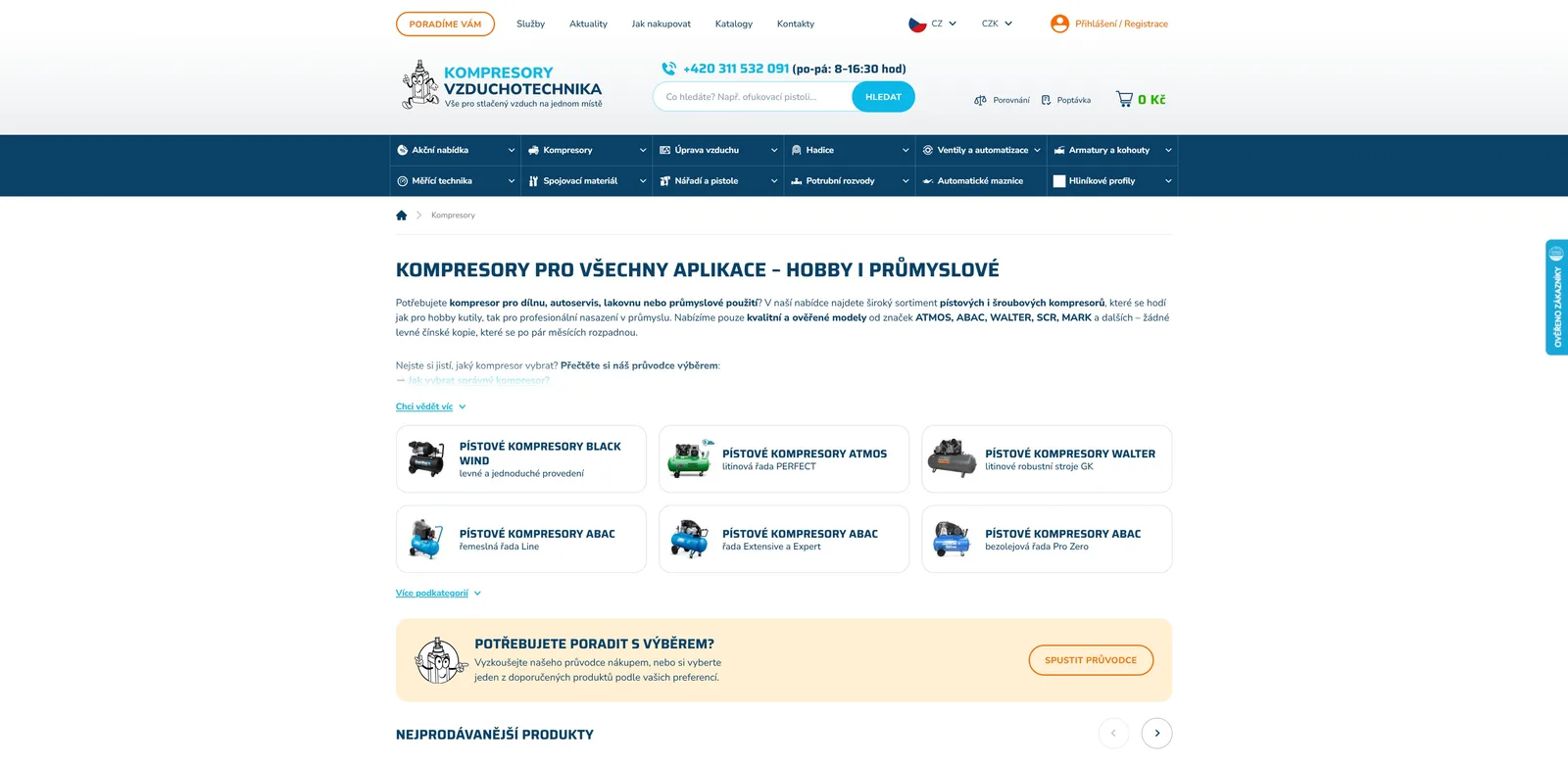
At Kompresory-vzduchotechnika.cz you will find a wide range of maintenance-free piston machines as well as professional oil compressors for demanding operation. Quality MARK compressors cover needs from small workshops up to industrial workplaces. For continuous operation screw compressors for continuous operation with a high reliability and long service intervals are available. The range of compressors also includes accessories, air hoses and pneumatic tools. Expert consultation is available for a choice exactly according to your operation and requirements.
Most frequent questions
Is a maintenance-free compressor really completely without any maintenance?
No, a basic check of the state and cleaning is recommended by the manufacturer even with a maintenance-free compressor. As the guide of the manufacturer states, even maintenance-free machines require an occasional check of the air filter and the seals.
For which applications is a maintenance-free compressor unsuitable?
It is not suitable for continuous industrial operation or for applications with a permanently high load. The shorter service life under intensive load is the main reason for choosing an oil or screw machine in these conditions.
How often does a maintenance-free compressor need to be checked in an ordinary workshop?
Generally it is enough to check the basic parts such as the filter and the seals regularly according to the instructions of the manufacturer. As the recommendation of the manufacturer confirms, a basic check even with maintenance-free equipment is part of correct operation.
What is the difference between a maintenance-free and an oil compressor?
Oil compressors have a longer service life in demanding operation, maintenance-free ones are suitable for occasional use and applications requiring clean air. For heavy industry an oil compressor is the standard and more reliable choice.
Recommended
- Avoid the most frequent mistakes in using compressors - Kompresory-Vzduchotechnika.cz
- Two-stage compressor: higher efficiency for industry 2026
- Energy saving with a compressor: an expert guide 2026 - Kompresory-Vzduchotechnika.cz
- A list of safety rules for working with a compressor in automotive 2026 - Kompresory-Vzduchotechnika.cz