

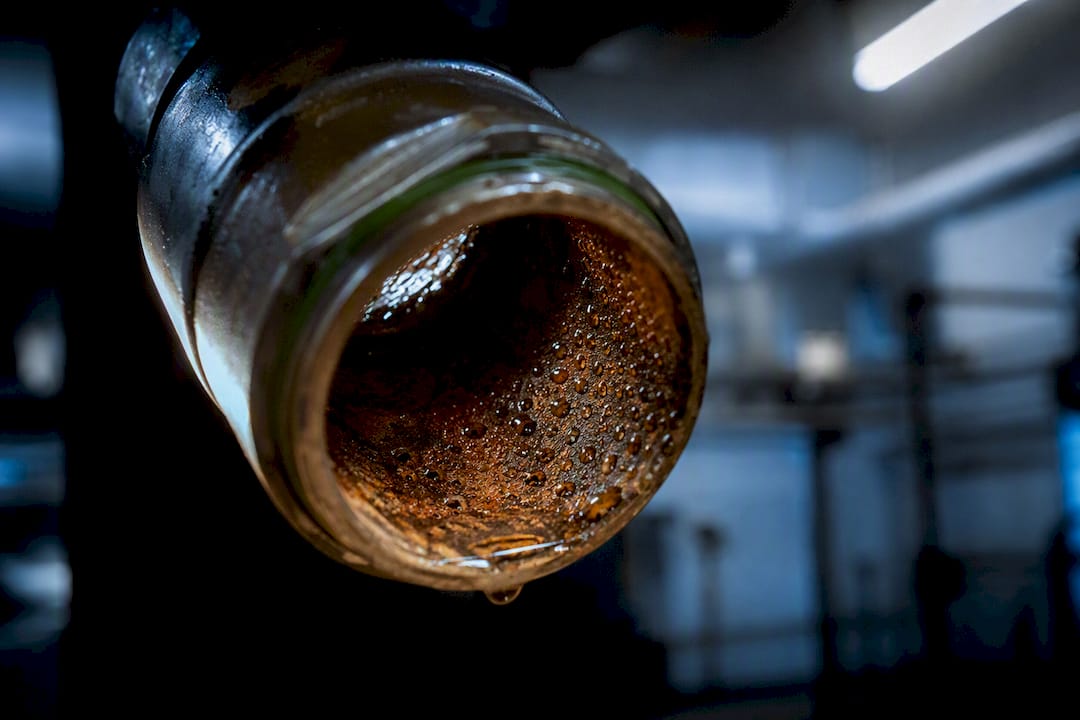
Corrosion in the air distribution system primarily arises from the condensation of moisture inside the piping. The fastest defense is to install a suitable dryer together with an automatic condensate drain, which captures water before it starts attacking the pipe walls. Regular inspections according to recognized standards and the choice of a durable piping material will then keep the risk to a long-term minimum.
In short:
- Corrosion in the air distribution system arises mainly from the condensation of moisture as the air cools, which increases pressure losses and causes equipment wear.
- The most effective prevention is the correct choice of dryer and automatic condensate drain, while stainless steel or plastic pipes reduce the risk of corrosion.
- Checks for rust and other signs of corrosion should be carried out regularly, for example weekly or monthly, and an annual camera inspection helps detect hidden damage.
- Measuring the pressure dew point allows for a more precise evaluation of the degree of condensation and optimization of the drying parameters, significantly reducing the risk of corrosive processes.
- Long-term maintenance includes checking slopes, replacing filters, and, where necessary, replacing the piping material to minimize the risk and effects of corrosion.
Contents
- What is corrosion in compressed air distribution and why it occurs
- How corrosion manifests in operation and what its effects are
- Main causes and risk factors of corrosion formation
- Prevention: technical measures, equipment and design recommendations
- Maintenance, inspection and standards: specific intervals and records
- Measuring dew point (PDP) and monitoring for predictive maintenance
- What to do when you find corrosion: immediate and long-term steps
- Author Zdeněk's experience: most common mistakes and proven solutions from practice
- Solutions for corrosion prevention from Kompresory-vzduchotechnika
- Frequently Asked Questions
What is corrosion in compressed air distribution and why it occurs
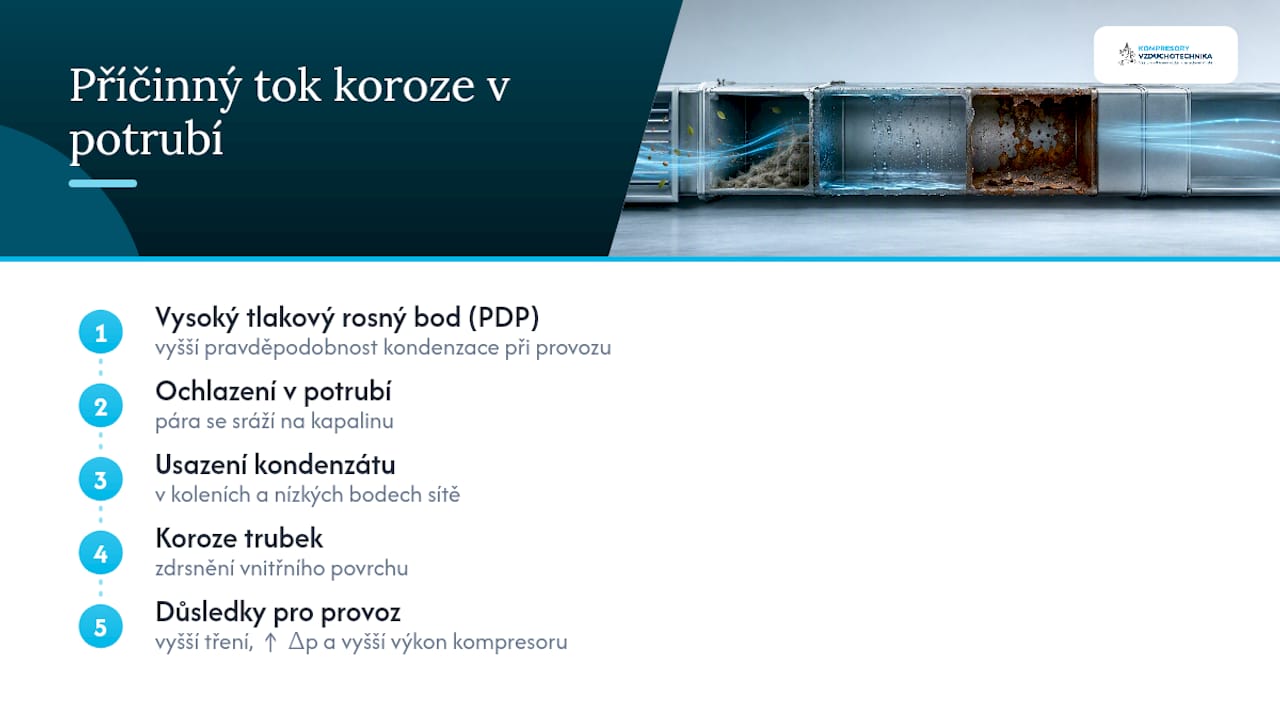
The air drawn in by the compressor contains water vapor. During compression, both temperature and pressure rise, but as soon as the air cools down in the piping, the vapor begins to condense into liquid water. This liquid settles in slopes, elbows, and low points of the network, where it gradually attacks the metal.
The key parameter is the pressure dew point (PDP), the temperature at which vapour in a pressurised system begins to condense. The higher the PDP, the higher the risk that water will appear in the piping at normal operating temperatures. Corrosion then does not remain merely a cosmetic defect. It roughens the internal surface of the pipes, which increases friction of the flowing air and thus pressure losses (Δp) throughout the network. The compressor must operate at higher output to deliver the same volume of air to the end of the distribution system.
How corrosion manifests in operation and what its effects are
Rust in the piping can be detected even without dismantling the system. The most common signs can be found directly on the end elements of the network.
- Rust stains or rust-coloured condensate at the outlet of the drains.
- Metal particles captured in the filter element, which becomes clogged faster than usual.
- Increasing pressure drop between the compressor room and the end consumer with unchanged consumption.
- Premature wear of seals and cylinders in pneumatic tools.
Corrosion can significantly shorten the service life of equipment, because released rust particles act as an abrasive material inside valves and cylinders. The result is a chain of failures, where one neglected section of piping gradually damages expensive end equipment. Besides the costs, the safety risk also increases: corrosion of the internal walls of pressure vessels and air tanks often remains invisible for a long time, because the weakening occurs from the inside, not on the surface where a technician would notice it during a routine inspection.
Main causes and risk factors of corrosion formation
Most cases of corrosion are caused by a combination of several operational errors, not a single obvious fault.
- Insufficient drying or filtration, which leave the system's PDP too high for the given application.
- Stagnation of air in dead-end sections, water traps, and poorly designed slopes where condensate accumulates.
- Unsuitable pipe material or damaged surface treatment that exposes bare metal.
- Neglected condensate drainage, whether manual or due to a malfunctioning automatic drain.
Professional tip: Before you start replacing piping, check the slopes and lowest points of the network. Most corrosion we encounter arises in the same section where a long-neglected water pocket repeatedly fills and empties.
Prevention: technical measures, equipment and design recommendations
Effective corrosion prevention in air distribution relies on a combination of drying, moisture separation and proper material selection, ranked according to where the greatest risk arises.
- A dryer as the first line of defense. A refrigerant dryer is sufficient for common workshop and production operations with a target PDP of around +3 °C. An adsorption dryer is necessary where critical applications are involved, such as food processing, pharmaceuticals, or outdoor distribution exposed to frost, since it achieves a PDP in the range of −40 °C to −70 °C.
- A separator or cyclone right after the compressor. It captures bulk moisture and oil droplets before they move further into the network, reducing the load on subsequent filtration.
- An automatic condensate drain at every low point and after every dryer, so water doesn't accumulate unattended.
- Coalescing filtration to capture oil aerosols that would otherwise settle on the walls and promote corrosion processes.
The choice of pipe material determines how quickly even residual moisture turns into a problem. Stainless steel and aluminum significantly reduce susceptibility to internal corrosion compared to standard black steel. Modern pipes for compressed air distribution made of aluminum or quality plastic also offer lower pressure drop, albeit with a limitation on maximum operating pressure that must be respected at higher pressure levels.
| Measures | When to use | Main benefit |
|---|---|---|
| Refrigerant dryer | Standard operation, workshops, production | PDP reduction to approx. +3 °C |
| Adsorption dryer | Critical and frost-resistant applications | PDP down to −70 °C |
| Cyclone separator | Immediately after the compressor | Capturing bulk moisture and oil |
| Automatic drain | Low points, dryer outlet | Continuous condensate drainage |
| Coalescing filter | Upstream of sensitive equipment | Removal of oil aerosols |
When designing a new line, remember the slopes towards drain points, inspection openings for camera inspection, and easy access to drains. For details on calculating pipe diameter and slope, see the separate compressed air distribution sizing procedure.
Maintenance, inspection and standards: specific intervals and records
The maintenance plan for air distribution systems is based on two technical standards. ČSN EN 15780 defines three cleanliness classes for ventilation systems and recommends a procedure: first visual assessment, then contamination measurement. ČSN ISO 8573-1, on the other hand, classifies compressed air quality according to particle, water and oil content, and therefore serves as the reference value against which measurement results are compared.
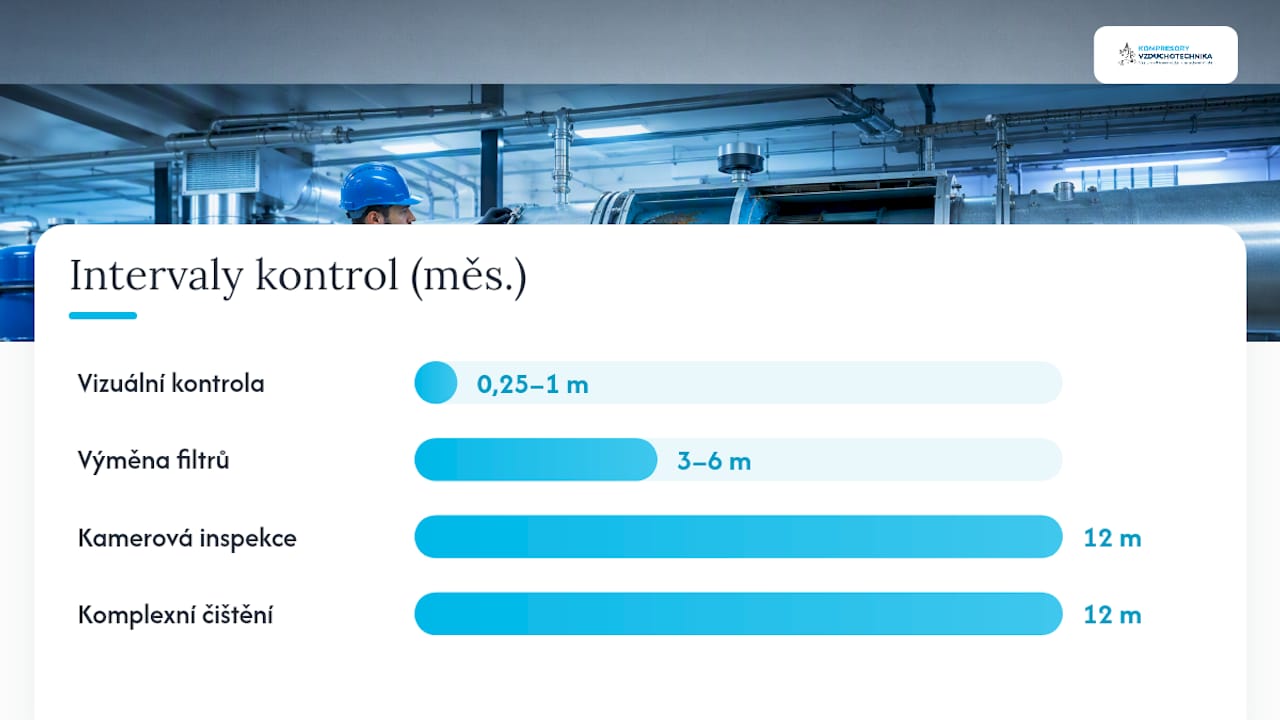
- Quick visual check of critical sections: weekly to monthly.
- Detailed annual inspection with camera inspection of the internal surface of piping and pressure vessels.
- Replacement of filter cartridges according to the degree of contamination, usually every three to six months.
- In industrial operations, complete cleaning of the distribution system at least once a year has proven effective.
Professional tip: Photographically document each inspection, ideally the same section at each check from the same angle. Comparing the images over time will show the rate of corrosion progress much more accurately than individual isolated observations.
The inspection record should include the measured pressure dew point, the date of the last filter change, and photographic documentation of the internal condition. This data then serves as a basis for deciding whether the section should just be cleaned or already replaced.
Dew point (PDP) measurement and monitoring for predictive maintenance
PDP measurement is the only reliable way to assess the risk of condensation in a pressurised system. This is because relative humidity (RH) distorts the actual condition in a pressurised environment, as it is measured differently than in atmospheric air. The PDP sensor is placed after the dryer and, if applicable, also at the end of the longest or most critical branch of the distribution system.
| Application type | Target PDP |
|---|---|
| Standard workshop operation | approximately +3 °C |
| Moisture-sensitive production | +3 °C |
| Critical and frost-resistant applications | −40 °C to −70 °C |
Controlling dryers based on the currently measured PDP, rather than on a fixed time cycle, reduces energy consumption while also better protecting the network against an unexpected rise in moisture. An alarm set just above the target PDP value gives the technician time to intervene before the first drops appear in the piping.
What to do if you find corrosion: immediate and long-term steps
Corrosion found requires a quick but structured approach, not a panic-driven replacement of the entire section.
- Isolate the affected section immediately, drain the accumulated condensate, and if operations allow, redirect the air flow via another route.
- Perform a visual and camera inspection to estimate the depth of the attack, and decide whether a local repair is sufficient or whether the section needs to be replaced.
- For pressure vessels and air receivers, consult the extent of damage with a specialist, as a weakened vessel wall represents a safety risk. The rules for draining condensate from such vessels are summarized in the overview condensate from compressors and Czech Republic law.
- In the long term, consider changing the piping material, adjusting the slopes, or adding a dryer so that the same problem does not recur.
Experience of the author Zdeněk: the most common mistakes and proven solutions from practice
In practice, corrosion most often returns where the automatic drain was omitted to save money or replaced with manual draining, which is then forgotten. Aluminum modular piping combined with regular PDP measurement and an advisory service you can turn to before the problem solves itself at your expense has proven effective.
— Zdeněk
Corrosion prevention solutions from Kompresory-vzduchotechnika
Kompresory-vzduchotechnika offers specific equipment that addresses corrosion at the point where it originates, not after the damage has occurred. Compact Combibloc compressed air treatment units combine drying, filtration, and moisture separation into one compact unit for operations up to 16 bar, so you don't have to assemble a system from several separate components.
For low points in the network, we recommend familiarizing yourself with the overview condensate drains, their types, and installation, which will help you choose the right type according to the size of the operation. If you are not sure exactly where in your network the risk of corrosion arises, or if you need to measure the current pressure dew point, contact Kompresory-vzduchotechnika and arrange a consultation or service intervention tailored directly to your operation.
Frequently Asked Questions
How does corrosion manifest in the air distribution system?
Most commonly by a rusty discoloration of the condensate, metal particles in filters, a faster-rising pressure differential, and premature wear of pneumatic tools.
How to prevent corrosion in the compressed air distribution system?
The most effective approach is a combination of a dryer, a separator, a coalescing filter, and an automatic condensate drain, supplemented by regular inspection according to ČSN EN 15780.
What is the difference between a refrigerant dryer and an adsorption dryer?
A refrigerant dryer achieves a pressure dew point of around +3 °C and is sufficient for standard operation, while an adsorption dryer drops as low as −70 °C and is necessary for critical or frost-resistant applications.
How often should the air distribution system be checked for corrosion?
Inspect critical sections visually on a weekly to monthly basis, and carry out a detailed inspection with camera inspection and PDP measurement at least once a year.
Why is the pressure dew point more important than relative humidity?
Relative humidity in a pressurized system distorts the actual risk of condensation, while PDP directly indicates the temperature at which water will start condensing in the piping.