
You can solve condensate freezing in the distribution system with three steps: set the pressure dew point as a monitored parameter, verify that condensate drains are actually removing water, and insulate or actively heat pipe sections in unheated areas. Without these three measures, the pipework can become blocked by an ice plug without warning during frost. Air quality is described by the ČSN ISO 8573-1 standard, and for more serious problems it is worth consulting a service company such as Kompresory-vzduchotechnika.
In short:
- If the temperature at the coldest points of the distribution system is lower than the set PDP, there is a risk of freezing and an ice plug forming in the pipework.
- For outdoor or unheated piping, it is necessary to use a dryer with a deeper pressure dew point margin, for example an adsorption dryer, and install a heating cable.
- Condensate drains should be correctly sized, regularly inspected, and fitted with insulation or heat tracing to prevent freezing.
- Measuring the pressure dew point at strategic points provides early warning of freezing risk and facilitates preventive maintenance.
- Repairing a burst pipe is a short-term solution; in the long term, it is worth investing in insulation, a more powerful dryer, or a system with an appropriate PDP.
Contents
- Why condensate forms in piping and when there is a risk of freezing
- Where to measure the pressure dew point and how to set up warnings
- How to size the dryer and filtration for freezing operating conditions
- Condensate drains: installation, slope, and inspection intervals
- Insulation and heating of piping in exposed sections
- Operating procedures for winter mode
- How to safely thaw a frozen section of the distribution system
- When a repair is not enough: operational decisions and the economics of prevention
- How Kompresory-vzduchotechnika can help you reduce the risk of freezing
- Recommended technical resources and standards
- Frequently asked questions
Why condensate forms in piping and when there is a risk of freezing
Compressed air contains water vapour, which the compressor draws into the system from the intake air. Once the air is compressed and subsequently cooled, the vapour condenses into liquid water. This is governed by the pressure dew point (PDP), the temperature at which, at a given operating pressure, water vapour begins to turn into condensate. PDP is a different quantity from the atmospheric dew point, which describes the behaviour of air at normal pressure, and must therefore not be confused with it when designing a system.
The higher the overpressure in the piping and the lower the surface temperature of the pipe, the sooner the vapour will condense into droplets. In practice, this means that critical points are not random:
- outdoor sections of piping and connections without thermal insulation,
- the lowest points of the network, where water accumulates by gravity,
- branches and dead-end sections with low air flow,
- condensate drain outlets leading into unheated shafts.
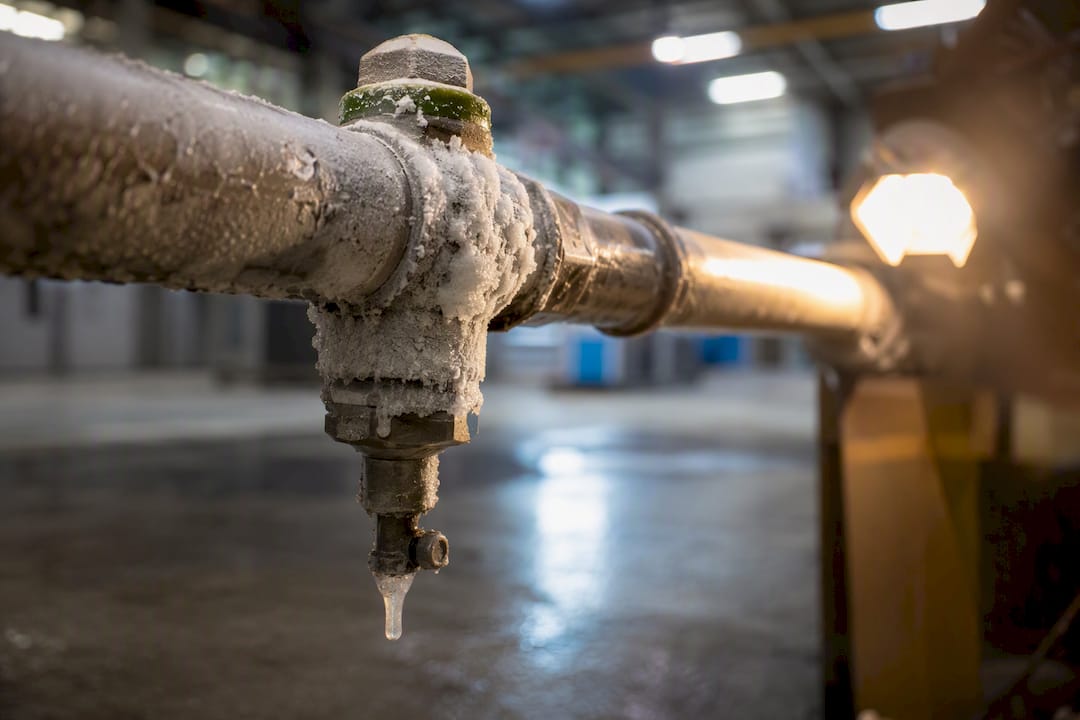
It is precisely at these points that an ordinary drop of water turns into an ice plug, which restricts or completely stops the flow of air to the production machines.
Where to measure the pressure dew point and how to set alarms
It makes sense to place the PDP sensor where the quality of the air for the entire network or for a sensitive part of production is determined. As standard, it is installed:
- at the dryer outlet, to verify that the equipment actually achieves its declared performance,
- on the main distribution branches before splitting into sub-circuits,
- at critical consumers, where moisture in the air endangers production quality or operational safety.
For long-term operation in freezing conditions, polymer capacitive sensors have proven more reliable than older Al2O3-based sensors. Polymer sensors withstand condensate and oil vapours better and reliably measure even deep dew points around minus 60 °C, which older technology often could not manage without frequent calibration.
Professional tip: Set the alarm according to the purpose of the air, not universally. For common pneumatic drives, a PDP within the temperature range specified by the dryer manufacturer is usually sufficient, but for sensitive processes where moisture must not affect product quality, a significantly lower PDP matching the air quality requirements is recommended.
Continuous PDP monitoring also enables predictive maintenance: you can replace the filter or dryer before moisture penetrates the network and causes damage to tools and valves.
How to size the dryer and filtration for freezing operating conditions
The dryer must provide a margin against the coldest point in the distribution system, not against the average temperature in the hall. The practical rule is: set the target PDP significantly lower than the lowest expected pipe temperature to minimize the risk of condensation and freezing. So if a pipe runs through an outer wall where the temperature drops to minus 10 °C in January, you need a dryer with a PDP around minus 20 to minus 30 °C, not a refrigeration unit designed for +3 °C.
The choice between dryer types depends on this goal:
- a refrigeration (condensation) dryer covers standard indoor distribution with a PDP around +3 °C,
- an adsorption dryer can achieve the deep dew points needed for outdoor runs and freezing halls.
Even the best dryer won't solve anything if condensate isn't drained from the pipework. A filter capturing solid particles and a coalescing separator that strips oil droplets from the air stream should therefore be installed before the drain. Without this filtration, drains clog faster and their valves seize up in frost in a position where water remains inside the pipe.
Professional tip: Before the season, compare the actually measured PDP with the value stated on the dryer's nameplate. A deviation of more than a few degrees indicates worn sorption media or a leak that is worth addressing before the frosts arrive.
Condensate drains: installation, slope and inspection intervals
A non-functioning drain is the most common cause of freezing in plants that otherwise have a correctly sized dryer. You can choose between several principles, each with different weaknesses:
- Manual drain requires an operator who opens the valve regularly. Without operator discipline, water remains in the piping.
- Timer drain discharges condensate at fixed intervals regardless of how much water has actually accumulated, so at higher humidity it is insufficient and at low humidity it wastes air.
- Float drain responds to the water level, but the strainer and mechanism become clogged with deposits and oil.
- Electronic (capacitive) drain discharges condensate according to actual need and is usually the most reliable choice for operations with variable humidity.
Regardless of type, the same installation rules apply: the line to the drain must have sufficient slope, the trap must be permanently filled with water, and all joints must be sealed, otherwise it draws in air and the mechanism falsely signals an empty pipe. In unheated spaces, the trap should have insulation or a heating cable, otherwise it will freeze first.
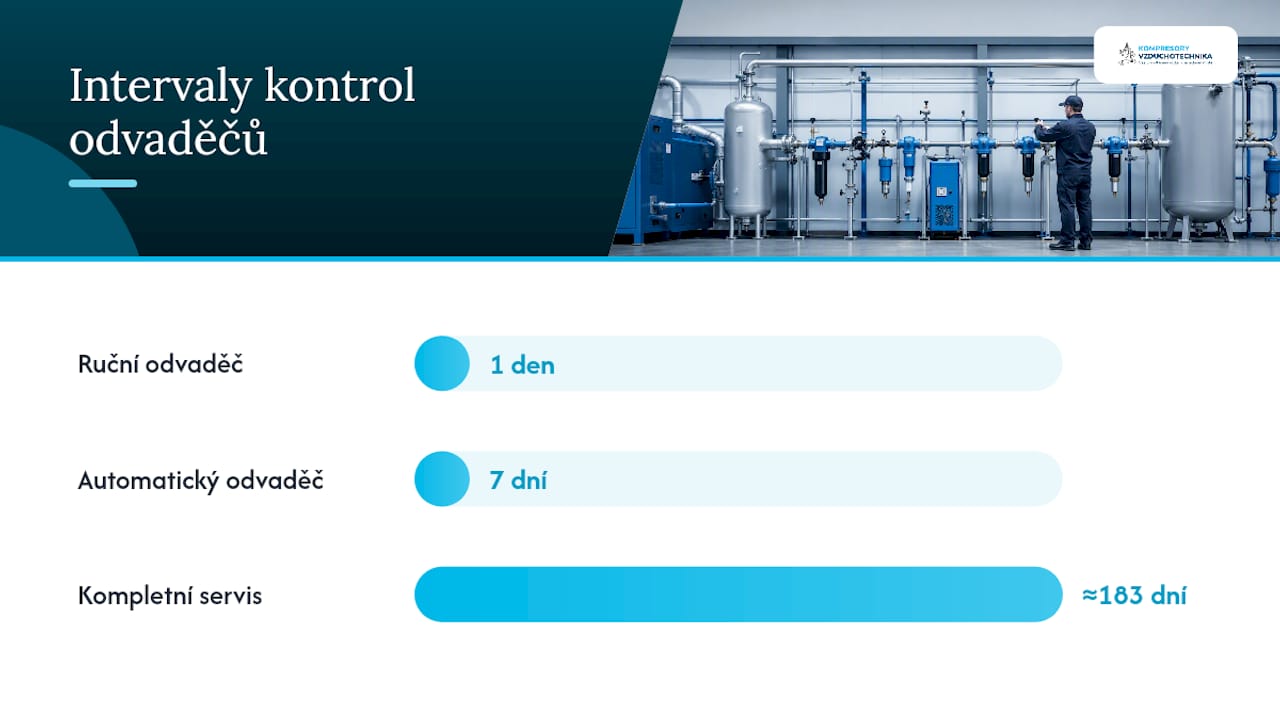
Inspection intervals vary by device type: manual drains should be checked daily, automatic ones weekly, and a complete service including the strainer and valve should be performed at least twice a year. More on selecting and installing individual types can be found in the guide to condensate drains.
Insulation and heating of piping in exposed sections
Passive insulation handles most internal distribution, where the temperature does not drop toward freezing anyway. However, once the piping runs through an exterior wall, roof, or unheated hall, insulation alone is not enough, because it only slows heat loss, it does not stop it. That's where a heating cable wound along the pipe or an electric jacket with a thermostat belongs, keeping the pipe surface above freezing even during prolonged frost.
When installing a heating cable, several principles apply:
- run the cable along the underside of the pipe, where condensate accumulates first,
- protect the electrical connection against moisture with an enclosure rating of at least IP65,
- include traps and drains in the heated route, not just straight sections of piping.
Professional tip: The cost of heating cable and insulation pays for itself at the first shutdown it prevents. An hour of production downtime due to a blocked pipeline usually exceeds the cost of heating the entire risk branch for a season.
Operating procedures for winter mode
Time-based dryer switching is unreliable in frost because it does not respond to actual air humidity. Better results are achieved by control based on the actual dew point, known as dew point-dependent switching, which activates the dryer only when the PDP actually requires it.
The winter operating plan includes:
- responding to a PDP alarm within the same shift, not the next day,
- recording every intervention on drains and the dryer for subsequent trend review,
- a pre-season test of all drains and heating cables before the first frosts.
This approach also saves energy, as the dryer does not run unnecessarily at full power when the PDP indicates that the air is sufficiently dry.
How to safely defrost a frozen section of the pipeline
Detecting a frozen blockage usually starts with a pressure drop downstream of the given section or a silent outlet where escaping air used to hiss before. Defrosting procedure:
- Depressurize the affected section and isolate it from the rest of the network so that sudden release of the blockage does not create a pressure spike.
- Check the sensors and drains in the surrounding area, as an ice blockage is often related to a previous drainage fault.
- Apply local controlled heating, for example with a hot air gun or an attached heating cable, and increase the temperature gradually.
- After thawing, slowly re-pressurize the section again and verify that water is actually draining out.
Open flame on piping has no place here, as it risks damaging seals and igniting oil residues. Likewise, abrupt over-pressurizing of the frozen section or rough mechanical removal of the plug is not advisable, as both methods risk bursting the pipe or damaging fittings.
When repair is not enough: operational decisions and the economics of prevention
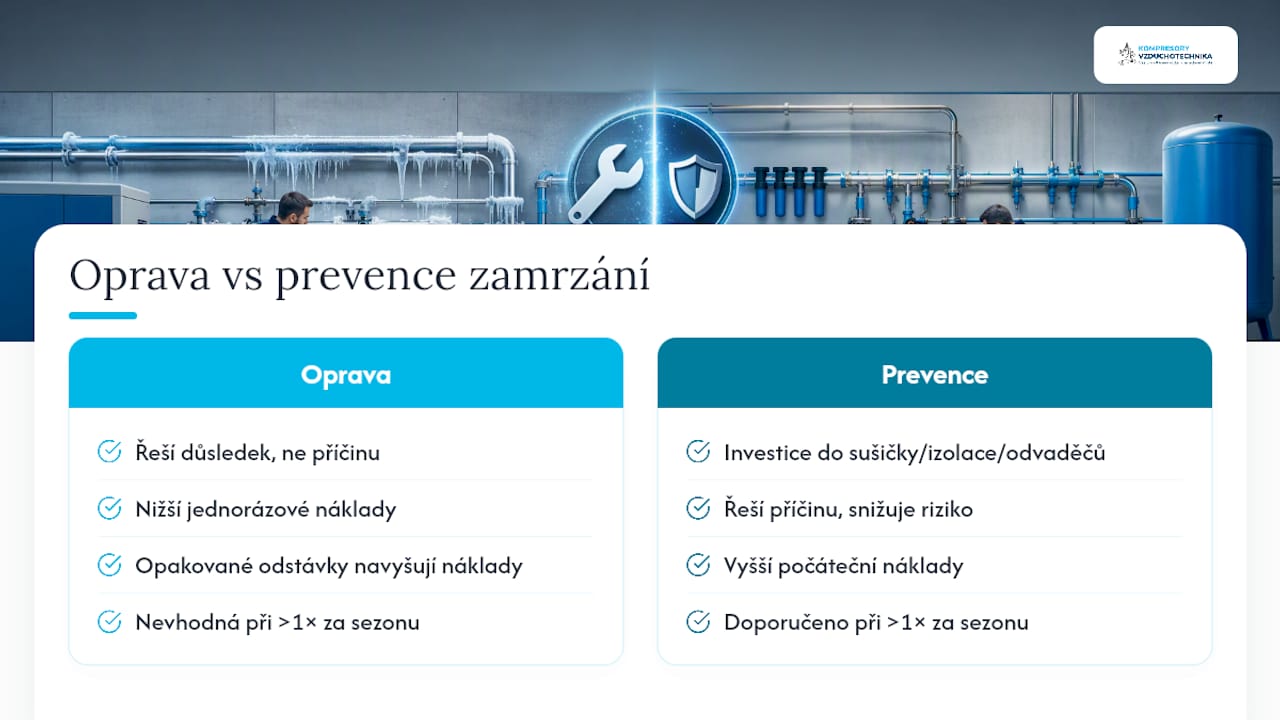
Repairing a burst pipe or replacing a damaged valve addresses only the consequence, not the cause. If freezing recurs at the same spot more than once per season, it is a signal that the system needs investment in a dryer, insulation, or higher-quality drains, not another patch. A one-off repair looks cheaper on paper, but repeated production stoppages quickly outweigh it.
A signal to order a professional intervention is also a situation where the measured PDP does not match the dryer's parameters over the long term, or when the drains need cleaning more often than the schedule indicates. In such a case, it makes sense to have a professional energy audit of the distribution system carried out, which will reveal where the system is losing performance and where the risk of freezing arises. A professional audit is available for facilities where prevention pays off more than repeatedly firefighting problems.
— Zdeněk
How Kompresory-vzduchotechnika helps you reduce the risk of freezing
Kompresory-vzduchotechnika is an alternative to random repairs for your operation: instead of addressing individual ice plugs, it delivers a complete air treatment solution that eliminates the risk of freezing at the source. The offer includes compressed air treatment units up to 18 bar for dimensioning the PDP according to your coldest route, as well as a filtration program according to ISO 8573, which protects condensate drains from clogging.
In addition to selling equipment, Kompresory-vzduchotechnika also offers installation, inspections, and service interventions described in the services overview. If condensate freezing in your distribution system keeps recurring, or if you are unsure about correctly sizing the dryer before winter, order a technical inspection of the system and have a specific solution calculated for your network.
Recommended technical resources and standards
- A detailed guide on selection and installation can be found in the article on types of condensate drains.
- Practical sensor placement is described in the guide on measuring air pressure.
- The legal aspects of handling condensate are summarized in the article on laws for compressor operators.
Frequently Asked Questions
What is the pressure dew point and why does it determine freezing?
The pressure dew point is the temperature at which water vapor begins to condense into liquid at the operating air pressure. The lower you keep it below the freezing point in the coldest section of the piping, the lower the risk of an ice plug.
How often should condensate drains be checked in winter?
Manual drains should be checked daily, automatic ones weekly, and a complete service including the strainer should be performed at least twice a year, with emphasis on checking before the onset of frost.
What PDP should be chosen for outdoor piping?
The target PDP should be 10 to 20 °C lower than the lowest expected piping temperature, which for outdoor routes in winter usually means choosing an adsorption dryer instead of a refrigeration dryer.
Is it safe to thaw frozen piping with an open flame?
No. An open flame damages seals and risks igniting oil residues. The safe method is controlled local heating with gradual repressurization after depressurizing the section.
Who can help with auditing and servicing the piping system against freezing?
Technical consulting, installation of insulation and heating cables, as well as servicing of drains and dryers, including an energy audit, can be arranged through specialized companies for facilities with a recurring freezing problem.