

Whatever purpose you use compressed air for, and that especially if it is a matter of industrial use on a large scale, the filtration of compressed air is very important for you, if not downright essential. In the natural environment, in the household and in operations there occurs a whole range of small contaminants that can easily get into the compressed air and through it for example into pneumatic charges and circuits or onto surfaces treated with compressed air.

Why filter compressed air ?
These contaminants, which include above all dust, water and oil, then contaminate and wear out the given charges, circuits or surfaces, which may mean not only a worsened quality of products or a shorter service life of machines, but it may also lead to the creation of holes and the escape of air from the closed circuit. That is essentially the same as if you threw money out of the window. The investment in filtration equipment will therefore ultimately save you a not inconsiderable amount of money, you just have to choose the right technology and model.
Why are our filters a good choice ?
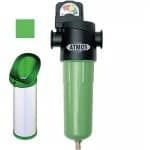 |
The range of microfilters of the new generation (NGF) that we offer from the Hankison brand, which is one of the leading firms in this field, has compared with other products a whole range of advantages, thanks to which you will be able to filter very fine particles very easily and to a very high standard, and that at very low cost. The reasons for this are understandably rather technical, but nevertheless I will try to explain them briefly, so that it is clear that we do not expect you to trust us blindly. |
The difference between a good and a bad filter lies in the first place in how large a fluctuation of the pressure of the compressed air it causes, because pressure fluctuation is together with the contaminants the main factor accelerating the wear of circuits with compressed air. The pleated (or corrugated) filters of the NGF range cause very low pressure fluctuation thanks to their large surface and high porosity, just as they limit its turbulence (or swirling) on leaving the filter. Classic filters of the old generation tend not to be pleated or corrugated and therefore lack these advantages. The resulting fluctuation of NGF filters ranges only approximately between half a per cent and one per cent, which is up to 50% less than with competing products.
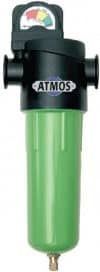
| Another distinguishing characteristic of a good filter is how easy or flexible its installation and use is. NGF filters can be mounted very easily and even interconnected with one another, just as they are equipped with an analogue manometer, or gauge of pressure fluctuation. If desired, a digital manometer can also be installed. The filter elements last under normal conditions a whole year and even a layperson can replace them, in which the colour marking on the product also helps. The quantity of filtered-out condensate (captured contaminants) is also clearly visible. The absence of silicon in the products of the NGF range also allows their use for example in paint shops. All these properties of the filters of the NGF range will lead to further savings of time or professional work needed for mounting and maintenance. | 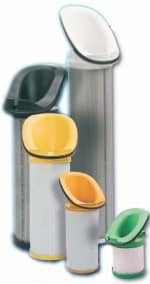 |
And finally, when comparing the quality of filtration equipment you should not forget the construction materials and design elements used in the production of the filter either. The filters of the NGF range are assembled from several different materials, so that all the main utility properties of the filter can be maximised. From the solid stabilising cylinder of stainless steel, through the 96% porous filter fabric of microfibres, up to the chrome-plated and twice powder-coated aluminium housing, every part of NGF filters performs its own function top-notch. The firm Hankison even uses in this product several of its own patented materials and design elements that you will not see elsewhere, such as for example the filter O-ring of the material Nitrile or the patented Venturi-Wave shape of the head distributing the air evenly over the surface of the filter element.
Which product to choose ?
If I have managed to convince you that the NGF range of filters is really of high quality and that the investment in it will save you money, I will also advise you on what it makes sense to choose a specific model by. The models of the NGF range differ in principle above all in how large the particles are that they are able to filter. All of them should manage both solid and liquid particles, and all comply with the international ISO standard 8573 laying down standards for the quality of compressed air filtration, but not every customer will make use of the finest filtration – dust is for example considerably easier to filter than liquids. The range of particle sizes is between 3 and 0,01 micrometres. With the fineness of filtration is also logically connected how many contaminants and how much residual oil per volume of air will ultimately remain in the circuit – finer filtration means fewer contaminants.
 |
Another important characteristic of the filter is of course also the maximum pressure under which the filter is able to work, which with the filters of the NGF range is 11 or 16 bar, as well as the maximum volume of air flow, which with the various variants of NGF filters ranges between 34 and 2549 cubic metres per hour. The larger the flow you need to filter, the larger and heavier the filter that will need to be installed (the weights of the filters range between 0,8 and 28,7 kilograms). The supplementary accessories of the filters then include further additional indicators, if you want to have a better overview of how the filter works and when it will need to be replaced, and also various options of automatic draining of the condensate, or the filtered-out contaminants. And quite at the end, the option of choosing a filter with activated carbon is still worth mentioning, with the help of which you can also remove unwanted odours by filtration or neutralise contaminants of biological origin. A word in conclusionIf I were therefore to sum up what is good to know about filtration using filters of the NGF range, it is that it is a high-quality technological solution that will ultimately save you a lot of money, and that on the one hand thanks to the filtration itself, but also on mounting and maintenance. If you know what flow volume and pressure your air system has and how large particles of what type you need to get rid of, it is enough to look into the documents specifying the technical parameters of the individual variants of the NGF technology and choose the version that falls within the given range. If you moreover have some special requirements regarding the control of operation or the manner of installation, you can in addition choose from many special supplementary components. If you take care over the regular replacement of the filter element and the observance of the operating parameters, you will thereby solve the filtration of compressed air for a very long time. |