
In the technological system of production and treatment of compressed air, in all devices there occurs the material transformation of water vapour into water, which combines with solid contaminants and oil and creates an emulsion called condensate. The condensate needs to be drained from all cyclone separators, filters, dryers and pressure vessels, which can be realised by means of several technical solutions with various benefits and in different price ranges.
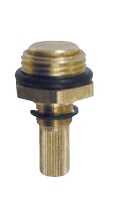 |
Manual drainingThe simplest solution of draining, formed by a valve that the operator opens by hand. The disadvantage is the failure of the human factor, when the operator forgets to carry out the draining and there is a high risk of condensate entering the further part of the air system. This way of draining cannot inform the user of the need to carry out maintenance, so often the operation is carried out unnecessarily and with costs for the drained air and shutdowns. |
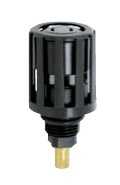
Float drainingSimple automatic draining with a low price. Float drains are integrated either into the vessels or from the outside and work on the principle of a float body lifted by the level of the condensate. The operation needs no maintenance, however there is a risk that larger contaminants will block the float in the raised state and a massive depressurisation of the compressed air system will occur. |
 |
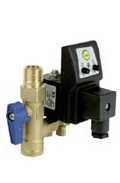 |
Timed drainingThe timed drain is formed by a solenoid valve controlled by a coil with a time relay. |
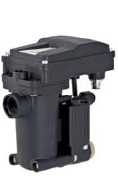
Electronic drainingElectronic drains are the most modern and most expensive systems for draining condensate. For their operation they need electrical energy. The design with a movable body, capacitive level sensors, electronic control and a solenoid valve provides perfect automatic operation according to needs, without unnecessary losses and with possibilities of remote reporting and visualisation of the state on the control panel. |
 |
Function of the electronic drain
The condensate enters the drain through the inlet opening (1) and collects in the vessel (2). The rise of the condensate level inside the vessel moves upwards the movable body freely fixed on a pin (4). The pin is equipped either with one or with two capacitive sensors detecting the minimum or maximum height of the condensate level. The reading from the sensor is fed into the electronic system. If the level is at the maximum state, the unit lets electric current onto the coil of the solenoid valve (5,6), which opens and drains the condensate to the outlet (8), to which a waste hose (9) is connected. As soon as the level falls, the valve closes.
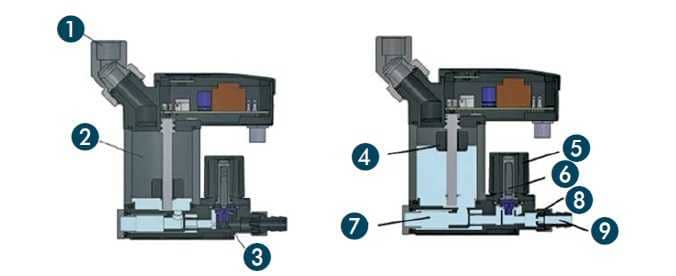
By this principle only the condensate is drained and no air, which prevents any losses and increased costs for air consumption. Besides standard running, the electronic drain is equipped with detection of a possible blockage of the system and can alert the operator to the problem either on the panel or by a remote connection. The mechanics of the valve is protected from contaminants by a filter (7).