
Regular maintenance of the compressor for a long service life

Just as with every machine, the compressor must be properly cared for and its regular maintenance and service of the machine carried out. By observing the instructions prescribed by the manufacturer you will ensure the reliability of the compressed air supply and extend the service life of the compressor. Maintenance with piston compressors is in no way demanding and in our programme you will find everything necessary for carrying it out successfully. Service of piston and other compressors can be ordered by e-mail or by telephone.

Draining condensate from the pressure vessel

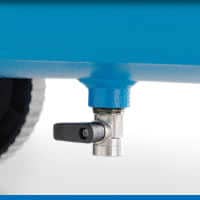
Check the condensate level in the pressure vessel regularly and drain it using the drain valve on the underside of the air receiver.
You will prevent frequent switching of the compressor and the entry of water into the piping or hoses. If you do not have time to check the formation of condensate, we recommend the intelligent condensate draining, which will take care of the draining for you. It is a professional solution in an automatic version.
Condensate draining of the compressor

Topping up oil for correct lubrication of the compressor

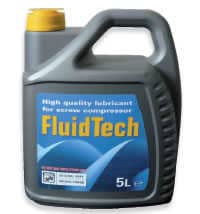
With oil-lubricated compressors the regular topping up of the oil level is extremely important. Check the oil level conscientiously using the oil sight glass or the dipstick, which is part of every machine. Use exclusively oils recommended by the manufacturer, which have the necessary viscosity. You will thus prevent poor lubrication and high temperatures reducing the service life of the compressor. All oils can also be bought in our online shop in the section accessories for compressors - oils. Oil change of the compressor

Cleaning the intake filters

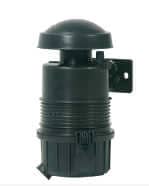
Replace the elements of the intake filters regularly. Their clogging by the drawn-in contaminants significantly reduces the performance of the compressor. A possible rupture of the element may cause large contaminants to enter the internal mechanism of the compressor and its subsequent damage. At the very least the filters need to be cleaned regularly. It depends on the surrounding environment and the speed of fouling of these filters for drawing in the air.
All filters can also be bought in the following section: Intake filters for compressors.

Cleaning the compressor filter

Faults of the compressor and subsequent service

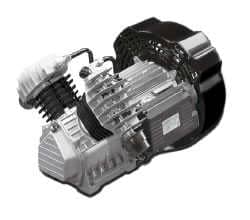
In the event of a fault of the compressor turn preferably always to an authorised service, which will ensure for you the supply of original parts and a professional approach. With a sensible repair you save compared with buying a new machine. To order service please use our e-mail. If you need to buy spare parts for compressors, always state the number and the brand of the machine, ideally with an attached photograph of the faulty part. Simple spare parts can be bought in the section: Accessories for compressors. compressor unit

Compressor units and their division

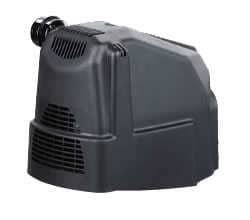
compressor unit

Oil-free units with an electric motor

  • standalone compressor units for the supply of oil-free air
  • single-stage compressor with one piston and a maximum pressure of 8 bar
  • direct connection with the electric motor
  • valve plate with stainless steel valves
  • aluminium cylinders
  • a cover for directing the air flow and excellent cooling
compressor unit

Single-piston compressors with an electric motor

  • small standalone compressor units in an oil-lubricated version
  • single-stage compressor with one piston and a maximum pressure of 8 or 10 bar
  • direct connection with the electric motor
  • single-phase motor with a voltage of 230V/50Hz with thermal protection
  • valve plate with stainless steel valves, aluminium cylinders
  • a cover for directing the air flow and excellent cooling
  • 100% testing at the production plant
compressor unit

Two-piston compressors with an electric motor

  • standalone compressor units in an oil-lubricated version
  • single-stage compressor with a maximum pressure of 10 bar
  • robust version with two pistons arranged in a V shape
  • direct connection with the electric motor
  • single-phase motor with a voltage of 230V/50Hz with thermal protection
  • valve plate with stainless steel valves, aluminium cylinders
  • massive finning and a large fan for good cooling
  • 100% testing at the production plant
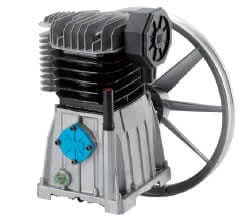
unit of the compressor

Single-stage compressors for connection with V-belts

  • standalone piston compressors
  • oil-lubricated version with an external oil sight glass
  • single-stage version with a maximum pressure of 10 bar
  • compressor with two steel pistons
  • fitted with a pulley for connection to the belt drive
  • valve plate with stainless steel valves, aluminium cylinders
  • a large oil tank for better lubrication
  • slow-running version to reduce the air temperature and for a long service life
  • massive finning and a large fan on the belt pulley for good cooling
  • the compressors A29B and A39B are fitted at the outlet with an aftercooler
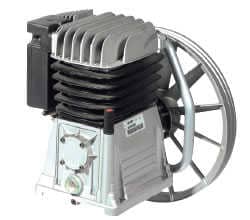
unit of the compressor

Two-stage compressors with 2 pistons for connection with V-belts

  • standalone piston compressors
  • oil-lubricated version with an external oil sight glass
  • two-stage version with a maximum pressure of 11 bar for maximum output
  • compressor with two steel pistons
  • fitted with a pulley for connection to the belt drive
  • valve plate with stainless steel valves, robust cast iron cylinders
  • a large oil tank for better lubrication
  • slow-running version to reduce the air temperature and for a long service life
  • massive finning and a large fan on the belt pulley for good cooling
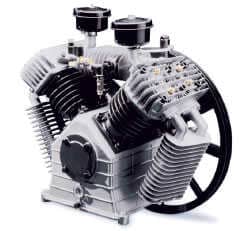
unit of the compressor

Two-stage compressors with 4 pistons for connection with V-belts

  • robust standalone piston compressors for extreme performance
  • oil-lubricated version with an external oil sight glass
  • two-stage compressor with a maximum pressure of 11 bar for maximum output
  • compressor with two pairs of steel pistons arranged in a "V"
  • fitted with a pulley for connection to the belt drive
  • valve plate with stainless steel valves, robust cast iron cylinders
  • a large oil tank for better lubrication
  • slow-running version to reduce the air temperature and for a long service life
  • massive finning and a large fan on the belt pulley for good cooling