


 |
What contaminates compressed air?
The atmospheric air drawn into the compressor contains three kinds of contaminants:
- Solid particles: Up to 140 to 150 million contaminant particles in every cubic metre of air, and several times more in an industrial environment. Most of these contaminants (80 %) are smaller than 2 µm and are therefore too small to be caught by the compressor intake filter (which usually removes particles of 25 µm).
- Oil gets into compressed air from piston and screw compressors that are lubricated with oil.
- Water – the water vapour in the air condenses once the air cools down in the piping. You can read about where the moisture in the air comes from and how to get rid of it in the article Why and how to dry air
Contaminated compressed air smells unpleasant and, what is more, leaves its mark on the condition of your equipment:
- All seals wear out faster and often have to be replaced.
- The valves in the control circuits suffer as well.
- Contaminants from the compressed air get into the silencers and impair their function.
- Openings and nozzles gradually clog up.
- Finished products and production equipment get damaged – solid particles can scratch surfaces and so on.

Compressed air quality according to ISO 8573-1
The guideline for compressed air quality is the ISO 8573-1 standard. In the standard, compressed air quality is described by seven classes from 0 to 6 (table 1): each class has a prescribed maximum content of solid particles, water and oil. Different purity classes are required for different applications and flow rates.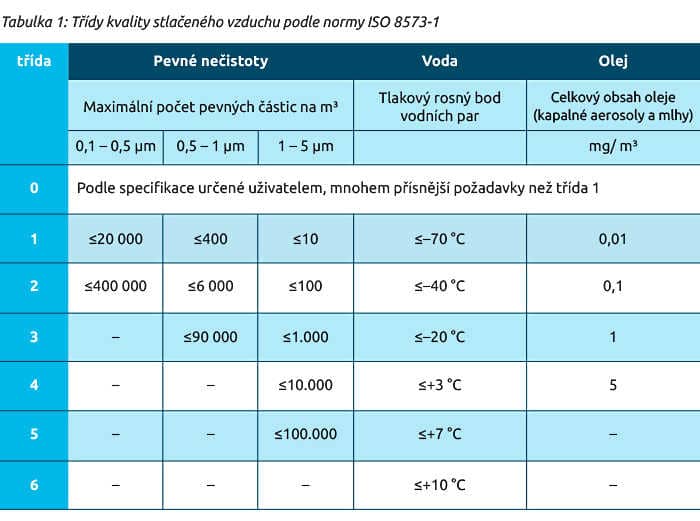
How clean does compressed air have to be for different applications?
For individual applications the ISO 8573-1 standard sets quality classes; for workshop air, for example, the standard prescribes quality 4-4-5. These three digits state three prescribed quality classes in the following order:
- quality class for solid particles,
- quality class for water (dew point temperature)
- quality class for oil.
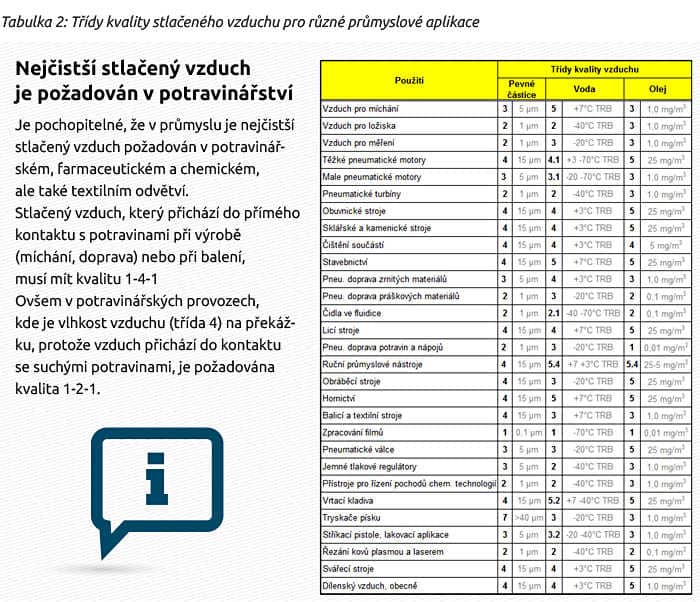
Table 2 lists the compressed air quality classes for various industrial applications.
How to remove contaminants from compressed air?
Solid particles are caught by a suitable filter, or by two or more filters in series. The first barrier against solid particles entering is the compressor intake filter, but that only removes particles of 25 µm. Further filters are installed before or after the dryers.
Oil – can be present in the air as an aerosol or as vapour. A good quality standard filter catches the aerosol. Oil vapour is caught by an activated carbon filter. The efficiency and service life of the activated carbon are affected by the temperature of the compressed air and its humidity.
Water is removed from compressed air by a suitable dryer installed downstream of the compressor. You will find details and practical advice on air drying in the article Why and how to dry air.
Before you set off to buy filters and dryers, answer these questions:
- How clean does the compressed air have to be for the purpose I use it for?
The requirements for compressed air used in a workshop for cleaning parts or on a building site are completely different from those for, say, measurement or the pneumatic conveying of food. You will find the quality classes for your application in the ISO 8573-1 standard or in table 2. - How clean does the compressed air have to be so that it does not damage the cylinders, valves and other components in the distribution system?
Contaminated compressed air used for the pneumatic drive of manipulators, pistons and conveyors must not cause pneumatic cylinders to seize, nozzles to clog or any other damage to the equipment. - How clean is the compressed air that my compressor delivers?
When the air from the compressor does not match the quality the application requires, you have to decide on suitable filters or compressed air treatment units.
Choosing the right filter
You can choose suitable filters for your system from a wide range
here
When selecting a filter, go by three parameters:
- Required air quality
The air quality you need for your workshop or plant is set out in the ISO 8573-1 standard.
Some examples of use can be found in table 2. The quality determines the filter type you choose (microfilter, activated carbon filter ...) - Air pressure at the filter inlet
You choose a suitable filter model according to the pressure in the compressed air system. - Capacity, i.e. the volumetric air flow
Filters are sized according to the amount of air flowing through them. This amount (the volumetric flow) is a basic parameter of a compressor or a dryer and is referred to as output, delivery or flow rate.
It is given in litres per minute (l/min), but sometimes also in m³/hod.
That is easy to convert: 1 m³/hod = 16,67×1 l/min. Many other units are used for volumetric flow, for instance litres per second and so on. So that you do not make a mistake when converting, you can also use an online calculator.
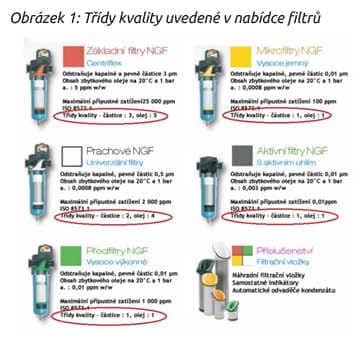
Quality classes in filter offersWhen selecting, you need to make sure that after filtration the air has the content of solid particles and oil that our application requires. Find Suppliers state the classes in the filter descriptions |
 |
@KATEGORIE@(/filtrace-vzduchu-ngf-vcetne-indikace-zaneseni/)(15,random)(slider)
Watch out for pressure losses
Every filter (like any other device, such as a dryer or a fitting) causes a pressure drop, and that costs money. So do not filter more than is necessary.
A pressure loss can easily be compensated by a higher pressure at the compressor outlet, but not for free. Energy consumption goes up (by 6 to 10 % for every 1 bar increase in pressure) and, unfortunately, the temperature of the compressed air rises with the pressure too, which increases its humidity.
- Pre-filters and dust filters with a coarser structure of the filter elements reduce the pressure the least.
- Fine filters for capturing oil and moisture have a higher pressure loss.
- Regular replacement of the filter elements also helps in the fight against pressure loss. A clogged filter reduces the pressure more than a clean one.
A differential pressure gauge will tell you ...
You can check the pressure loss on the differential pressure gauge that is part of some filters.

Where to install compressed air filters
-
An intake filter is installed before the compressor intake and filters out larger solid particles so that they do not damage the compressor.
-
It is a good idea to place a coarse filter between the aftercooler and the air tank; it protects the dryer mainly against solid particles.
-
A fine filter can be fitted downstream of a refrigeration dryer to remove the remaining condensate.
-
A fine filter has to be fitted upstream of an adsorption dryer to protect it against contamination with oil. Only downstream of the dryer is a coarse filter fitted.
Microporous filters with regular pores (pre-filter, coarse filter)
This type of filter captures solid particles from the compressed air ahead of the dryer. It copes with solid particles from 3 µm, but only to a minimal extent with oil, water and fine particles. The filters contain replaceable filter elements – hollow cylinders of porous sintered bronze, ceramics, polyethylene or polypropylene.
Microfilters with randomly arranged microfibres (coarse filter)
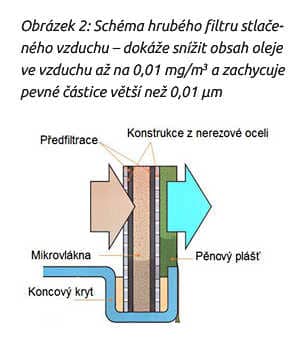
The oil particles hit the glass microfibres and form larger drops, which are carried by the air flow to the outer edge of the element into the foam jacket. There the oil drops fall to the bottom of the filter under their own gravity. |
 |
Activated carbon filters (fine filter)
After the compressed air has passed through the dryer and the filters, oil vapours still remain in it. That is why an activated carbon filter, which reduces the oil content of the air to as little as 0,005 mg/m³, is fitted downstream of the microfilter. A filter with porous activated carbon works on the principle of adsorption. The compressed air flows through the activated carbon filling and the hydrocarbons it contains bind to it
Design of the filters
Filters are fitted with a thread or a flange for connection. Filters also have the following elements:
- a differential pressure gauge for measuring the drop in air pressure as it passes through
- a condensate drain – manual or automatic.
Filters have colour coding according to their parameters. At a glance, the operator can see what type of filters is installed in the system and what filter elements will be needed.
When designing a filter system, let us bear in mind that filters are often built into dryers, cyclone separators, air tanks and other equipment.
Compressed air treatment units
In production plants we come across very specific requirements for compressed air quality. In such cases treatment units come in handy. These devices usually combine a pressure regulator, filters and lubricators in a single unit, and you can choose exactly the model that matches the properties the compressed air in your plant should have.
@KATEGORIE@(/upravne-jednotky--pro-stlaceny-vzduch/)(15,random)(slider)
Measuring contaminants in compressed air
How do you check whether compressed air does not contain too many contaminants? The purity of compressed air can be verified with:
- oil detectors
- solid particle detectors
- portable measuring stations
Oil detectors
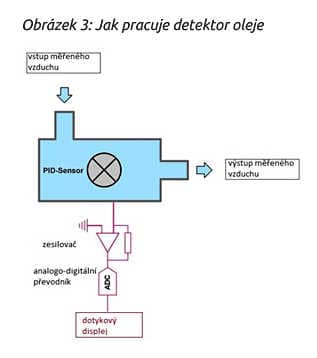
Photoionization detectors, PID (Photoionization Detector), are used to determine the oil content in compressed air.
Measuring principleThe photoionization detector uses a UV lamp to ionize* the molecules of the air being measured. UV radiation is not able to It can, however, reliably ionize hydrocarbons, which are the components of oils. The strength of the ion flow (and therefore of the electrical signal) is directly proportional to the concentration of ionized molecules. The electrical signal is amplified and displayed on the screen as the total oil content. These detectors only measure air free of aggressive, corrosive, toxic, caustic, combustible and flammable substances*) Note: During ionization an electrically neutral molecule becomes a molecule with an electric charge, i.e. an ion. The flow of ions creates an electrical signal. |
 |
Installing the oil detector
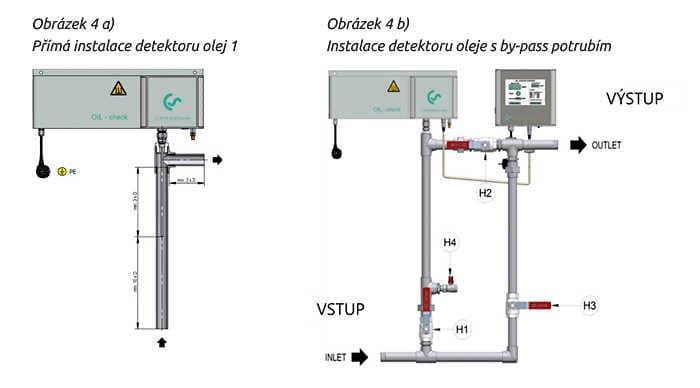
Oil detectors are installed on a vertical supply pipe with upward flow.
The diagrams (figure 4) show two installation options:
- direct installation) installation with by-pass piping
- installation with by-pass piping
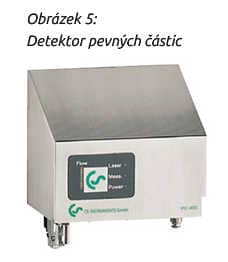
Solid contaminant detectorsSolid contaminants in compressed air (and in other technical gases as well) are measured by transillumination using a laser diode placed The instrument can also distinguish particle size – it measures how many particles of 0,1 to 0,5 mm, 0,5 to 1 mm and 1 to 5 mm the gas contains. |
 |
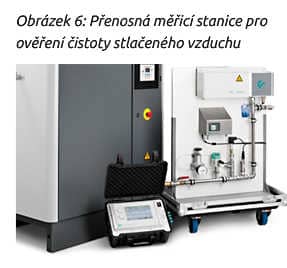
Portable measuring stationsPortable measuring stations are also used to check compressed air quality; they contain:
We simply wheel the station up to the compressor and measure the compressed air quality. |
 |