

 |
A pneumatic cylinder converts the energy of compressed air into mechanical motion with a force proportional to the area of its cylinder and to the working pressure.
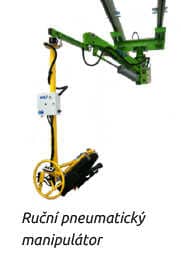
| Pneumatic cylinders therefore serve as linear actuators, for example in simple manipulators intended to move parts or semi-finished products of lower load capacity in a straight line. Cylinders can perform not only linear but also rotary or swivel movements. That is useful for actuating grippers, peripheral elements of robots and equipment in automated workplaces. | 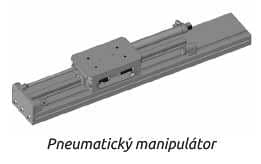 |
Pneumatic actuators are widely used in the food industry, where the cleanliness of the plant has to be ensured (which is why hydraulic systems are not suitable there).
Where you will find pneumatic cylinders
|
 |
Advantages of pneumatic cylinders
|
 |
Criteria for choosing a pneumatic cylinder
1. Types of pneumatic cylinders
- single-acting, double-acting
- with a magnet, without a magnet
- of round or non-round cross-section
- compliant with standards (ISO 6432, ISO 15552, CNMO)
- with adjustable cushioning
- with a piston rod, without a piston rod
@KATEGORIE@(/valce-a-prislusenstvi--jednocinne-a-dvojcinne/)(20,random)(slider)
2. Cylinder dimensions: the required pulling or pushing force determines the suitable piston diameter
3. Piston stroke
4. Method of mounting the cylinder in the pneumatic system
5. Surrounding environment – temperature, humidity, dust, etc.
Single-acting or double-acting pneumatic cylinder?
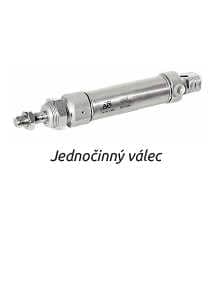
Single-acting cylinderIn a single-acting cylinder, air is supplied to the piston from one side only, so the force generated by the air pressure acts on the piston area in one direction only. Once the supply of compressed air to the cylinder is interrupted, the piston rod is returned to its initial position by the force of a spring. Single-acting cylinders are used for strokes up to 50 mm. 3/2 valves in particular are used to control single-acting cylinders. Single-acting pneumatic cylinders can be used for clamping semi-finished products, as ejectors in various jigs for feeding semi-finished products, for lifting them and for other operations. Compared with double-acting pneumatic cylinders of the same dimensions, they consume less air. The force of the coil spring acts against the force generated by the air pressure on the piston area, so the usable force is smaller by the force of the spring. Single-acting cylinders are longer than double-acting cylinders of the same diameter and stroke (by the size of the spring). |
 |
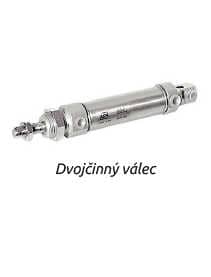
Double-acting cylinderAir is supplied to the piston from both sides, so both movements, forward and backward, are performed by compressed air. Thanks to this they can achieve longer strokes (up to 2 m) than single-acting cylinders. 5/2 and 5/3 valves in particular are used to control double-acting cylinders. The working movement is not affected by a return spring and the return stroke is fast and even. In addition, the speed of the piston movement can be set in both directions. The range of movement is usually limited by piston stops inside the cylinder. When the piston rod retracts, double-acting pneumatic cylinders develop less force than when it extends, because the effective piston area is reduced by the area given by the piston rod diameter. This has to be taken into account if the cylinder is to work with the same load on the piston rod in both directions. |
 |
Pneumatic cylinder with a magnet
| If you need to monitor the position of the piston, choose a cylinder with a magnet. A position sensor is fitted to the cylinder (in the picture the sensor is fitted into the groove of the pneumatic cylinder) which detects, through the cylinder wall, the field of the magnet integrated in the piston | 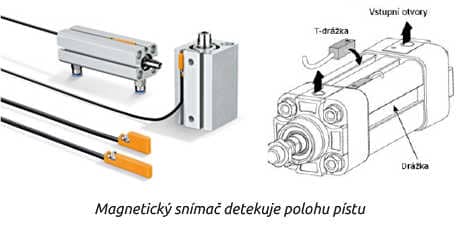 |
Cylinders of non-round cross-section
Where rotation of the piston about the axis of the piston rod has to be prevented, choose a pneumatic cylinder with a non-round cross-section. These cylinders are very rigid and resistant to torque. You will find a suitable type in our clear overview.
Pneumatic cylinders compliant with standards
Cylinder suppliers often state which standards their pneumatic cylinders comply with (ISO, VDMA, CNOMO, CETOP). The fact that cylinders are manufactured to a certain standard means that the manufacturer has to observe the prescribed installation and connection dimensions. The internal design of the cylinder, the type of profile used for the cylinder body and the design of the cylinder end caps may already differ between individual manufacturers. You will find cylinders to the individual standards in our clear overview.
Adjustable cushioning
When designing a pneumatic mechanism, care has to be taken to make the cylinder movement as slow as possible (while still keeping within the time frame of the given task). Slower movement means a weaker impact at the end of the stroke, which extends the service life of the cylinder.
Heavy impacts at the ends of the cylinder stroke can lead to failures, so it is advisable to soften them by using cushioning washers, pads or shock absorbers. This significantly extends the service life of the whole mechanism.
Adjustable cushioning allows a soft stop in the end positions. Shortly before this position, the cushioning spigot of the piston rod enters a cavity in the cylinder end cap. The air compressed in this cylindrical cavity slows down the movement of the piston. So that the piston can move all the way to the end position, the cavity is vented through a small hole. When moving in the opposite direction, the air passes freely through the throttle check valve and exerts pressure on the opposite side of the piston.
Cylinders with a piston rod, without a piston rod
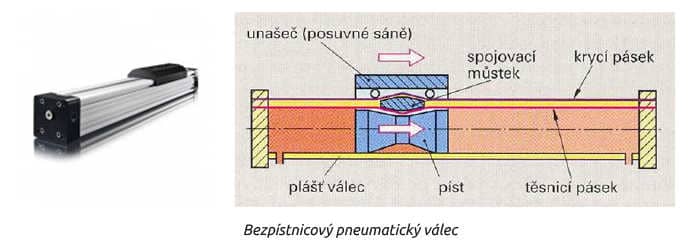
Above all in pneumatic systems where an extending piston rod would be in the way, we choose a cylinder without a piston rod. It is very space-saving and usually has the piston connected to a carriage outside the cylinder by rigid couplings that move in a longitudinal slot in the cylinder barrel. Rodless cylinders are made with stroke lengths up to 5,7 m.
Let us choose the right size of pneumatic cylinder
The key to determining the right cylinder size is the required pushing or pulling force. It depends on the piston area and the pressure in the cylinder.
You need to take into account:
- All loads including friction losses – dynamic and external loads have to be included in the calculation.
- The working air pressure that is available.
- The dynamic requirements of the equipment – that is, the speed and stroke of the piston
When sizing the piston, a reasonable reserve has to be allowed for, but it is true that a larger cylinder does not necessarily mean a better one.
An oversized cylinder is expensive to buy, and its operation is also more costly – oversized cylinders consume a larger volume of compressed air to run.
An undersized cylinder will indeed be cheaper, but it may not generate the required force, or the required force will have to be produced by increasing the working pressure, which means further costs.
Calculating the force of a pneumatic cylinder quickly and easily
If you want to make sure that the cylinder you have chosen meets your requirements, follow this link. There you will find a calculation tool that determines the force of a pneumatic cylinder from the piston and piston rod diameters and the pressure of the compressed air.
|
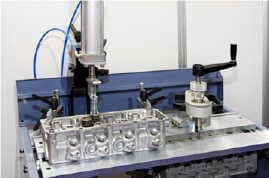
Horizontal or vertical installation? If the cylinder is installed in a vertical position and the piston rod moves up and down, the piston has to overcome gravity when moving up and only then can it accelerate. When moving down, gravity in turn helps the acceleration. That is why it is often necessary to install a throttle valve to limit the speed and reduce the impact energy at the end of the stroke. When selecting cylinders for vertical installation, choose a type with a higher pulling or pushing force. |
 |
Piston stroke of a pneumatic cylinder
Cylinders are ordered with the stroke stated in millimetres. On single-acting cylinders the stroke is limited by the size of the spring. If we do not find a cylinder with the stroke we need for our task in the range, we choose a cylinder with a stop for setting a suitable stroke.
Method of mounting a pneumatic cylinder
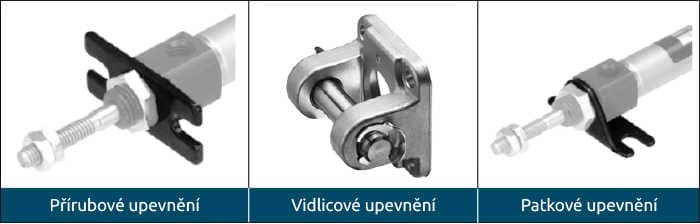
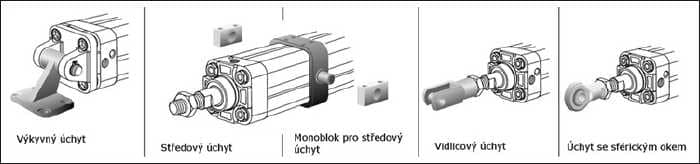
How the cylinder is mounted in the equipment depends on the function the cylinder is to perform in it. The cylinder can be mounted, for example: with flanges, side brackets, feet, the thread at the end of the piston rod, with clevis, swivel or pivot mountings, etc.
Cylinder material and design according to the surrounding environment
What temperatures will the cylinder be exposed to? Is there increased humidity or dust in the working environment? Will chemicals act on the cylinder? According to the surrounding environment we choose a pneumatic cylinder made of a suitable material and equipped with the appropriate seals, scraper rings, cup seals and the like.
In some plants, for example in the food industry, special certification of the equipment concerning its design and the materials used may be required.
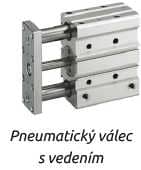
Cylinders with a guideThe piston rod is stressed mainly by pressure in the direction of its axis (axial pressure). When a radial load (perpendicular to the axis) acts on it as well, we add an external guide to the cylinder to absorb this load. Without such an additional "guiding" structure, the cylinder may wear out prematurely or leaks may occur. |
 |
A clear overview of pneumatic cylinders
Small round cylinders to ISO 6432
(with a diameter of 8 to 25 mm) are notable for the fact that they can also be used in systems with non-lubricated compressed air. For perfect tightness, the cylinder end caps are press-fitted to the profile. Cylinders made of aluminium or of stainless steel are available.

Cylinders with square cross-section according to ISO 15552
Cylinders with square cross-section according to ISO 15552 (formerly ISO 6431) feature high rigidity in bending and torsion.
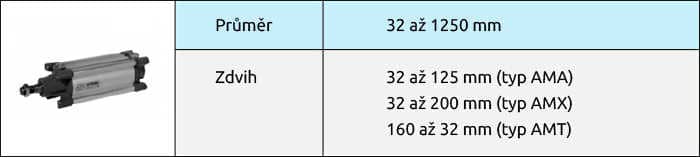
Profile cylinders to CNOMO
have the cylinder end caps joined by tie rods and are equipped with adjustable end-position cushioning.

Other standardised cylinders
Round cylinders RED, REDM

Compact cylinders to the ISO 21287 standard

Threaded cylinders

Short-stroke cylinders

Rodless cylinders

Linear guides for cylinders

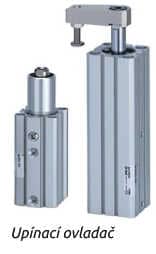
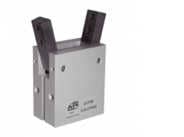
GrippersThe range also includes pneumatic cylinders that produce the angular movement of gripper jaws:
|
 |