
Activated carbon towers as an absorbent for compressed air
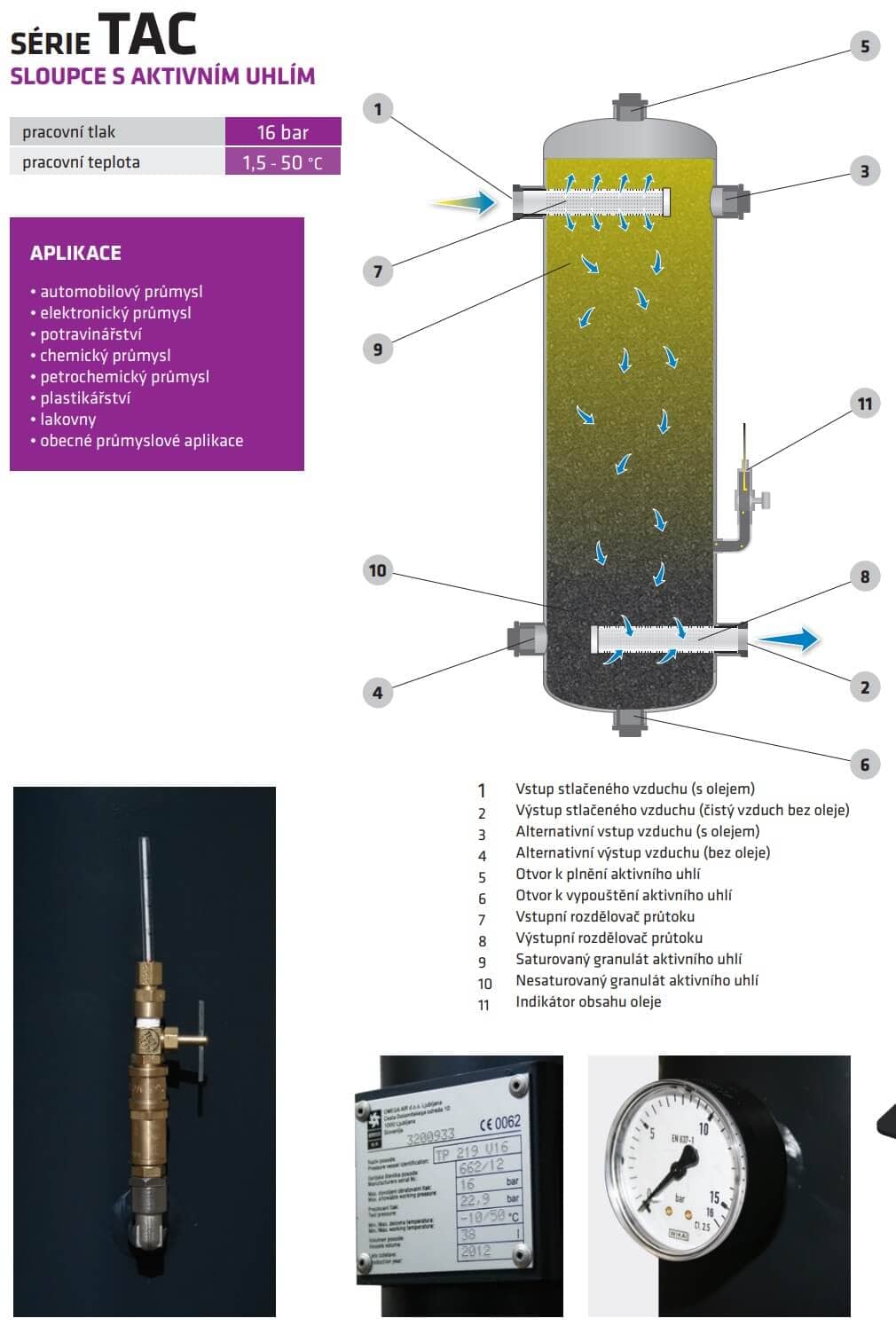
Activated carbon towers are a special type of equipment for the final polishing of compressed air, aimed at removing trace contaminants – above all oil vapours and odour. Inside the steel tower there is a bed of granular activated carbon, a material with an enormous specific surface area and excellent adsorption capability. As compressed air flows through this bed, molecules of hydrocarbons (oil vapours) and other organic substances are captured in the pores of the activated carbon (the adsorption process). This is so-called dry separation – unlike mechanical filtration, the contaminants are bound to the surface of the sorbent by a physico-chemical mechanism. What leaves the tower is exceptionally clean air free of oil vapours, suitable even for the most demanding applications. Activated carbon typically brings the residual oil content in the air below 0,003 mg/m³ (class 1 according to ISO 8573-1) and eliminates any odour of the compressed air.
#ShowMore#
Advantages
- A marked improvement in air quality: removal of oil vapours, odour and other trace contaminants that ordinary dryers and mechanical filters cannot eliminate. The resulting air is practically “oil-free” and odourless.
- Requires no electrical power and has no moving parts – it is a passive system with quiet, uninterrupted operation.
- Simple, robust construction and high reliability: the steel pressure tower withstands heavy loads, and activated carbon is a proven filter medium that needs no complicated attention.
- Allows oil-lubricated compressors to be used even for applications with strict air quality standards (food industry, healthcare, etc.) – carbon towers can turn an ordinary compressor into an air source with parameters approaching those of more expensive oil-free compressors.
Disadvantages
- It does not remove water moisture: activated carbon on its own does not dry the air of water vapour. If moist air enters the tower, the carbon quickly becomes saturated with water and loses its effectiveness at removing oil. A suitable air dryer (refrigeration or desiccant) must therefore be installed ahead of the carbon tower.
- A consumable bed – activated carbon has a limited service life. Its pores gradually fill with the captured contaminants and its effectiveness falls. The bed has to be replaced at regular intervals (for example once every 6–12 months, depending on operation), which is an additional running cost.
- Additional pressure drop in the system: the flow of air through the carbon layer creates a certain resistance. With correct sizing the pressure drop is small, but it has to be allowed for and the compressor must be powerful enough.
- A limited range of captured substances: activated carbon is excellent for organic substances (oils, hydrocarbons), but it will not capture carbon oxides or other gaseous components, for instance. For special purposes (e.g. preparing breathing air), further filtration is therefore needed alongside the carbon (e.g. catalytic) to remove CO/CO₂, plus sterilisation where applicable.
Applications
Dryers with activated carbon are used wherever drying the air alone is not enough and completely clean, technically oil-free air has to be achieved. A typical example is the food and beverage industry – compressed air comes into contact with food or packaging and must not affect its taste, smell or safety. Likewise in pharmaceuticals and healthcare (e.g. manufacture and packaging of medicines, dental compressors at the dentist), air with zero oil and odour content is critical. Another area is surface treatment and painting: in automotive paint shops, for example, the combination of a refrigeration dryer and an activated carbon tower provides perfectly dry and clean air for a flawless finish. Carbon filter towers are also used to reach breathing air quality (e.g. when producing breathing mixtures for diving or for supplied-air masks) – there, however, they are always combined with further drying and filtration stages to remove CO/CO₂ and micro-organisms.
Comparison with other dryer types
Towers filled with activated carbon differ from other types of dryer in what they actually do. Refrigeration and desiccant dryers primarily deal with removing water moisture from the air, while activated carbon takes care of oil contamination and odour. A conventional dryer therefore cannot be replaced by a carbon tower alone – on the contrary, the two are often deployed together: the air is first dried by refrigeration or adsorption and then passed through activated carbon for final polishing. Combining the technologies gives air that is both dry and clean. Other filtration elements (such as mechanical filters) remove solid particles and liquid oil, yet only activated carbon can capture the gaseous oil fraction as well. If your application does not call for extreme air purity, a standard refrigeration or desiccant dryer may well be enough. Otherwise, to reach the parameters of the highest air quality classes, activated carbon is an indispensable addition to the drying system.
Remember: always install the activated carbon tower downstream of the main dryer and filters. To do its job, it needs a supply of air that is as clean and dry as possible. Ideally a fine dust filter should be placed ahead of it to catch any carbon particles released from the bed into the air stream. Replace the activated carbon regularly according to the manufacturer's recommendation or the operating conditions – only then will it keep its ability to protect your equipment reliably against oil vapours.
.jpg)
-hankison-susicka-vzduch-kompresor-tllak-kondenzace-rosny-bod.jpg)
.jpg)
Product sorting
List of products

The TAC-1000 dry separator is designed to separate oil vapour from compressed air using activated carbon from the compressor up to a flow rate of 16,667 l/min at a maximum...

Dry separation TAC-110 designed for separation of oil vapours from compressed air by activated carbon from the compressor up to a flow rate of 1 833 l/min at a maximum pressure...

Dry separation TAC-150 designed for separation of oil vapours from compressed air by activated carbon from the compressor up to a flow rate of 2 500 l/min at a maximum pressure...

The TAC-200 dry separator is designed to separate oil vapours from compressed air using activated carbon from the compressor up to a flow rate of 3,333 l/min at a maximum...

Dry separation TAC-250 designed for separation of oil vapours from compressed air by activated carbon from the compressor up to a flow rate of 5 333 l/min at a maximum pressure...

Dry separation TAC-300 designed for separation of oil vapours from compressed air by activated carbon from the compressor up to a flow rate of 5 333 l/min at a maximum pressure...

Dry separation TAC-400 designed for separation of oil vapours from compressed air by activated carbon from the compressor up to a flow rate of 6 833 l/min at a maximum pressure...

The TAC-600 dry separator is designed to separate oil vapours from compressed air using activated carbon from the compressor up to a flow rate of 9,833 l/min at a maximum...

The TAC-800 dry separator is designed to separate oil vapours from compressed air using activated carbon from the compressor up to a flow rate of 12,833 l/min at a maximum...

The TACM-105 small dry separator is designed to separate oil vapours from compressed air using activated carbon from the compressor up to a flow rate of 1,950 l/min at a maximum...

The TACM-12 small dry separator is designed to separate oil vapours from compressed air using activated carbon from the compressor up to a flow rate of 200 l/min at a maximum...

The TACM-150 small dry separator is designed for separation of oil vapours from compressed air using activated carbon from the compressor up to a flow rate of 2,500 l/min at a...

The TACM-200 small dry separator is designed to separate oil vapours from compressed air using activated carbon from the compressor up to a flow rate of 3,333 l/min at a maximum...

The TACM-23 small dry separator is designed to separate oil vapours from compressed air using activated carbon from the compressor up to a flow rate of 400 l/min at a maximum...

The TACM-35 small dry separator is designed to separate oil vapours from compressed air using activated carbon from the compressor up to a flow rate of 600 l/min at a maximum...

The TACM-56 small dry separator is designed to separate oil vapours from compressed air using activated carbon from the compressor up to a flow rate of 1,250 l/min at a maximum...

The TACM-6 small dry separator is designed to separate oil vapours from compressed air using activated carbon from the compressor up to a flow rate of 100 l/min at a maximum...

The TACM-70 small dry separator is designed to separate oil vapours from compressed air using activated carbon from the compressor up to a flow rate of 1,250 l/min at a maximum...

Service kit for the TAC-1000 activated carbon column. Activated carbon is a material in the form of small pellets designed to purify compressed air and gases in adsorption...

Service kit for TAC-110 activated carbon column. Activated carbon is a material in the form of small pellets designed to purify compressed air and gases in adsorption processes.

Service kit for the TAC-150 activated carbon column. Activated carbon is a material in the form of small pellets designed to purify compressed air and gases in adsorption...

Service kit for the TAC-200 activated carbon column. Activated carbon is a material in the form of small pellets designed to purify compressed air and gases in adsorption...

Service kit for the TAC-250 activated carbon column. Activated carbon is a material in the form of small pellets designed to purify compressed air and gases in adsorption...

Service kit for the TAC-300 activated carbon column. Activated carbon is a material in the form of small pellets designed to purify compressed air and gases in adsorption...

Service kit for the TAC-400 activated carbon column. Activated carbon is a material in the form of small pellets designed to purify compressed air and gases in adsorption...

Service kit for the TAC-600 activated carbon column. Activated carbon is a material in the form of small pellets designed to purify compressed air and gases in adsorption...

Service kit for the TAC-800 activated carbon column. Activated carbon is a material in the form of small pellets designed to purify compressed air and gases in adsorption...

Service kit for activated carbon column TACM-105. Activated carbon is a material in the form of small pellets designed to purify compressed air and gases in adsorption processes.

Service kit for the TACM-12 activated carbon column. Activated carbon is a material in the form of small pellets designed to purify compressed air and gases in adsorption...

Service kit for the TACM-150 activated carbon column. Activated carbon is a material in the form of small pellets designed to purify compressed air and gases in adsorption...

Service kit for the TACM-200 activated carbon column. Activated carbon is a material in the form of small pellets designed to purify compressed air and gases in adsorption...

Service kit for the TACM-23 activated carbon column. Activated carbon is a material in the form of small pellets designed to purify compressed air and gases in adsorption...

Service kit for the TACM-35 activated carbon column. Activated carbon is a material in the form of small pellets designed to purify compressed air and gases in adsorption...

Service kit for the TACM-56 activated carbon column. Activated carbon is a material in the form of small pellets designed to purify compressed air and gases in adsorption...

Service kit for the TACM-6 activated carbon column. Activated carbon is a material in the form of small pellets designed to purify compressed air and gases in adsorption processes.

Service kit for the TACM-70 activated carbon column. Activated carbon is a material in the form of small pellets designed to purify compressed air and gases in adsorption...