

High-pressure regulators HP for gases with inlet up to 414 bar
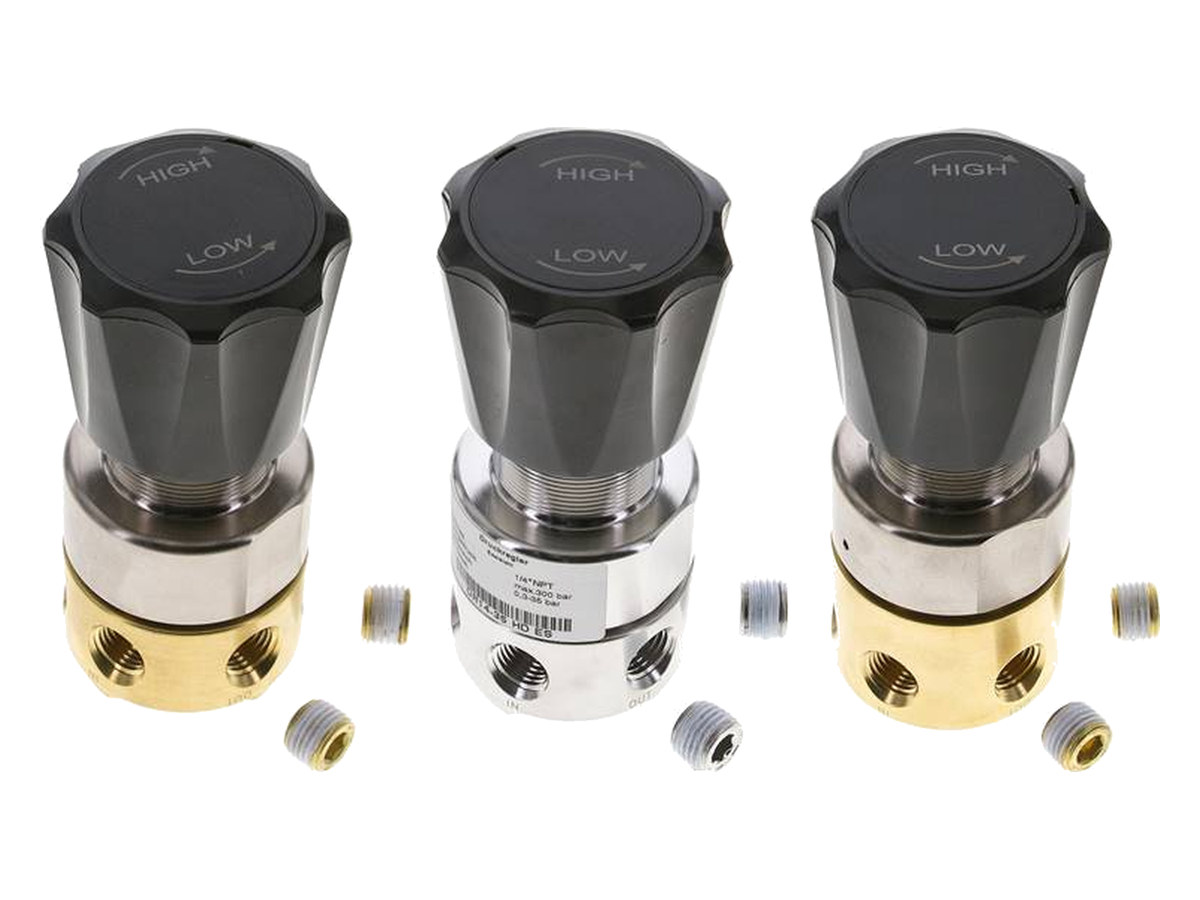
High-pressure regulators of the HP series by the manufacturer AirCom reduce the gas pressure from a gas cylinder, a cylinder bundle or a high-pressure network – up to 300 or 414 bar – to an adjustable pressure of 0.1 to 172 bar.
They are small (50 × 137 mm), with a body made of brass or stainless steel 1.4404, internal parts made of stainless steel and a PFA valve seat. They are supplied without pressure gauges – the two NPT 1/4" ports for the inlet and outlet pressure gauges are sealed with plugs.
What the HP regulators offer
- inlet pressure up to 300 bar (ranges up to 35 bar) or 414 bar (ranges up to 172 bar)
- seven ranges from 0.1–1.7 to 1–172 bar
- for compressed air, nitrogen, oxygen (inlet up to 200 bar), hydrogen and helium, the 300 bar type also for CO₂
- body made of brass or stainless steel 1.4404, internal parts made of stainless steel, PFA seat
- small dimensions of 50 × 137 mm, any mounting position
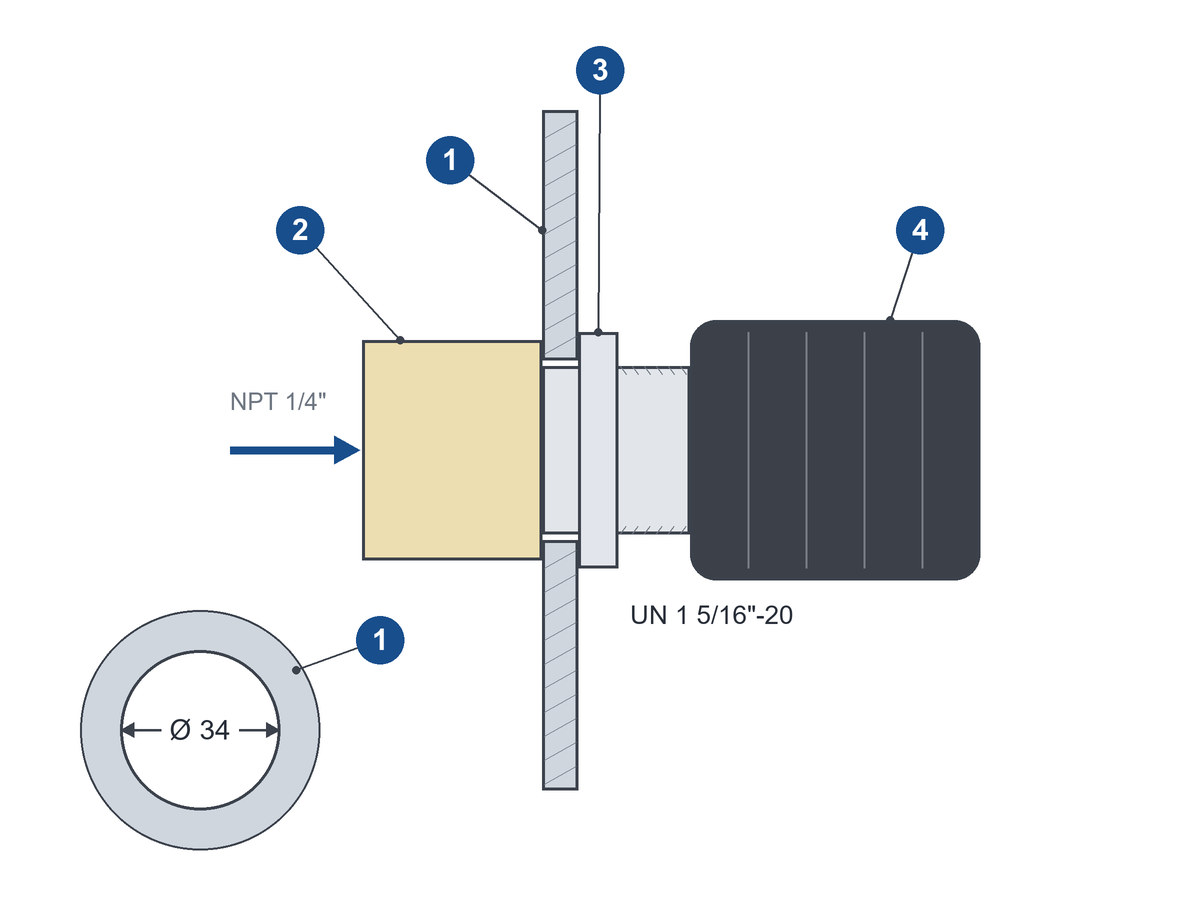
- panel mounting (hole ⌀ 34 mm, nut UN 1 5/16"-20)
- two NPT 1/4" gauge ports – for inlet and outlet pressure
- operation from −40 to +75 °C (414 bar type −25 to +75 °C)
All HP regulators
| Code | Control range | Inlet pressure | Flow rate | Body | Operating temperature | Weight |
|---|---|---|---|---|---|---|
| DR14-1,7HD | 0.1–1.7 bar | 300 bar | 500 l/min* | brass | −40 to +75 °C | 1.0 kg |
| DR14-3,5HD | 0.1–3.5 bar | 300 bar | 600 l/min* | brass | −40 to +75 °C | 1.1 kg |
| DR14-7HD | 0.1–7 bar | 300 bar | 1,000 l/min* | brass | −40 to +75 °C | 1.1 kg |
| DR14-17HD | 0.2–17 bar | 300 bar | 1,400 l/min* | brass | −40 to +75 °C | 1.1 kg |
| DR14-35HD | 0.3–35 bar | 300 bar | 1,500 l/min* | brass | −40 to +75 °C | 1.1 kg |
| DR14-104HD | 0.7–104 bar | 414 bar | 2,600 l/min* | brass | −25 to +75 °C | 1.2 kg |
| DR14-172HD | 1–172 bar | 414 bar | 2,800 l/min* | brass | −25 to +75 °C | 1.2 kg |
| DR14-1,7HDES | 0.1–1.7 bar | 300 bar | 500 l/min* | stainless steel | −40 to +75 °C | 1.0 kg |
| DR14-3,5HDES | 0.1–3.5 bar | 300 bar | 600 l/min* | stainless steel | −40 to +75 °C | 0.95 kg |
| DR14-7HDES | 0.1–7 bar | 300 bar | 1,000 l/min* | stainless steel | −40 to +75 °C | 1.0 kg |
| DR14-17HDES | 0.2–17 bar | 300 bar | 1,400 l/min* | stainless steel | −40 to +75 °C | 1.0 kg |
| DR14-35HDES | 0.3–35 bar | 300 bar | 1,500 l/min* | stainless steel | −40 to +75 °C | 1.0 kg |
| DR14-104HDES | 0.7–104 bar | 414 bar | 2,600 l/min* | stainless steel | −25 to +75 °C | 1.1 kg |
| DR14-172HDES | 1–172 bar | 414 bar | 2,800 l/min* | stainless steel | −25 to +75 °C | 1.2 kg |
* Flow rate according to the manufacturer, measured at the maximum inlet and maximum outlet pressure of the range. It is lower at a lower pressure in the cylinder or network.
How to choose an HP regulator
- Range according to the pressure you want to set. Choose a range whose upper limit is above the required pressure. In a smaller range, the pressure can be set more finely.
- Inlet pressure. Ranges up to 35 bar withstand 300 bar at the inlet, the 104 and 172 bar ranges up to 414 bar. For oxygen, the inlet pressure may be no more than 200 bar.
- Body material. Both versions have the same ranges, internal parts made of stainless steel and a PFA seat. They differ in the body material – brass or stainless steel 1.4404 (the code ends in ES).
- Flow rate. The manufacturer specifies it at full inlet pressure. When gas flows through the valve, the flow rate increases with the absolute inlet pressure (formula 13.4 × kv × p1) – with half the pressure in the cylinder, expect roughly half the flow rate.
Example: a laboratory needs 10 bar of helium from a 200 bar cylinder. The range up to 7 bar is not sufficient; the 0.2–17 bar range is suitable – DR14-17HD with a brass body or DR14-17HDES in stainless steel.
Not sure which regulator to choose? Try the pressure regulator selector – based on line pressure, required pressure and flow.
#showmore#
Which gases, and how to use them safely
The manufacturer specifies HP regulators for compressed air, nitrogen, oxygen (inlet pressure no more than 200 bar), hydrogen and helium, and the type with a 300 bar inlet additionally for carbon dioxide (CO₂). Safety instructions of the manufacturer AirCom:
- never use oils or greases on gas regulators – they ignite easily and react violently with some compressed gases
- do not use any lubricant during installation – the regulator becomes contaminated, and with oxygen there is a risk of fire
- protect the connected equipment against overpressure with a separate safety valve – the regulator has no secondary venting and cannot protect it by itself
- only instructed personnel may work with flammable, pyrophoric and toxic gases; provide ventilation and gas leak detectors
- the regulator is neither a shut-off valve nor a flow regulator – shut off the gas with the cylinder valve or a shut-off valve in the network
How an HP regulator works
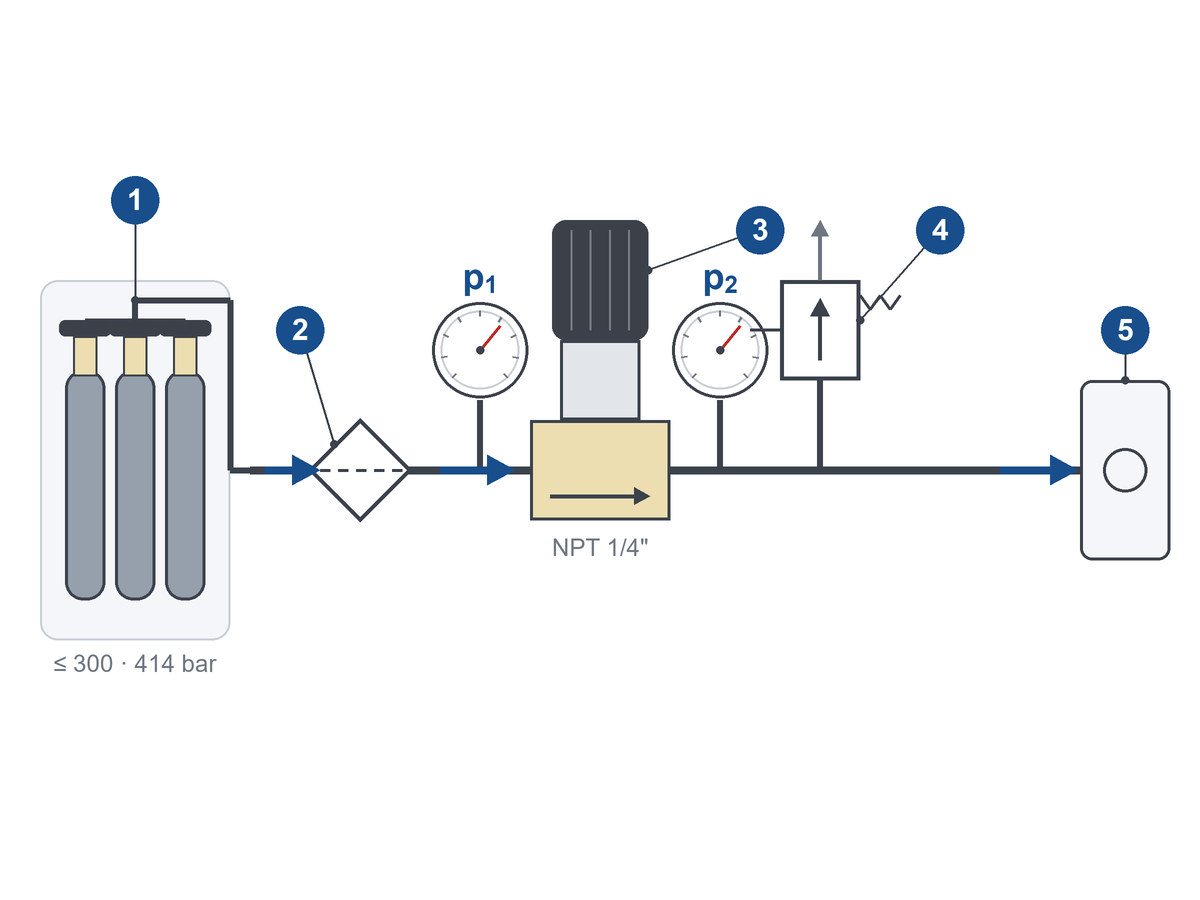
- Turning the knob clockwise tensions the spring and increases the outlet pressure; turning it anticlockwise reduces it.
- The 300 bar type controls with a stainless steel diaphragm, the 414 bar type with a piston. When the outlet pressure reaches the set value, the valve partially closes and lets through only as much gas as is being drawn off.
- The outlet reacts only slightly to inlet pressure fluctuations: when the inlet changes by 7 bar, the set pressure changes by less than 120 mbar (414 bar type by less than 250 mbar).
- The regulator has no secondary venting: when you reduce the set pressure, the outlet pressure only drops once gas is drawn off.
Flow curves
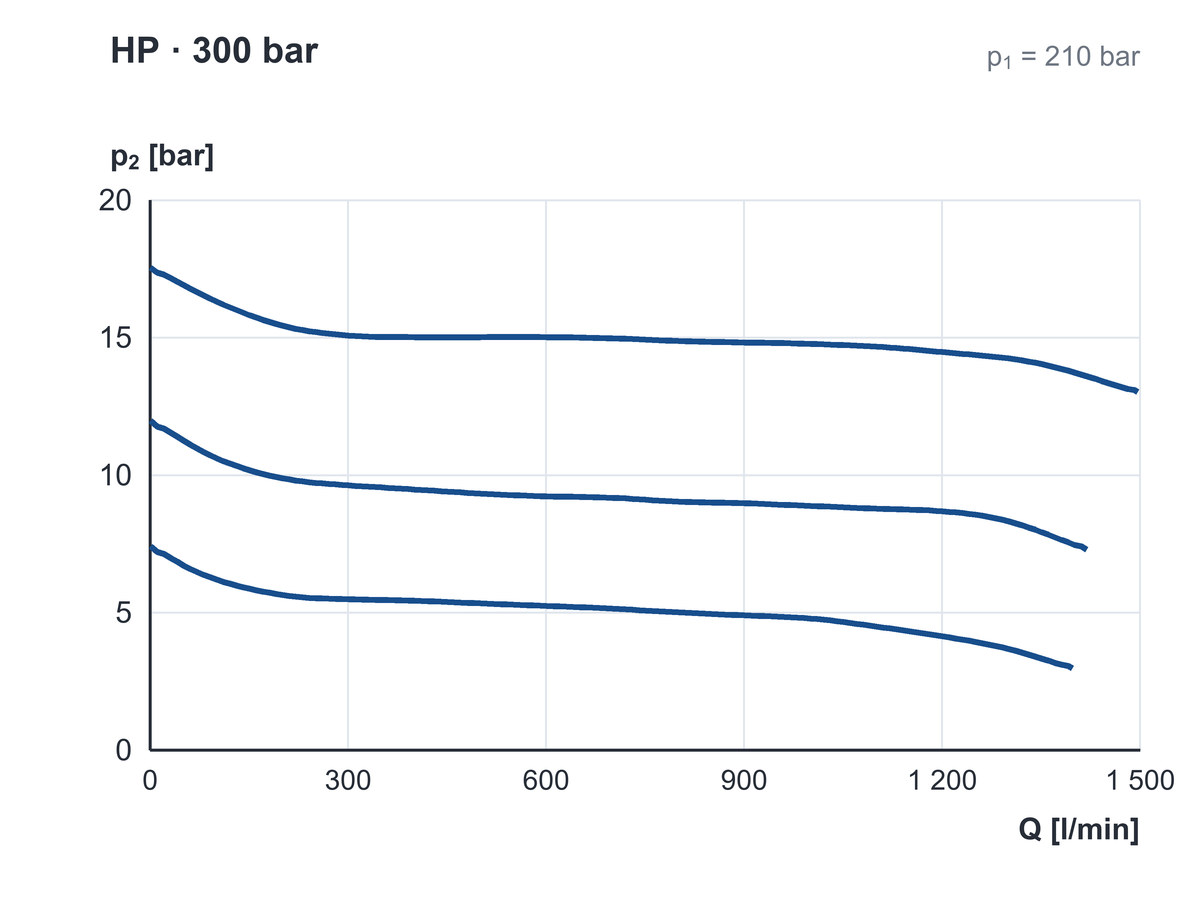
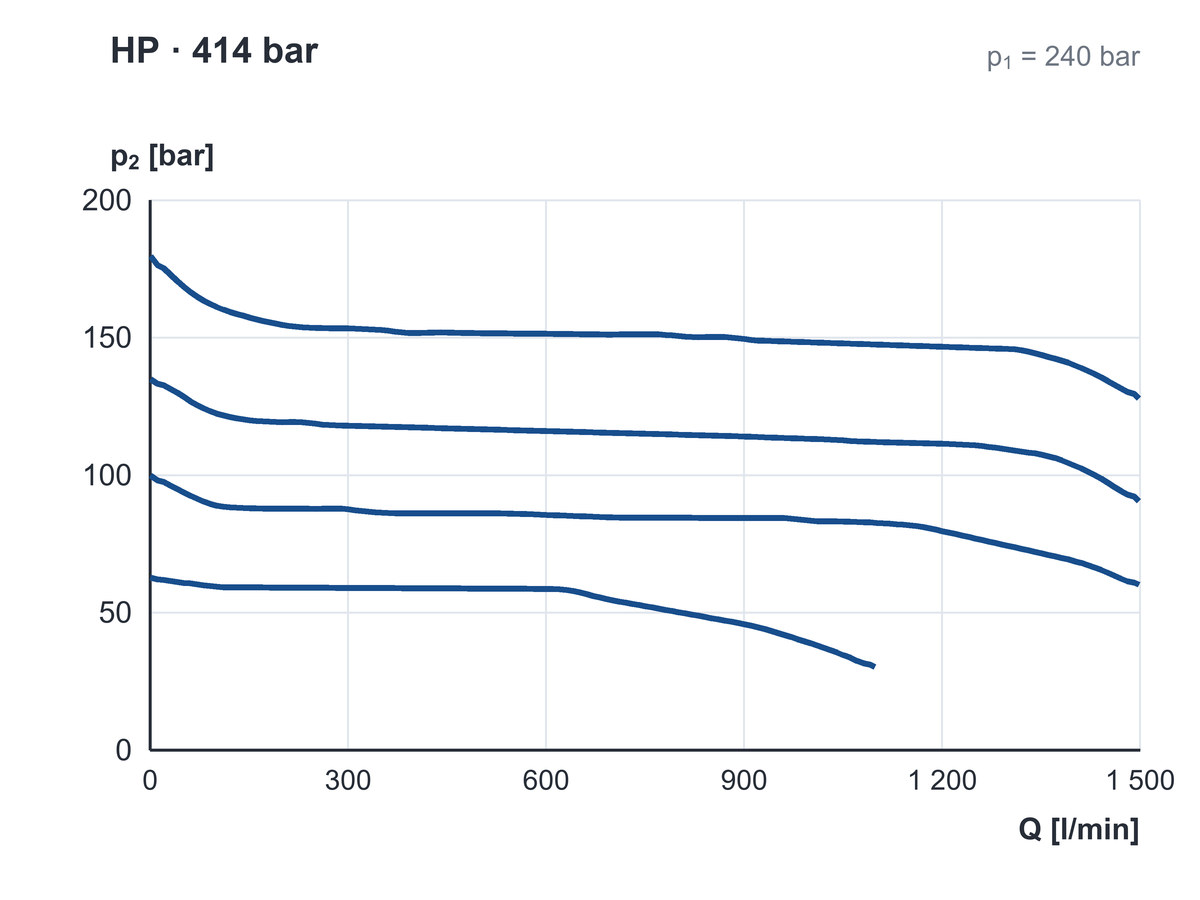
AirCom specifies how the outlet pressure drops as the flow rate increases – for the 300 bar type at an inlet pressure of 210 bar, for the 414 bar type at an inlet pressure of 240 bar. Each curve starts at the pressure set without any flow.
Dimensions and panel mounting
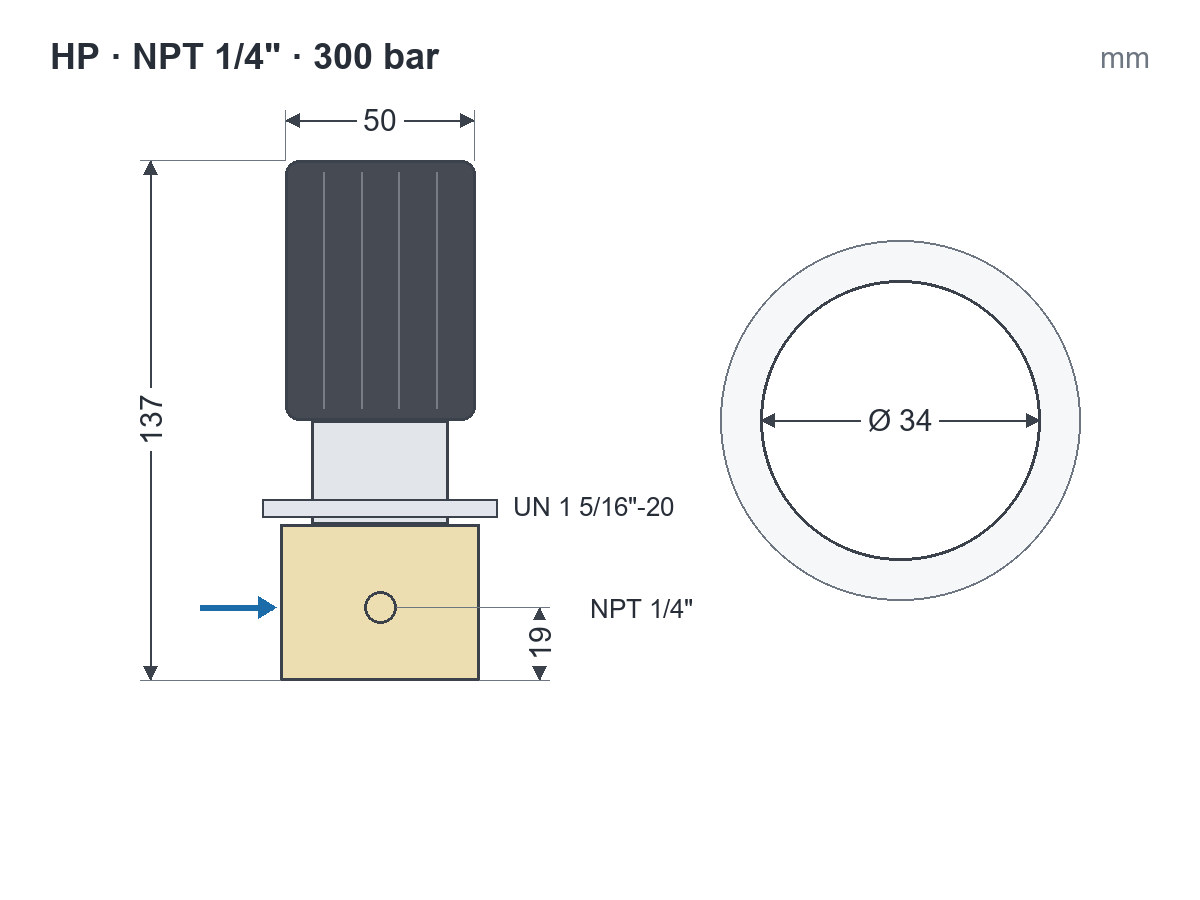
The regulator is 50 mm wide and 137 mm high (A × B); the axis of the ports is 19 mm above the base (414 bar type 13 mm). You fix it in a control panel through a ⌀ 34 mm hole with a UN 1 5/16"-20 panel nut, which is ordered separately.
Installation and adjustment
- blow out all pipes before installation – dirt will damage the valve seat
- before connecting, loosen the knob anticlockwise so that the spring is not under tension
- connect the regulator according to the arrow on the body – from inlet IN to outlet OUT; any mounting position is possible
- the internal filter only provides protection during installation – the manufacturer recommends a filter at the inlet; the gas should be dry so that the regulator does not ice up at high flow rates
- set the pressure from below, always fine-tune towards a higher pressure; do not turn the knob beyond the upper limit of the range
- screw in pressure gauges with NPT 1/4" connections in place of the plugs – the left one for inlet pressure and the right one for outlet pressure
Series specifications
| Parameter | Value |
|---|---|
| Inlet pressure | max. 300 bar (ranges up to 35 bar), max. 414 bar (104 and 172 bar); oxygen max. 200 bar |
| Control ranges | 0.1–1.7 / 0.1–3.5 / 0.1–7 / 0.2–17 / 0.3–35 / 0.7–104 / 1–172 bar |
| Flow rate | 500 to 2,800 l/min at maximum inlet and outlet pressure |
| Kv | 0.05 m³/h |
| Connection | NPT 1/4" inlet and outlet, 2 × NPT 1/4" for pressure gauges |
| Secondary venting | no |
| Control | diaphragm (300 bar), piston (414 bar) |
| Deviation when the inlet changes by 7 bar | < 120 mbar (300 bar), < 250 mbar (414 bar) |
| Operating temperature | −40 to +75 °C (414 bar: −25 to +75 °C) |
| Medium | compressed air, nitrogen, oxygen (max. 200 bar), hydrogen, helium; 300 bar also CO₂ |
| Material | body brass or stainless steel 1.4404, internal parts stainless steel, spring housing nickel-plated brass, knob PA, seat PFA, seals FKM |
| Dimensions | 50 × 137 mm, panel hole ⌀ 34 mm, panel thread UN 1 5/16"-20 |
| Scope of delivery | regulator with plugs in the gauge ports, without pressure gauges and without panel nut |
| Mounting position | any |
Ventilek advises
With HP regulators, remember the pressure gauges – they are not included. And always install a safety valve downstream of the regulator that withstands the highest pressure of your equipment.
- air or nitrogen network up to 200 bar with pressure gauges included: regulators 120
- regulator directly on the cylinder: cylinder pressure regulators
- all high-pressure series: high-pressure regulators
- Are pressure gauges included?
- No. The regulator has two NPT 1/4" ports for the inlet and outlet pressure gauges, which are sealed with plugs on delivery. Choose the pressure gauges according to the pressure and the gas.
- May I use the HP regulator for oxygen?
- The manufacturer specifies oxygen up to an inlet pressure of 200 bar. The regulator, pipework and pressure gauges must be free of oil and grease, and no lubricant may be used during installation.
- Why is the flow rate stated for the regulator so high?
- The manufacturer measures it at the maximum inlet pressure of 300 or 414 bar. As the pressure in the cylinder falls, the flow rate drops roughly in proportion to the absolute inlet pressure.
- Does the regulator release pressure when I reduce it?
- No. HP regulators have no secondary venting – the outlet pressure only drops once gas is drawn off.
- What is the difference between a code with ES and without ES?
- A code with ES has a body made of stainless steel 1.4404, a code without ES a brass body. The ranges, internal parts and dimensions are the same.
Technical data according to the manufacturer AirCom Pneumatic GmbH. Flow rate at the maximum inlet and outlet pressure of the range.
You will find more high-pressure regulators in the category high-pressure regulators.


Product sorting
List of products

AirCom HP series high-pressure regulator for gases, without secondary venting.control range 0.1–1.7 bar, inlet pressure up to 300 barconnection NPT 1/4", 2 gauge portsbrass...

AirCom HP series high-pressure regulator for gases, without secondary venting.control range 0.1–1.7 bar, inlet pressure up to 300 barconnection NPT 1/4", 2 gauge portsstainless...

AirCom HP series high-pressure regulator for gases, without secondary venting.control range 0.1–3.5 bar, inlet pressure up to 300 barconnection NPT 1/4", 2 gauge portsbrass...

AirCom HP series high-pressure regulator for gases, without secondary venting.control range 0.1–3.5 bar, inlet pressure up to 300 barconnection NPT 1/4", 2 gauge portsstainless...

AirCom HP series high-pressure regulator for gases, without secondary venting.control range 0.1–7 bar, inlet pressure up to 300 barconnection NPT 1/4", 2 gauge portsbrass body,...

AirCom HP series high-pressure regulator for gases, without secondary venting.control range 0.1–7 bar, inlet pressure up to 300 barconnection NPT 1/4", 2 gauge portsstainless...

AirCom HP series high-pressure regulator for gases, without secondary venting.control range 0.2–17 bar, inlet pressure up to 300 barconnection NPT 1/4", 2 gauge portsbrass body,...

AirCom HP series high-pressure regulator for gases, without secondary venting.control range 0.2–17 bar, inlet pressure up to 300 barconnection NPT 1/4", 2 gauge portsstainless...

AirCom HP series high-pressure regulator for gases, without secondary venting.control range 0.3–35 bar, inlet pressure up to 300 barconnection NPT 1/4", 2 gauge portsbrass body,...

AirCom HP series high-pressure regulator for gases, without secondary venting.control range 0.3–35 bar, inlet pressure up to 300 barconnection NPT 1/4", 2 gauge portsstainless...

AirCom HP series high-pressure regulator for gases, without secondary venting.control range 0.7–104 bar, inlet pressure up to 414 barconnection NPT 1/4", 2 gauge portsbrass...

AirCom HP series high-pressure regulator for gases, without secondary venting.control range 0.7–104 bar, inlet pressure up to 414 barconnection NPT 1/4", 2 gauge portsstainless...

AirCom HP series high-pressure regulator for gases, without secondary venting.control range 1–172 bar, inlet pressure up to 414 barconnection NPT 1/4", 2 gauge portsbrass body,...

AirCom HP series high-pressure regulator for gases, without secondary venting.control range 1–172 bar, inlet pressure up to 414 barconnection NPT 1/4", 2 gauge portsstainless...