

TL;DR:
- An electric compressor uses exclusively an electric drive and is not tied to the mechanical drive of an engine.
- It offers a lower energy consumption, lower emissions, less noise and smaller dimensions compared with traditional compressors.
- Work safety requires disconnection from the power supply, the use of non-conductive oil and training of the operator.
A number of industrial companies and service workshops still confuse the electric compressor with a classic compressor driven by a combustion engine or a belt. Yet the differences are fundamental, and not only from the point of view of the principle of operation, but also of the safety requirements, operating costs and suitability for specific applications. The right choice of electric compressor can reduce energy costs, simplify installation and ensure safer operation without dependence on a mechanical drive. This article breaks down the principles, types, advantages and practical use of electric compressors, so that your decision-making is supported by technical facts, not by marketing promises.
Contents
- The principle of the electric compressor and its types
- Advantages of the electric compressor over traditional compressors
- Safety measures when using an electric compressor
- Practical applications of the electric compressor in industry and automotive
- Our experience: how to find a really efficient electric compressor
- Where to find a quality electric compressor and accessories
- Frequently asked questions
Key findings
| Point | Details |
|---|---|
| The principle of the electric compressor | The electric compressor uses an electric drive for higher efficiency and independence from the engine. |
| Advantages over the classic ones | Electric compressors save energy, reduce emissions and volume, and have a quieter operation. |
| Safety requirements | High voltage requires careful safety measures and non-conductive oil. |
| Practical applications | Electric compressors find use in automotive as well as industry for efficient cooling and air operation. |
The principle of the electric compressor and its types
An electric compressor is a device which compresses air or other gases exclusively by means of an electric drive. It does not depend on a combustion engine or on a mechanical transfer of force via a belt or a cardan shaft. That is the key difference from traditional compressors, where the output of the compressor is directly tied to the revolutions of the engine of the vehicle or machine.
In an industrial environment electric compressors are divided into two basic types according to the principle of compression: positive displacement and dynamic. Positive displacement compressors, such as piston and screw compressors, work on the principle of the repeated reduction of the volume of the working space. Dynamic compressors use the kinetic energy of rotating blades to accelerate and then slow down the flow of gas, whereby an increase of pressure occurs.
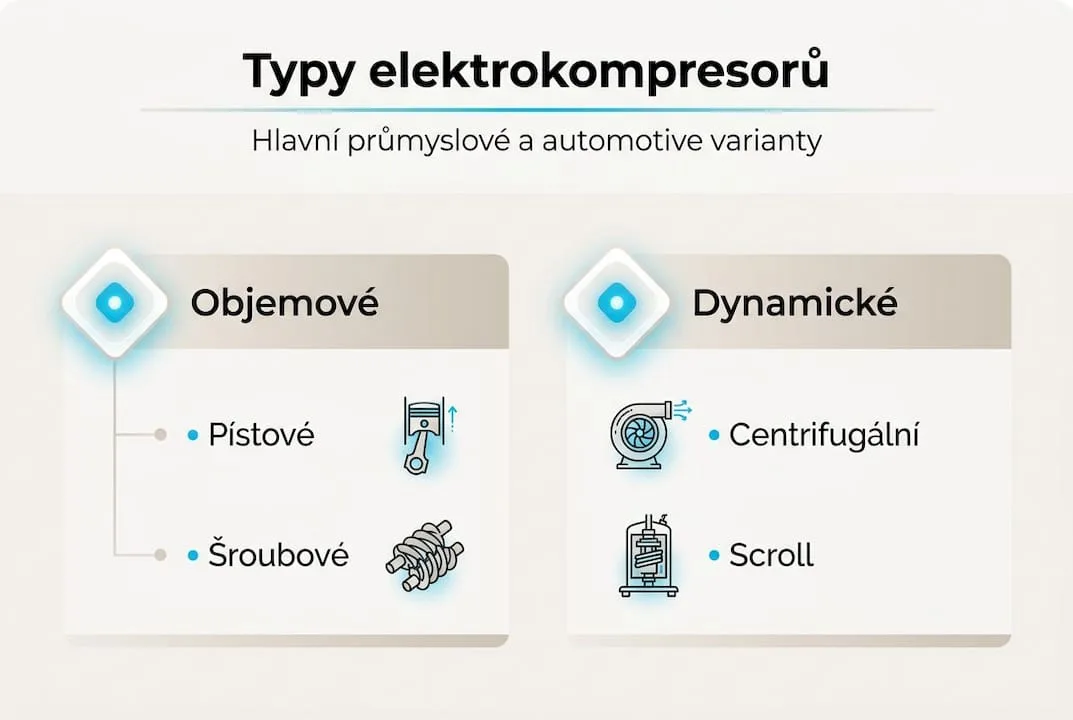
In the automotive industry the term electric compressor has a specific meaning. An e-compressor denotes a high-voltage compressor of the air conditioning for electric cars and hybrid vehicles, working on the principle of a scroll compressor with a BLDC motor. The BLDC motor (brushless direct current motor) ensures precise control of the revolutions, low wear and high efficiency even at low speeds of the vehicle.
Professional tip: In an electric car or a hybrid the electric compressor of the air conditioning works independently of the running of the combustion engine. The air conditioning therefore works also when standing or during recuperation, which is a fundamental advantage over classic systems.
The following table serves for a clear comparison of both worlds:
| Parameter | Automotive electric compressor | Industrial electric compressor |
|---|---|---|
| Voltage | 200–400 V (high-voltage system) | 230/400 V (three-phase networks) |
| Type of motor | BLDC (brushless) | Asynchronous or BLDC |
| Principle of compression | Scroll compressor | Piston, screw, vane |
| Lubrication | POE oil (non-conductive) | Mineral or synthetic oil |
| Primary application | Air conditioning of EVs and hybrids | Air distribution, pneumatic tools |
| Regulation of output | Frequency converter or direct control | Frequency converter, pressure switch |
From the table it is clear that automotive and industrial electric compressors share the electric drive, but differ in the voltage levels, the principle of compression and the requirements for lubrication. Confusing these two categories when choosing equipment is one of the most frequent mistakes we encounter in practice.
Advantages of the electric compressor over traditional compressors
The principle is clear. What specific advantages does the electric compressor bring in practice over diesel or mechanically driven alternatives?
These facts summarise the basic advantages:
- Lower energy consumption: An electric drive is more efficient than a combustion engine in converting energy into mechanical output. Operation is cheaper, especially under continuous load.
- Lower emissions: The electric compressor does not produce exhaust gases directly at the place of operation. That is key for enclosed production halls and areas with requirements on air quality.
- Independence from the drive of the engine: The output of the compressor is not conditional on the running of the combustion engine or on its revolutions. The equipment works whenever electric energy is available.
- Less noise: Electric motors are generally quieter than combustion engines, which reduces the noise load of the working environment.
- Higher efficiency: The advantages over the traditional ones include a lower consumption, lower emissions, independence from the engine, higher efficiency and less noise.
- Smaller dimensions and weight: Electric compressors in automotive applications achieve a saving of volume and weight of up to 20 % compared with mechanically driven alternatives.
From the point of view of operating costs energy efficiency is key. Electric energy is in industrial operation cheaper than diesel when converted to a unit of output, and that even at current energy prices. In addition the electric compressor does not require changes of fuel, exhaust gas filters or complicated management of the fuel system.
For industrial applications the two-stage compressor in industry is also important, where the electric drive makes precise control of every stage of compression independently possible. The result is a higher overall efficiency and a longer service life of the equipment.
Pneumatic tools driven by an electric compressor bring further operational advantages. A stable air pressure without fluctuations dependent on the revolutions of the engine ensures a consistent performance of the tools. More about why that is important is described by the overview of the advantages of pneumatic tools.
Summary: the electric compressor is not just a more modern variant of the classic compressor. It is a fundamentally different approach to producing compressed air, which with the right deployment brings measurable savings and operational advantages.
Safety measures when using an electric compressor
The advantages are clear. Now comes the key safety, which with electric compressors is specific and cannot be underestimated.
Electric compressors, especially in automotive applications, work with a high voltage in the range of 200 to 400 V. High voltage requires safety measures which in EV applications are extended to the cooling of the batteries and the cabin too. Every worker who comes into contact with such equipment must be demonstrably trained and equipped with the corresponding protective means.
A basic safety checklist for work with an electric compressor:
- Disconnection from the power supply before any maintenance. Never carry out service on equipment under voltage. With high-voltage systems in EV vehicles it is necessary to wait for the capacitors to discharge (usually 5 minutes after disconnection).
- Checking the insulation and the cabling. Before starting, check the state of the insulation of the supply cables and connectors. Damaged insulation in a high-voltage system presents a direct danger to life.
- Use of non-conductive POE oil. Automotive electric compressors require exclusively POE oil (polyol ester oil), which is electrically non-conductive. Substituting ordinary mineral oil can cause a short circuit inside the compressor.
- Expert maintenance only. Service of high-voltage compressors may be carried out exclusively by a trained technician with the relevant qualification for work on electrical systems.
- Protective means. Dielectric gloves, insulated tools and protective goggles are obligatory equipment during every intervention.
- Marking of the workplace. During service work mark the vehicle or the equipment with a visible warning, so that unintended switching on of the system does not occur.
Professional tip: POE oil is not just a recommendation of the manufacturer, it is a safety requirement. Its electrical non-conductivity protects both the equipment and the operator from a short circuit in the event of a leak of oil into the electrical part of the compressor. Always use oil approved by the manufacturer of the compressor.
The detailed the rules of safe work with a compressor also cover the specifics of industrial installations, where the risks are different but equally serious.
Industrial electric compressors work with lower voltage levels than automotive variants, but here too the principle applies: work on disconnected equipment protects lives as well as property. Neglecting safety procedures is the most frequent cause of accidents at work during the maintenance of air systems.
Practical applications of the electric compressor in industry and automotive
We have mastered safety. How do electric compressors actually work in practice and where do they bring the greatest added value?
In the automobile industry electric compressors are deployed primarily in three areas. The first is the air conditioning of the cabin of electric cars and hybrids, where they replace mechanically driven compressors dependent on the combustion engine. The second area is the cooling of traction batteries, where precise control of the output of the compressor directly influences the service life and performance of the battery. The third area is the optimisation of the overall energy balance of the vehicle, where electric compressors in automotive differ from industrial air equipment by their focus on positive displacement and dynamic compression.
In industrial operation electric compressors are the basis of the air distribution in factories, assembly halls and service centres. The key applications include:
- Driving pneumatic tools (nutrunners, grinders, drills)
- Blasting and painting in the car service
- Automated production lines with pneumatic actuators
- Cleaning and blowing applications in the food industry and pharmacy
- Air distribution for measuring and control technology
This table serves as an overview of the specifics of both sectors:
| Parameter | Automotive application | Industrial application |
|---|---|---|
| Type of compression | Scroll | Piston, screw, vane |
| Working pressure | 1.5–3.5 MPa (refrigerant) | 0.6–1.3 MPa (air) |
| Medium | Refrigerant R134a, R1234yf | Air, nitrogen |
| Safety class | High-voltage (HV) | Low-voltage (LV) |
| Energy efficiency | High (BLDC regulation) | High (frequency converter) |
| Typical output | 1–5 kW | 1.5–250 kW |
In industrial practice it is important to distinguish the function the decompressor in industry from the compressor itself. The decompressor controls the drop in pressure in the system and protects the equipment from overpressure. For demanding industrial applications with high requirements for flow and pressure SCR screw compressors are suitable, which combine an electric drive with the high reliability of screw compression.
The advantages of electric compressors in industrial operation are measurable: fewer emissions in the working environment, a quieter run reducing the noise load and precise control of the output by means of a frequency converter. The frequency converter makes stepless regulation of the revolutions of the motor according to the current consumption of air possible, thereby eliminating energy losses under partial load.
Our experience: how to find a really efficient electric compressor
From practice we know that firms all too often choose a compressor primarily according to the purchase price. Real efficiency, however, depends on the right application, not on the lowest price on the market. We have seen installations where a cheap piston compressor was deployed in continuous industrial operation, and the result was high repair costs and outages of production.
The marketing materials of manufacturers promise energy savings and low operating costs. Always verify the specific technical parameters: type of motor, power input, nominal pressure, air flow and compatibility with your air distribution. General promises without figures are worthless.
The return on an investment in a quality electric compressor with a frequency converter is in industrial operation usually 2 to 4 years. The exact calculation depends on the number of operating hours and the current price of electricity. A detailed overview of the savings of a screw compressor shows how specific parameters influence the return in real operation.
Do not rely only on the type of equipment. Focus on the specific operating conditions, the required pressure, the flow and the available electrical connection. A correctly chosen electric compressor pays for itself. A badly chosen one generates costs from the first day.
Where to find a quality electric compressor and accessories
If you are looking for specific equipment for your plant, kompresory-vzduchotechnika.cz offers a complete range of industrial electric compressors from leading manufacturers. The selection includes piston, screw and vane compressors with an electric drive for various operating requirements.
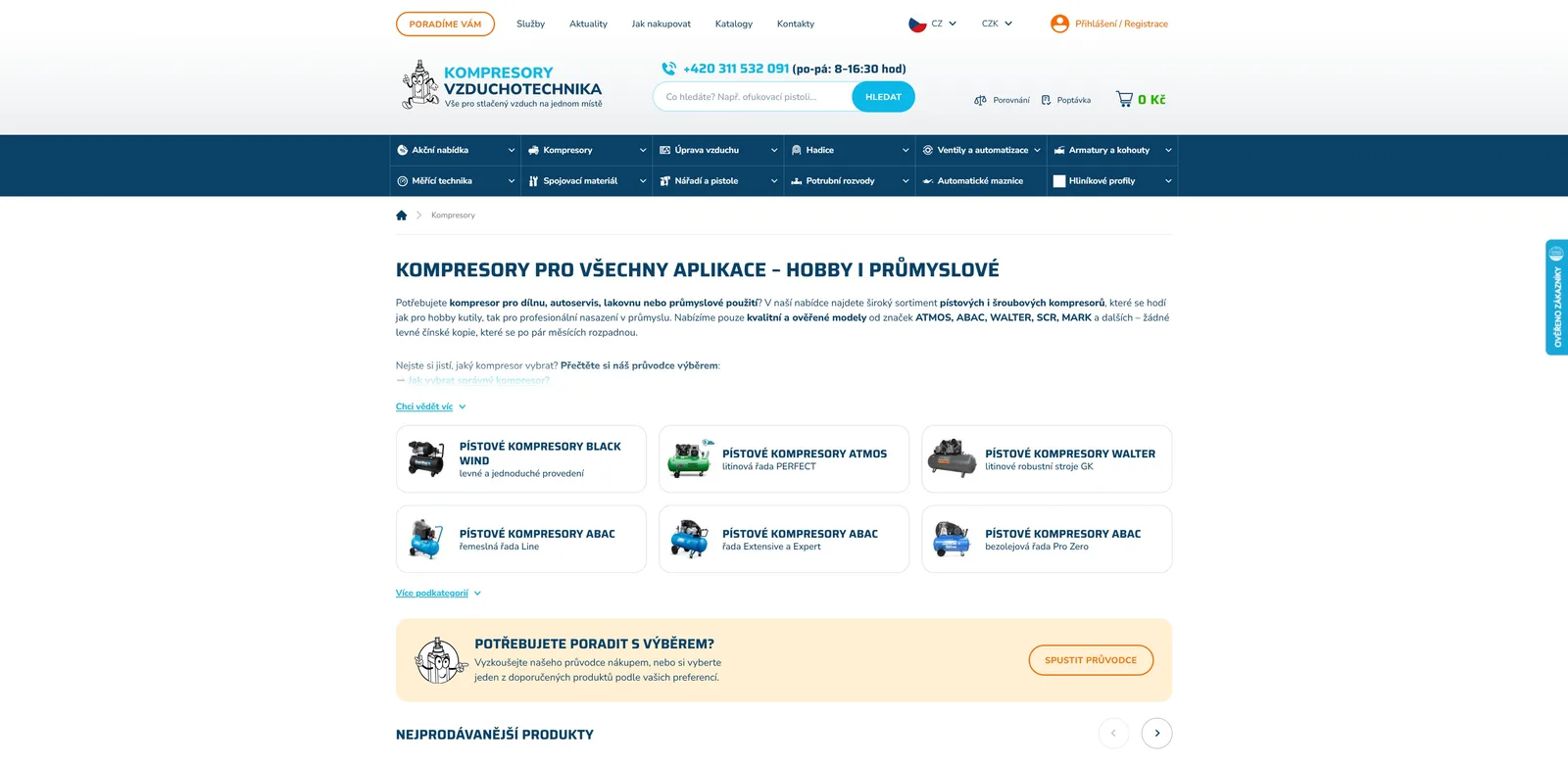
For automotive and industrial applications MARK compressors with a proven reliability in demanding operation are available. For higher outputs and continuous industrial deployment we offer SCR screw compressors with a frequency converter for maximum energy efficiency. Expert consultation is part of our standard offer, so that your equipment corresponds to the exact operating parameters without unnecessary compromises.
Frequently asked questions
What is the main difference between an electric compressor and an ordinary compressor?
The electric compressor is driven exclusively electrically and is not tied to the mechanical drive of the engine of a vehicle or machine. The e-compressor for EVs works on the principle of a scroll compressor with a BLDC motor and provides an independent output regardless of the running of the combustion engine.
What safety requirements must be observed when using an electric compressor?
The equipment must be disconnected from the power supply before any maintenance and it is necessary to use non-conductive POE oil. The high voltage in EV systems additionally requires a qualified technician and dielectric protective means.
Where will I find an industrial electric compressor suitable for my business?
A wide range of industrial electric compressors for various applications and outputs can be found at kompresory-vzduchotechnika.cz, where expert consultation for the choice of the right equipment is also available.
What are the main advantages of an electric compressor from the point of view of operating costs?
Electric compressors bring a lower consumption, emissions and noise compared with traditional alternatives, which translates directly into lower long-term operating costs and simpler management of the equipment.
Is an electric compressor suitable for every industrial application?
No, suitability depends on the required pressure, flow and available electrical connection. Industrial electric compressors are focused on positive displacement or dynamic compression of air and need not be optimal for all specific operating conditions.