


For stable continuous production, choose a rotary screw compressor; for intermittent operation, a piston compressor is sufficient. Four figures are decisive: the required flow rate in m³/min, the operating pressure in bar, the required air purity class according to ISO 8573, and the nature of the load throughout the day. Before requesting offers, determine the average and peak load and consider variable speed drive (VSD) where air demand fluctuates.
In brief:
- Piston compressors are suitable for intermittent operation, while rotary screw compressors are the best choice for continuous industrial use.
- A higher air purity class according to the ISO 8573 standard is required in the food industry, pharmaceuticals, and other sensitive sectors, where oil and moisture must be eliminated.
- Correct compressor sizing depends on actual consumption in m³/min, the required pressure, and a reserve of 20–25%, and it is recommended to compare this with the technical data at operating pressure.
- Variable speed drive (VSD) brings greater energy savings in fluctuating operations where air demand varies, while in steady operation, a fixed-speed option is more advantageous.
- When choosing a compressor, it is important to consider not only the purchase price but also the operating costs and regular servicing, which minimizes the risk of unplanned downtime.
Contents
- How to choose an industrial compressor: piston or screw?
- How to calculate the required compressor flow rate and pressure
- When is variable speed drive (VSD) worth it?
- What air quality is needed according to ISO 8573
- How much does compressor operation cost per year?
- What are the requirements for installation and noise level of a compressor
- Checklist: steps to selecting the right compressor
- What practice says: a view on compressor selection
- Choose a compressor with expert advice from Kompresory-Vzduchotechnika
- Recommended resources for further study
- Frequently asked questions
How to choose an industrial compressor: piston, or screw?
A piston compressor compresses air by the movement of a piston in a cylinder. It is a simpler, cheaper technology with a lower purchase price, but with higher wear during long operation. A screw compressor compresses air between two interlocking rotors and handles continuous operation considerably better. For continuous industrial operation, rotary screw units are therefore usually more suitable, while piston compressors prove themselves in intermittent operation and less demanding applications, where the machine runs only part of a shift.
The choice between an oil-lubricated and oil-free design depends on what you plan to do with the air:
- Oil-lubricated compressors are cheaper to operate and suitable where the air does not come into contact with the final product.
- Oil-free compressors are necessary in the food, pharmaceutical, or electronics industries, where traces of oil would devalue the product.
- Oil-free technology requires more frequent servicing of compressor heads, but it saves you additional filtration stages.
- Oil-lubricated solutions, on the other hand, need quality oil separation and regular filter replacement.
The choice of technology also affects installation: screw compressors require more carefully planned cooling and heat dissipation, while piston compressors are less demanding but louder during extended operation.
How to calculate the required compressor flow and pressure
Sizing is mathematics, not a rough estimate. According to manufacturers, it is essential to take into account both daily and peak air demands, since an oversized unit increases costs while an undersized one limits production. Proceed as follows:
- List the consumption of each tool in m³/min according to the nameplate, including the pressure at which the consumption applies (usually 6 or 7 bar).
- Determine the cycle time – what percentage of the shift the tool is actually in operation (duty factor).
- Add up the real consumption of all devices running simultaneously, not the theoretical maximum of all tools at once.
- Add a reserve of 20 to 25% for leaks in the piping, future expansion, and system aging.
- Compare the result with the pressure drop in the piping – the compressor must deliver the tool's pressure plus the losses in the piping and filtration.
Professional tip: Never size solely according to the rated motor power in kW – what matters is the actual delivered flow at your operating pressure, which you will find in the technical data sheet, not on the nameplate.
For critical operations, one main unit is often combined with a backup, so that servicing or a failure does not stop production.
When does speed regulation (VSD) pay off?
A compressor with VSD (variable speed drive) adapts the motor speed to the current air demand, instead of running at full power and releasing the surplus. Where air demand fluctuates – multi-shift operations, seasonal production, a variable number of active tools – it brings noticeable energy savings.
According to data from manufacturer Atlas Copco, speed regulation in operations with fluctuating consumption can bring substantial energy savings compared to a fixed-speed unit, depending on the specific load profile.
Practical recommendations:
- For operation with significant demand fluctuations, choose a combination of one VSD compressor and one fixed-speed unit – the VSD covers peaks and fluctuations, while the other holds the base load.
- For stable, fully loaded continuous operation, the investment in VSD pays off more slowly – there, a fixed-speed unit is sufficient.
- The decision should be based on actual consumption measurement, not on estimates.
What air quality is needed according to ISO 8573
The ISO 8573 standard defines compressed air purity classes based on the content of solid particles, moisture, and oil. Air quality is critical especially where the air comes into contact with the product or precision components, and some applications require oil-free air with additional filtration and drying.
- Lower ISO 8573 class (common pneumatic tools, workshop operation) – basic filtration and a refrigerant dryer are sufficient.
- Higher ISO 8573 class (painting, electronics, laboratories) – a combination of an oil-lubricated compressor with multi-stage filtration, or an oil-free solution, is necessary.
- Food and pharmaceutical industry – an oil-free compressor is practically required without exception, supplemented by a dryer and filtration according to hygiene requirements.
Dryers are divided into refrigerant dryers, suitable for common industrial use, and adsorption dryers, which achieve a much lower dew point for sensitive applications. In practice, it is common to supplement the system with a dryer, filters and an air tank, which stabilises the air supply even during peak demand. Specific compressed air treatment units up to 18 bar handle both filtration and drying in one compact unit.
How much does it cost to operate a compressor per year?
The purchase price is only a fraction of the total cost of ownership (TCO). The calculation should include the investment, energy consumption, servicing, spare parts and losses caused by downtime. Energy costs form a significant part of the TCO, and investments in efficiency, such as VSD or optimisation of distribution lines, often pay off in the form of lower operating expenses.
- Monitor the operating temperature, pressure fluctuations and oil condition – deviations signal an impending fault earlier than before the line is shut down.
- Follow the service intervals specified by the manufacturer; for screw compressors, this usually means changing the oil and filters after a set number of operating hours.
- A service contract with regular inspections minimises the risk of unplanned downtime far better than a reactive approach of "let's wait until something breaks".
Professional tip: Do you keep an operating log with temperatures and pressures? A deviation of a few degrees above the usual value is often the first sign that a service intervention is approaching – not yet a fault.
What are the installation and noise requirements for a compressor
Screw compressors without an acoustic enclosure commonly reach a noise level that complicates normal communication in a small workshop. The solution is an acoustic enclosure, sufficient distance from workstations, or a separate compressor room.
- A compressor room needs effective ventilation – heat dissipation is essential, because an overheated compressor loses performance and wears out faster.
- Keep free access to the service panels; filters and oil must be accessible without dismantling the surrounding structures.
- Placement on flexible mounts limits the transmission of vibrations into the building structure.
- Safety clearances and marking of pressure vessels must comply with applicable standards for pressure equipment.
You can find a detailed overview in the article about basic requirements for a compressor room.
Checklist: steps to selecting the right compressor
Before contacting suppliers, go through the five steps that form the backbone of any reasonable inquiry:
- List your consumption – record the power of all pneumatic tools and their actual utilization factor.
- Calculate the required flow rate and pressure including a reserve of 20 to 25%.
- Choose the technology – screw for continuous operation, piston for occasional use, oil-free where product cleanliness requires it.
- Verify air quality according to ISO 8573 and add filtration or a dryer as needed.
- Consider VSD, redundancy, and service support and prepare these figures as a basis for consultation with the supplier.
With this information, you will receive a tailored offer from the supplier, not a catalog-based estimate.
What practice says: a look at compressor selection
The recommendations in this article are based on common practice in industrial operations – car factories, foundries, and production lines, where an undersized compressor means lost production and an oversized one means unnecessary energy costs. The author of articles on Kompresory-Vzduchotechnika, Zdeněk, has long focused on the technical side of compressor selection and air treatment.
Kompresory-Vzduchotechnika helps companies turn these figures into a real solution – from measuring consumption through designing the assembly to installation and service. If you have data from the checklist above, a consultation with prepared figures will save time for both sides.
— Zdeněk
Choose a compressor with expert advice from Kompresory-Vzduchotechnika
Kompresory-Vzduchotechnika offers what a catalog alone cannot: a technician who will go through the measured figures with you and design an assembly tailored precisely to your operation, instead of selling you the first compressor based on motor power.
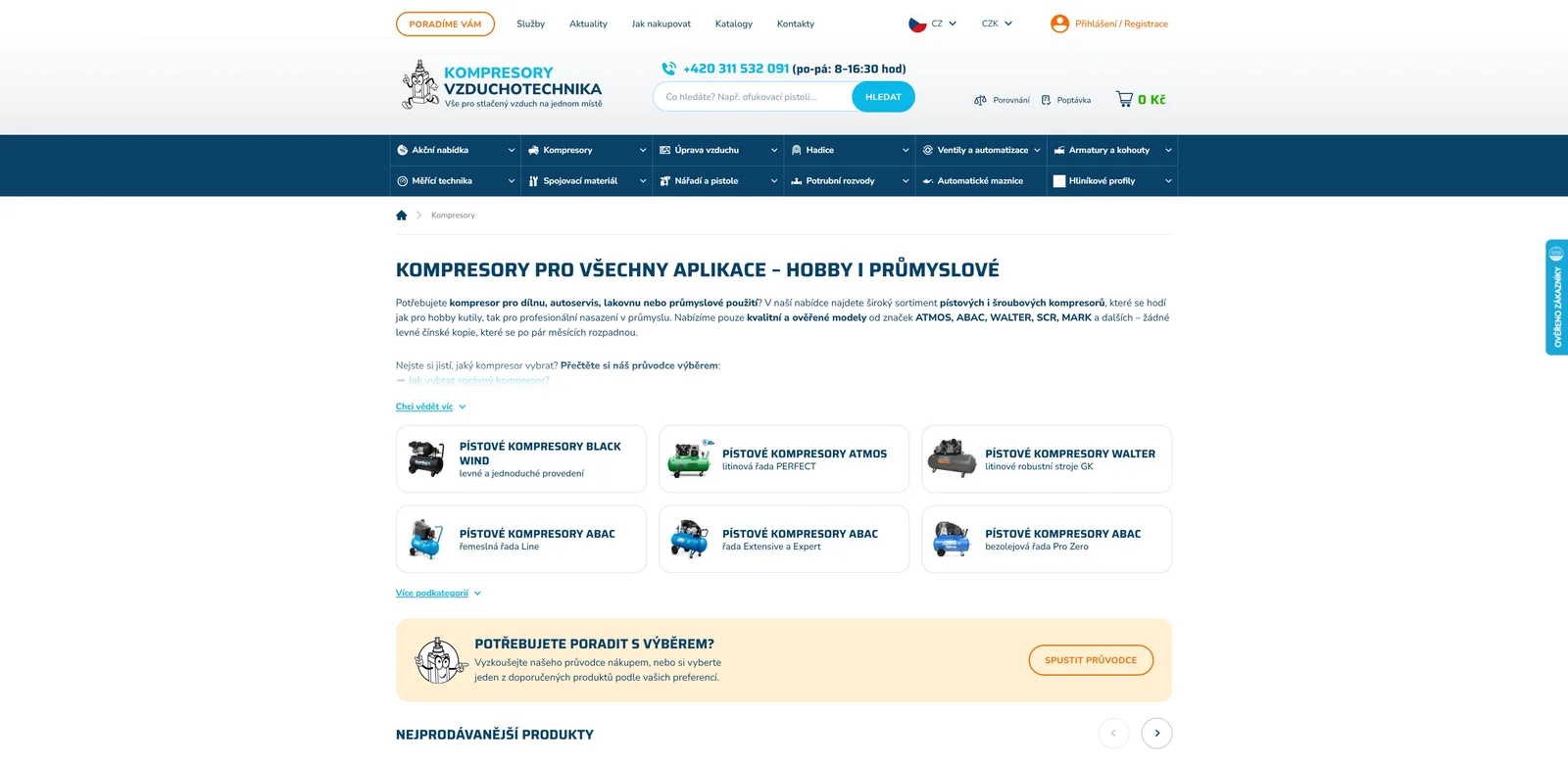
In the offer you will find piston and screw compressors in oil-lubricated and oil-free versions, complemented by filtration according to the ISO 8573 standard and dryers for the required air purity class. The consultation includes measuring the actual consumption, designing a suitable technology and capacity reserve, preparing an offer, and subsequently installation and service support. If you are also dealing with related pneumatic equipment, a range of pneumatic tools is also available. Get in touch with the figures measured from the checklist above and have a specific assembly design tailored to your operation prepared for you.
Recommended resources for further study
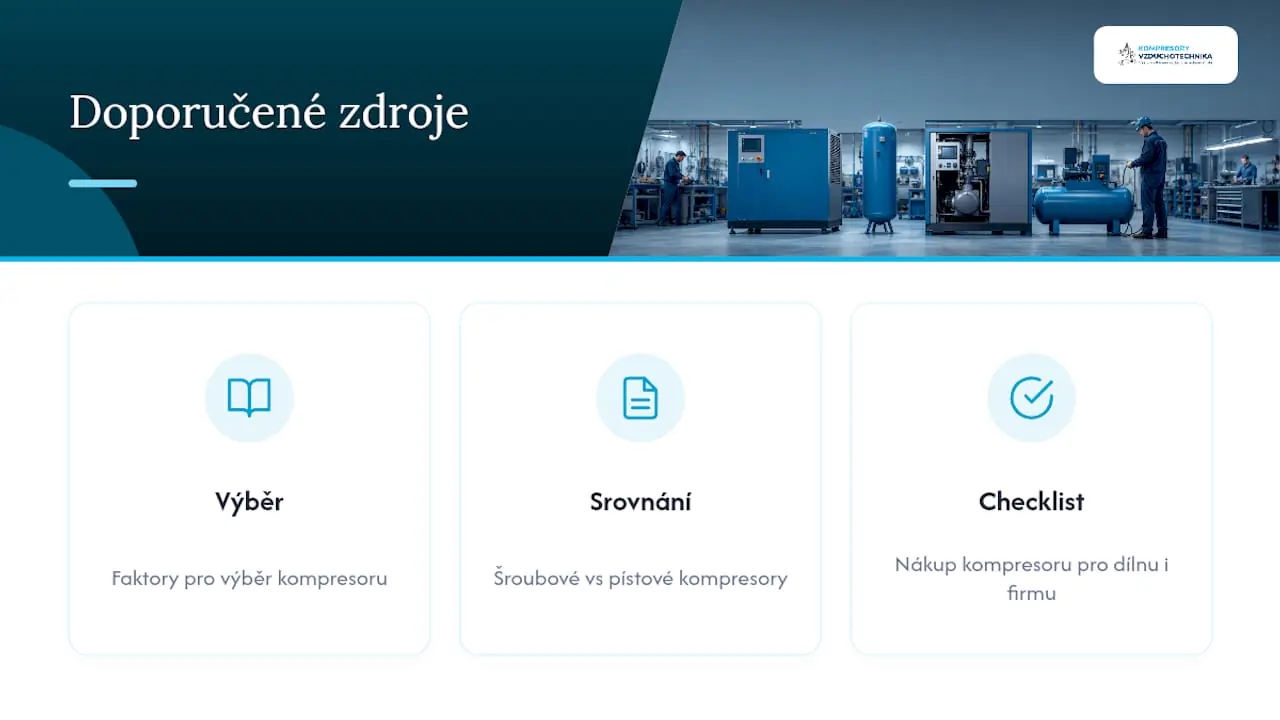
You can find deeper technical materials in the internal articles on factors for selecting a compressor, comparison of screw and piston compressors, and the checklist on buying a compressor for a workshop or company.
Frequently asked questions
Which compressor should I choose for my company?
For continuous industrial operation, choose a rotary screw compressor; for intermittent or occasional operation, a cheaper piston compressor is sufficient. The decisive factors are the actual consumption in m³/min, the required pressure, and the nature of the load.
What is the intake capacity of a compressor and how do I determine it?
Intake capacity indicates the amount of air a compressor delivers per minute at a given pressure, usually in m³/min. You determine it by adding up the consumption of all tools running simultaneously and adding a reserve of 20 to 25 %.
Which is better, an oil-lubricated or oil-free compressor?
An oil-lubricated compressor is cheaper to operate and suitable for common workshop and industrial use. An oil-free compressor is necessary where air comes into contact with the product, for example in the food or pharmaceutical industry.
What compressor is suitable for a home workshop or small operation?
For smaller intermittent operation, a smaller piston compressor with sufficient reserve relative to the rated consumption of the tools is sufficient. For more regular all-day use, it is worth considering even a smaller screw unit.
When is investing in VSD speed control worthwhile?
VSD pays off especially in operations with fluctuating air consumption, for example with multiple shifts or variable tool workload. In stable, fully loaded continuous operation, the payback is slower and fixed speed is sufficient.