
Pneumatic systems are still an indispensable technology in industry and construction. Compressed air drives mechanical movements thanks to the compressibility of the gas, which at the same time damps impacts and protects the equipment from damage. Pneumatics today is among the most reliable technologies for production lines, building sites and vertical handling. In this article we analyse how the systems work, where they really excel and how to compare them correctly with hydraulics.
Key findings
| Point | Details |
|---|---|
| Speed and simplicity | Pneumatics offers fast connection and easy control in many applications. |
| Safety of operation | Compressed air eliminates leaks of liquids and the risks of explosion. |
| Easy maintenance | Correct air treatment and regular servicing significantly extend the life of the system. |
| Comparison with hydraulics | Pneumatics dominates in speed, but hydraulics leads for high forces and precision. |
The basic principle: how pneumatics works and why
A pneumatic system works in a straightforward way: the compressor compresses the air, it is distributed through the pipework and at the point of consumption presses on a piston or rotor. The result is a linear or rotary movement with immediate response. It is precisely this simplicity that makes pneumatics a popular choice where speed and reliability matter.
The compressibility of air is a practical advantage. If a tool meets unexpected resistance, the air is compressed and absorbs the energy of the impact. Hydraulic fluid cannot do that, which is why hydraulic systems require more complicated safety elements.
Typical components of every pneumatic system:
- A compressor – the heart of the whole system.
- Pipework and hoses – transfer of the medium to the point of consumption.
- Pneumatic cylinders – conversion of pressure into linear movement.
- Rotary drives – conversion of pressure into rotary movement.
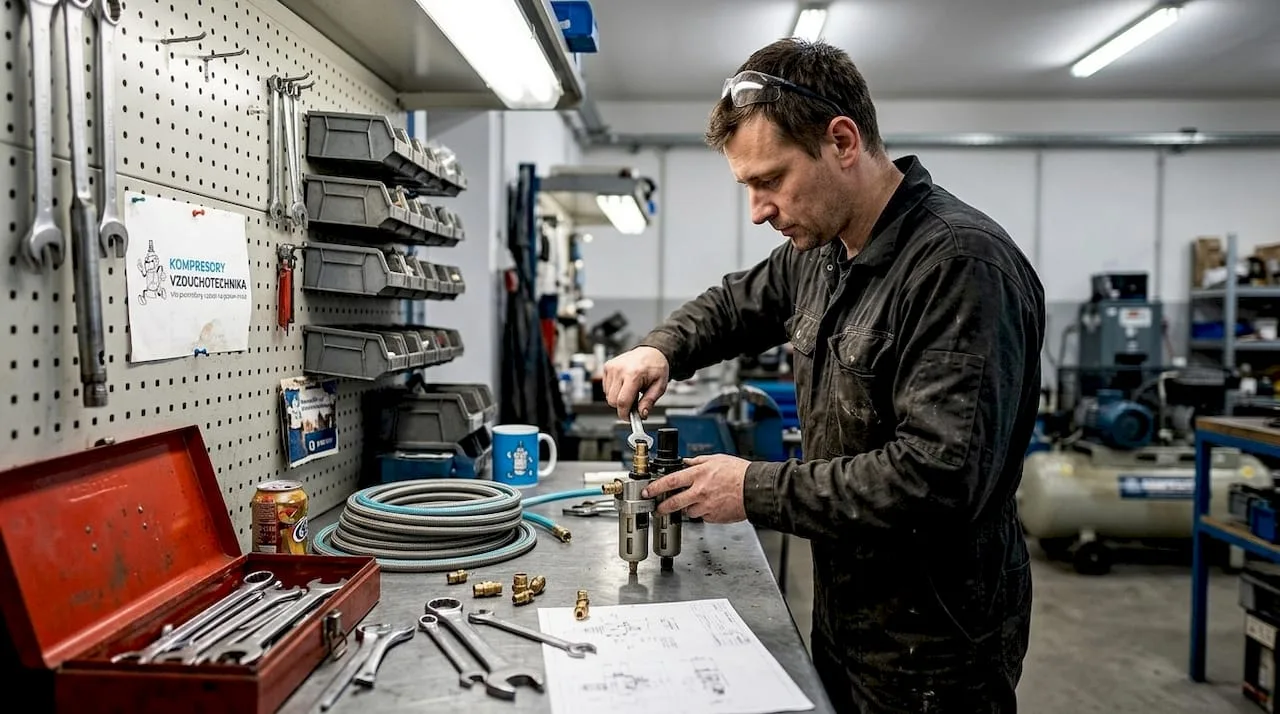
- Filters and regulators – treatment of the air before it enters the tools.
- Valves – control of the direction and the flow of the air.
The main reasons for using pneumatic systems
Speed and simplicity come first. Pneumatic tools react immediately and do not require warming up. On a production line that means shorter cycles and higher productivity. The consistent quality of the joints is the reason why pneumatic systems dominate in serial production.
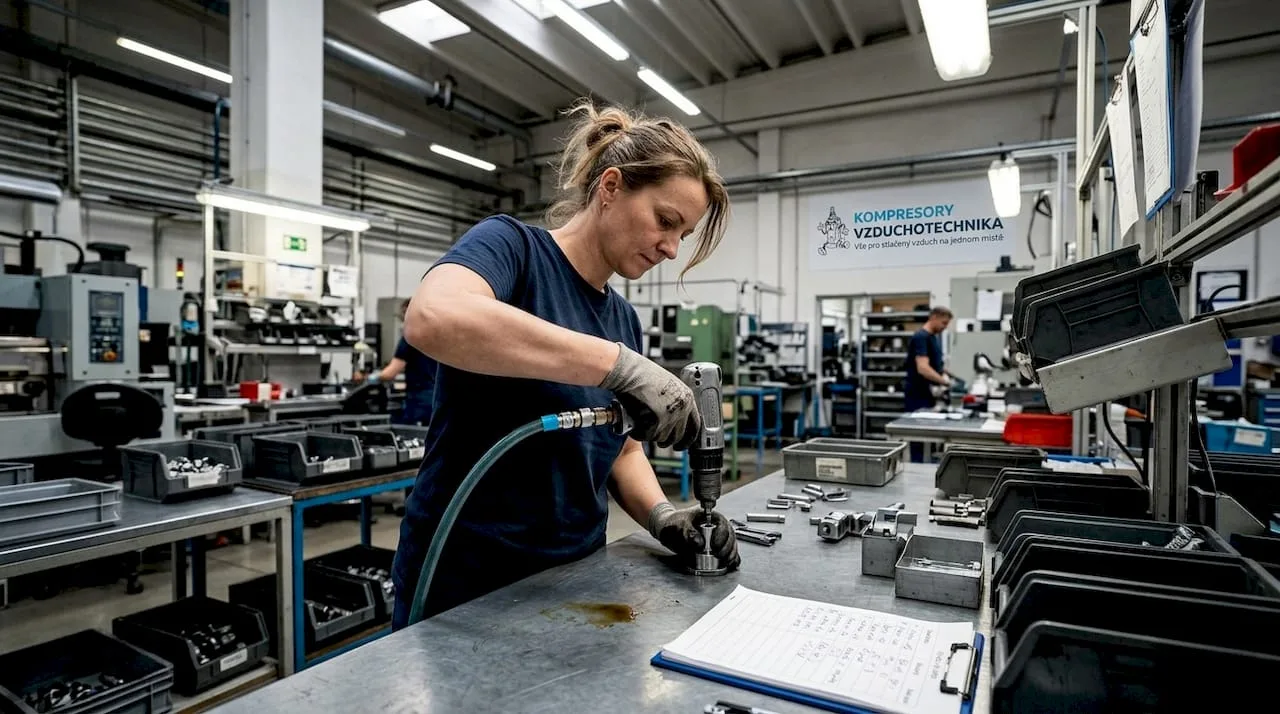
Service life and minimal downtime are another strong argument. Pneumatic tools have fewer moving parts than electrical equivalents, which means fewer faults. Safety is then the area where pneumatics clearly leads – no oil leaks and no risk of an electrical short circuit.
Specific benefits:
- Lower purchase costs of tools compared with hydraulics.
- Easy operation without the need for extremely specialised training.
- Ergonomic tools with a lower weight.
- Resistance to dust, moisture and mechanical impacts.
Professional tip: The most frequently underestimated factor of performance is not pressure, but the quality of the air. Moisture and impurities in the distribution system cause most premature faults. The investment in filtration comes back quickly.
When and why to choose pneumatics for vertical applications
Vertical handling and the lifting of loads place specific demands on the systems. Pneumatic lifts offer fast lifting and high efficiency in repeated work. In car services and production halls alike they handle hundreds of lifts a day without a drop in performance.
Decision criteria:
- Frequency of use – with a high number of lifts per shift pneumatics is more economical.
- Speed – pneumatics lifts faster than hydraulics at a comparable load.
- Safety – in areas with flammable substances pneumatics is the safe choice.
Pneumatics vs. hydraulics: an objective comparison
| Parameter | Pneumatics | Hydraulics |
|---|---|---|
| Speed of movement | Very high | Medium |
| Maximum force | Medium | Extremely high |
| Cleanliness of operation | Excellent (without liquids) | Risk of oil leakage |
| Precision of position | Medium | High |
| Maintenance | Low demands | Medium to high |
The key roles of air technology and air treatment
The best pneumatic tool will fail if it receives poor-quality air. Filtration and drying decide the reliability of the system. The three main factors are the filtration of solid particles (protection of the seals), the drying of the air (prevention of corrosion) and the removal of oil (key for painting or the food industry).
The most frequent mistakes in operation:
- Neglecting the draining of condensate from the vessel.
- Use of an unsuitable filtration class for the given application.
- Over-pressurising the system above the recommended values.
- Use of hoses with too small a diameter.
Top-class products for pneumatics
At Kompresory-vzduchotechnika.cz you will find complete solutions for every phase of your pneumatic system.
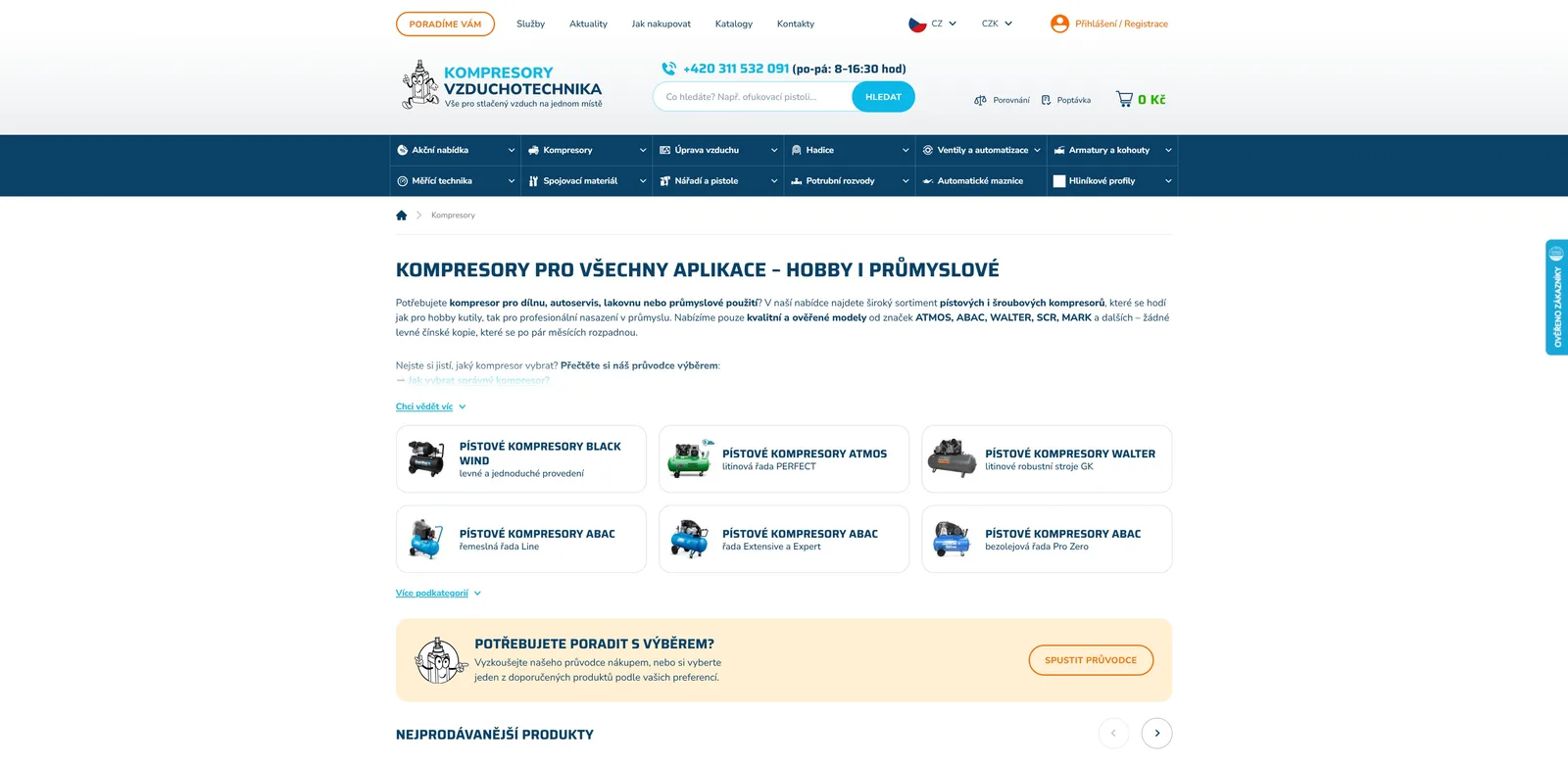
Our offer covers everything from basic components to specialised applications. We have a wide range of pneumatic tools ready with immediate availability and solutions for the treatment of compressed air which will extend the life of the whole system. Technical advisers will help you choose the right combination for your specific operation.
Frequently asked questions
Why are pneumatic systems often preferred over hydraulic ones?
They provide higher speed and safety in environments where extreme force is not a priority, and they eliminate the risk of leakage of dangerous liquids.
What are the most frequent mistakes in operation?
Underestimating the filtration and drying of the air. That leads to faults of the seals, corrosion of internal components and, in winter, to freezing of the pipework.
In what way does pneumatics increase safety?
Thanks to the absence of flammable liquids and the ability to damp impacts with compressed air, it is ideal for environments with a risk of explosion or fire.
What role does air technology play in service life?
An absolutely fundamental one. Condensate and impurities in untreated air cause most premature faults of pneumatic components.