
Did you know that up to 30 % of industrial plants still cannot fully use the potential of pneumatic automation because of a lack of knowledge of its principles? Yet a correctly designed pneumatic system can increase operating efficiency by tens of percent and significantly reduce maintenance costs. In this guide you will learn how pneumatics works in automated systems, which components are key for reliable operation and how modern simulation methods help optimise performance. You will learn practical procedures for implementing pneumatic solutions which will improve the productivity of your plant.
Key findings
| Point | Details |
|---|---|
| The principle of pneumatics | It uses compressed air to convert energy into mechanical work with high reliability. |
| Key components | A compressor, an air treatment unit, directional valves and pneumatic cylinders. |
| Main advantages | High safety (no sparks), a clean medium and low maintenance demands. |
| Simulation and control | Modern digital twin models make it possible to optimise the performance and dynamics of the system in advance. |
What is pneumatic automation and how does it work
Pneumatic automation is a technology using compressed air to control movements and processes. Unlike hydraulics it works with a clean medium, which makes it ideal for the food industry or pharmaceuticals. The basic principle consists in converting the energy of compressed air into mechanical work. The compressor compresses the air to 6 to 10 bar, which is subsequently distributed to the actuators. The response speed of these systems reaches milliseconds.
The main components of a pneumatic circuit:
- The compressor generates compressed air and maintains the pressure in the reservoir.
- The air treatment unit removes moisture, impurities and regulates the pressure.
- Directional valves control the direction and speed of the flow of air to the cylinders.
- Pneumatic cylinders or motors carry out the mechanical work.
Key components and their role in automation
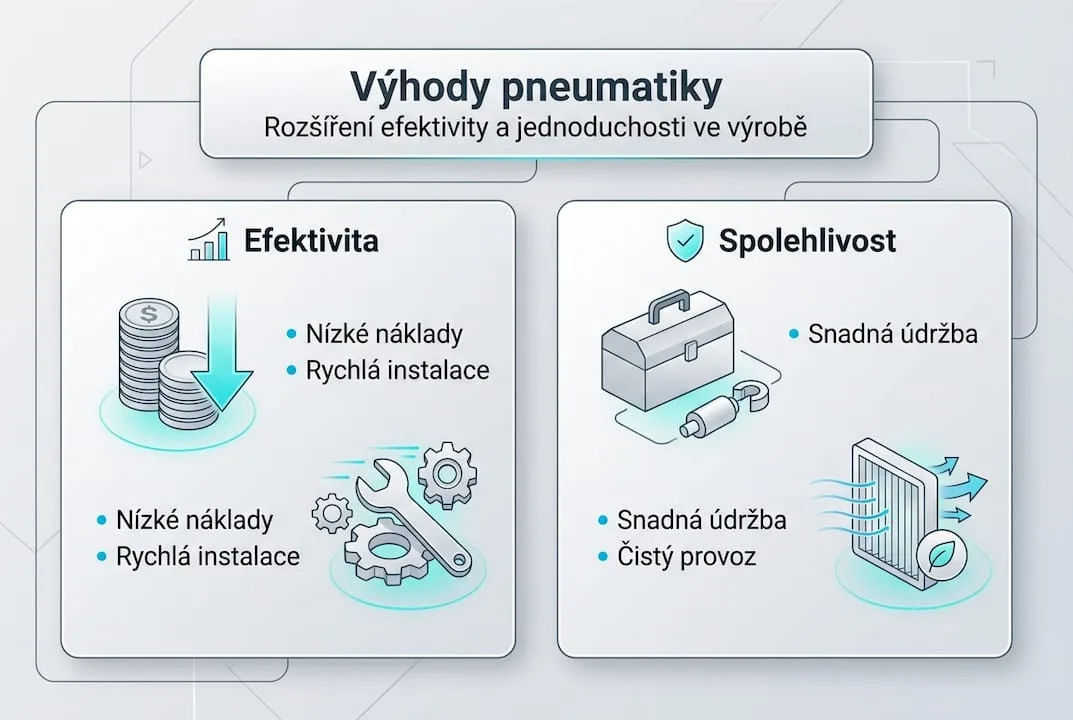
The valves represent the brain of the system. Directional valves control the direction of the air and determine the activation of the actuators. They must be dimensioned precisely according to the flow; underestimating slows down the cycles. Pneumatic cylinders then convert the energy of the air into movement. Double-acting cylinders allow precise control in both directions, while single-acting ones use a spring for the return.
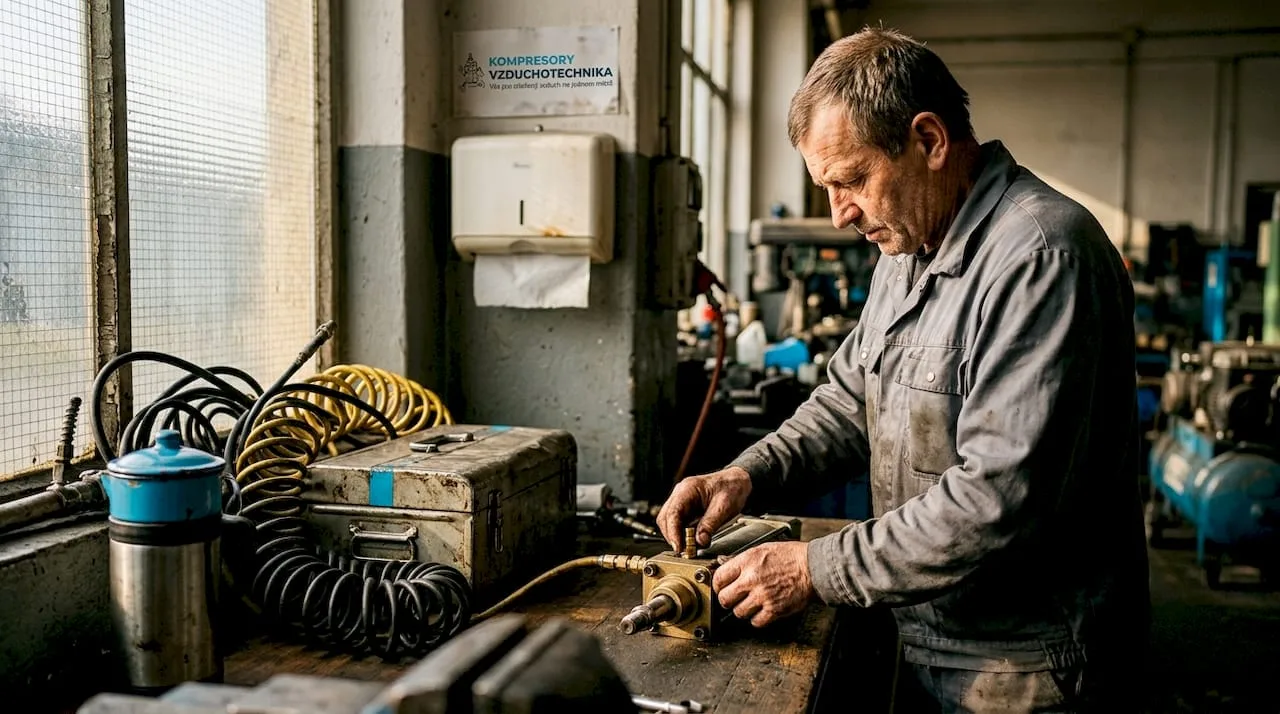
Filtration and treatment are critical. Atmospheric air contains dust and moisture which destroy the seals. A quality treatment unit filters particles, regulates the pressure and lubricates if necessary. The investment in clean air extends the life of the valves by up to 40 %.
Professional tip: The investment in quality air treatment comes back during the first year. Clean and dry air dramatically reduces the occurrence of faults. Install filters with automatic condensate drainage.
Advanced methods of simulation and control of dynamics
Digital twin technology creates a virtual replica of the equipment. It makes it possible to simulate the behaviour of the system including the delay caused by the compressibility of the air and friction in the seals. These advanced models take into account the time constants of the valves and the pressure losses in the pipework. The simulation can predict the behaviour of the system with an accuracy better than 5 %, which significantly saves the costs of prototypes and shortens the development time by up to half.
Practical applications for increasing efficiency
Introducing automation requires a systematic approach. From the analysis of manual operations to the installation of a pilot workplace. Automotive plants use pneumatic wrenches for a precise torque, the food industry in turn cylinders for hygienic dosing.
| Criterion | Traditional manual operation | Pneumatic automation |
|---|---|---|
| Cycle speed | 15-20 seconds | 3-5 seconds |
| Consistency of quality | Dependent on the operator | Constant (±0,1 mm) |
| Fatigue of the worker | High | Eliminated |
| Return on investment | N/A | 1-2 years |
Professional tip: You will achieve the greatest savings by eliminating air leaks and by sequential control of the compressors. Intelligent management of consumption can reduce energy costs by 20 to 35 %.
Equip your plant with efficient solutions
The right choice of components is the basis of success. Kompresory-vzduchotechnika.cz offers solutions from powerful screw compressors to precise valves and cylinders for professional deployment.
Our SCR screw compressors ensure a stable supply of air with minimal energy consumption. The specialists will help you configure a system which minimises downtime and moves your production to a higher level of efficiency.
Frequently asked questions
What is the difference between pneumatic and hydraulic automation?
Pneumatics uses air, it is cleaner, faster and safer in an environment with a risk of explosion. Hydraulics uses oil, it is suitable for extreme forces but more demanding as regards maintenance and tightness.
How often is maintenance necessary?
A visual check daily, draining of the condensate weekly and a check of the filters and the tightness of the joints monthly. Preventive maintenance is always cheaper than dealing with a breakdown.
How much energy does pneumatics consume?
The efficiency is lower (10-20 %) than that of electric drives, but pneumatics wins by speed and simplicity. By optimisation and the repair of leaks the costs can be reduced by tens of percent.
Can the systems be used at extreme temperatures?
Yes, commonly from -40 °C to +80 °C. It does, however, require the right sealing materials and dry air so that the condensate does not freeze in frost.
What is the typical return?
Mostly 12 to 24 months. With highly repetitive operations with a large volume of production the return can even be under one year.