
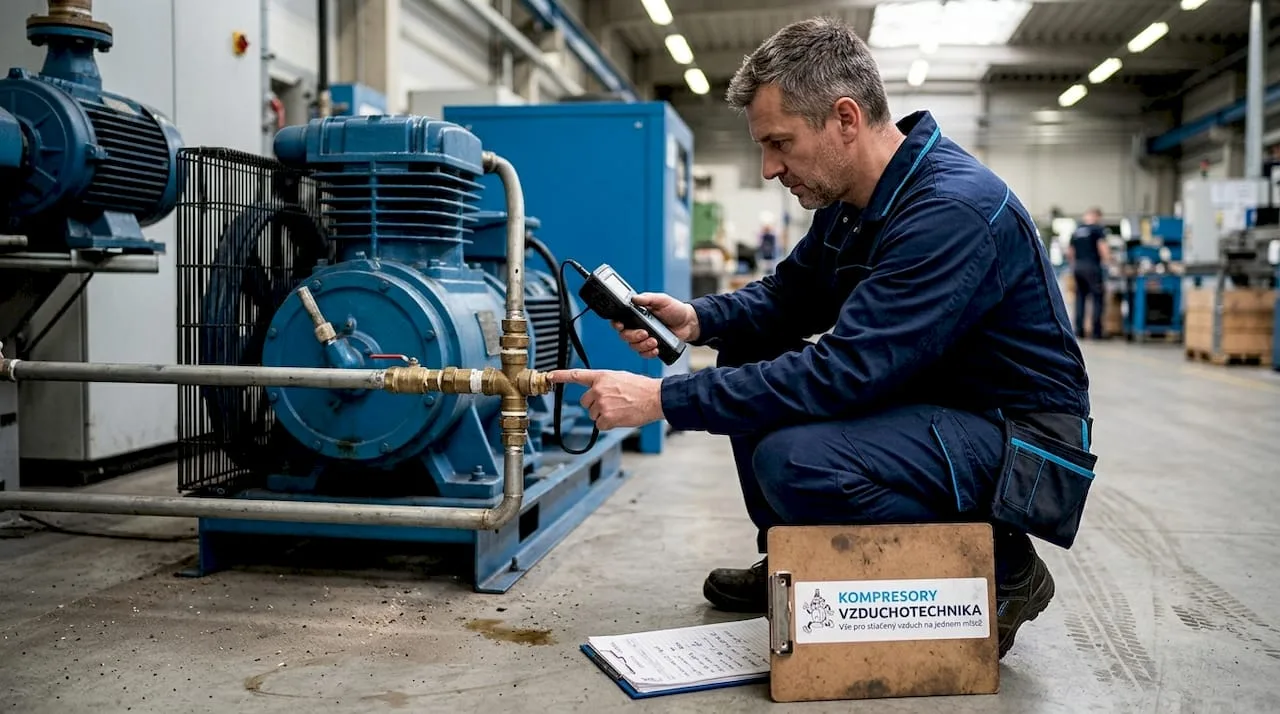
Air leaks in pneumatic systems represent one of the most significant hidden costs of industrial plants. A single quarter-inch hole can cause losses exceeding thousands of crowns a year, while the total leaks often reach 20 to 30 percent of all the consumption of compressed air, and in neglected plants significantly more. This practical guide provides a systematic procedure for identifying, eliminating and preventing air leaks, which leads to demonstrable energy savings of up to 42 percent.
Key findings
| Point | Details |
|---|---|
| The share of leaks in consumption | Air leaks form 20 to 30 percent of the total consumption of compressed air, in neglected distribution systems up to 50 percent. |
| A non-linear impact | A 10 % air leak increases the power input by up to 30 percent, not by 10 percent. |
| Ultrasonic detectors | They reveal even inaudible leaks in a noisy plant without the need for a shutdown. |
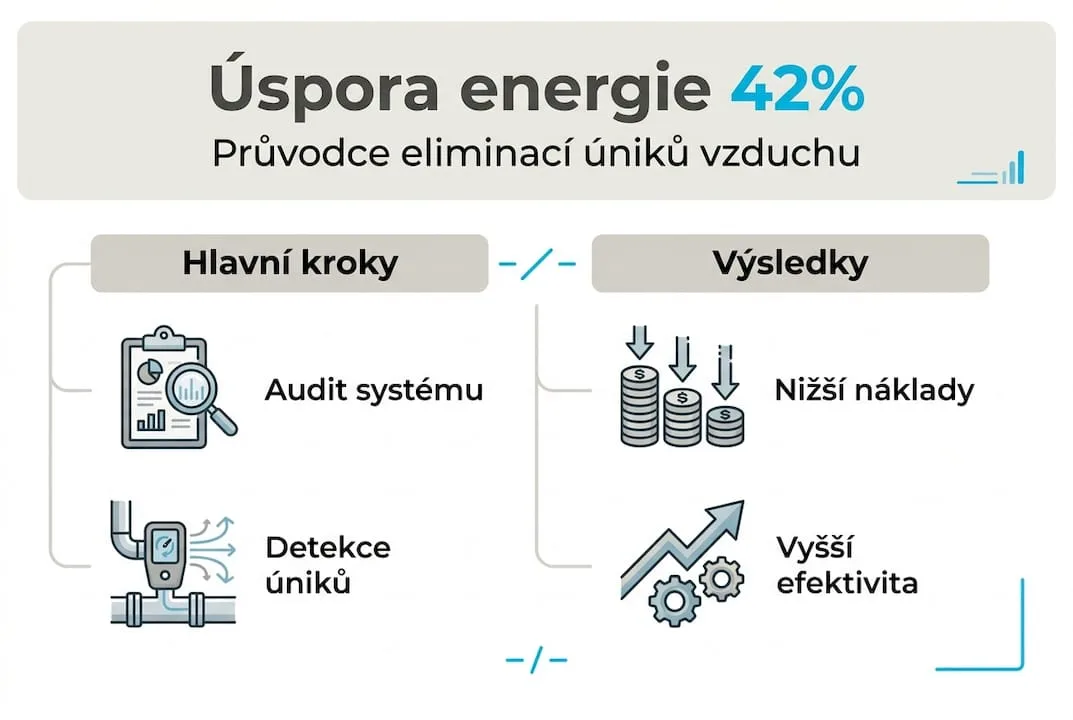
| Audit and energy saving | Regular audits of the network lead to energy savings of up to 42 percent. |
| A fast return | The investment in detection and repairs comes back within 6 to 24 months. |
Understanding the problem: financial impacts and frequent leak sites
Compressed air leaks significantly influence the economics of a plant. They mean a 20 to 30 percent loss of air, in old and neglected distribution systems commonly even 50 percent. These losses cause not only needless expenses for electricity, but also excessive wear of the compressors, which have to run longer to compensate for the lost volume. A system which loses 30 percent of the compressed air requires a compressor a third more powerful than would be necessary.
The relationship between leakage and consumption is not linear. With a 10 % air leak a fan or compressor increases its power input by roughly 30 percent. A small increase in leakage therefore has a disproportionately large impact on the consumption of electricity and the wear of the equipment.
In practice people speak of the so-called „Dirty Thirty“: the last approximately 9 metres of pipework before the consumer is statistically the riskiest section. It is precisely here that flexible hoses, quick couplings and provisional branches accumulate, which tend to be the source of the largest share of leaks.
The most frequent sites of air leaks and their approximate share:
| Source of the leak | Share of the losses | Typical cause |
|---|---|---|
| Joints and threads | 30 % | Insufficient sealing, vibrations |
| Hoses and supply lines | 25 % | Mechanical damage, age |
| Valves and regulators | 20 % | Wear of the inner seal |
| Quick couplings | 15 % | Wear of the cartridge, frequent connecting |
| Others (drains etc.) | 10 % | Blockage by impurities |
Regular monitoring of pressure enables the timely detection of newly arisen leaks, especially during night hours, when the draw of the machines is minimal.
Preparation for eliminating a leak: equipment and detection methods
Effective elimination begins with the right choice of detection methods. While listening for hissing or soapy water work in a quiet environment, in industry these methods are ineffective. Advanced detection methods use technologies for precise localisation even in full operation.
| Detection method | Accuracy | Works in noise | Shutdown | Suitability |
|---|---|---|---|---|
| Listening for hissing | Low | No | No | Quiet and small workshops |
| Soapy water | Very high (locally) | Yes | Yes | Verification of a specific joint |
| Ultrasonic detector | High | Yes | No | Industrial plants of all sizes |
| Acoustic camera | Very high | Yes | No | Large halls, a fast audit |
| Measurement of the pressure drop | Medium | Yes | Yes | Quantification of the extent of the leak |
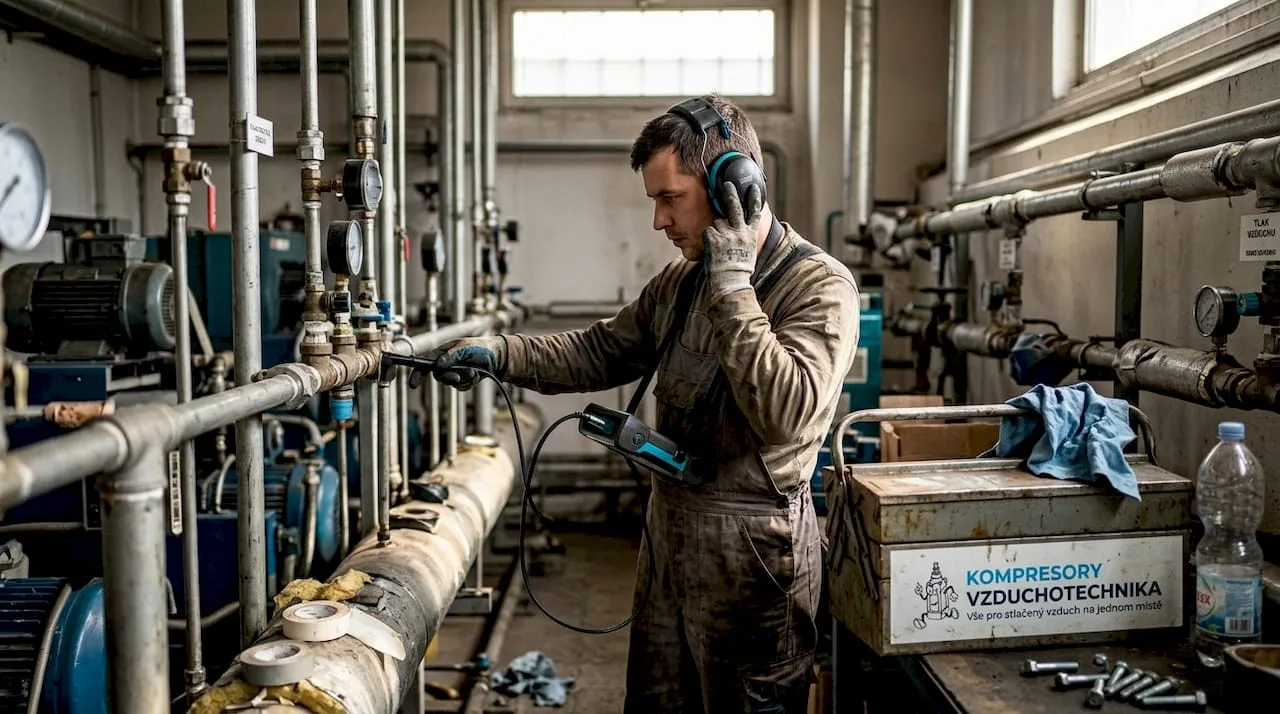
An ultrasonic detector works on the principle of capturing the high-frequency sound of escaping air (typically around 40 kHz). The detector converts these frequencies into the audible band, so the technician hears them in headphones even in a noisy hall. Systematically go through all joints and connections at a distance of 5 to 10 cm from the surface; an increased value on the display or a change of tone indicates a leak.
You prepare the soap solution by mixing an ordinary washing-up liquid with water in a ratio of roughly 1:10. Apply it with a brush or a sprayer to suspicious places; the formation of bubbles reveals even small leaks and serves for the precise confirmation of a joint found by ultrasound.
Professional tip: When choosing an ultrasonic detector give preference to models with a setting of sensitivity and a frequency filter. Without a filter, in a noisy hall the signal from the compressor often drowns out the actual leak. A leak you can hear with the naked ear is already so big that it costs tens of thousands of crowns a year — the aim of ultrasound is to find those that nobody hears.
How to carry out the elimination of a leak: step by step
The systematic elimination of air leaks requires a structured procedure from preparation through repair to prevention. Before dismantling any part always first switch off the compressor, disconnect it from the supply and depressurise the system completely by opening the drain valve.
- Preparatory phase: Work out an audit plan according to the diagram of the distribution and mark the individual sections. Ideally carry out the detection outside the main production, so that the background noise is minimal. Before detection let the compressor run for at least 10 minutes so that it reaches operating temperature — a warm system reveals leaks better.
- Detection phase: Systematically go through the network from the compressor to the consumers. Mark every leak with a label or coloured tape with a number and record it for repair.
- Quantification phase: Close the system, pressurise to operating pressure and measure the time of the pressure drop by 0,5 bar. A drop greater than approximately 0,14 bar (2 psi) per minute signals a significant leak. From these data you estimate the escaping volume in litres per minute and prioritise the repairs by size.
- Repair phase: Clean the area around the leak of grease and corrosion. On threads wind 3 to 4 layers of PTFE tape in the direction of tightening or apply a liquid thread sealant resistant to a pressure of up to 20 bar and tighten with the prescribed torque. On quick couplings replace the seal, replace damaged hoses with new ones with the same diameter and pressure range. Use seals and sealants certified for compressed air and the corresponding operating temperatures.
- Verification phase: After the repair pressurise the system again and check the repaired place with ultrasound and with soap solution. The absence of bubbles for 2 minutes confirms a successful repair. Only after confirming tightness move on to the next leak. Repair without a confirming measurement is one of the most frequent mistakes.
- Preventive phase: Introduce regular check cycles and documentation of the findings for comparison over time.
Verification of success and long-term maintenance
Successful elimination requires verification of the results. The methods include a comparison of the energy consumption of the compressor before and after the repairs and the measurement of air consumption during night operation, when the draw of the machines is minimal. Long-term maintenance should include the installation of flow meters at key points of the system, which signal anomalies in time.
The most frequent mistake of plants is not a missing instrument, but the absence of regularity. Leaks arise continuously from vibrations, temperature cycles and ordinary wear. Recommended intervals of preventive maintenance:
| Operation | Interval | Benefit |
|---|---|---|
| Visual check of hoses and joints | Monthly | Timely detection of damage |
| Check of the safety valves | Monthly | Prevention of leaks and corrosion |
| Test of the pressure drop | Monthly to quarterly | Quantification of leaks |
| Ultrasonic detection of the whole system | Quarterly (large plants) to half-yearly | A comprehensive overview of the condition |
| Replacement of seals | According to wear, roughly 12 months | Prevention of sudden leaks |
| Replacement of hoses | According to wear, roughly 24 months | Prevention of cracks |
It is ideal to include the ultrasonic check in the same schedule as the planned maintenance and diagnostics of the compressor, not as an isolated action. Automation of the FLOWBOX type can moreover minimise night leaks by automatically disconnecting unused sections during shutdowns.
Optimise your system with Kompresory Vzduchotechnika
Eliminating leaks is only one step. Kompresory Vzduchotechnika offers comprehensive solutions including modern compressors, quality accessories and detection equipment.
Our SCR screw compressors offer excellent energy efficiency and quiet operation. For tight distribution and easy repairs we offer pipe distribution of the push-fit system, air treatment units for removing moisture and impurities and pneumatic tools including spare quick couplings and hoses. Certified technicians will identify the potential for savings in your system and ensure regular service inspections.