


Yes, a service contract for a compressor usually increases equipment availability, reduces unexpected downtime and stabilises operating costs. The company pays a predefined amount and receives regular inspections, spare parts and emergency assistance without having to deal with each intervention separately. A side effect is usually lower energy consumption and longer equipment service life. For key machines, it is worth having an offer and an energy audit prepared by a specialist.
In brief:
- A service contract for a compressor increases equipment availability and enables regular checks that prevent faults and shorten unplanned downtime.
- In addition to the basic inspection package, it may offer full service, which includes preventive replacements and energy optimisation, often a condition for the manufacturer's warranty.
- The greatest savings and lower risk of failure lie in regular leak checks, monitoring of operating parameters and early detection of leaks, which reduces both energy and repair costs.
- When choosing, emphasis should be placed on the guarantee of immediate intervention, availability of spare parts and clearly defined conditions in the offer, not just on the price.
- In operations where the compressor drives a production line, full service is often more economically advantageous than basic checks, as it minimises the risk of costly unplanned downtime.
Contents
- What a compressor service contract includes in practice and what benefits it brings
- Main benefits of a compressor service contract
- How a service contract reduces operational risks and costs
- How to choose a compressor service contract and what to ask the supplier
- Maintenance intervals that a service contract should cover
- Why we recommend service contracts in practice
- How Kompresory-vzduchotechnika.cz can help you with a service contract
- Useful resources and documents
- Frequently asked questions
What a compressor service contract includes in practice and what benefits it brings
A compressor service contract combines several types of activities into one package. Depending on the scope, it ranges from basic inspection up to what is known as full service, where the supplier takes over practically all responsibility for the operation of the equipment.
A standard contract includes:
- scheduled inspections at fixed intervals,
- preventive work (oil change, filters, leak-tightness check),
- spare parts included in the price or at a discounted rate,
- an assistance line for reporting faults outside normal working hours,
- the option to borrow a replacement unit during a longer shutdown,
- recommendations for energy-related system upgrades.
The difference between the individual levels is fundamental. Inspection means only a condition check without intervention. Maintenance already covers the replacement of consumables. Full service (for example, the model offered by KAESER) combines both with a guarantee of availability and often also energy optimization. A contract is moreover often a condition for maintaining the manufacturer's warranty, since it is often tied to the use of original parts and compliance with the prescribed intervals.
Main benefits of a compressor service contract
The biggest benefit of a service contract is measurable directly in operational figures. It's not about abstract "peace of mind," but about concrete savings and a lower risk of production downtime.
Professional tip: Before signing the contract, calculate how much your last unplanned compressor shutdown cost you. This figure is the best argument for negotiating terms with the supplier.
The main benefits of a service contract include:
- higher equipment availability — regular inspections detect wear before it causes a failure,
- lower energy consumption — clean filters and eliminated leaks reduce energy losses, which are one of the most common sources of waste in compressed air systems,
- longer compressor lifespan — adherence to maintenance intervals protects the compression block and motor,
- higher residual value — equipment with documented service history sells better and is assessed more favourably when buying it back,
- reduced risk of insurance or safety complications — compliance with standards and regular inspections limit operational risks.
Leak detection is one of the measures that pays for itself quickly. A leak in the air distribution system works like a tap that's left running all year round, and a service technician will find it during a routine inspection sooner than operating staff would. The combination of lower energy consumption and less costly repairs then translates directly into the cost per unit of compressed air produced, an indicator that makes sense to track even for small operations.
How a service contract reduces operating risks and costs
The benefit of a service contract isn't just based on paper promises. It involves specific mechanisms that a service technician carries out repeatedly and systematically.
- Planned oil and filter changes according to prescribed intervals, usually around 500 operating hours for oil.
- Checking the tightness of distribution lines and fittings, where the greatest energy losses occur.
- Monitoring operating parameters — pressure, temperature and humidity, which signal an approaching problem before a failure occurs.
- Remote diagnostics, thanks to which the service partner reacts to a deviation in the data before it's noticed by on-site staff. The topic is covered in more detail in compressor diagnostics for efficient operation.
- Fast availability of parts from stock and the possible loan of a replacement unit if the repair takes longer.
Return on investment in the contract is calculated simply: you compare the estimated cost per hour of downtime (lost production, overtime, penalties for late delivery) with the annual price of the contract. In an operation where the compressor powers the entire production line, the contract often pays for itself after avoiding just one serious failure. You can find the calculation of compressor operating costs broken down in the 7-day audit of compressor operating costs.
How to choose a compressor service contract and what to ask the supplier
When comparing offers, don't just look at the price per inspection. The difference between a cheap and an expensive contract usually lies in what is "below the line" and what only becomes apparent at the first failure.
Key criteria for selection:
- guaranteed response time (SLA) expressed in hours, not just "as soon as possible,"
- coverage of wearing parts and clearly stated exceptions,
- supplier's spare parts stock and actual availability of the specific model,
- transparent price list without hidden surcharges for call-outs or work outside business hours,
- the option to borrow a replacement unit during a longer repair,
- references and experience with the given type and output of compressor.
Specific questions worth asking: What exactly does the contract cover and what is excluded from it? What is the guaranteed delivery time for spare parts if they are not in stock? Is it possible to schedule service interventions outside shifts so they don't disrupt production? And how are situations handled when a failure exceeds the agreed repair time? The answers to these questions often reveal more than the price itself in the offer.
Maintenance intervals that a service contract should cover
A quality contract mirrors the real needs of the machine, not a universal template. The following overview serves as a reference framework for comparing the offered scope of services.
| Interval | Typical task | Who usually performs it |
|---|---|---|
| Daily | Checking oil level, draining condensate | Operating personnel |
| Weekly | Checking and, if necessary, replacing air filters | Operating personnel |
| Monthly | Checking belts, tightness of joints and piping | Operating personnel / technician |
| Every 500 h or 3 months | Oil and oil filter change | Service technician |
| Annually | Complete service inspection, compression block check | Service technician |
Operating personnel typically carry out daily and weekly checks, while specialized tasks are the responsibility of a service technician. A good contract aligns these two levels so that downtime for annual servicing is scheduled outside peak production periods. Common mistakes in operating a compressor that disrupt this alignment are described in the article on the most common mistakes when using compressors.
Why we recommend service contracts in practice
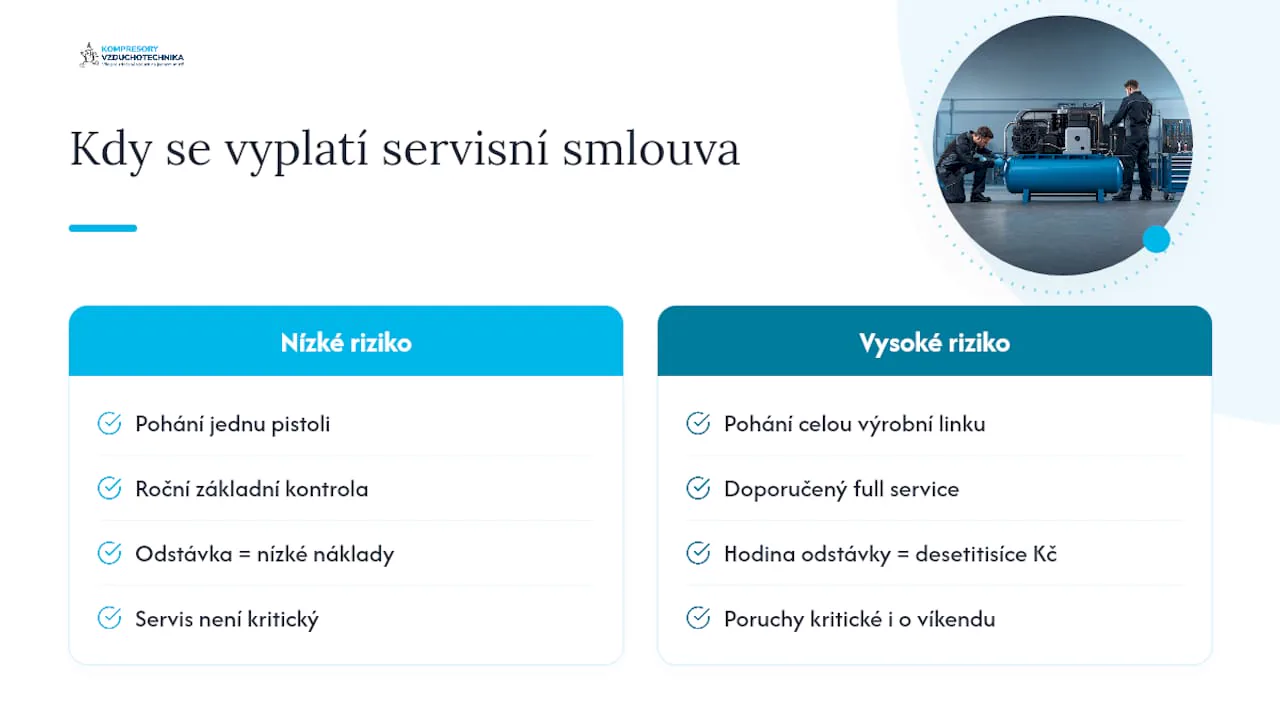
A service contract does not pay off equally for everyone. Where a compressor powers a single auxiliary pneumatic gun, a basic inspection once a year is sufficient. Where compressed air powers an entire production line and an hour of downtime costs tens of thousands of crowns, full service is the obvious choice regardless of the price difference compared to the basic package.
From real service interventions, we repeatedly see one pattern: companies that underestimated the contract end up dealing with failures at the worst possible moment, on a weekend or in the middle of an order with a deadline. Loaning a replacement unit and a parts stock for contract partners practically eliminate this scenario.
**
How Kompresory-vzduchotechnika.cz can help you with a service contract
There are specific alternatives to random interventions without a contract: technical support, a spare parts stock, energy audits, and installation of new units all under one roof.
If you operate a compressor that production depends on, it is worth having an energy audit carried out first and only then designing the scope of the service contract, not the other way around. The offer also typically includes an assessment of treated air quality, which follows on from the compressed air filtration program according to ISO 8573. Corporate customers can also take advantage of registration for special prices and faster processing of inquiries. For specific solutions, including compressed air treatment units up to 18 bar, request a quote via the product page with technical parameters and arrange a non-binding consultation.
Useful resources and materials
For a deeper understanding of the topic, we recommend materials from Atlas Copco on compressor energy efficiency, an overview of maintenance intervals from HQCompresor, and information on maintenance contracts from manufacturers ALMiG and KAESER, which describe the individual levels of service packages.

Frequently Asked Questions
What is the service life of a compressor?
The service life of a piston compressor typically ranges from ten to fifteen years of operation, while that of a screw compressor tends to be longer, provided the prescribed oil and filter change intervals are observed. Regular maintenance under a service contract is one of the strongest factors that extends this lifespan.
What is the service life of a screw compressor?
A screw compressor, when properly maintained, usually lasts longer than a piston compressor, as it has fewer mechanically worn parts in direct contact. Regular oil changes approximately every 500 operating hours and inspection of the compression block during the annual check-up are particularly decisive.
What kind of oil goes into a compressor?
Oil specified directly by the manufacturer for the given type of machine is used in a compressor, usually a synthetic or semi-synthetic oil with properties resistant to high temperatures and pressure. Using the wrong oil can jeopardize both the warranty and the function of the compression block, which is why a service contract with original parts eliminates this risk.
What is better, a compressor or a turbo?
A compressor and a turbocharger address different tasks and are not interchangeable alternatives: a stationary industrial compressor produces compressed air for pneumatic tools and manufacturing processes, while a turbocharger supplies pressurized air to a vehicle's combustion engine. The question of "which is better" therefore depends on the problem you're solving, not on a universal answer.
Is a service contract worthwhile even for a smaller workshop?
Yes, if a compressor failure stops even a single key operation, even a smaller workshop will save on predictable costs and faster parts availability. For operations with minimal load, a basic contract with an annual inspection may be sufficient instead of full service.