
Painting is one of the most demanding disciplines for air supply. A spray gun consumes a lot of air and runs for a long time without a break. In this subsection we will build on the main article How to choose a compressor and go through the selection of a machine specifically for paint shops and car body repair shops.
If you want to calculate the output directly, open the calculator on the Compressors page and enter your tools.
 13:22
Video: How to choose an air compressor step by step. The video starts right at the chapter Paint shop (9:21). Ventilek shows how to calculate air delivery, pressure and tank size, and goes through five workplaces. You can work it out straight away in the compressor selection calculator. The video is in Czech with English subtitles.
2:14 How much air and pressure your tools need 3:02 How to calculate air delivery and pressure 4:49 Air receiver and pressure switch 7:04 Car repair shop 8:02 Tyre shop 9:21 Paint shop 10:16 Joinery 11:17 Home workshop and garage
Why painting needs a lot of air
A spray gun takes approximately around 250 l/min at 4 bar pressure (the exact value is stated for the specific gun; the value from our calculator is indicative). Unlike pneumatic tools, which work in short bursts, a gun runs for a long time without a break during painting.
Therefore, the spray gun is included in the calculation as continuous operation, not occasional. This fundamentally changes the requirement for the compressor as well as for the size of the air receiver.
Calculation step by step
Let's take a typical setup: one spray gun in continuous operation (250 l/min) and occasional blowing (36 l/min). Together this gives 286 l/min.
- Consumption. 1 gun continuously 250 l/min + occasional blowing 36 l/min = 286 l/min.
- Reserve. With a reasonable 30% reserve, the required air delivery comes out to at least 380 l/min (the calculator rounds up to the nearest ten).
- Pressure. The gun itself works at 4 bar. The highest pressure in the setup is for blowing (6 bar), so with a 1.5 bar reserve that's 7.5 bar, meaning the machine should be rated for at least 8 bar (commonly 10 bar).
For such a setup, a 400 V piston compressor with a large tank is suitable. With a 270 l tank, the machine switches on about 5× per hour, which is a nicely calm operation. With 150 l, it switches on almost 10×, which is already a borderline value – the motor switches on frequently and heats up more.
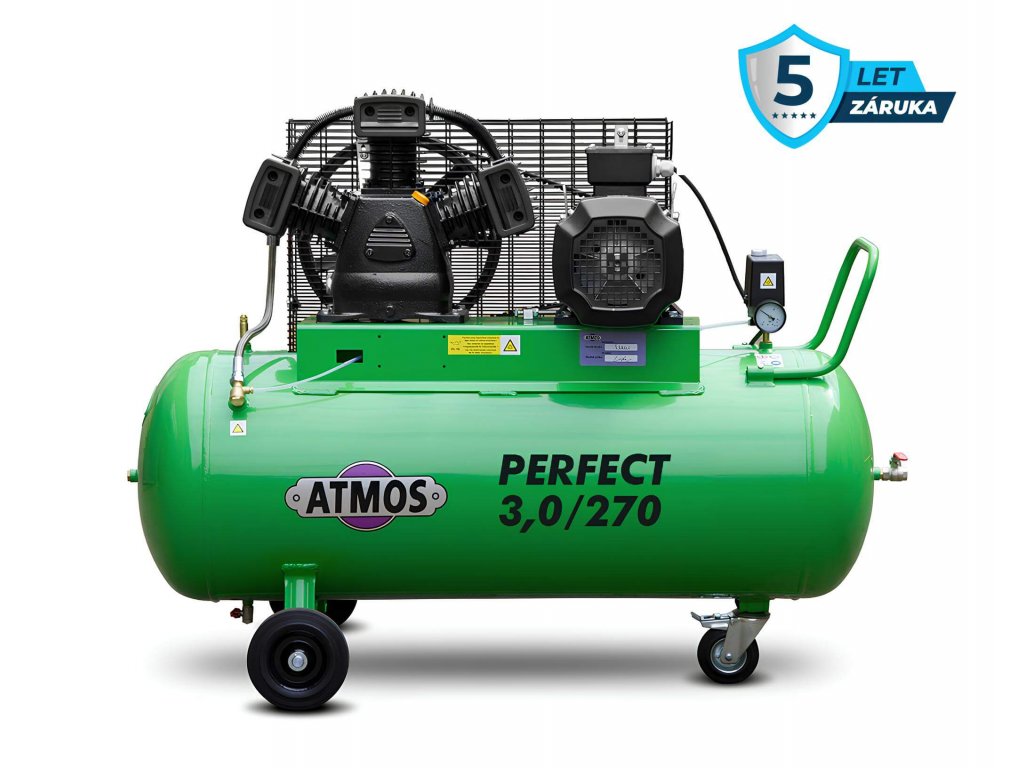
Specifically, the ATMOS Perfect 3/270 (408 l/min, 270 l tank, switches on about 5× per hour) works well. For comparison: the same machine with a 150 l tank (ATMOS Perfect 3/150) would switch on almost 10× per hour, so the calculator won't offer it for painting.
@produkty@(/pistovy-kompresor-perfect-3-270/)(/litinovy-pistovy-kompresor-gk630-40-270/)(/pistovy-kompresor-perfect-3-270s/)(/stacionarni-kompresor-b59b-4-270ft/)(/dvoustupnovy-kompresor-b59b-4-270ct/)(/sroubovy-kompresor-walter-sktg-5-5-500-sp-combo/)(/sroubovy-kompresor-walter-sftg-5-5-500-ksp-combo/)(slider)
Two guns at once
As soon as you plan to spray with two guns simultaneously, consumption jumps to around 700 l/min. That's already beyond the capabilities of a standard piston machine, and the solution is a screw compressor, which can handle long continuous operation at full output.
You can find details in the screw compressors section.
Air quality is just as important as output
For painting, it's not enough to have plenty of air – it must be clean. Oil, water, and dust in the air cause defects in the paint that are hard to repair. Air treatment is therefore a necessity for a paint shop, not an add-on.
- Filtration. A pre-filter captures coarse impurities and condensate, while a fine filter captures residual oil and fine dust.
- Air dryer. It removes moisture so that water doesn't condense in the hose and get into the paint.
- Pressure regulator. It keeps stable working pressure and spray quality at the gun.
You'll find all these components in the air treatment section. The calculator will alert you to the need for filtration and drying when selecting a spray gun.
Ventilek advises
Check the oil in the compressor regularly and change it according to the manual – for oil-lubricated machines, the oil determines both service life and how much oil passes into the air. You'll always find the correct oil for your compressor in the documentation of the specific machine; do not mix different types.
Spray gun
The result of painting depends on the gun. Choose based on air consumption and working pressure, which must match your compressor and air treatment.
@kategorie@(/strikaci-pistole--pro-lakovny-a-remeslniky/)(8)(slider)
Summary
- Treat the gun as continuous operation. Painting runs for a long time without breaks.
- Add a reserve. For 1 gun, the air delivery should be at least 380 l/min, the machine at least 8 bar.
- Large tank. With 270 l, the compressor switches on less often and runs more smoothly than with 150 l.
- Two guns = screw machine. At around 700 l/min, a piston machine is no longer sufficient.
- Clean air. Filtration, drying, and pressure regulation protect the paint from defects.
You'll get the most accurate result by calculating your own setup based on your tools.
Frequently asked questions
- What compressor do I need for painting?
- For one gun, a piston machine with 400 V, air delivery of at least 380 l/min, pressure of at least 8 bar, and a 270 l tank. For two guns, a screw compressor.
- Why is a spray gun considered continuous operation in painting?
- Because during spraying, the gun runs for a long time without a break, so the consumption is practically continuous, unlike impulse pneumatic tools.
- Why is air treatment important?
- Oil, water, and dust in the air cause defects in the paint. A pre-filter, fine filter, dryer, and pressure regulator at the gun prevent this.
- Is a 150 l tank enough?
- This is a borderline option – the compressor switches on almost 10 times per hour. With 270 l, it switches on about 5 times per hour and runs more smoothly.