
Choosing a compressor according to operation

Jaký kompresor zvolit podle toho, co v provozu poháníte: autodílna, pneuservis, lakování, truhlárna, domácí dílna a garáž. Obecný postup najdete v článku Jak vybrat kompresor, potřebný výkon si spočítáte v kalkulačce na stránce Kompresory.

List of articles

How to choose a compressor for a workshop and garage

This text is a practical supplement to the main guide How to choose a compressor. It focuses on a typical home workshop and garage – DIY work, blowing, inflating and routine car maintenance. If you want to skip the calculations, our power calculator will work out the required air delivery for you.
Open calculator

Ventilek: How to choose an air compressor – output, pressure and tank size step by step 13:22

Video: How to choose an air compressor step by step. The video starts right at the chapter Home workshop and garage (11:17). Ventilek shows how to calculate air delivery, pressure and tank size, and goes through five workplaces. You can work it out straight away in the compressor selection calculator. The video is in Czech with English subtitles.

2:14 How much air and pressure your tools need 3:02 How to calculate air delivery and pressure 4:49 Air receiver and pressure switch 7:04 Car repair shop 8:02 Tyre shop 9:21 Paint shop 10:16 Joinery 11:17 Home workshop and garage

What you power with air at home

Choosing a compressor starts with the tools, not the machine. Every pneumatic tool has its own air consumption in litres per minute and its own working pressure. Approximate values according to our calculator look like this:

ToolConsumptionPressure
Blow gun120 l/min–
Tyre inflation60 l/min–
Stapler40 l/min7 bar
Impact wrench 1/2"150 l/min–

Anyone who wants to get the tools themselves as well will find a wider selection in our offer.

@kategorie@(/pneumaticke-naradi/)(8)(slider)

Calculation step by step

The key point is that at home no tool runs continuously. You use each tool only for a short while – so let's assume roughly 30% of the time. We multiply the consumption of each tool by this ratio:

  • Blowing. 120 l/min × 30% = 36 l/min.
  • Inflating. 60 l/min × 30% = 18 l/min.
  • Stapler. 40 l/min × 30% = 12 l/min.
  • Impact wrench. 150 l/min × 30% = 45 l/min.

The sum gives 111 l/min. To this we add a 30% reserve, so as not to push the compressor to the limit of its capabilities – the air delivery should be at least 150 l/min (the calculator rounds up to the nearest ten).

111 l/minsum at 30% utilization
150 l/minrequired air delivery with reserve
8.5 barworking pressure + reserve

We calculate pressure in a similar way: the most demanding tool requires 7 bar, to which we add a 1.5 bar reserve for losses in the hose and switching – that is 8.5 bar. The machine should therefore be rated at least 9 bar; common piston machines have 10 bar.

Which machine to choose for a garage

For the described use, a piston compressor for a standard 230 V socket is ideal. You don't need to deal with a power supply line, and the machine will cover all DIY and maintenance work.

The volume of the air tank is important. We recommend a tank of at least 100 l. With a small tank, the compressor would switch on more than 10 times per hour at this consumption, wearing out unnecessarily and being noisy.

200 l tank

A piston machine for 230 V with an air delivery of 208 l/min and a 200 l air tank. It covers the described consumption with a reserve and switches on about 5 times per hour.

150 l tank, quiet

Air delivery of 310 l/min and a 150 l tank. Noise level of 72 dB makes it a choice that doesn't disturb much in a garage at home. However, at full load it switches on almost 10 times per hour, which is the upper limit.

Specific examples from our offer: Pro Line Extensive A29BT-2,2-200CM with an air delivery of 208 l/min and a 200 l tank, or ATMOS Perfect 2,2/150 EX with an air delivery of 310 l/min, 150 l tank and a noise level of 72 dB.

@produkty@(/kompresor-pro-line-extensive-a29bt-2-2-200cm/)(/pistovy-kompresor-perfect-2-2-150-e/)(/kompresor-pro-line-extensive-a39bt-2-2-150cm/)(/kompresor-pro-line-a39bp-2-2-150vm/)(/litinovy-pistovy-kompresor-gk420-22-200a/)(/kompresor-pro-line-extensive-a29bt-1-5-150cm/)(slider)

Ventilek advises

Don't be afraid of a tank with an adequate reserve. The bigger the air tank, the less the compressor cycles – and the longer the motor and the whole machine will last.

I also want to spray paint in the garage

Painting is a different league. Spray guns consume much more air and also require air that is clean and dry – that means dehumidification and filtration, so that no water or oil gets into the paint.

Note: If you plan to spray paint, enter this into the calculator. It will calculate the higher required air delivery and what air treatment you will need.

Summary

  • Calculate your consumption. Add up the tools at 30 % utilisation and add a 30 % reserve.
  • Pressure with reserve. Add 1.5 bar to the working 7 bar – the machine should be rated at least 9 bar (commonly 10 bar).
  • Oil-lubricated compressor on 230 V. For a standard garage without a power supply.
  • Tank of at least 90 l. Less cycling, longer service life.
  • Painting in addition. More air and clean dry air – have it calculated by the calculator.

Don't want to calculate manually? Open the calculator, choose a 230 V socket and the „In a hurry, in stock only“ mode – you'll get machines that fit straight away and are ready to ship.

Open calculator

Frequently asked questions

What compressor is suitable for a garage for common DIY use?
A piston machine for 230 V with a tank of at least 100 l and a pressure of at least 9 bar (commonly 10 bar) will cover blow guns, inflating tyres, a stapler and an impact wrench.
Why isn't a small tank enough?
With the consumption described above, a compressor with a small tank would switch on more than 10× per hour, be noisy and wear out quickly.
How do I verify the required output?
Use our calculator on the Compressors page. You enter the tools and it calculates the required air delivery and pressure.
Can I also paint in the garage?
Yes, but you need more air and its treatment to make it clean and dry. Enter painting into the calculator and it will recalculate it for you.
How to choose a compressor for a joinery workshop

For a joinery, carpentry workshop or furniture production, a compressor is the basic power source for staplers, nailers and blowing off sawdust. This text follows on from the main article Jak vybrat kompresor and shows a specific procedure for a workshop. You can then verify the power in the calculator on the Compressors page.

Open calculator

Ventilek: How to choose an air compressor – output, pressure and tank size step by step 13:22

Video: How to choose an air compressor step by step. The video starts right at the chapter Joinery (10:16). Ventilek shows how to calculate air delivery, pressure and tank size, and goes through five workplaces. You can work it out straight away in the compressor selection calculator. The video is in Czech with English subtitles.

2:14 How much air and pressure your tools need 3:02 How to calculate air delivery and pressure 4:49 Air receiver and pressure switch 7:04 Car repair shop 8:02 Tyre shop 9:21 Paint shop 10:16 Joinery 11:17 Home workshop and garage

What tools and what consumption they have

In a joinery, you will most often encounter fastening tools and blowing. The indicative values are based on our calculator and differ mainly in air consumption and required pressure rather than anything else.

  • Stapler or nailer. Consumption around 40 l/min, but requires a pressure of 7 bar. Without it, the fastener will not be driven in fully.
  • Blow gun. Around 120 l/min for cleaning surfaces and blowing off sawdust. Used only occasionally, but in short peaks.
40 l/minstapler / nailer
7 barrequired tool pressure
120 l/minblow gun

If you are still choosing the fastening tool itself, take a look at the range of pneumatic staplers and nailers.

@kategorie@(/sponkovace-a-hrebikovace--pneumaticke-provedeni/)(8)(slider)

Calculation step by step

You cannot simply add up the full consumption of all tools — they never all run at once and all the time. Real usage is taken into account, and a reserve is added.

Air consumption

Two staplers running approximately 60% of the time give around 48 l/min. Occasional blowing adds about 36 l/min to that. Together this is approximately 84 l/min.

With a 30% reserve, the required air delivery works out to at least 110 l/min (the calculator rounds up to the nearest ten). With four staplers, you get to 180 l/min.

Required pressure

The tools require 7 bar at the outlet. Approximately 1.5 bar is added for losses in the hose and the treatment unit, giving 8.5 bar. The machine should therefore be rated for at least 9 bar; common piston machines have 10 bar.

SetupRequired air deliveryMachine pressure
2 staplers + occasional blowingat least 110 l/minat least 9 bar
4 staplersat least 180 l/minat least 9 bar

Pressure and tank matter, not consumption

The consumption of fastening tools is low, so for a joinery workshop what matters is not the liters per minute, but the pressure and the volume of the air tank. With a small tank, the machine would switch on too often — more than 10× per hour — and would wear out quickly.

  • Tank of at least 100 l. Evens out demand during nailing and reduces the number of motor switch-ons.
  • 230 V power supply. A standard socket is usually sufficient for this type of operation, a three-phase connection is not necessary.
  • Noise level. For a workshop where work goes on all day, a quieter machine pays off. The operator's comfort is noticeable.

An example of a machine for all-day operation is the ATMOS Perfect 2,2/150 EX — 230 V, 310 l/min, 150 l tank, 72 dB, with two staplers it switches on about 8× per hour. You can find a selection of suitable piston compressors below.

@produkty@(/pistovy-kompresor-perfect-2-2-150-e/)(/kompresor-pro-line-extensive-a39bt-2-2-150cm/)(/kompresor-pro-line-a39bp-2-2-150vm/)(/kompresor-pro-line-extensive-a29bt-1-5-150cm/)(/litinovy-pistovy-kompresor-gk420-22-200a/)(/kompresor-pro-line-extensive-a29bt-2-2-200cm/)(slider)

Ventilek advises

Keep an eye on the oil. For oil-lubricated piston compressors, check the level and change it in time according to the manual — this way, cleaner air goes to the fastening tools and the machine lasts longer. You can always find which oil is suitable for the compressor in the documentation of the specific machine.

View piston compressors

Summary

  • Calculate the real consumption. Not the sum of all tools at full capacity, but based on the duration of use and with a 30% reserve.
  • Aim for 10 bar. Tools require 7 bar, add losses to that.
  • Choose a tank of at least 100 l (150 l for four staplers). You will reduce frequent switching and extend the service life.
  • For an all-day workshop, a quieter machine. Operator comfort pays off.

In the calculator on the Compressors page, enter the number of staplers and select a quiet machine — you will get a specific recommendation for your workshop.

Frequently asked questions

What compressor for a nail gun in a joinery workshop?
A nail gun requires 7 bar, therefore choose a machine for at least 9 bar (commonly 10 bar) with a tank of at least 100 l. Consumption is low, what matters is the pressure and the air tank volume.
Is a 230 V socket enough for me?
For operating staplers, nail guns and occasional blowing, usually yes. Three-phase connection is generally not necessary for this type of work.
Why isn't a small tank enough?
With an air tank under 100 l, the machine would switch on too often, more than 10× per hour, and would wear out quickly.
Which oil goes into a compressor?
For oil-lubricated machines, follow the manual of the specific compressor — the manufacturer states the oil type and the replacement interval there.
How to Choose a Compressor for a Tire Service

A tyre service and auto repair shop with tire fitting places specific demands on compressed air: impact wrenches, inflation and blow-off run alternately and sometimes simultaneously, practically without a break during the season. This text follows up on the general guide Jak vybrat kompresor and focuses on which compressor to choose for a tyre service based on actual air consumption.

The most accurate way to verify the required output is to enter your own tools into the output calculator on the Kompresory page.

Open the calculator

Ventilek: How to choose an air compressor – output, pressure and tank size step by step 13:22

Video: How to choose an air compressor step by step. The video starts right at the chapter Tyre shop (8:02). Ventilek shows how to calculate air delivery, pressure and tank size, and goes through five workplaces. You can work it out straight away in the compressor selection calculator. The video is in Czech with English subtitles.

2:14 How much air and pressure your tools need 3:02 How to calculate air delivery and pressure 4:49 Air receiver and pressure switch 7:04 Car repair shop 8:02 Tyre shop 9:21 Paint shop 10:16 Joinery 11:17 Home workshop and garage

How much air tools in a tyre service consume

The basis for selection is the sum of the consumption of the tools you use. Approximate values according to our calculator are given in the table. The numbers in brackets indicate the operating pressure required by the given tool.

ToolAir consumptionPressure
Impact wrench 1/2"150 l/min6.3 bar
Impact wrench 3/4" to 1" (truck)350 l/min—
Inflating passenger car tyres60 l/min3 bar
Inflating truck tyres60 l/min8 bar
Blow gun120 l/min—

Quality tyre inflators and accessories are also suitable for inflating tools. You can find a wider selection here:

@kategorie@(/pneuhustice-a-prislusenstvi/)(8)(slider)

Normal operation: step-by-step calculation

Do not add up consumption as if everything were running at once. What matters is how often the tool is actually in operation. A typical daily workshop operation looks approximately like this:

  • Two impact wrenches often (60%). 2 × 150 l/min × 0.6 = 180 l/min.
  • Inflating often. Approximately 36 l/min.
  • Occasional blowing. Approximately 36 l/min.

The total comes to 252 l/min. With a reasonable 30% reserve, you need an air delivery of at least 330 l/min (the calculator rounds up to the nearest ten). The highest required pressure is 6.3 bar, so with a reserve that's 7.8 bar, meaning the machine should have at least 8 bar (standard piston machines have 10 bar).

For this range, a 400 V oil-lubricated compressor with a tank of at least 200 liters is suitable. A larger tank means less frequent motor starts and a smoother supply during impact wrench tightening.

330 l/minminimum air delivery for normal operation
7.8 barworking pressure with reserve
200 lrecommended tank

Suitable machines for everyday tire service operation — from piston compressors for daily tire changing to a more powerful variant for higher consumption:

@produkty@(/litinovy-pistovy-kompresor-gk420-22-200/)(/pistovy-kompresor-perfect-3-270/)(/litinovy-pistovy-kompresor-gk530-30-200/)(/kompresor-pro-line-expert-a49bp-3-200ct/)(/dvoustupnovy-kompresor-a49b-4-200ct/)(/sroubovy-kompresor-walter-sktg-5-5-500-sp-combo/)(/sroubovy-kompresor-spn-5-5-10dx-270/)(slider)

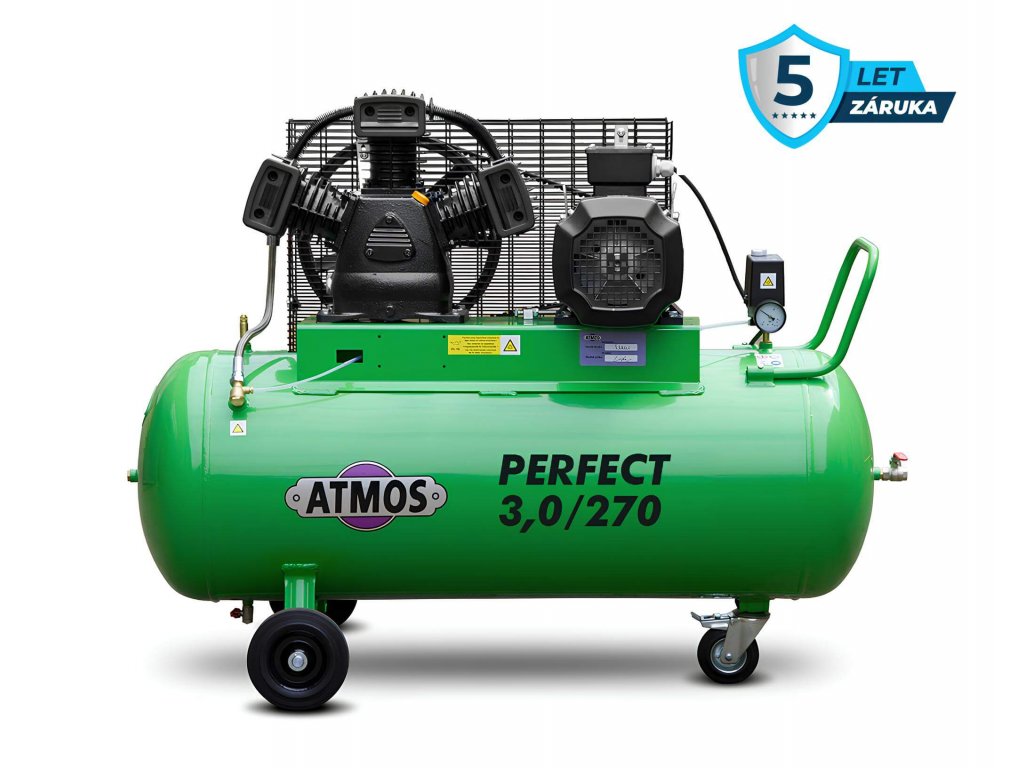
An example for normal operation is the cast iron piston WK430-3-0/200P with an air delivery of 340 l/min and a 200 l tank, or the more powerful ATMOS Perfect 3/270 with 408 l/min and a 270 l tank, which at this consumption level cycles on about six times per hour.

Tire-changing season: when a piston machine is no longer enough

In spring and autumn, the situation changes. Impact wrenches and inflation run practically non-stop, and blowing happens frequently. Consumption at that point jumps to approximately 432 l/min, and with a reserve to 570 l/min.

This is already a job for a screw compressor with a tank. It works smoothly and handles long continuous consumption without overheating. An example is the WALTER SKTG 5.5/500 SP COMBO with an air delivery of 850 l/min and a 500 l tank.

Attention: A piston compressor must not run without a break — it needs a run-to-rest ratio of approximately 3 : 1. In continuous operation during the season, it would overheat and its service life would drop rapidly.

Ventilek advises

If you are changing tyres at full speed throughout the season, a screw machine pays off even where it would otherwise seem oversized. A piston unit running without rest will end up costing you more in repairs and replacements.

A wider selection of machines for continuous operation can be found in the screw compressors category.

View screw compressors

Truck tyres

Servicing truck wheels has different requirements. Inflation requires 8 bar, so the machine must have at least 10 bar (8 + 1.5 = 9.5 bar). The calculator for such a service recommends a 500 l tank. A 1" impact wrench additionally draws around 350 l/min, which significantly increases the required air delivery.

  • Higher pressure. A machine of at least 10 bar due to inflation to 8 bar.
  • Large air delivery. A 1" impact wrench alone consumes 350 l/min.
  • Large tank or screw machine. Short impact peaks require a reserve of air.

Frequently asked questions

What compressor for a passenger car tyre service?
For normal daily operation with two impact wrenches, inflation and occasional blowing, a piston compressor on 400 V with an air delivery of at least 330 l/min and a tank of at least 200 l is sufficient.
When does a screw compressor pay off?
During the tyre-changing season, when the tools run almost continuously and consumption rises above 500 l/min. A piston machine would not withstand such operation without overheating.
What pressure do I need for inflating truck tyres?
Inflating itself requires 8 bar, so choose a compressor rated for at least 10 bar.
How do I calculate the required output precisely?
Enter the number of impact wrenches and how often they run into the calculator on the Compressors page — you'll get the air delivery and recommended pressure.

Summary

  • Add up consumption according to frequency of use. Don't calculate as if everything ran at once.
  • Add a 30% reserve. This applies to both air delivery and pressure.
  • Normal operation can be handled by a piston machine with a tank of at least 200 l on 400 V.
  • For seasonal peaks and truck tyres, use a screw compressor or a machine for higher pressure.

The fastest way to verify the right machine is the calculator on the Compressors page — just enter the number of impact wrenches and how often they run.

How to Choose a Compressor for Painting
Compressor for painting

Painting is one of the most demanding disciplines for air supply. A spray gun consumes a lot of air and runs for a long time without a break. In this subsection we will build on the main article How to choose a compressor and go through the selection of a machine specifically for paint shops and car body repair shops.

If you want to calculate the output directly, open the calculator on the Compressors page and enter your tools.

Open calculator

Ventilek: How to choose an air compressor – output, pressure and tank size step by step 13:22

Video: How to choose an air compressor step by step. The video starts right at the chapter Paint shop (9:21). Ventilek shows how to calculate air delivery, pressure and tank size, and goes through five workplaces. You can work it out straight away in the compressor selection calculator. The video is in Czech with English subtitles.

2:14 How much air and pressure your tools need 3:02 How to calculate air delivery and pressure 4:49 Air receiver and pressure switch 7:04 Car repair shop 8:02 Tyre shop 9:21 Paint shop 10:16 Joinery 11:17 Home workshop and garage

Why painting needs a lot of air

A spray gun takes approximately around 250 l/min at 4 bar pressure (the exact value is stated for the specific gun; the value from our calculator is indicative). Unlike pneumatic tools, which work in short bursts, a gun runs for a long time without a break during painting.

Therefore, the spray gun is included in the calculation as continuous operation, not occasional. This fundamentally changes the requirement for the compressor as well as for the size of the air receiver.

250 l/minindicative consumption of a spray gun at 4 bar
380 l/minminimum air delivery with a 30% reserve (1 gun)
270 lrecommended tank

Calculation step by step

Let's take a typical setup: one spray gun in continuous operation (250 l/min) and occasional blowing (36 l/min). Together this gives 286 l/min.

  • Consumption. 1 gun continuously 250 l/min + occasional blowing 36 l/min = 286 l/min.
  • Reserve. With a reasonable 30% reserve, the required air delivery comes out to at least 380 l/min (the calculator rounds up to the nearest ten).
  • Pressure. The gun itself works at 4 bar. The highest pressure in the setup is for blowing (6 bar), so with a 1.5 bar reserve that's 7.5 bar, meaning the machine should be rated for at least 8 bar (commonly 10 bar).

For such a setup, a 400 V piston compressor with a large tank is suitable. With a 270 l tank, the machine switches on about 5× per hour, which is a nicely calm operation. With 150 l, it switches on almost 10×, which is already a borderline value – the motor switches on frequently and heats up more.

Note: The smaller the tank, the more often the compressor switches on. For painting, where the gun draws air continuously for a long time, a large air receiver on the compressor is an advantage – it evens out the draw and spares the motor.

Specifically, the ATMOS Perfect 3/270 (408 l/min, 270 l tank, switches on about 5× per hour) works well. For comparison: the same machine with a 150 l tank (ATMOS Perfect 3/150) would switch on almost 10× per hour, so the calculator won't offer it for painting.

@produkty@(/pistovy-kompresor-perfect-3-270/)(/litinovy-pistovy-kompresor-gk630-40-270/)(/pistovy-kompresor-perfect-3-270s/)(/stacionarni-kompresor-b59b-4-270ft/)(/dvoustupnovy-kompresor-b59b-4-270ct/)(/sroubovy-kompresor-walter-sktg-5-5-500-sp-combo/)(/sroubovy-kompresor-walter-sftg-5-5-500-ksp-combo/)(slider)

Two guns at once

As soon as you plan to spray with two guns simultaneously, consumption jumps to around 700 l/min. That's already beyond the capabilities of a standard piston machine, and the solution is a screw compressor, which can handle long continuous operation at full output.

You can find details in the screw compressors section.

Air quality is just as important as output

For painting, it's not enough to have plenty of air – it must be clean. Oil, water, and dust in the air cause defects in the paint that are hard to repair. Air treatment is therefore a necessity for a paint shop, not an add-on.

  • Filtration. A pre-filter captures coarse impurities and condensate, while a fine filter captures residual oil and fine dust.
  • Air dryer. It removes moisture so that water doesn't condense in the hose and get into the paint.
  • Pressure regulator. It keeps stable working pressure and spray quality at the gun.

You'll find all these components in the air treatment section. The calculator will alert you to the need for filtration and drying when selecting a spray gun.

Ventilek advises

Check the oil in the compressor regularly and change it according to the manual – for oil-lubricated machines, the oil determines both service life and how much oil passes into the air. You'll always find the correct oil for your compressor in the documentation of the specific machine; do not mix different types.

Spray gun

The result of painting depends on the gun. Choose based on air consumption and working pressure, which must match your compressor and air treatment.

@kategorie@(/strikaci-pistole--pro-lakovny-a-remeslniky/)(8)(slider)

Summary

  • Treat the gun as continuous operation. Painting runs for a long time without breaks.
  • Add a reserve. For 1 gun, the air delivery should be at least 380 l/min, the machine at least 8 bar.
  • Large tank. With 270 l, the compressor switches on less often and runs more smoothly than with 150 l.
  • Two guns = screw machine. At around 700 l/min, a piston machine is no longer sufficient.
  • Clean air. Filtration, drying, and pressure regulation protect the paint from defects.

You'll get the most accurate result by calculating your own setup based on your tools.

Calculate your own setup

Frequently asked questions

What compressor do I need for painting?
For one gun, a piston machine with 400 V, air delivery of at least 380 l/min, pressure of at least 8 bar, and a 270 l tank. For two guns, a screw compressor.
Why is a spray gun considered continuous operation in painting?
Because during spraying, the gun runs for a long time without a break, so the consumption is practically continuous, unlike impulse pneumatic tools.
Why is air treatment important?
Oil, water, and dust in the air cause defects in the paint. A pre-filter, fine filter, dryer, and pressure regulator at the gun prevent this.
Is a 150 l tank enough?
This is a borderline option – the compressor switches on almost 10 times per hour. With 270 l, it switches on about 5 times per hour and runs more smoothly.
How to choose a compressor for an auto repair shop

A compressor is the heart of the compressed air system in an auto repair shop or car service. It powers impact wrenches, blow guns, tyre inflation and spray guns, and if it is undersized, it cannot keep up and slows down the work. In this article, we will build on the general guide How to Choose a Compressor and go through the selection specifically for a workshop. For an exact calculation for your tools, use the power calculator directly on the Compressors page.

Open calculator

Ventilek: How to choose an air compressor – output, pressure and tank size step by step 13:22

Video: How to choose an air compressor step by step. The video starts right at the chapter Car repair shop (7:04). Ventilek shows how to calculate air delivery, pressure and tank size, and goes through five workplaces. You can work it out straight away in the compressor selection calculator. The video is in Czech with English subtitles.

2:14 How much air and pressure your tools need 3:02 How to calculate air delivery and pressure 4:49 Air receiver and pressure switch 7:04 Car repair shop 8:02 Tyre shop 9:21 Paint shop 10:16 Joinery 11:17 Home workshop and garage

Tools in an auto repair shop and their consumption

Each tool has its own air consumption and working pressure. The following values are indicative, from our calculator; exact figures can always be found on the label of the specific tool.

ToolAir consumptionPressure
Impact wrench 1/2"150 l/min6.3 bar
Pneumatic ratchet wrench120 l/min—
Blow gun120 l/min—
Tyre inflation60 l/min3 bar
Spray gun250 l/min4 bar

The most demanding tool is usually the spray gun and the impact wrench. These are the ones that determine how large a machine you will need. Impact wrenches are among the most commonly used equipment in a workshop:

@kategorie@(/priklepove-utahovaky--pneumaticke-provedeni/)(8)(slider)

Calculation step by step

It is important to note that not all tools in a workshop usually run at the same time. Therefore, we multiply the consumption of individual tools by the proportion of time during which they are actually used. Our calculator works the same way.

  • Impact wrench used often (60% of the time). 150 l/min × 0.6 = 90 l/min.
  • Spray gun used occasionally (30%). 250 l/min × 0.3 = 75 l/min.
  • Blowing occasionally. approximately 36 l/min.
  • Inflating occasionally. approximately 18 l/min.

Adding these up gives 90 + 75 + 36 + 18 = 219 l/min. We add a 30% reserve to this value, so the air delivery should be at least 290 l/min (the calculator rounds up to the nearest ten). The pressure is calculated as the highest tool pressure plus 1.5 bar, i.e. 6.3 + 1.5 = 7.8 bar, so the machine should be rated for at least 8 bar. Common workshop piston compressors have 10 bar.

290 l/minminimum air delivery including reserve
7.8 barrequired tool pressure + reserve
200 lrecommended tank

Which machine to choose

For a typical car repair shop, a 400 V piston compressor with a tank of at least 200 l is ideal. A sufficiently large tank ensures that the machine doesn't switch on too often — ideally 4–6 times per hour, at most 10 times. Frequent switching shortens the service life.

From our range, the cast iron WK430-3-0/200P with an air delivery of 340 l/min and a 200 l tank (switches on about 7 times per hour) meets these requirements, as does the ATMOS Perfect 3/270 with an air delivery of 408 l/min and a 270 l tank (about 6 times per hour).

@produkty@(/litinovy-pistovy-kompresor-gk420-22-200/)(/pistovy-kompresor-perfect-3-270/)(/kompresor-pro-line-extensive-a39bt-3-200ct/)(/litinovy-pistovy-kompresor-gk530-30-200/)(/kompresor-pro-line-extensive-a39bt-3-270ct/)(/kompresor-pro-line-expert-a49bp-3-200ct/)(slider)

It makes sense to switch to a screw compressor where you have several workstations operating simultaneously or impact wrenches running continuously — roughly from a constant consumption above 400 l/min. A screw machine supplies air steadily and withstands continuous operation.

Ventilek advises

Don't buy a machine that's "just enough". When a compressor switches on too often, both the motor and the airend suffer. It's better to have a larger tank and a reasonable reserve in air delivery — in the workshop this will pay off in smoother operation and longer service life.

Oil, operation and maintenance

An oil-lubricated piston compressor needs the correct compressor oil — do not use ordinary automotive engine oil. It requires special compressor oil of the viscosity specified by the manufacturer in the manual. Regular replacement and level checks are essential for trouble-free operation.

If you're wondering which oil belongs in a compressor, always follow the label and manual of the specific machine — specifications vary depending on the type of airend. As a general rule, check the level before each major use and change the oil at the interval recommended by the manufacturer.

The piston compressor draws air into the cylinder and compresses it with a piston into the tank. A decompressor is a component that relieves the head on startup and makes it easier for the motor to start. A check valve between the unit and the tank prevents compressed air from leaking back into the cylinder.

Painting: clean and dry air

If you paint or spray fillers in the workshop, you need air without oil, water and impurities. Include suitable filtration in the distribution system and ideally also an air dryer. Otherwise there is a risk of craters, mapping and paint defects.

View air treatment

Warning: Insufficiently treated air will ruin both the paint and the pneumatic tools. Moisture inside the distribution system accelerates corrosion and shortens the service life of the tools.

Summary

  • Calculate consumption. Add up the tools according to actual usage and add a 30% reserve.
  • Watch the pressure. The highest tool pressure plus 1.5 bar, the machine at least 8 bar (commonly 10 bar).
  • Choose a piston compressor for 400 V. A tank of at least 200 l for smooth switching (4–6×, at most 10× per hour).
  • A screw compressor for continuous operation. Above roughly 400 l/min of constant consumption.
  • For painting, a filter and a dryer. Clean and dry air is a condition.

You will get the most accurate result when you enter your own tools and their number into the calculator on the Compressors page. Then you will see the required air delivery and pressure exactly for your workshop.

Frequently asked questions

Which oil goes into a compressor?
Special compressor oil of the viscosity specified in the manufacturer's manual, not ordinary motor oil. You can find the correct type on the machine's label.
What is a decompressor?
A component that relieves the unit's head at startup and makes it easier for the motor to start, so it does not have to start against full pressure.
How does a piston compressor work?
It draws air into the cylinder and compresses it into the tank using the piston. A check valve then prevents the compressed air from escaping back.
Is a single-phase compressor enough for my workshop?
For more demanding tools such as impact wrenches and spray guns, we recommend a piston machine running on 400 V with sufficient air delivery.

Listing controls

5 items total