

TL;DR:
- Spiral hoses increase the efficiency of pneumatic systems thanks to better flexibility and lower flow losses. The material (PU, PVC, hybrid) influences the resistance, flexibility and price of the hose. The right choice depends on the operating environment, the pressure and the long-term resistance.
Modern spiral hoses are not just a more comfortable alternative to straight hoses. They are a technically different category which directly influences the efficiency of the pneumatic system. While many technicians still choose hoses according to price and length, the key parameter is the material and construction. Hybrid materials reduce flow losses by 20 to 30 % compared with PVC, which in real operation means a lower load on the compressor and a longer service life of the tools. This article brings an overview of the types of spiral hose, their parameters, applications and specific recommendations for the choice.
Contents
- What exactly a spiral hose is and how it works
- The key parameters and materials of spiral hoses
- Typical applications of spiral hoses in practice
- Choosing a spiral hose: what to watch out for
- Our experience: what most specialists underestimate about spiral hoses
- A solution of spiral hoses and accessories for your plant
- Frequently asked questions
Key findings
| Point | Details |
|---|---|
| Efficiency and compactness | Spiral hoses improve work in the workshop thanks to flexibility and a saving of space. |
| The choice of the right material | Polyurethane and hybrids significantly reduce flow losses compared with PVC. |
| The right choice extends the service life | Taking the parameters of the working environment into account increases the safety and reliability of the hoses. |
| Practical use | The right hose saves time as well as costs in demanding operation. |
What exactly a spiral hose is and how it works
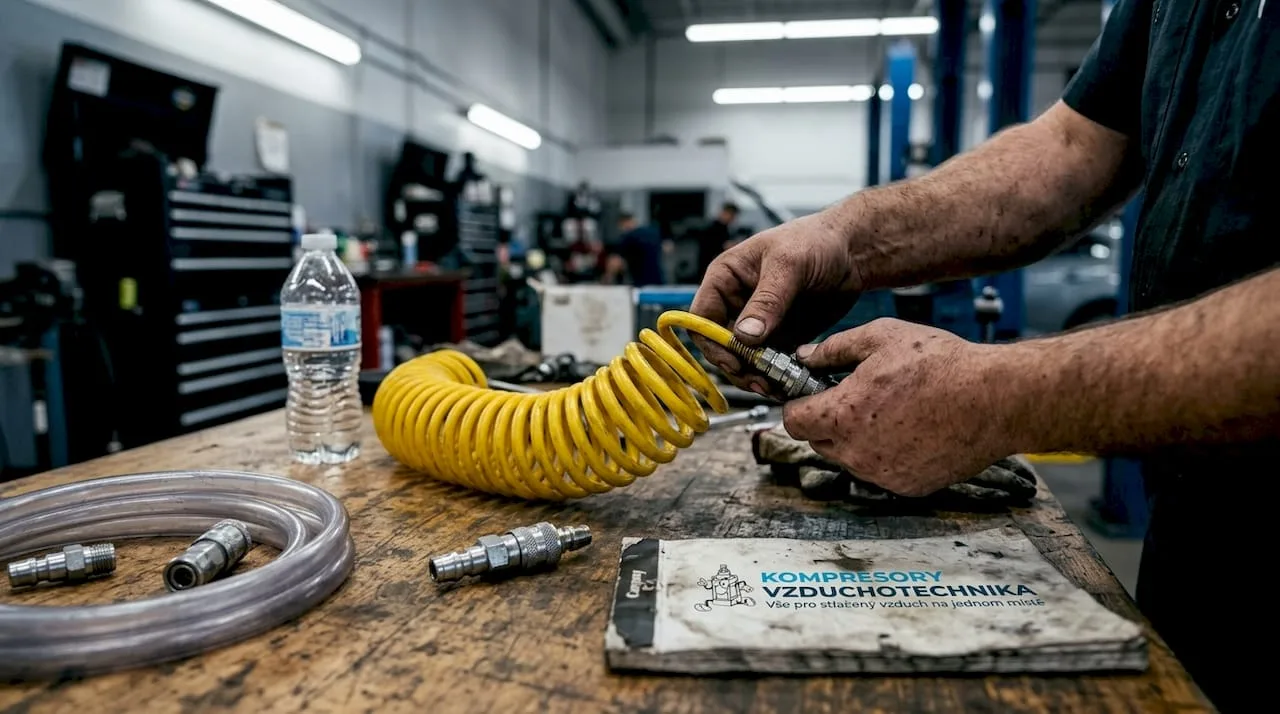
A spiral hose is an air or pneumatic hose formed into a helix. The shape arises either by winding the material while hot, or by production from a pre-formed semi-finished product. The result is a hose which extends in use and after release automatically returns to a compact spiral form. This principle of self-retraction is key for work safety as well as for order at the workplace.
The basic construction of a spiral hose consists of an inner tube (the carrier of the medium), possibly a reinforcing layer and an outer sheath. The materials differ according to the application:
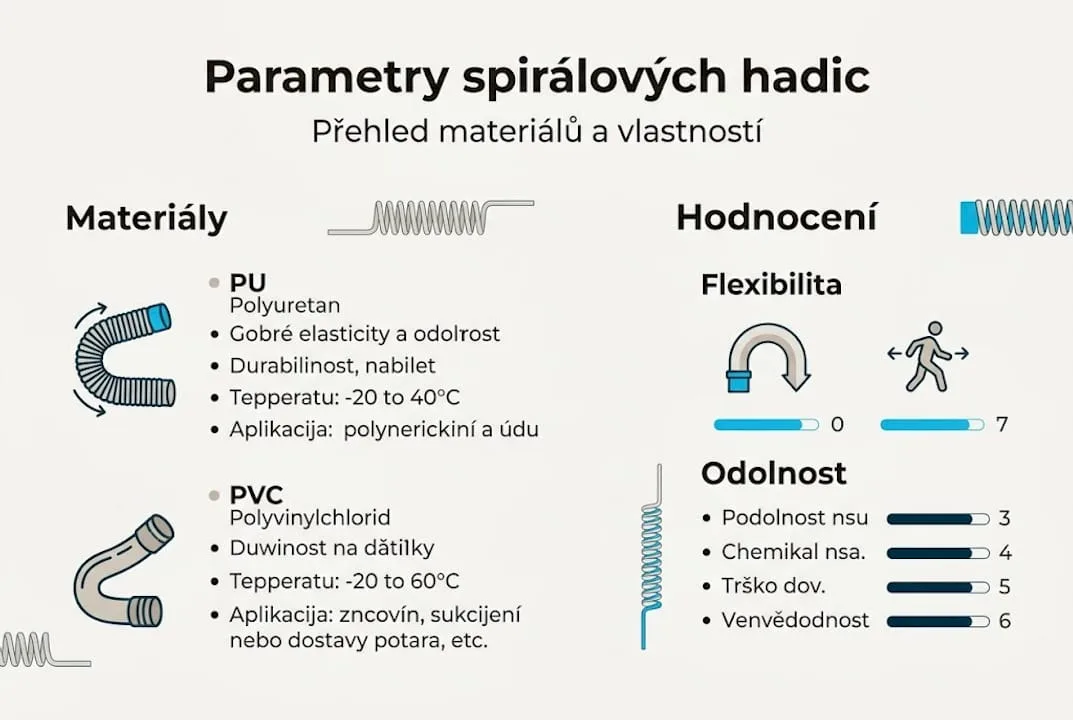
- Polyurethane (PU): The most widespread material. High flexibility, resistance to abrasion and chemicals, low weight.
- PVC: The cheaper variant, suitable for less demanding applications. Lower flexibility at low temperatures.
- Hybrid materials: A combination of polyolefin and other polymers. Low weight, good flexibility even in the cold.
- Polyamide (PA): High strength, suitable for higher pressures and aggressive environments.
Compared with a straight hose, a spiral hose has the fundamental advantage of not being in the way at the workplace. A straight hose 10 metres long lies on the floor and presents a safety risk as well as a logistical problem. A spiral hose of the same length takes up a fraction of the space and returns to its place by itself. Moreover protective spirals extend the service life of the hoses by protecting their ends from mechanical damage.
The parameter of the hardness of the material, designated as durometer, is also important. PU spirals with durometer 95A withstand thousands of cycles of extension without deformation, which is fundamental for intensive industrial use. Softer materials (a lower durometer value) are more pleasant to the touch, but lose their shape faster.
Spiral hoses are produced in various diameters (most often 6, 8, 10 and 12 mm internal diameter) and lengths in the extended state (usually 7.5 to 20 metres). The length in the resting state is approximately a third to a quarter of the extended length. This ratio must be taken into account when planning the distribution at the workplace.
Professional tip: When choosing a spiral hose always follow the length in the extended state, not the length in the resting state. Manufacturers state both figures, but for practical use it is the length at full extension that decides.
The key parameters and materials of spiral hoses
When you have a basic idea of the construction of a spiral hose, it is necessary to know the key technical parameters. Every parameter directly influences the suitability of the hose for a specific application.
| Parameter | PU | PVC | Hybrid |
|---|---|---|---|
| Flexibility in the cold | Excellent | Weak | Good |
| Resistance to abrasion | High | Medium | Medium |
| Weight | Low | Medium | Low |
| Flow losses | Low | Higher | Low |
| Price | Medium | Low | Higher |
| Chemical resistance | Good | Limited | Good |
Polyurethane is in practice the most popular material for spiral hoses for several reasons. It keeps its elasticity even at temperatures below 0 °C, so it is suitable for outdoor construction sites or refrigerated plants. Hoses of PUJ polyurethane moreover have a high resistance to oils and lubricants, which is fundamental in workshops and service centres.
PVC hoses are affordable in price, but their use is limited. At temperatures below 5 °C they lose their elasticity and can crack. For seasonal outdoor work or for environments with fluctuations of temperature they are not suitable. In enclosed workshops with a stable temperature they can serve for less demanding applications.
Hybrid materials combine the advantages of polyolefin and other polymers. The result are hoses which reduce flow losses by 20 to 30 % compared with PVC, while keeping a low weight and good flexibility. They are suitable especially where the energy efficiency of the whole pneumatic system is important.
Another key parameter is the maximum working pressure. Standard spiral hoses for workshops and assembly work at a pressure of 8 to 10 bar. For more demanding applications, for example in mechanical engineering or when used with high-pressure compressors, it is necessary to choose hoses certified for higher pressures. Always check whether the stated pressure is the working one or the maximum one (burst pressure).
The temperature range is another parameter which is underestimated in practice. Standard polyurethane hoses work in a range of approximately minus 20 °C to plus 60 °C. For outdoor applications with direct sunlight special UV-resistant hoses are suitable, which do not lose their mechanical properties even after long-term exposure.
Typical applications of spiral hoses in practice
After knowing the parameters the question remains: where do spiral hoses excel in everyday practice? The answer depends on the segment, but several general rules apply.
- Automated production lines: The spiral hose adapts to the movement of robotic arms and manipulators. It does not form loops which could catch moving parts of the machines.
- Assembly workplaces: Technicians work in various positions and at various distances from the air supply. The spiral hose extends exactly to the necessary length and after finishing the work returns.
- Car services and tyre services: Frequent moving and various distances from the compressor. The spiral hose eliminates the risk of tripping and shortens the time needed for tidying up.
- Construction sites: Work with pneumatic hammers, drills and other tools at various places of the building. The spiral hose reduces the weight of the equipment carried.
- Paint shops: Precise dosing of the air and minimal flow losses are key for the quality of the surface finish.
PU spirals with durometer 95A withstand thousands of cycles of extension, which corresponds to several years of intensive operation on an assembly line. This service life is considerably higher than that of straight PVC hoses, which are damaged faster by repeated bending and being driven over by trolleys.
Statistics: Spiral hoses shorten the time needed for preparing and tidying the workplace by 15 to 25 % compared with straight hoses, thanks to the elimination of manual winding and storing.
For the choice of the right type of hose according to the working load a simple rule applies: the more intensive and variable the operation, the more an investment in a higher-quality material pays off. the advantages of pneumatic systems are described in more detail in a separate overview, which also includes a comparison with electric tools. Information about how the hose directly influences the performance of the tools can be found in the article about increasing the performance of tools.
Professional tip: For mobile applications on a construction site choose spiral hoses with end fittings equipped with swivel couplings. This prevents twisting of the hose during movement and extends its service life.
Choosing a spiral hose: what to watch out for
After mapping the applications it is time to give specific advice on the choice. The right hose must correspond to three basic criteria: the working pressure, the operating environment and the mechanical load.
| Criterion | PU | PVC | Hybrid |
|---|---|---|---|
| Working pressure up to 10 bar | Yes | Yes | Yes |
| Flexibility in frost | Excellent | No | Good |
| Resistance to UV | Special types | No | Limited |
| Suitability for oils | Yes | Limited | Yes |
| Recommendation for intensive operation | Yes | No | Yes |
The most frequent mistakes in choosing a spiral hose:
- Choosing only according to price: A cheap PVC hose in intensive operation fails before the difference in price is returned in savings.
- Ignoring the temperature range: A hose intended for indoor spaces cracks on a winter construction site.
- Underestimating the diameter: Too small an internal diameter causes pressure losses and reduces the performance of the tools.
- An incorrect length: Too short a hose restricts movement, too long a one unnecessarily increases pressure losses.
- Missing protection of the ends: Without protective spirals the ends of the hose are damaged at the first contact with an edge or a tool.
You will recognise a quality hose by several signs: an even winding of the spiral without deformations, firm and tight end fittings without visible gaps, marking of the maximum pressure directly on the hose and certification of the manufacturer. The material should be flexible even at room temperature, without cracks or whitening at the bends.
Hybrid materials reduce flow losses by 20 to 30 % compared with PVC, so their use contributes directly to the optimisation of air consumption and the reduction of operating costs. When choosing a hose therefore follow not only the purchase price, but also the influence on the overall consumption of the compressor. Information about how correctly to eliminate air leaks in a pneumatic system is key for maintaining the efficiency of the whole distribution.
Our experience: what most specialists underestimate about spiral hoses
From long-term practice in air technology one recurring problem emerges: technicians pay attention to the choice of the compressor and the pneumatic tools, but take the hose as an inferior consumable. This mistake has direct operational consequences.
Incorrect storage is the most frequent cause of premature failure. A spiral hose stored in excessive heat or squashed under heavy equipment loses its elasticity. After several months of such storage the hose stops returning to the spiral shape and becomes a safety risk.
The second underestimated factor is the fitting of the end couplings. An incorrectly tightened or unsuitable coupling causes micro-leaks which show up only at full load of the system. In one specific case from a production plant a loose coupling on a spiral hose led to a drop in pressure of 1.5 bar, which caused the inability of the pneumatic screwdriver to reach the required tightening torque. The result was a stoppage of the line and repeated re-checking of the joints.
For the protection of the hoses we recommend using protective spirals at the ends of the hoses, where the greatest mechanical stress occurs. The decision about the choice of a hose should never rest only on the price, but always on the operating parameters and conditions of the specific workplace.
A solution of spiral hoses and accessories for your plant
If you are clear about what you need, we will make the further steps of choice and purchase easier for you. At Kompresory-vzduchotechnika.cz you will find a wide range of spiral hoses in various materials, diameters and lengths, complemented by compatible accessories for pneumatic systems.
For a comprehensive solution of the distribution of compressed air we also offer MARK compressors and accessories and pipes for air distribution for fixed installations. Our technicians are available for individual advice on the choice of the right hose according to your operating conditions. Contact us directly or use the product filters on the website for a fast choice according to parameters.
Frequently asked questions
What does durometer 95A mean with spiral hoses?
Durometer 95A designates a high hardness of the material, which guarantees a long service life and resistance to deformation. PU spirals with durometer 95A withstand thousands of cycles of extension without loss of shape, which is key for intensive industrial operation.
What are the main advantages of polyurethane spiral hoses over PVC?
Polyurethane hoses are more flexible, more durable and tend to have lower losses of air flow than PVC variants. Hybrid materials reduce flow losses by 20 to 30 % compared with PVC, while PU achieves comparable results with a higher mechanical resistance.
Is a spiral hose suitable for outdoor use?
Yes, some polyurethane variants are resistant to UV radiation and can be safely used outdoors too. For long-term outdoor deployment it is necessary to choose a type with explicit UV certification from the manufacturer.
How do I recognise that the hose needs to be replaced?
Replacement should occur with a loss of elasticity, damage to the spiral or a leak of air. The visual check should also include a check of the end fittings and of the surface of the hose for cracks or whitening of the material.
Recommended
- Why use pneumatics: efficiency, speed and safety - Kompresory-Vzduchotechnika.cz
- How pneumatics works: a complete guide for industry 2026
- The function of the air receiver: how to increase the efficiency of pneumatic systems - Kompresory-Vzduchotechnika.cz
- Practical use of pneumatic hoses in the car service 2026 - Kompresory-Vzduchotechnika.cz