
Electronic condensate drains BEKOMAT
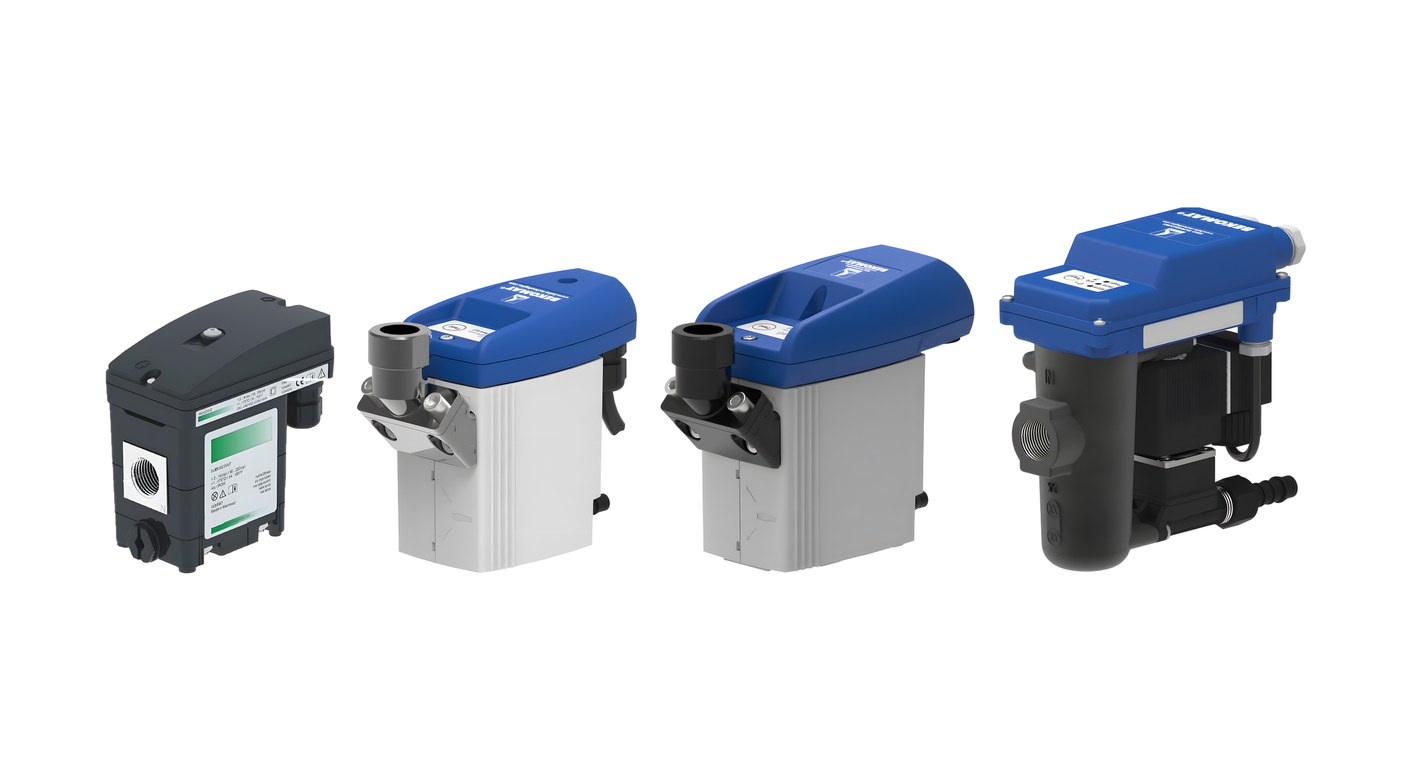
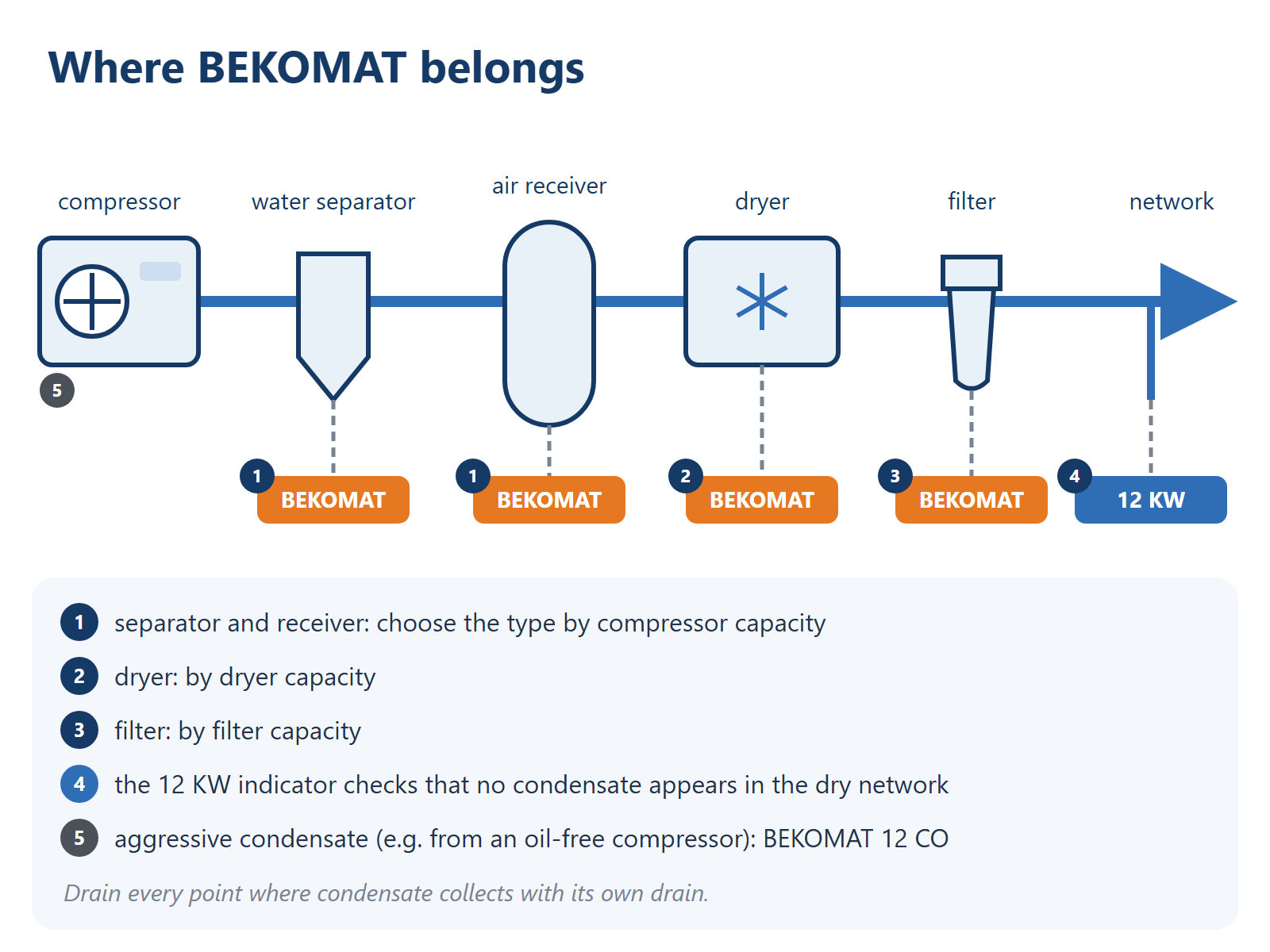
BEKOMAT is an electronic drain that watches the condensate level with a capacitive sensor and opens the valve only when there is something to let out — so no compressed air is wasted while draining. The measurement has no moving parts to wear out. You choose it by how much air flows through the place where the drain will go: compressor, dryer or filter.
Which BEKOMAT you need
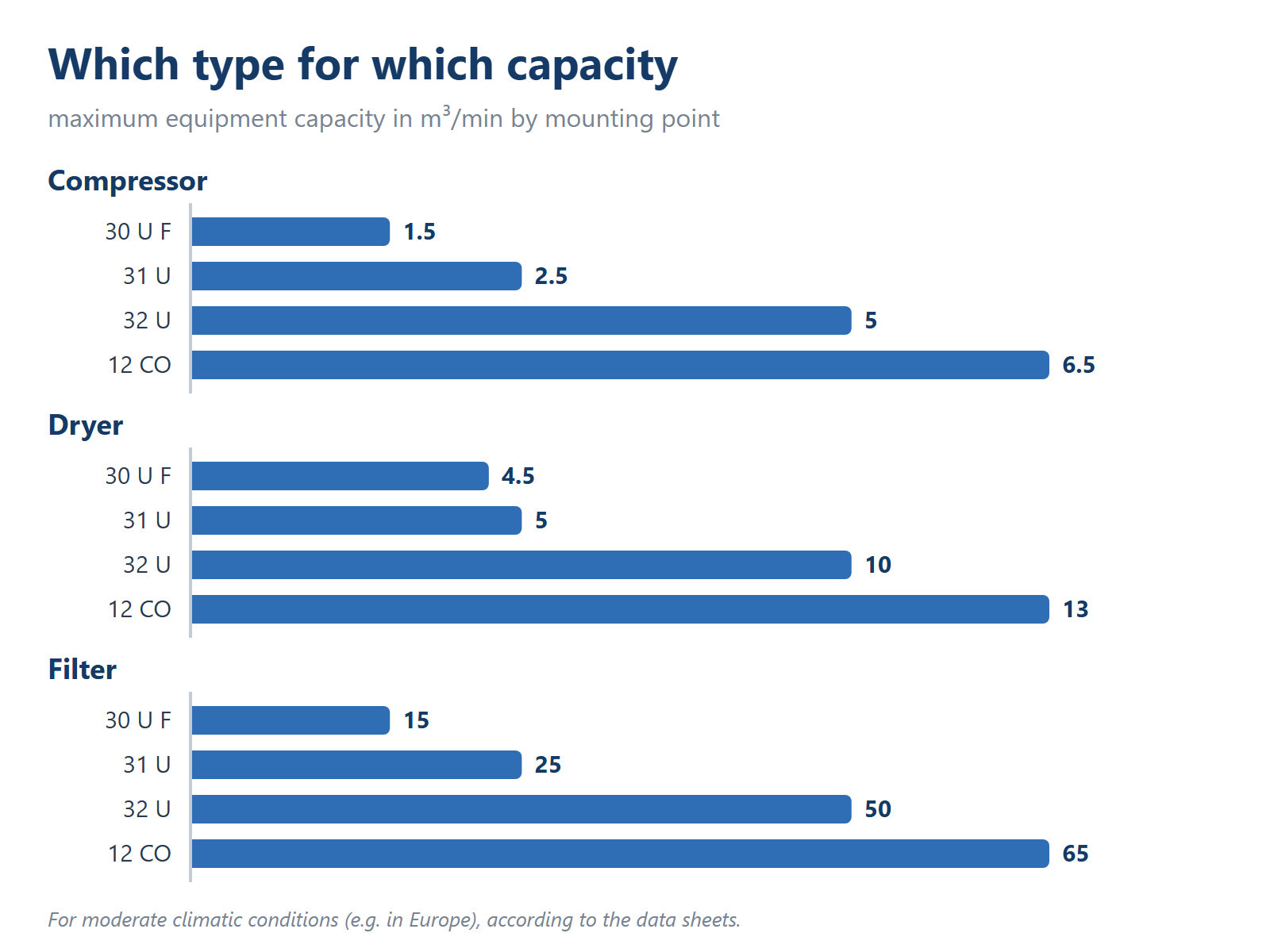
Each drain has three figures depending on where it is fitted. Behind the compressor the most condensate forms, on the dryer less and in a filter least — so the same unit can serve a filter ten times larger than a compressor. Choose by the column where it will really go.
| BEKOMAT drains — equipment capacity by mounting point, pressure, protection and supply | ||||||
|---|---|---|---|---|---|---|
| Order code | Compressor | Dryer | Filter | Working pressure | Protection | Supply |
| BEKOMAT 30 U F | 1.5 m³/min | 4.5 m³/min | 15 m³/min | 0.8–16 bar | IP 54 | 200–240 V AC |
| BEKOMAT 31 U | 2.5 m³/min | 5 m³/min | 25 m³/min | 0.8–16 bar | IP 67 | 95–240 V AC / 100–125 V DC |
| BEKOMAT 32 U | 5 m³/min | 10 m³/min | 50 m³/min | 0.8–16 bar | IP 67 | 95–240 V AC / 100–125 V DC |
| BEKOMAT 12 CO | 6.5 m³/min | 13 m³/min | 65 m³/min | 0.8–16 bar | IP 65 | 230 V AC |
The figures give the equipment capacity in m³/min whose condensate the drain can keep up with. They apply to moderate climatic conditions such as in Europe. Supply refers to the standard version.
#showmore#
How BEKOMAT works
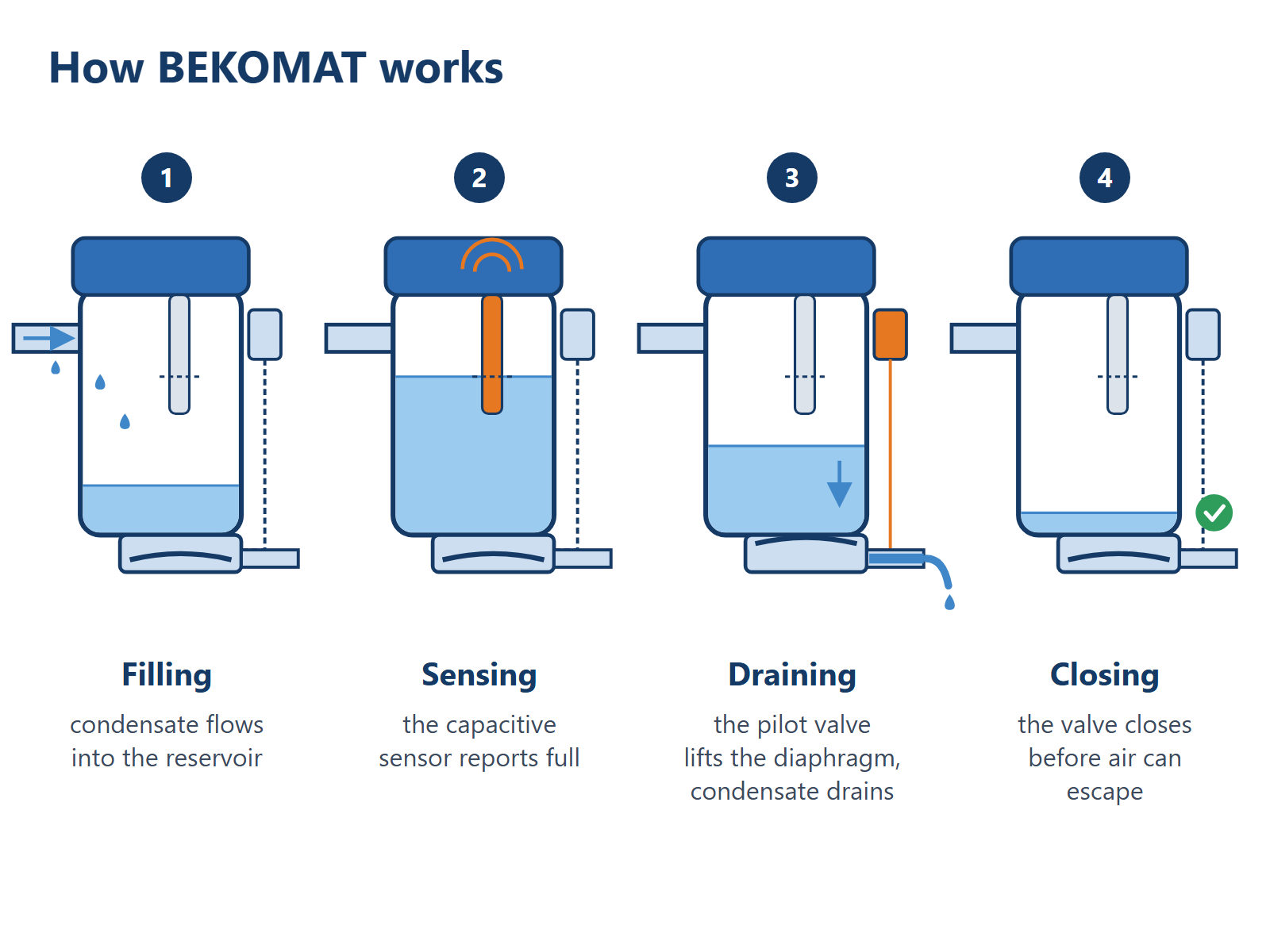
Condensate runs through the inlet pipe into a collecting chamber, where a capacitive sensor watches the level. When the level reaches the upper limit, the electronics open a pilot solenoid valve, which uses control-air pressure to lift the diaphragm of the main valve — the condensate drains through the outlet pipe.
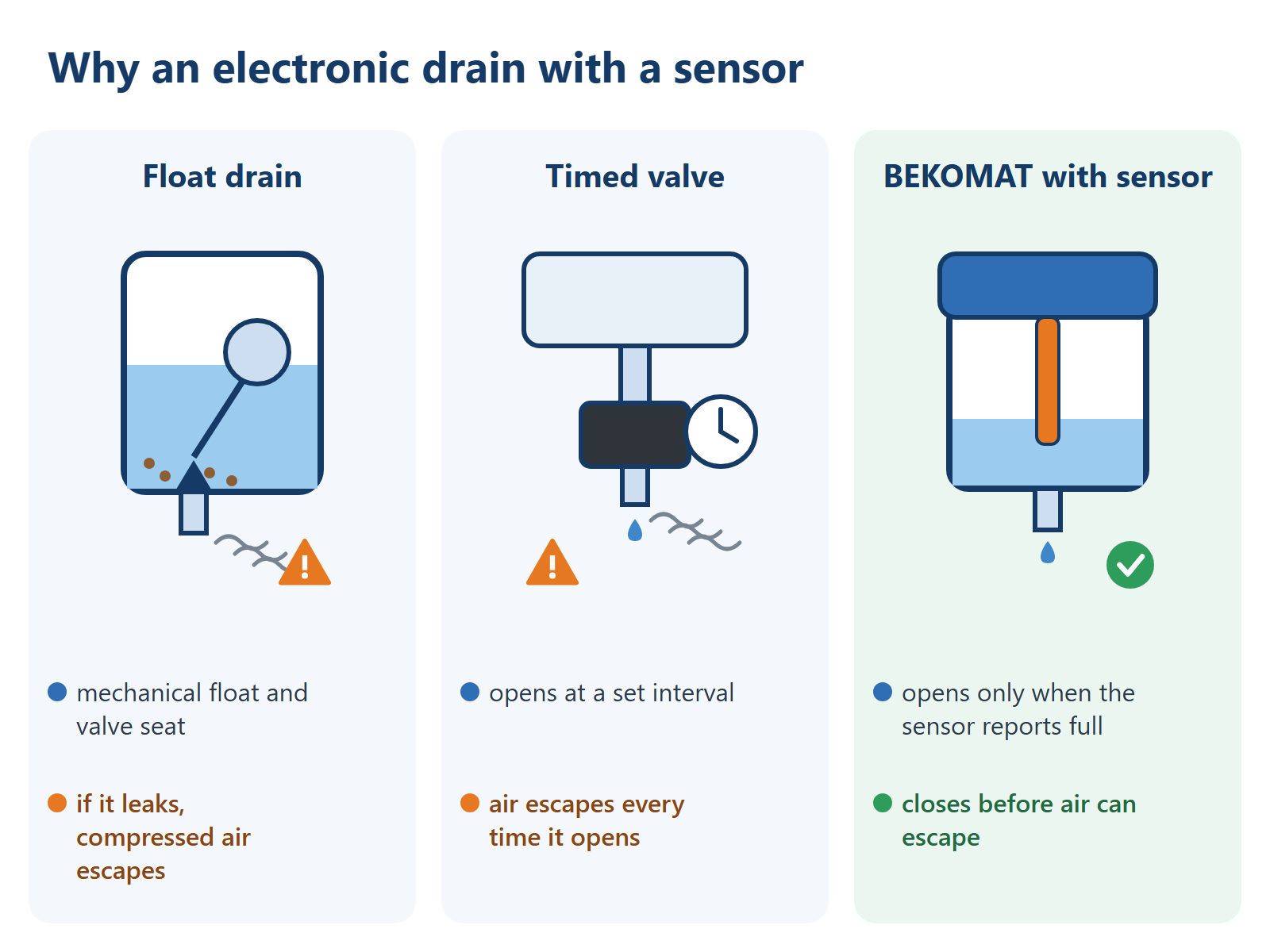
The valve stays open only while there is something to let out, so no air is wasted behind the condensate. The drain thus works exactly to the amount of condensate coming in: in dry operation it hardly moves, in humid operation it opens more often.
Maintenance: one service unit
On types 30 U F, 31 U and 32 U all wearing and pressure-loaded parts sit in one service unit. Maintenance means replacing it as a whole in one move — no seals, no dismantling. On the 30 U F this takes less than two minutes according to the data sheet.
On the 31 U and 32 U the electronics announce maintenance themselves: after 2 × 8 760 operating hours or one million switching cycles the green LED flashes, and the service unit is replaced after two years at the latest. No preventive checks or cleaning are needed in between. On the 12 CO the manufacturer's maintenance plan calls for replacing the wear-part kit once a year and cleaning the drain at the same time.
BEKOMAT 12 CO for aggressive condensate
Type 12 CO is designed for oil-laden and oil-free condensate and for aggressive condensate — from compressed air and from inert gases. The housing is made of a corrosion-resistant aluminium alloy, glass-bead blasted and protected by a hard lacquer coating inside and out. A potential-free contact reports drainage faults.
Electronic condensate drain BEKOMAT 12 CO
BEKOMAT 12 KW condensate indicator
The 12 KW indicator is not a drain. It belongs in a dry air network, for example after the dryer, and watches whether condensate forms there. When a critical amount builds up, it sends a visual and acoustic signal and passes it on to the control system through a potential-free contact. You then drain the collected condensate through the ball valve, for instance into a small container.
Condensate indicator BEKOMAT 12 KW
Installation
The condensate inlet has a G½ thread, NPT ½ on request. The manual for type 31 requires the inlet pipe to have a slope of at least 1 % towards the drain, otherwise condensate stands in the pipe.
The outlet is a hose connection: 8–10 mm on the 31 U and 32 U, 10–13 mm on the 12 CO; the 30 U F has a G¼ female thread. Supply is 230 V AC as standard (31 U and 32 U 95–240 V AC or 100–125 V DC), low-voltage versions on request.

Ventilek advises
One drain, three places — and three different figures.
The most common mistake is choosing by the filter figure when the drain will go under the air receiver right after the compressor. The 31 U handles a filter of 25 m³/min, but directly after a compressor only up to 2.5 m³/min. And condensate from an oil-lubricated compressor does not belong in the drain — route it to an oil/water separator.
Frequently asked questions about BEKOMAT drains
- Which BEKOMAT should I choose?
- By the equipment capacity at the mounting point. After a compressor of up to 1.5 m³/min the 30 U F is enough, up to 2.5 m³/min the 31 U, up to 5 m³/min the 32 U and up to 6.5 m³/min the 12 CO. For a dryer and a filter the higher figures in the table apply.
- How does it differ from the LD series?
- The principle is the same — a capacitive sensor and zero-loss draining. On types 30 U F, 31 U and 32 U the BEKOMAT has all replaceable parts in one service unit, and the 12 CO also copes with aggressive condensate.
- Is air lost while draining?
- Not needlessly. The valve opens by level, not by clock, and stays open only while there is something to let out. That is why drains with a capacitive sensor are called zero-loss — unlike timed drains, which open blindly.
- Does BEKOMAT need electricity?
- Yes. 230 V AC as standard; types 31 U and 32 U run on 95–240 V AC or 100–125 V DC. Where there is no socket, a float drain is the option.


Product sorting
List of products

Zero-loss electronic drain with a capacitive sensor for a compressor up to 6.5 m³/min, a dryer up to 13 m³/min or a filter up to 65 m³/min. Also for aggressive condensate.

Zero-loss electronic drain with a capacitive sensor for a compressor up to 2.5 m³/min, a dryer up to 5 m³/min or a filter up to 25 m³/min.

Zero-loss electronic drain with a capacitive sensor for a compressor up to 5 m³/min, a dryer up to 10 m³/min or a filter up to 50 m³/min.

Watches a dry air network: when condensate builds up it gives a visual and acoustic signal and passes the fault on to the control system. You drain the condensate through the...

Zero-loss electronic drain with a capacitive sensor for a compressor up to 1.5 m³/min, a dryer up to 4.5 m³/min or a filter up to 15 m³/min.