

Condensate drains: electronic, timed and float
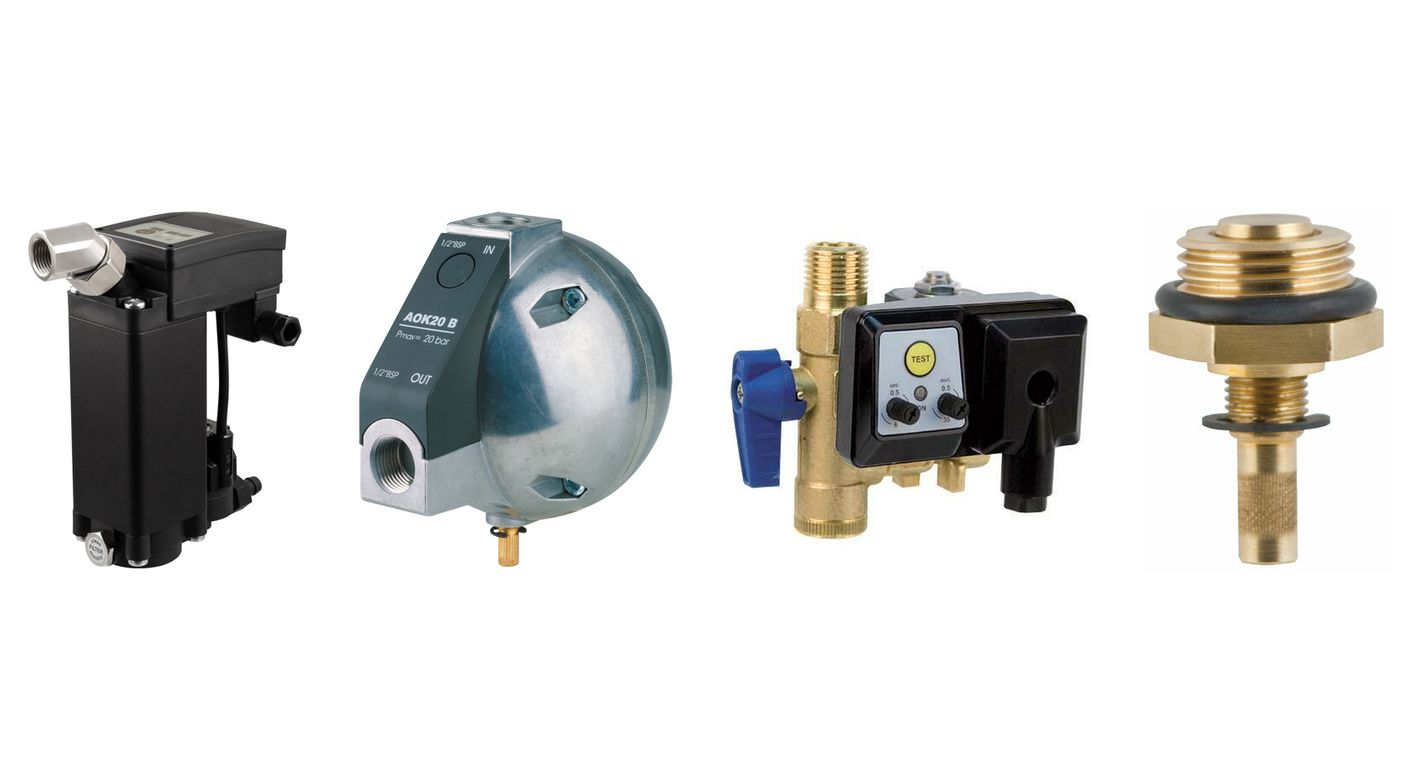
Compressing air produces condensate — a mix of water, oil and dirt. Left in the receiver it rusts the tank from the inside, and the water carries on into the tools and into the paint shop. A drain takes it away on its own, with nobody having to open a valve every day. They differ in how they know there is something to let out — and that is what decides what running them costs you.
Which principle you need
It comes down to where it will hang and whether you have power nearby. Electronic drains let out not one litre of air more than they must, but they need a socket. Float drains manage without electricity. Timed ones are the cheapest, but every opening lets some air out too — how much depends on how you set them.
| Condensate drains by principle — air loss, power supply and placement | |||||
|---|---|---|---|---|---|
| Principle | Series | How it senses condensate | Air loss | Power | Where it goes |
| Electronic | Electronic LD, Electronic AD20 | capacitive sensor watches the level | none | 230 V | receiver, dryer, filter |
| Float | Float AOK, Float B2FD | a float lifts the valve | none | none needed | filter, tank, separator |
| Timed | Timed TD, Timed CTD16 | it cannot — it opens on a clock | depends on the setting | 230 V | anywhere in the pipework |
| Manual | Manual MCD | it cannot — you open it | only what you let out | none needed | filter, tank |
No loss does not mean the valve lets nothing through — it means it shuts before the air can follow the condensate out. On a timed drain that cannot be watched, because it opens blind on the clock.
#showmore#
Why condensate has to be drained
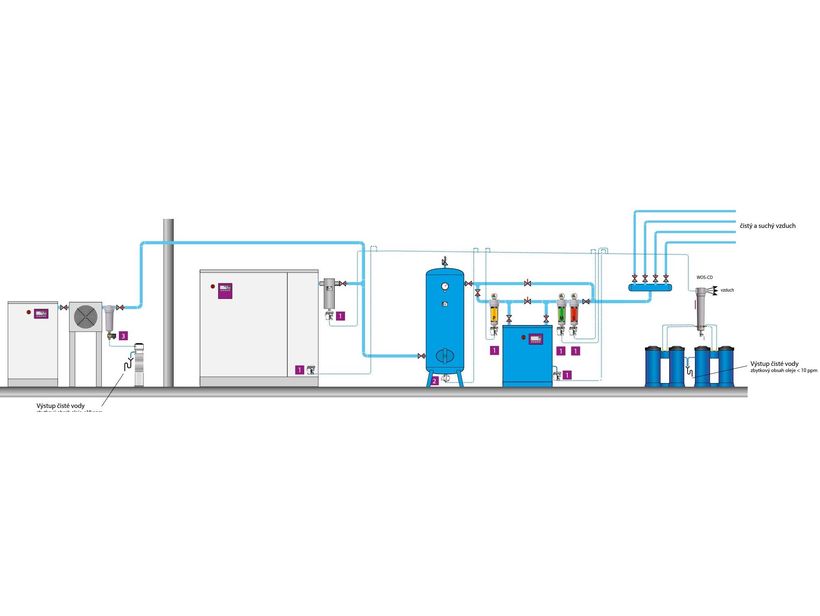
The air a compressor draws in carries moisture. Compression shrinks the volume, concentrates that moisture, and on cooling it drops out as water. On an oil-lubricated machine oil mist joins it, along with dirt from the dust drawn in. Together it is an acidic mix that corrodes from the inside.
There are three kinds of damage and all of them show up later than they start. The receiver rusts from the inside, where nobody can see it. Water travels on into the pipework and washes the lubricant out of air tools. And during spraying it reaches the gun, where it leaves a crater in the paint. That is why condensate is drained from every place it settles.
Where it settles
- receiver — most of it is here — air cools in the tank and the water sinks to the bottom
- dryer — that is its job: to take out moisture that would otherwise travel on
- filters — they catch the oil mist and the droplets that got through
- separators — the cyclone shakes water out of the air stream right behind the compressor
What to watch when choosing
Pressure
The commonest mistake. A high-pressure float will not work at low pressure — it needs at least 10 bar for the valve to shut at all. The other way round, an ordinary 16 bar drain simply will not take 50 bar.
How much condensate
It follows how much air passes through the machine, not the size of the tank. That is why the electronic series give three different figures depending on whether the drain sits on the compressor, on the dryer or in a filter.
Connection
Most fit G 1/2", but filters often take another size. Some models also have a side connection, handy wherever you cannot get at the tank from above.
Electricity
Electronic and timed drains need 230 V. With no socket by the compressor, that leaves a float or a manual drain.
What to do with the condensate
Condensate from an oil-lubricated compressor is hazardous waste — it does not belong in the drain. It goes into an oil/water separator, which holds the oil back and leaves water that may be discharged. On an oil-free machine the condensate is cleaner, but it still tends to be acidic; local rules may require treating that too.
- Oil/water separators — Separators take the water apart from the oil
What we stock
Each principle has its own section with a table of the models and their figures.
- Electronic LD — The LD series watches the level with a capacitive sensor and opens the valve only once there is something to let out — then shuts it before the air can follow the condensate.
- Electronic AD20 — The AD20 is a zero-loss drain with a capacitive sensor made chiefly for filter bowls.
- Timed TD — A timed drain opens on the clock, not on the level.
- Timed CTD16 — The CTD16 is a timed drain with an integrated ball valve — so the valve can be shut by hand without taking the whole line out of service.
- Float AOK — A float drain needs no electricity.
- Float B2FD — The B2FD is a float drain built for filters and preparation units.
- Manual MCD — The simplest way to get condensate out: open it and let it go.
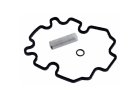
- Service kits — An electronic drain holds a filter screen and seals inside, and both are changed at the annual service.

Ventilek says
Nobody drains the water out of the receiver. That is why receivers rust through.
Folks, hand on heart — who opens the valve under the receiver every day? Quite. And that water stays there, the tank rusts from the inside, and you find out at the next inspection. A drain does it for you and costs a fraction of a new receiver. Two pieces of advice. First: choose by pressure, not by price — a high-pressure float needs at least ten bar or it will not even shut. Second: condensate from an oil-lubricated compressor does not belong in the drain, it belongs in a separator. That is not red tape, it really is hazardous waste.
Frequently asked questions about condensate drains
- Which drain should I choose?
- Three things decide. The pressure in your system — it must not exceed what the drain will take. The place it goes: a receiver, a dryer and a filter each ask for something different. And whether you have power nearby: with no socket, that leaves a float or a manual drain.
- What does „zero-loss" mean?
- That the valve shuts before the air can follow the condensate out. An electronic drain senses with a capacitive probe when the chamber is full and when it is empty, and opens and shuts accordingly. A timed drain cannot tell — it opens on the clock, so when there is nothing to let out, air goes instead.
- How much air does a timed drain lose?
- It depends entirely on the setting. The longer the opening and the shorter the pause, the more air goes out. That is why a timed drain is set by how much condensate you actually produce — and that changes with humidity, load and the season.
- Do I need a drain on a small workshop compressor?
- Condensate forms there too. On a small machine a manual valve or a float drain is enough — what matters is that the water leaves the tank regularly, not once a year.
- Why does one drain have three different flow figures?
- Because it depends where it is fitted. Behind the compressor the condensate is heaviest, on the dryer less, in a filter least — hence the three columns on the electronic series. You choose by where the drain will go, not by the biggest number.
- Can I discharge condensate into the drain?
- Not from an oil-lubricated compressor — it is hazardous waste and belongs in an oil/water separator. Only the water that leaves the separator may be discharged.
- How do I know the drain has stopped working?
- Two ways. Either nothing comes out underneath and the level in the receiver rises — then it is blocked or the sensor has failed. Or it hisses continuously and air escapes — then the valve is not sealing. The electronic series have service kits for exactly this.
The figures follow the manufacturer’s datasheets attached to the individual models. A drain is chosen by the pressure and the amount of condensate in your system — if you are unsure, write and tell us what machine you have and we will go through it with you.



Product sorting
List of products

Service kit for the ECDB-150 condensate skimmer for annual regular maintenance.

Service kit for the ECDB-90 condensate skimmer for annual regular maintenance.

The new range of LD condensate drainers uses a system called capacitive drainage for its function. Compared to traditional time forgiveness, this system has several significant...

Service kit for condensate drainers ECDB-15 and ECDB-40 for annual regular maintenance.

A zero-loss electronic condensate drain with a capacitive sensor for receivers, dryers and filters. It opens only when there is something to let out, so not one litre of...

A zero-loss electronic condensate drain with a capacitive sensor for receivers, dryers and filters. It opens only when there is something to let out, so not one litre of...

A zero-loss electronic condensate drain with a capacitive sensor for receivers, dryers and filters. It opens only when there is something to let out, so not one litre of...

A zero-loss electronic condensate drain with a capacitive sensor for receivers, dryers and filters. It opens only when there is something to let out, so not one litre of...

The LogiDrain LD200 intelligent condensate drainage system with a compressor flow rate of up to 15,000 l/min is a state-of-the-art condensate drainage system with automatic...

The LogiDrain LD203 intelligent condensate drain with a compressor flow rate of up to 158,333 l/min is a state-of-the-art condensate drainage system with automatic operation...

The LogiDrain LD202 intelligent condensate drainage system with a compressor flow rate of up to 30,000 l/min is a state-of-the-art condensate drainage system with automatic...

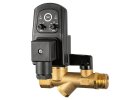
A timed condensate drain with a solenoid valve, an integrated ball valve and a cleanable screen. Adjustable opening and interval, two LEDs and a test button.

A zero-loss electronic condensate drain with a capacitive sensor for receivers, dryers and filters. It opens only when there is something to let out, so not one litre of...

A zero-loss electronic condensate drain for filter bowls. A capacitive sensor watches the level and the opening time adapts to the flow. Supply 230 V AC.

The TD16MR timed drain with a solenoid valve opens at a set interval (0.5–45 min) for a set time (0–10 s). Stainless steel body, 230 V AC, up to 16 bar.

A manual condensate drain for filters, pressure vessels and cyclone separators. Stainless steel build, with no electronics and no moving parts that could seize.

A float condensate drain for filters, pressure vessels and cyclone separators. It works mechanically, without electricity and without setting. Body made of stainless steel.

A float condensate drain for filters, pressure vessels and cyclone separators. It works mechanically, without electricity and without setting. Body made of brass.

A float condensate drain for filters, pressure vessels and cyclone separators. It works mechanically, without electricity and without setting. Body made of stainless steel.

A zero-loss electronic condensate drain with a capacitive sensor for receivers, dryers and filters. It opens only when there is something to let out, so not one litre of...

The TD150M timed drain with a solenoid valve opens at a set interval (0.5–45 min) for a set time (0–10 s). Brass body, 230 V AC, up to 150 bar.

The TD25M timed drain with a solenoid valve opens at a set interval (0.5–45 min) for a set time (0–10 s). Brass body, 230 V AC, up to 25 bar.

The TD420M-230VAC timed drain with a solenoid valve opens at a set interval (0.5–45 min) for a set time (0–10 s). Stainless steel body, 230 V AC, up to 420 bar.

The TD420M-24VDC timed drain with a solenoid valve opens at a set interval (0.5–45 min) for a set time (0–10 s). Stainless steel body, 24 V DC, up to 420 bar.

The TD50M timed drain with a solenoid valve opens at a set interval (0.5–45 min) for a set time (0–10 s). Brass body, 230 V AC, up to 50 bar.