
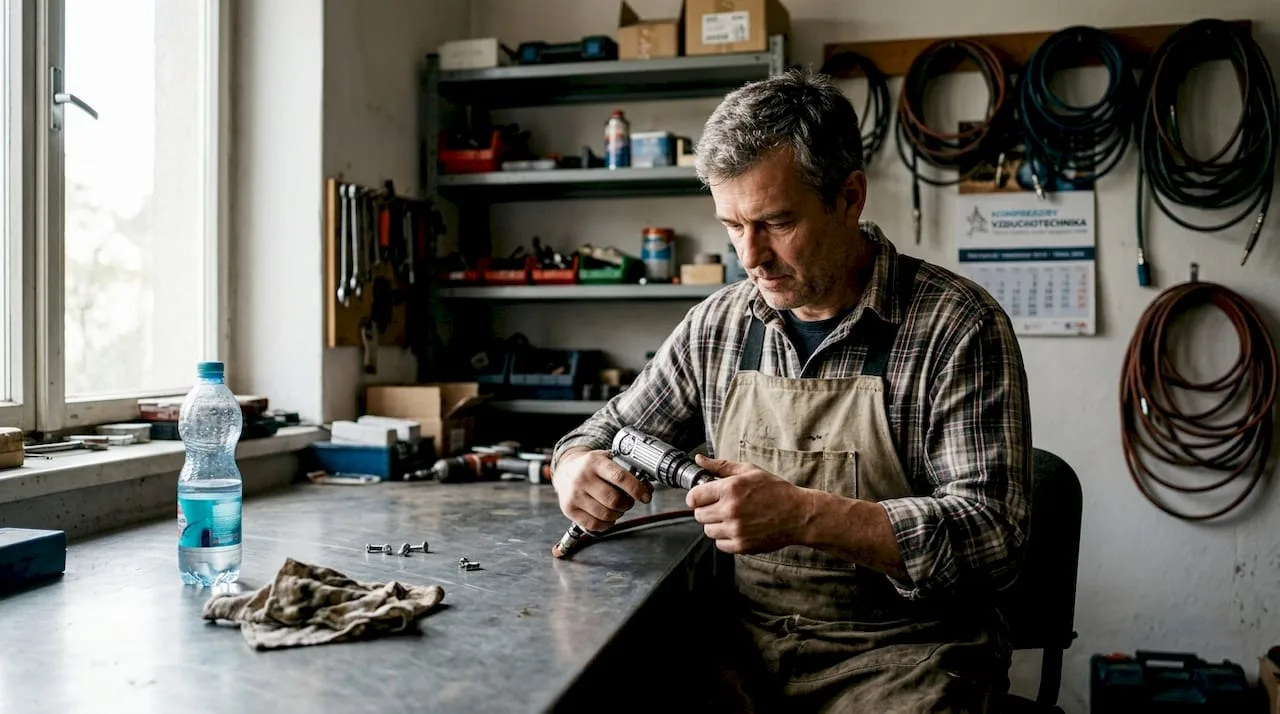
A badly secured hose under a pressure of 8 bar can tear off and cause a serious injury within a fraction of a second. This is not a theoretical scenario, but the reality that workers in car services and on building sites meet every year. Pneumatic tools offer high performance, speed and reliability, but only when they are used correctly. This article summarises specific procedures for preparation, pressure setting, handling of hoses and maintenance of the tools.
Key findings
| Point | Details |
|---|---|
| Check of the equipment | Before every use check the tools, hoses and couplings for damage. |
| Setting of the pressure | Optimise the air pressure according to the type of tool (typically 5–8 bar). |
| Securing of the hoses | Use clamps and safety couplings to prevent slipping off. |
| Regular maintenance | Observing the standard ČSN EN ISO 4414 extends the service life and protects health. |
| A stable grip | Handle the tool with both hands to eliminate the risk of kickback. |
Basic requirements and preparation before use
Preparation is not a formality, but the basis of safe work. Before use always check the visual condition of the whole system. Any cracks, abrasion or deformation of the hoses are a reason for immediate replacement. The correct preparation of the working space includes free space around the workplace, a stable floor and sufficient ventilation, especially in enclosed spaces where escaping air can stir up dust.
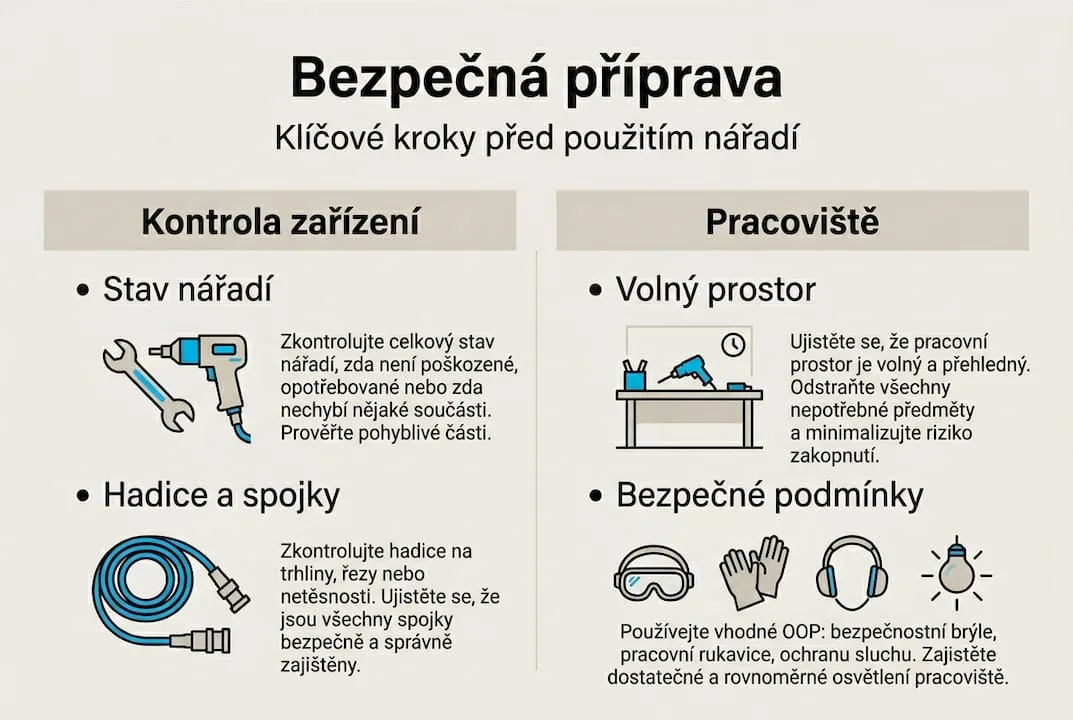
Checklist before starting work:
- Visual check of the hoses for cracks and abrasion.
- Verification of the condition and tightness of the quick couplings.
- Check of the pressure manometer and the safety valve on the compressor.
- Verification that the set pressure corresponds to the requirements of the specific tool.
Professional tip: Before disconnecting the air supply always first release the pressure from the hose by running the tool empty. Never disconnect a hose under pressure, it risks being uncontrollably "shot out".
Setting the correct pressure and the air system
Air pressure is a key parameter. Too high a pressure does not lead to higher output, but to extreme wear and the risk of an accident. Set the working pressure exactly according to the instructions for the tool, usually in a range of 5 to 8 bar.
| Type of tool | Recommended pressure (bar) | Maximum limit (bar) |
|---|---|---|
| Pneumatic screwdriver | 5,5 to 6,5 | 7 |
| Pneumatic grinder | 6 to 6,5 | 8 |
| Riveting gun | 5 to 7 | 8 |
| Pneumatic hammer | 6 to 7 | 8 |
The cleanliness of the air is also important. Air containing moisture or residues of oil destroys the internal mechanisms. The installation of a filter and a condensate separator is a necessity in professional operation.
Safe connection and handling of hoses
The hose is the most vulnerable part of the system. It must always be secured on the nipple with a clamp against slipping off. Quality quick couplings with a safety mechanism are the standard which minimises the risk of unintended disconnection under pressure.

Principles of safe handling:
- Do not drive over hoses with a vehicle and do not lay them across sharp edges.
- The hose must not be twisted or kinked, which limits the flow and damages the material.
- After finishing work vent the hose and roll it up without loops away from sources of heat.
Professional tip: Use safety cables (so-called whip checks), which connect the hose with the compressor or the tool and prevent its "whipping" in the event of failure of the joint.
Verification of safety and maintenance of the tools
The correct clamping of the tool in the chuck or collet is critical for eliminating vibrations and kickback. The tool must be clamped to the recommended depth without any play. For professional plants in the Czech Republic observing the standard ČSN EN ISO 4414, which specifies the requirements for the safety of pneumatic systems, is binding.
| Maintenance operation | Interval | Responsibility |
|---|---|---|
| Visual check of the condition | Before every use | Operator |
| Lubrication of the moving parts | According to the manufacturer’s instructions | Operator |
| Replacement of the air filters | According to contamination | Maintenance |
| Overall inspection of the system | Annually | Expert service |
Safety in practice: Watch out for routine
The greatest enemy of safety is routine and fatigue. In repeated activities attention falls and check steps start to be skipped. The risk of kickback when the tool (e.g. a drill bit) jams always requires a firm grip with both hands and a stable stance. We recommend introducing short check pauses during longer intensive work to verify the tightness of the joints.
Equipment for safe work
Increasing safety begins with quality components. At Kompresory-vzduchotechnika.cz we offer proven equipment for professionals.
In our offer you will find gun sets with safety attachments, air treatment units resistant up to 18 bar and a complete range of M7 pneumatic tools. All products meet strict safety standards for deployment in demanding conditions in automotive and construction alike.
Frequently asked questions
What pressure is optimal for ordinary tools?
Usually it is 5 to 8 bar. Always follow the data on the label of the tool and do not exceed the maximum, so as to prevent damage to the seals.
How to prevent a hose from slipping off?
Secure the hose with a clamp on every nipple and use quality quick couplings with a safety catch.
How often should maintenance of the tools be carried out?
A basic check before every switching on. An overall inspection at an authorised service we recommend at least once a year.
How to minimise the risk of kickback?
Always hold the tool with both hands, keep a stable stance and when working with drills or hammers count on the possibility of the tool suddenly jamming.
Which standards regulate safety in the Czech Republic?
The key one is the standard ČSN EN ISO 4414, which defines the safety requirements for components and the operation of pneumatic equipment.