
TL;DR:
- Up to 30 percent of operating outages of compressors arise because of a bad choice or neglected maintenance of the electric motor. The right choice of type and size and regular maintenance of the electric motor are the key to efficient and reliable operation of a compressor. Modern motors with a higher efficiency and intelligent control reduce energy costs and extend the service life of the equipment.
Up to 30 % of operating outages of industrial compressors arise because of a bad choice or neglected maintenance of the electric motor. Yet in practice the electric motor is still an underestimated component. Specialists deal with pressure, flow and the air receiver, but the motor tends to be taken for granted. This article brings an overview of the types of electric motor, their key parameters and practical impacts on the operation of a compressor. The aim is to provide technically precise information which will help optimise the choice, deployment and maintenance of an electric motor in an industrial environment.
Contents
- The basic principle: why the electric motor is key for the function of a compressor
- Types of electric motor used in industrial compressors
- The influence of the electric motor on the efficiency, maintenance and service life of a compressor
- Faults of the electric motor in a compressor and their solution
- A practical view: what specialists often do not realise when choosing an electric motor
- Expert solutions, components and service – your route to a reliable compressor
- Frequently asked questions
Key findings
| Point | Details |
|---|---|
| The electric motor is the core of the compressor | Without a quality motor a compressor cannot achieve the required efficiency or service life. |
| The type of motor influences the output | The right choice of type and output of the electric motor determines the suitability and operating savings in industry. |
| Maintenance extends the service life | Regular and correct maintenance of the electric motor fundamentally reduces the risk of faults and extends the period of fault-free operation. |
| Typical faults can be detected in time | By following the basic symptoms and with regular maintenance most accidents of electric motors in a compressor can be prevented. |
The basic principle: why the electric motor is key for the function of a compressor
An electric motor converts electrical energy into mechanical energy to drive the compressor unit. This conversion takes place in every cycle of the compressor, and therefore even small losses of efficiency of the motor have a direct impact on the overall operating costs. The motor is not just a drive, it is the basis of the whole energy balance of the equipment.
The output of the electric motor is stated in kilowatts (kW) and must correspond to the required working pressure (bar) and flow of air (l/min or m³/min). An undersized motor works permanently at the limit of its possibilities, overheats and degrades quickly. An oversized motor conversely unnecessarily increases the purchase as well as the operating costs.
In industrial practice we most often meet two basic types of electric motor:
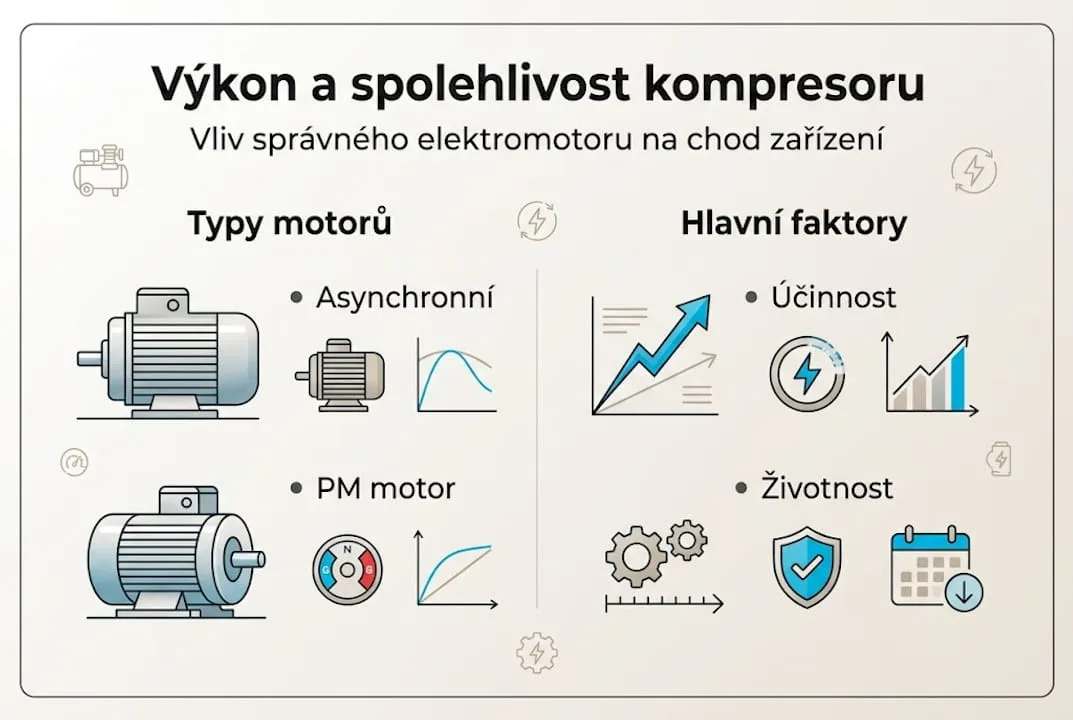
- Asynchronous motors (induction): The most widespread choice for compressors. Simple, robust, cheap to purchase and maintain. The revolutions change slightly with the load, which is acceptable in most compressor applications.
- Synchronous motors: The revolutions are constant regardless of the load. Suitable for applications requiring precise regulation, for example with screw compressors with a frequency converter.
- Motors with permanent magnets (PM motors): A modern alternative with a high efficiency even under partial load. They are increasingly deployed in energy-intensive plants.
A correct matching of the electric motor with the compressor unit can reduce energy consumption by 10 to 20 % compared with an unsuitably dimensioned solution.
When choosing the output of the motor it is necessary to take into account not only the nominal output of the compressor, but also the starting currents, the operating cycle (duty cycle in percent) and the conditions of the environment, such as temperature and altitude. Each of these factors influences the thermal stress of the motor and its long-term reliability.
Professional tip: When designing a new installation always ask the manufacturer of the compressor for a recommendation of the efficiency class of the motor (IE2, IE3, IE4). Motors of class IE3 and higher are today obligatory in the EU for outputs above 0.75 kW and bring demonstrable energy savings.
The role of the electric compressor in industrial operation is therefore directly dependent on the right choice and setting of the electric motor. Ignoring this relationship leads to energy losses, premature faults and unnecessary spending on service.
Types of electric motor used in industrial compressors
The choice of the right type of electric motor depends on the specific application, the required efficiency and the operating conditions. The choice of the right motor is fundamental according to the application and the possibilities of energy saving. Every type has its specifics, advantages and limitations.
| Type of motor | Efficiency | Controllability | Typical deployment | Purchase costs |
|---|---|---|---|---|
| Asynchronous (squirrel cage) | IE2/IE3 | Limited | Piston compressors, fans | Low |
| Synchronous with exciter | High | Good | Large industrial compressors | Medium to high |
| PM synchronous | IE4/IE5 | Excellent | Screw compressors with VFD | High |
| Reluctance (SynRM) | IE4 | Good | Modern industrial applications | Medium |
Asynchronous squirrel cage motors dominate the market thanks to their simplicity and the availability of spare parts. A disadvantage is the drop in efficiency under partial load, which is a problem with compressors with a variable consumption of air.
Synchronous motors with permanent magnets (PMSM) offer a considerably higher efficiency across the whole range of load. That is key with screw compressors, where the load changes during the day. Their disadvantage is the higher price and the necessity of using a frequency converter (VFD).
When choosing the type of motor proceed systematically:
- Determine the required flow of air and the working pressure for the given application.
- Establish the operating cycle, that is the ratio of running time to idle time.
- Evaluate the variability of the consumption of air, whether it is constant or fluctuating.
- Compare the efficiency classes and calculate the return on an investment in a higher IE class.
- Verify the compatibility of the motor with the control system of the compressor and a possible frequency converter.
For industrial plants with a high consumption of air and a variable load, an investment in a PM motor with a VFD is as a rule returned within 2 to 4 years. For smaller applications with a constant load a quality asynchronous motor of class IE3 is enough. The efficiency of two-stage compressors is directly dependent on a correctly chosen motor, because two-stage compression places higher demands on an even torque.
An important parameter is also the protection of the motor (IP degree). In a dusty or damp environment IP55 is the minimum, in an aggressive environment IP65 or higher. Underestimating this parameter leads to premature degradation of the insulation of the winding.
The influence of the electric motor on the efficiency, maintenance and service life of a compressor
Correct care of electric motors fundamentally influences energy consumption and operating costs. A quality motor in good technical condition works with an efficiency over 95 %, while a neglected motor of the same output can have an efficiency below 88 %. In continuous operation the difference shows up on the electricity bill very quickly.
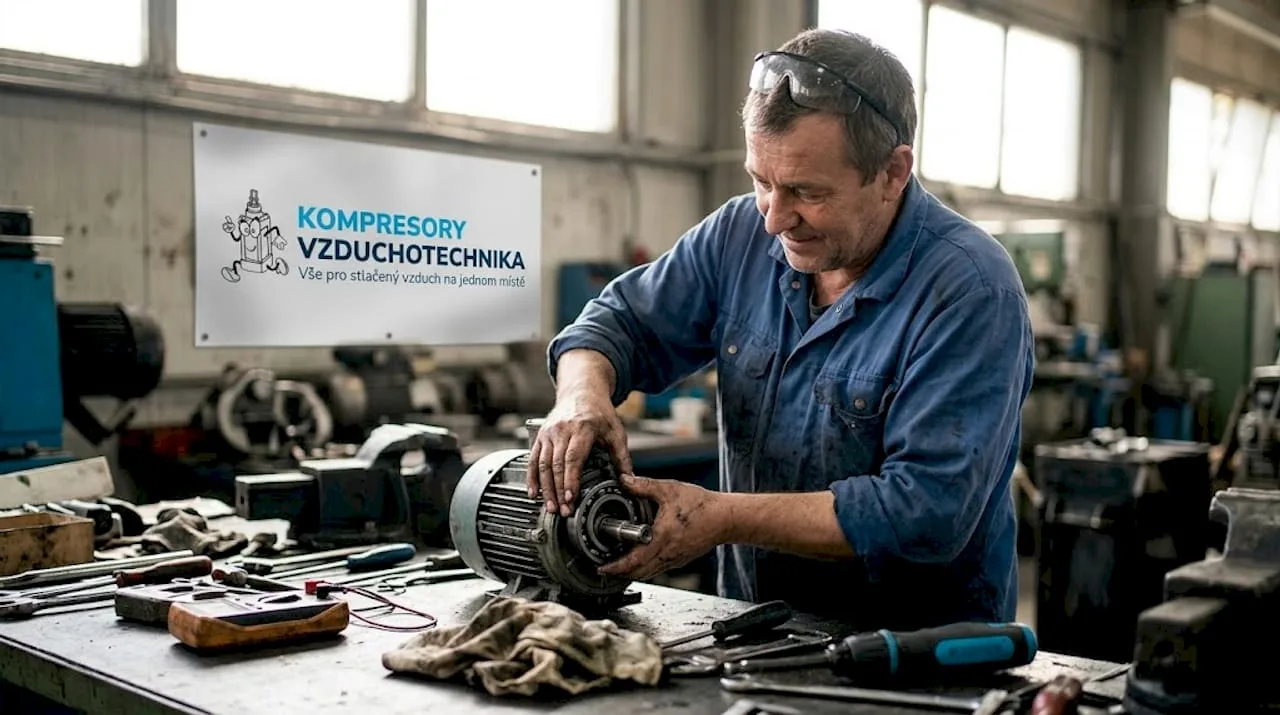
The following table shows the typical impacts of various states of the electric motor on the operation of a compressor:
| State of the motor | Efficiency | Risk of fault | Impact on costs |
|---|---|---|---|
| New, correctly dimensioned | 93 to 96 % | Low | Optimal |
| After 5 years without service | 88 to 91 % | Medium | +8 to 12 % of consumption |
| Undersized | 80 to 86 % | High | +15 to 25 % of consumption |
| Damaged insulation of the winding | Below 80 % | Very high | An outage of operation is a risk |
Regular maintenance of an electric motor includes several key actions:
- Lubrication of the bearings: According to the instructions of the manufacturer, as a rule every 2 000 to 4 000 operating hours. Insufficient or excessive lubrication are equally harmful.
- Checking the insulation resistance of the winding: Measurement with a megohmmeter at least once a year. A drop below the recommended value signals degradation of the insulation.
- Cleaning the cooling channels and the fan: Blocked cooling is the most frequent cause of overheating of the motor.
- Checking the terminal box and the electrical connections: Loose connections cause contact resistances, local overheating and faults.
- Measuring vibrations and noise: A change of the vibration profile indicates wear of the bearings or an imbalance of the rotor.
Professional tip: Record the results of every check in the operating log of the compressor. The trend of worsening values reveals an approaching fault before it causes an unplanned outage. Modern compressors with intelligent control offer this function automatically.
Observing the safety rules for work with a compressor is obligatory during service work on an electric motor. Before any intervention it is necessary to disconnect the power supply and secure the equipment against unintended starting.
An undersized motor works permanently at a high load, the winding overheats and the insulation degrades faster. The result is a shortened service life, frequent outages and high repair costs. A correctly dimensioned and maintained motor on the contrary works reliably for 15 to 20 years.
Faults of the electric motor in a compressor and their solution
Typical defects include wear of the bearings, problems with the winding and overloading. Each of these defects has characteristic symptoms which allow timely diagnosis. Knowledge of these symptoms is the basis of preventive maintenance.
Typical symptoms of faults of an electric motor in a compressor:
- Increased vibrations: Wear of the bearings, imbalance of the rotor or loose mounting of the motor.
- Unusual noise: A metallic sound signals a bearing defect, a humming can indicate a problem with the winding or the power supply.
- A smell of burnt insulation: Overheating of the winding, as a rule caused by overloading or bad cooling.
- A drop in the output of the compressor: The motor does not deliver sufficient torque, the cause can be a damaged winding or a problem with the power supply.
- Excessive heating of the body of the motor: Overloading, blocked cooling or a fault of the fan.
The prevention of faults of an electric motor rests on three pillars: correct installation, regular checks and ensuring adequate cooling. During installation it is necessary to pay attention to precise axial alignment of the motor with the compressor unit. Misalignment causes increased vibrations and premature wear of the bearings and the shaft seals.
The procedure for solving common faults:
- Stop the compressor and disconnect the power supply.
- Visually check the motor, the terminal box and the cooling system.
- Measure the insulation resistance of the winding with a megohmmeter.
- Check the state of the bearings by listening and by measuring vibrations.
- Verify the correctness of the supply voltage and the symmetry of the phases.
- If the defect persists or is beyond your competence, contact an expert service.
Professional tip: An asymmetry of the supply voltage of a mere 2 % causes a rise in the current in the winding of 6 to 10 %. Regularly measure the supply voltage at the terminals of the motor, especially in plants with an unstable network.
An expert service is essential when damaged insulation of the winding or mechanical damage to the rotor or stator is found and with repeated faults without an obvious cause. The most frequent mistakes in using compressors also include underestimating the first symptoms of a fault of the motor, which leads to considerably higher repair costs.
A timely reaction to the symptoms of a fault is always cheaper than a repair after the complete failure of the motor. A preventive replacement of the bearings costs a fraction of the cost of repairing the winding after an accident caused by their failure.
A practical view: what specialists often do not realise when choosing an electric motor
In practice one pattern repeats itself: specialists devote great attention to the parameters of the compressor, but take the correct dimensioning of the motor for granted. Yet the quality of the power supply, the stability of the network and harmonic distortion have a direct influence on the service life of the motor and its efficiency. Operation in a network with pronounced harmonics causes additional thermal losses in the winding, which manufacturers of motors do not include in the standard specifications.
Another overlooked factor is the dependence of the efficiency of the whole system on the technological chain. A motor working with an unsuitably designed distribution of compressed air or outdated filters loses part of its efficiency without any defect of its own. A system is always as efficient as its weakest link is efficient.
Modern intelligent control and remote diagnostics of motors make it possible to follow trends of vibrations, temperature and energy consumption in real time. These data are the basis of predictive maintenance, which significantly reduces unplanned outages. An investment in intelligent control returns faster than most operators expect.
Expert solutions, components and service – your route to a reliable compressor
Knowledge of the electric motor is the basis, but the right solution also requires the corresponding technology. At Kompresory-vzduchotechnika.cz we offer industrial equipment with proven electric motors for demanding applications.
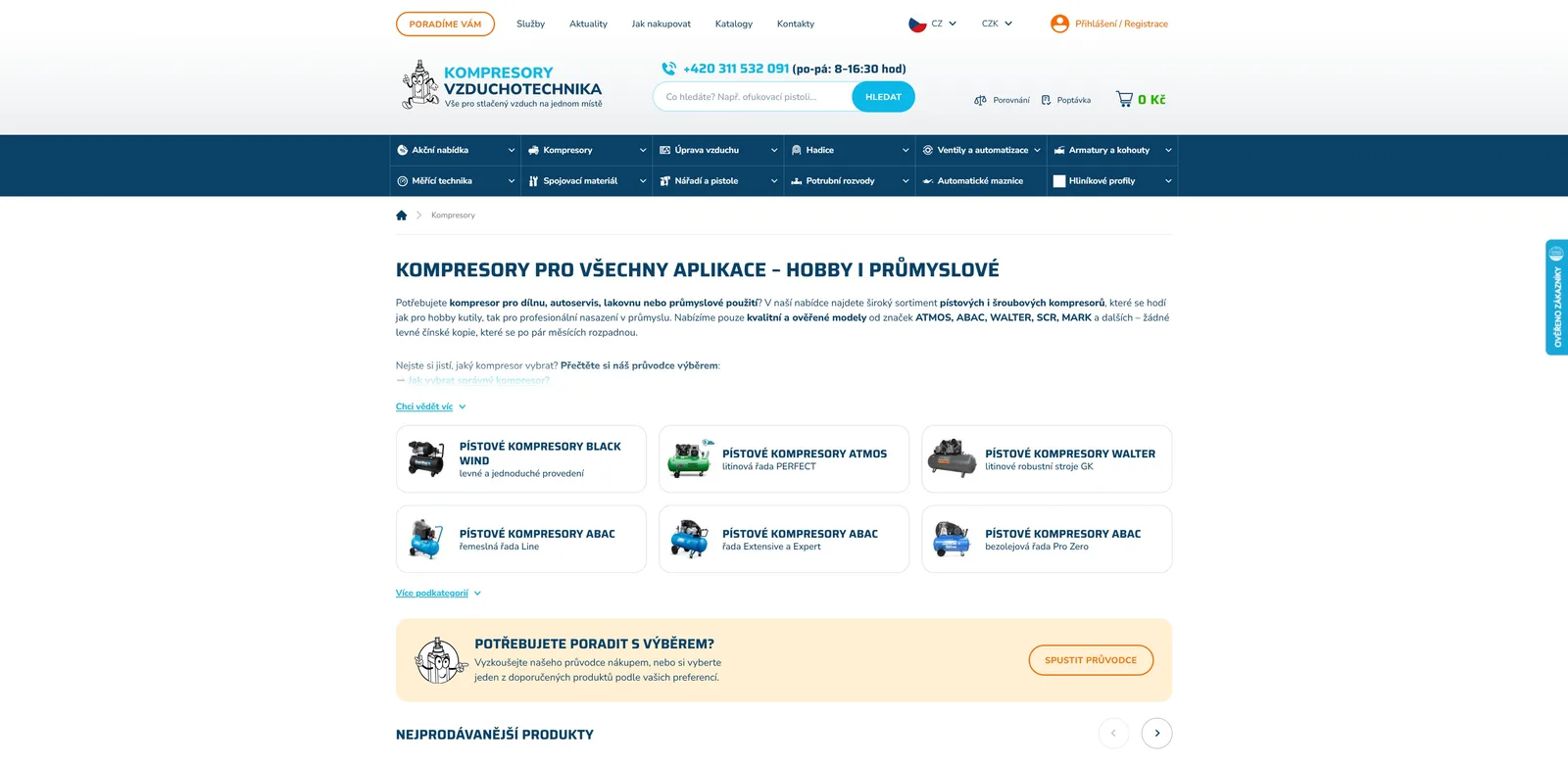
In the offer you will find top MARK compressors with motors of class IE3 and higher, intended for continuous industrial operation. For applications with a variable consumption of air SCR screw compressors with an integrated frequency converter and PM motor are ideal. If you are looking for specific data on the energy savings with an SCR compressor, you will find them directly on the product pages. We are available for individual consultation on the choice of technology and for technical support during deployment.
Frequently asked questions
How do I recognise the suitable type of electric motor for my compressor?
The choice of the right motor depends on the required output, efficiency and operating load. Consult the choice with the manufacturer of the compressor or an expert supplier.
How often is it necessary to carry out maintenance of the electric motor in a compressor?
Carry out a complete service at least once a year. With intensive operation check the key components, such as the bearings and cooling, every 500 to 1 000 operating hours. Correct care of electric motors directly influences energy consumption and operating costs.
What most frequently causes a fault of the electric motor in a compressor?
Typical causes are wear of the bearings, overheating of the winding and neglected maintenance. Wear of the bearings and overloading are among the most frequently diagnosed defects.
What are the signs that the electric motor in a compressor is not working correctly?
Vibrations, increased noise, a smell of burnt insulation, excessive heating or a drop in the output of the compressor are clear signals of a possible defect. Each of these symptoms requires an immediate check.
Why should the output of the electric motor be correctly matched with the compressor?
Unsuitable dimensioning leads to increased operating costs, frequent faults and a loss of efficiency. The electric motor determines the output and the energy efficiency of the whole compressor, so a bad choice shows up immediately on the bill and in reliability.