
TL;DR:
- Stepless pressure regulation makes dynamic adaptation possible and increases the stability of systems.
- Proportional valves with feedback and control units represent the key elements of this technology.
- The introduction of stepless regulation reduces energy consumption, extends the service life of the components and increases safety.
A simple pressure regulator is not enough everywhere. In industrial applications where the requirements on pressure change in the order of milliseconds, a step change of pressure causes instability of the whole system, wear of the components and safety risks. Stepless pressure regulation brings a different approach: instead of a fixed set value the system reacts continuously to the current state and adjusts the pressure as needed. This article explains the technical basis of stepless regulation, describes the key technologies and specific industrial applications and points out aspects which most often escape attention when designing a system.
Contents
- Definition and principle of stepless pressure regulation
- Technologies and mechanisms for stepless regulation
- Advantages of stepless regulation in industry and construction
- Practical use of stepless pressure regulation in automated lines
- Our view: what most specialists overlook when choosing regulation
- A solution for stepless pressure regulation – a tailored offer
- Frequently asked questions
Key findings
| Point | Details |
|---|---|
| Proportional valves | They make stepless and precise pressure control possible thanks to feedback and solenoids. |
| A closed control loop | Integration with a PLC supports maximum accuracy even in dynamic applications. |
| Efficiency and safety | Stepless regulation reduces risk and costs and extends the service life of systems. |
| Practical use | It significantly improves the performance of automated production lines and complex construction solutions. |
Definition and principle of stepless pressure regulation
Stepless pressure regulation denotes a method of control in which the output pressure in a pneumatic system changes steplessly and continuously, not in steps. While a classic mechanical regulator keeps the pressure at a fixed set value, stepless regulation makes dynamic adaptation to the current requirements of the process possible. That is fundamental in applications where the load or flow changes over time.
The technical basis are proportional valves. These valves regulate the flow or pressure of air depending on the magnitude of the electrical control signal, most often 0 to 10 V or 4 to 20 mA. Proportional valves use an electrical signal and feedback for precise regulation, whereby they differ fundamentally from standard two-position valves, which are either fully open or closed.
Feedback is the key element of the whole system. A pressure sensor measures the current value at the output and sends a signal to the control unit. The control unit compares the measured value with the required one (setpoint) and adjusts the position of the valve so that the deviation is minimised. This principle is called a closed control loop (closed-loop control).
For better orientation in the principles of pneumatic systems it is useful to know the basic block diagram of regulation:
| Element | Function |
|---|---|
| Control unit (PLC) | Generates the required value of pressure |
| Proportional valve | Adjusts the flow of air |
| Pressure sensor | Measures the current output pressure |
| Feedback loop | Compares the actual and the required value |
The main differences compared with a traditional regulator:
- A classic regulator: a fixed set value, a mechanical spring, no electronic feedback
- A proportional valve: electronic control, a stepless change of pressure, a fast reaction to a change of load
- Stepless regulation: the ability to follow a variable setpoint in real time
Stepless pressure regulation is not only about accuracy. It is about the ability of the system to react to changes faster than a human operator is able to intervene.
Understanding this principle is the basis for the right choice of components and the design of the whole pneumatic circuit. The efficiency of pneumatics depends precisely on how precisely the pressure is controlled at every point of the system.
Technologies and mechanisms for stepless regulation
After the definition we will focus on the specific technologies and mechanisms which make the regulation possible. The market offers several approaches, each with different properties and suitability for specific applications.
Solenoid valves with PWM control are the simplest variant. Fast switching (pulse width modulation) simulates a stepless change of flow. They are cheap, but have a limited accuracy and a higher noise level. Suitable for less demanding applications.
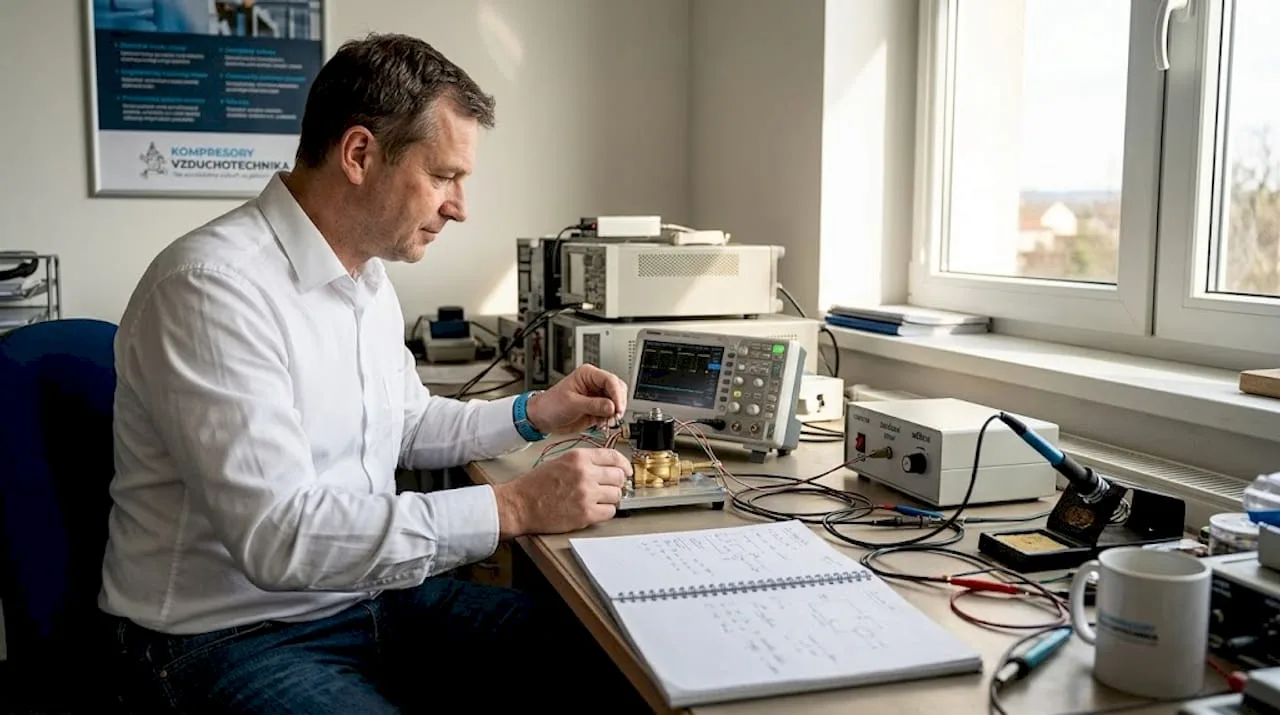
Proportional solenoid valves work with an analogue control signal. The position of the spool of the valve is directly proportional to the magnitude of the signal. They achieve an accuracy of regulation in the order of single percent, and proportional regulation is key for dynamic applications in industry, while integration with a PLC ensures the closed loop.
Pressure sensors are an essential part of every system with a closed loop. The choice of sensor depends on the range of pressures, the required accuracy and the resistance to the environment. For industrial applications sensors with an output of 4 to 20 mA or a digital IO-Link interface are used.

A comparison of regulation technologies:
| Technology | Accuracy | Price | Suitability |
|---|---|---|---|
| Mechanical regulator | Low | Low | Simple applications |
| Solenoid with PWM | Medium | Medium | Less demanding processes |
| Proportional valve | High | Higher | Industrial automation |
| Servo-pneumatics | Very high | High | Robotics, precision production |
The procedure for integrating a proportional valve into a system:
- Define the range of required pressures and the speed of changes
- Choose a pressure sensor with a corresponding range and accuracy
- Choose a proportional valve compatible with the control signal of the PLC
- Set the PID controller in the PLC for optimal dynamics
- Carry out a calibration and verify the response of the system under various loads
When designing it is necessary to take into account the influence of variable pressure on the overall efficiency of the system. An unstable pressure causes fluctuation of the performance of the actuators and shortens the service life of the seals.
Professional tip: The integration of a proportional valve with a PLC requires the correct setting of the PID parameters. Too aggressive a setting causes oscillations of pressure, too slow a setting leads to overshoot. We recommend starting with conservative values and gradually optimising on the real process. Also do not forget pneumatic automation as a whole: the valve is only one element in the chain.
An important part of the design are also safety valves, which protect the system from exceeding the maximum permitted pressure in the event of a failure of the control electronics.
Advantages of stepless regulation in industry and construction
Once we know the technologies, we can look at the specific benefits in practice. Stepless pressure regulation brings not only technical advantages, but has a direct impact on operating costs and safety.
Accuracy and repeatability of the process are the primary benefits. Stepless regulation makes high accuracy possible thanks to the closed loop, which means that every working cycle runs under identical conditions. In pressing or assembly operations that directly influences the quality of the product.
The key advantages in industrial practice:
- Reduction of energy consumption: The system delivers only as much pressure as is currently needed. Excess pressure means unnecessary consumption of the compressor.
- Extension of the service life of the components: The elimination of pressure surges reduces the stress on seals, hoses and actuators. A smaller number of faults means lower maintenance costs.
- Operational safety: Precise control of pressure prevents exceeding the permitted values on sensitive tools or fixtures.
- Flexibility of production: One system can be adapted to various production recipes without a mechanical rebuild.
- Traceability of the process: Electronic records of pressure values make auditing and analysis of quality possible.
Statistics: Systems with proportional regulation achieve in industrial applications an energy saving of 15 to 30 % compared with systems with a fixed set pressure, because they eliminate over-pressurisation in periods of lower load.
In construction the situation is specific. Pneumatic tools work in a demanding environment with a variable length of hoses and various devices connected at the same time. Stepless regulation ensures that every tool gets the right pressure regardless of what is connected on other branches of the distribution.
Professional tip: When choosing sensors for stepless regulation choose a sensor with a range at least 1.5 times higher than the maximum working pressure of the system. A sensor working permanently at the limit of its range degrades faster and loses accuracy. For construction applications prefer sensors with protection IP67 or higher.
For the correct function of the whole system mini units for air treatment are also key, which ensure the cleanliness and correct humidity of the compressed air before it enters the control circuit. Contaminated air causes premature wear of the proportional valves. Equally important is an efficient air receiver, which dampens pressure surges and stabilises the supply.
Practical use of stepless pressure regulation in automated lines
After analysing the advantages we will focus on the specific applications where stepless pressure regulation excels. Automated production lines are the environment where its benefit shows itself most clearly.
Assembly lines with various production recipes are a typical example. Every type of product can require a different pressure for pressing, tightening or forming. Proportional regulation makes it possible to switch to a different value of pressure by merely changing a parameter in the PLC, without a physical intervention by the operator.
Painting and coating processes are extremely sensitive to the stability of pressure. A fluctuation of pressure of a mere 0.1 bar causes uneven application and rejects. The integration of stepless regulation with production systems makes high flexibility and accuracy possible, which is critical in these applications.
Robotic applications require precise control of the force of pneumatic actuators. Stepless pressure regulation makes a software setting of the gripping or contact force possible without replacing mechanical components.
Typical problems and their solution:
- Instability of pressure when starting the line: The cause is an insufficient capacity of the air receiver or too fast a setting of the PID. Solution: increase the volume of the air receiver, slow down the dynamics of the controller.
- Oscillations of pressure during operation: Usually caused by an incorrect setting of the PID or resonance of the piping. Solution: add a damping volume, retune the PID.
- A slow response to a change of setpoint: Too small a cross-section of the valve or long piping. Solution: choose a valve with a higher flow coefficient Kv.
- Drift of the sensor: The sensor loses its calibration through the influence of temperature or vibrations. Solution: regular calibration, the choice of a sensor with temperature compensation.
For industrial installations metal treatment units are suitable, able to work up to 18 bar, which ensure the treatment of the air before it enters the control circuit. For robust applications in production lines treatment units of the I8 series are intended, designed for continuous operation in demanding conditions.
The correct connection of the valves in a line must respect the order: filter, regulator, automatic lubricator (if required), and only then the proportional valve. The opposite order causes contamination of the proportional valve and its premature failure.
Our view: what most specialists overlook when choosing regulation
After the practical applications it is time to think about what often escapes attention in practice. When designing systems of stepless regulation most of the discussion revolves around the choice of the valve and the sensor. That, however, is only part of the problem.
The most frequently overlooked factor is the speed of reaction of the whole system, not just of the valve itself. The valve may have a response time of 20 ms, but if it is connected at the end of 10 metres of piping with a small cross-section, the real response of pressure at the place of consumption will be many times slower. This difference between the specification of the valve and the real response of the system causes problems which are difficult to diagnose.
The second overlooked aspect is the quality of the control signal. Integration with a PLC makes a closed control loop for high accuracy possible, but only if the analogue signal is free of interference. Electromagnetic interference from frequency converters or welders near the cabling causes trembling of the valve and instability of pressure. Shielding of the cables and correct earthing are just as important as the choice of the valve.
The third factor is the analysis of the real requirements of the process before choosing the technology. Many installations use proportional valves where a simple adjustable regulator would be enough, and vice versa. A detailed analysis of the dynamics of the process, the range of pressures and the required accuracy saves costs as well as complications during commissioning. More about variable pressure in practice will help in correctly setting the requirements.
A solution for stepless pressure regulation – a tailored offer
After the expert opinion we will recommend a specific solution for stepless pressure regulation. The right regulation begins at the source of compressed air and continues through the treatment of the air to the end elements.
For industrial applications requiring stable and clean air we offer screw compressors with stepless regulation of output, which ensure a constant pressure even with variable consumption. Before entry into the control circuit the correct treatment of compressed air using filters and regulators is necessary. For the distribution of air around the hall or building site pipe distribution with minimal pressure losses are available. Contact us for individual consultation and the choice of components exactly for your application.
Frequently asked questions
How does a proportional valve work in stepless pressure regulation?
Proportional valves use a solenoid controlled by an electrical signal and feedback from sensors, which makes stepless and precise control of pressure without step changes possible.
Where is stepless pressure regulation essential?
It is fundamental in applications of automation and robotics, where rapid changes of pressure occur. Proportional regulation is key for dynamic industrial applications, where ordinary regulation is not enough.
What advantages does stepless regulation bring in construction?
It increases safety and efficiency and extends the service life of the components. Stepless regulation eliminates fluctuations of pressure and ensures a stable performance of the tools with various lengths of hose and various numbers of connected devices.
What is the basic technical element of stepless regulation?
The key are proportional valves complemented by pressure sensors and control via a PLC. Proportional valves and a PLC make a closed loop for a high accuracy of regulation in real time possible.
Recommended
- How variable pressure influences the efficiency of pneumatic systems - Kompresory-Vzduchotechnika.cz
- Why use pneumatics: efficiency, speed and safety - Kompresory-Vzduchotechnika.cz
- What pneumatic automation is: a guide for industry - Kompresory-Vzduchotechnika.cz
- Decompressor: a key function in industrial pneumatics - Kompresory-Vzduchotechnika.cz