
TL;DR:
- The right choice of pneumatic hoses depends on the material, length and technical parameters.
- The use of an unsuitable hose can lead to losses of pressure, damage or a danger to safety.
- Regular checking and correct installation extend the service life of the system and minimise faults.
A badly chosen pneumatic hose can stop a whole car service. Bursting under pressure, a leak of air in the paint shop or an incompatible connection to a pneumatic tool are problems which cost time, money and in extreme cases endanger the safety of the workers. The choice of the right hose is not a routine matter, but a technical decision with a direct impact on operation. This guide clearly explains how to evaluate the material, parameters and the method of installation, and will help you choose the optimal solution for the specific conditions in the workshop or industrial plant.
Contents
- A basic overview of the types and use of pneumatic hoses
- Criteria for the choice: what to focus on when buying
- The correct connection of hoses to compressors and maintenance of the system
- How to verify the correctness of the choice and installation in practice
- What technicians must not forget: mistakes which can cost you more than time
- Complete accessories for your installation in one place
- Most frequent questions
Key findings
| Point | Details |
|---|---|
| Choice according to use | Choose a hose with regard to the specific tool, pressure and operating conditions. |
| Safety and maintenance | Regularly check the tightness and state of the hoses for a long service life of the system. |
| Correct installation | An expert connection of the hoses to the compressor minimises the risk of leaks and accidents. |
| Verification in practice | After installation always test the system for maximum certainty of correct function. |
A basic overview of the types and use of pneumatic hoses
The choice of the right type of hose begins with an understanding of the properties of the materials. Every material offers different parameters and suits different applications. Confusing the material can lead to rapid degradation, a loss of pressure or even to an accident.
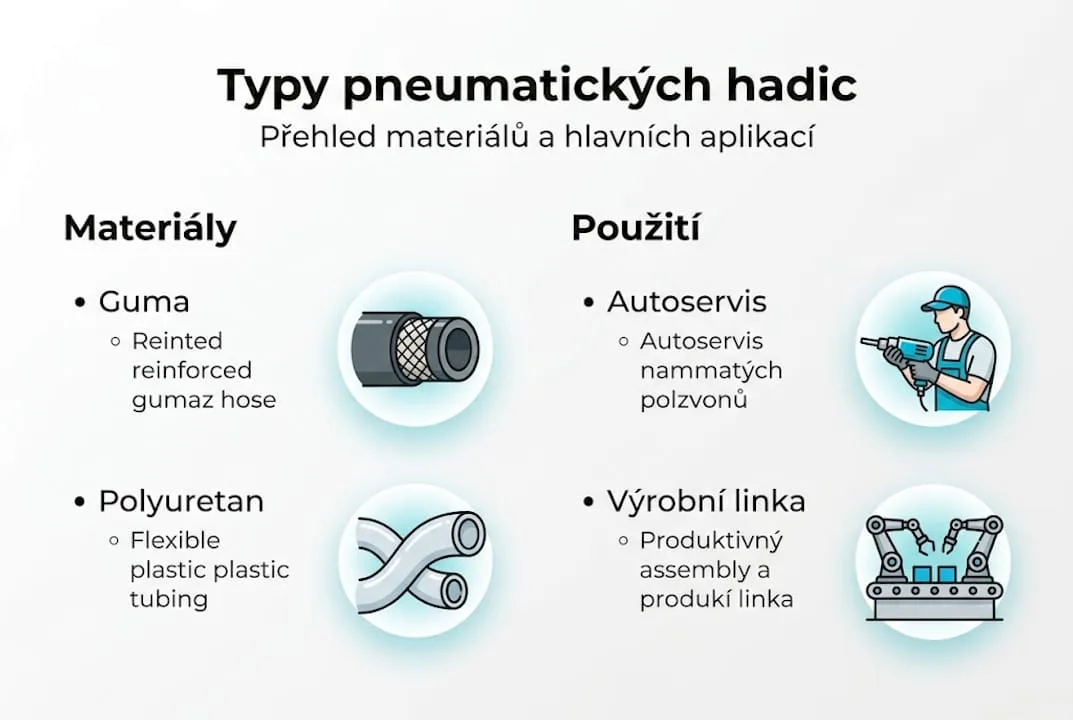
The main types of pneumatic hose:
- Rubber hoses are the most widespread variant in car services. They are characterised by high flexibility, resistance to oils and the ability to work in a wide temperature range. They suit pneumatic impact wrenches, air guns and the inflation of tyres.
- Polyurethane hoses (PU) offer a considerably lower weight than rubber and a very good resistance to abrasion. They are popular in paint shops, where lightness of handling and cleanliness of the surface are important.
- Polyamide hoses (PA12) have a high chemical resistance and strength of the wall. They are used especially in the brake systems of lorries and in environments with a higher chemical load.
- Spiral hoses wind themselves back automatically after use. They reduce the risk of tripping and are practical everywhere where work involves short, repeated movements of the tool.
The use of hoses in car services includes a wide range of applications, from diagnostics through painting to the fitting and removal of wheels.
| Material | Flexibility | Chemical resistance | Typical use |
|---|---|---|---|
| Rubber | High | Medium | Car service, assembly |
| Polyurethane | Medium | Medium | Paint shop, light tools |
| Polyamide | Low | High | Brake systems, industry |
| Spiral (PU/rubber) | Very high | Medium | Hand tools, car service |
For industrial environments and production lines, where the advantages of pneumatic systems show themselves most strongly, the choice of material is even more important. Industrial applications place higher demands on the maximum working pressure and resistance to UV radiation or aggressive liquids. In paint booths, for example, an antistatic treatment of the hose is key, which prevents electrostatic discharges. In heavy industry, where pneumatic automation in industry is applied, polyamide or reinforced rubber hoses with certification for specific pressure classes are most often chosen.
When choosing it is always necessary to take the length of the hose into account too. Longer hoses cause a drop in pressure, which reduces the performance of the tool. The standard lengths for use in a car service range from 5 to 20 metres, while for every metre of length there is a measurable drop of working pressure at the end of the hose.

Criteria for the choice: what to focus on when buying
After orientation in the types of hose comes the evaluation of the specific technical parameters. The right choice of hose directly influences the whole operation and the safe use of tools in the workshop.
The key parameters when choosing:
- The internal diameter (ID) determines the flow of air. For light tools (grinders, guns) a diameter of 6 mm is enough. For heavy tools (impact wrenches, chipping hammers) at least 10 mm is needed.
- The maximum working pressure must always be higher than the working pressure of the compressor. The safety margin should be at least 25 % above the working pressure.
- The length of the hose influences the pressure losses. Every 10 metres of length with a diameter of 8 mm causes a drop in pressure of approximately 0.1 bar at a flow of 200 l/min.
- The temperature range is critical in paint shops or outdoor plants. Rubber hoses manage a range from -20 °C to +80 °C, polyurethane hoses are more sensitive to low temperatures.
- The type of connectors and quick couplings must correspond to the standard used in the workshop (most often the standards DN 7.2 or DN 7.8 in European car services).
| Parameter | Light tools | Heavy tools | Brake systems |
|---|---|---|---|
| Internal diameter | 6 mm | 10 mm | 6 mm (PA12) |
| Max. pressure | 10 bar | 16 bar | 12 bar |
| Recommended material | PU, rubber | Rubber, reinforced | Polyamide PA12 |
Spiral hoses have specific advantages for work in a car service, especially thanks to the self-acting winding which keeps order at the workplace and reduces the risk of damage to the hose by a vehicle driving over it.
The most frequent mistakes in choosing:
- The choice of too thin a hose for powerful tools, which leads to a permanent drop in performance
- The use of a hose without certification for brake systems (in the Czech Republic strict standards apply for hoses in brake circuits)
- Ignoring the temperature range in plants with extreme conditions
- Confusion of connector standards, which causes leaks or the impossibility of connection
Professional tip: Before buying always measure the actual working pressure of the compressor at full load, not just the nominal pressure. The working pressure at full output tends to be 10 to 15 % lower than the maximum value on the label.
The correct connection of hoses to compressors and maintenance of the system
Once the hose is chosen, it depends on the correct installation. A bad connection nullifies even the best properties of the material. How pneumatics works in industrial operation depends directly on the quality of all the joints and regular maintenance of the whole system.
The procedure for correctly connecting a hose to a compressor:
- Check that the compressor is disconnected from the power supply and the air receiver is depressurised.
- Verify that the diameter and type of connector of the hose corresponds to the outlet of the compressor.
- Apply sealing tape (PTFE) to the threaded joints, if they are not quick couplings.
- Connect the hose firmly, but without excessive force which could damage the thread.
- Gradually increase the pressure and watch all the joints using a soap solution.
- Only after verifying the tightness connect the tool and start operation.
A correct connection of the hoses extends the service life of the whole system and increases the safety of the workers. Every leaking joint causes not only a loss of pressure, but also an unnecessary overloading of the compressor which shortens its service life.
The decompressor in pneumatics is a key part of a safe circuit. It makes safe depressurisation of the system before changing a hose or tool possible without having to wait for a spontaneous drop in pressure. In professional car services the decompressor is a standard part of every distribution station.
Regular maintenance of the pneumatic system:
- A visual check of the hoses once a week (cracks, abrasions, deformations)
- A test of the tightness of the joints once a month
- Replacement of hoses with visible cracks or deformations immediately, without delay
- Cleaning of the filters and condensate separators according to the recommendation of the manufacturer of the compressor
- Lubrication of the moving parts of the quick couplings once a quarter
Regular maintenance directly influences a longer service life of pneumatic tools in the whole plant. Tools supplied with clean, dry air from a correctly maintained system last considerably longer.
Professional tip: Mark every hose in the system with coloured tape or a label with the date of installation and the maximum working pressure. This simple record significantly speeds up diagnosis in the event of a fault and makes planning replacements easier.
How to verify the correctness of the choice and installation in practice
For maximum certainty every system needs to be verified functionally before full deployment in operation. Ongoing checking of the system prevents faults and practical verification of the hoses is part of a professional approach to caring for a pneumatic system.
The procedure of the test of tightness and functionality:
- Pressurise the system to the maximum working pressure and let it stabilise for 5 minutes.
- Apply a soap solution to all joints, connectors and places with quick couplings.
- Watch whether bubbles form, which signal a leak of air.
- Check the pressure gauge: if the pressure falls without a tool connected, the system is not tight.
- Carry out a functional test with the tool connected and watch whether the performance corresponds to the specifications.
Signs of a correctly chosen and installed system:
- The tool achieves full performance without fluctuation
- The compressor does not switch on too often (a leak of air causes shorter switching intervals)
- The hoses are in operation without visible tension or twisting
- The temperature of the hoses during operation does not exceed the range recommended by the manufacturer
Statistics: Leaks of air in industrial pneumatic systems cause on average 20 to 30 % unnecessary energy consumption of the compressor. A regular test of tightness is therefore not only a safety but also an economic measure.
What to watch out for in full operation:
- Unusual sounds (whistling, hissing) signal a leak at a joint or damage to the hose
- Vibrations of the hose during operation can cause the connectors to loosen over time
- Hoses passing through areas with a high temperature (exhausts, welding workplaces) must be protected with thermal insulation
When identifying problems proceed systematically: first depressurise the system, visually check the whole route of the hose, then carry out a test with a soap solution at all joints. Only after localising the problem proceed to replacement or repair.
What technicians must not forget: mistakes which can cost you more than time
Experienced fitters in car services and industrial plants repeatedly run into the same mistakes, which are not always visible immediately. The most expensive problems do not arise from a one-off failure, but from long-overlooked small things.
An underestimated risk is the confusion of materials during a repair or extension of the system. If a technician replaces a polyamide segment with a rubber hose without verifying the pressure class and chemical compatibility, gradual degradation can occur which shows up only after weeks or months. Visually the joint looks all right, but the internal structure of the hose is gradually damaged.
Another overlooked problem is repeated small leaks. A small leak at a joint which the technician repairs by tightening returns in three months. The cause tends to be fatigue of the material of the seal or a slightly damaged thread. The correct solution is replacement, not repeated tightening. The risks during the fitting of hoses are described in detail in safety guides, yet in practice these places are forgotten.
A practical tip for records: Keeping a simple record of every hose in the system (date of installation, material, maximum pressure, date of the last check) makes it possible to plan preventive replacements before a fault occurs. This approach reduces unplanned downtime and extends the service life of the whole pneumatic system.
Complete accessories for your installation in one place
After mastering the whole procedure of choice, installation and verification, the simplest next step is to secure suitable hoses and accessories from a proven supplier.
At Kompresory-vzduchotechnika.cz you will find all types of hose, from standard rubber and polyurethane ones to specialised hoses for air brakes of polyamide PA12. The offer also includes pipes for air distribution in diameters of 15 to 28 mm for fixed installations. The complete range is complemented by MARK compressors and accessories for professional car service and industrial applications. In case of uncertainty expert consultation is available directly on the pages of the e-shop.
Most frequent questions
What is the difference between a rubber and a polyamide pneumatic hose?
Rubber hoses are flexible and resistant to oils, suitable for most car service applications. Polyamide hoses have a higher chemical resistance and lower weight, which is why they are used in brake systems and chemically demanding environments.
How often is it necessary to check the tightness of pneumatic hoses?
It is recommended to carry out a check of tightness at least once a month or at every change of accessories. Regular maintenance reduces the risk of a fault of the system and unnecessary energy consumption of the compressor.
What to do when a hose lets air through or bursts?
Stop operation immediately and depressurise the system. Replace the damaged hose with a type identical to the original parameters and check the safety procedure during replacement including all the neighbouring joints.
Can the same hose be used for various types of compressor?
It is always necessary to follow the values of the working pressure and diameter for compatibility with the compressor. A hose with a lower pressure class must not be used with a compressor with a higher working pressure.
Recommended
- Practical use of pneumatic hoses in the car service 2026 - Kompresory-Vzduchotechnika.cz
- How pneumatics works: a complete guide for industry 2026
- How to use pneumatic tools safely: a guide - Kompresory-Vzduchotechnika.cz
- Advantages of pneumatic tools 2026: 40% longer service life - Kompresory-Vzduchotechnika.cz