
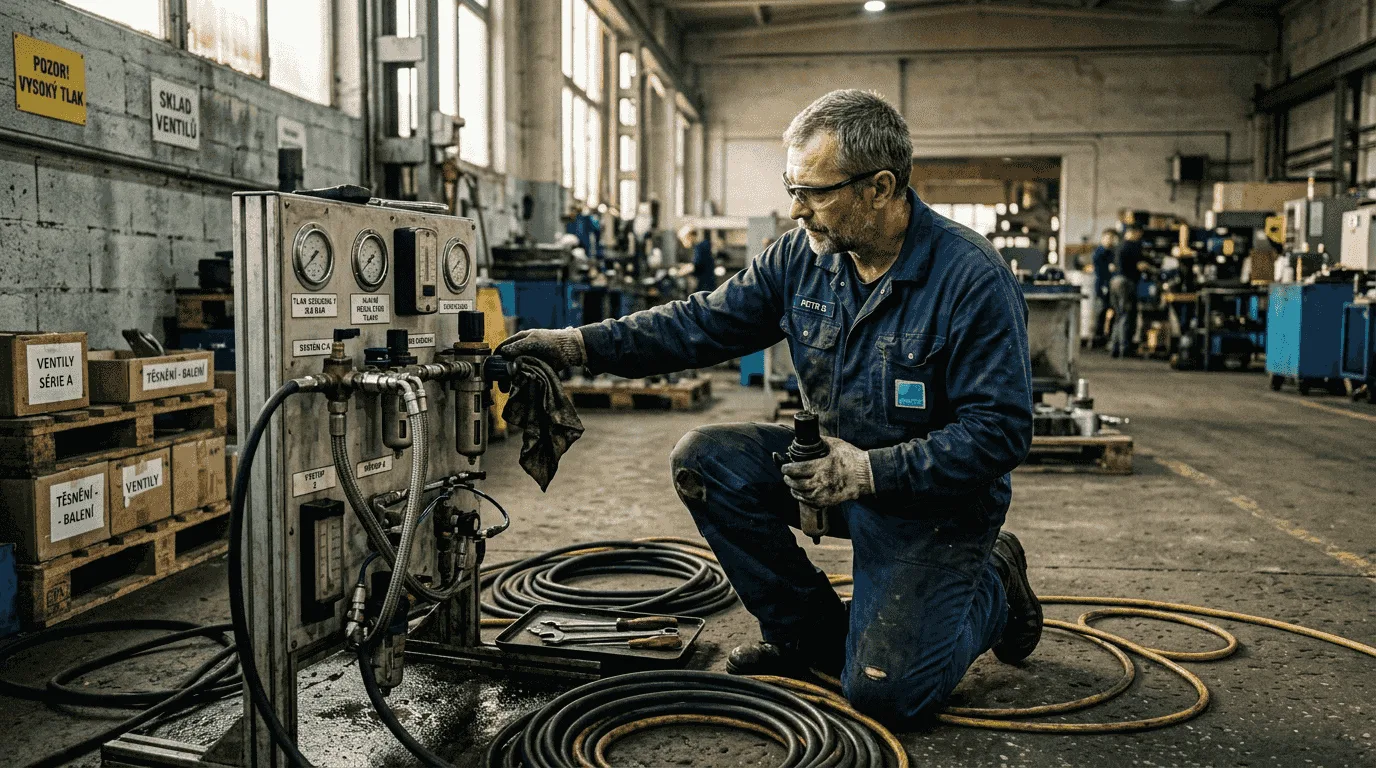
Did you know that poor maintenance of pneumatic systems causes energy losses of over 11 % and can increase operating costs by up to half? Pneumatic systems are an indispensable part of modern industry and craft workshops, yet many specialists do not use their full potential. Understanding the basic principles of operation, correct maintenance and optimisation of components can dramatically reduce costs and increase productivity. This guide will show you how pneumatics really works, which components are key for reliable operation and how predictive maintenance saves tens of thousands of crowns a year.
Key findings
| Point | Details |
|---|---|
| The principle of compressed air | Pneumatic systems convert the energy of compressed air into mechanical movement by means of compressors, valves and actuators. |
| Components of the system | A compressor, pressure vessel, filters, dryers, pressure regulators, valves and pneumatic cylinders form a complete functional whole. |
| Predictive maintenance | Monitoring and regular checks reduce operating costs by 30 to 40 % and extend the life of the equipment. |
| Air quality | Observing the ISO 8573 standards for filtration and drying of air is fundamental for protecting components and for efficient operation. |
| Optimisation of pressure | The correct setting of the operating pressure according to the specific application significantly reduces energy consumption and wear. |
Basic principles of the operation of pneumatic systems
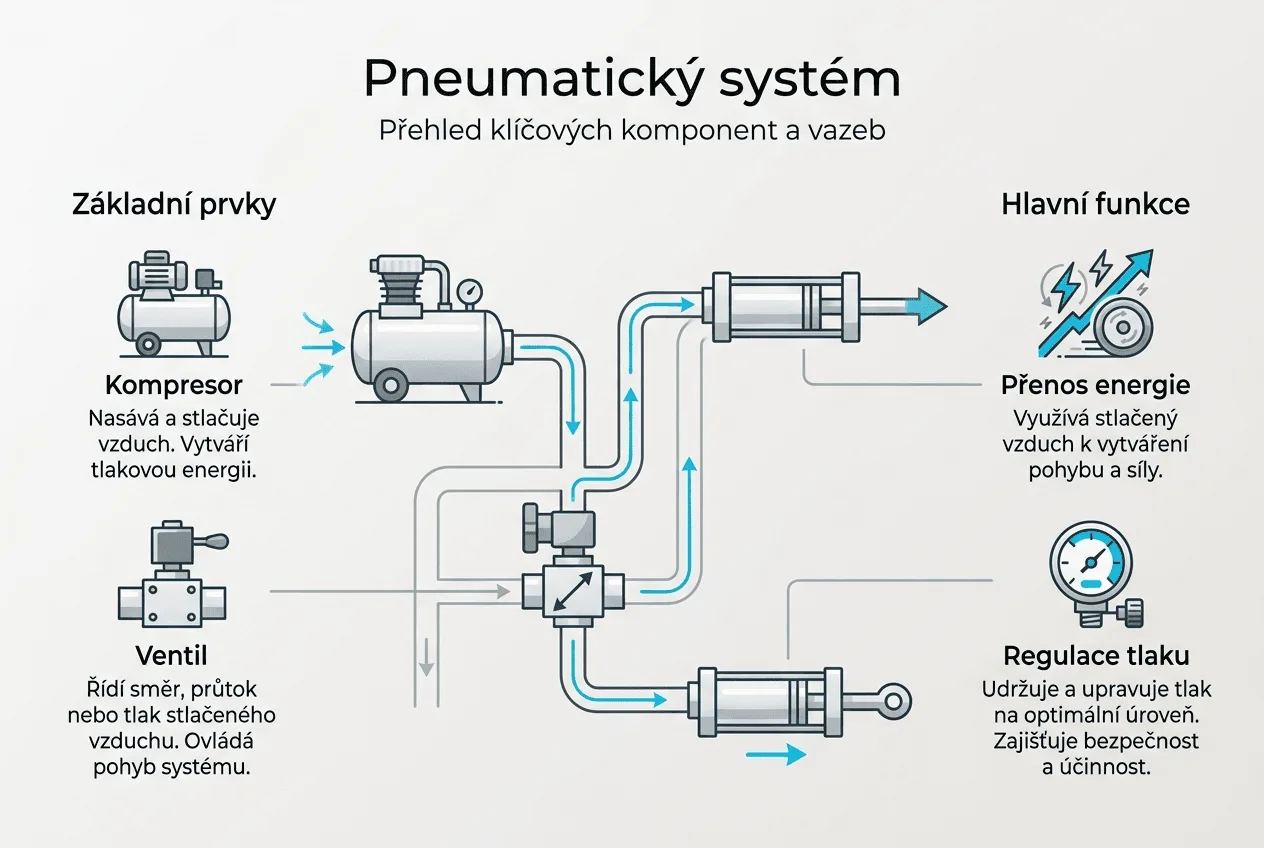
Pneumatic systems represent an elegant way of transferring energy in industrial applications. Pneumatics works on the principle of compressed air as a source of energy, where atmospheric air is compressed by the compressor to the required pressure, stored in a pressure vessel and subsequently distributed to the workplaces. This process is based on Pascal’s law, which says that pressure in a closed system is transferred evenly in all directions.
A complete pneumatic system consists of several key components which must work together in precise synchronisation. The compressor sucks in atmospheric air and compresses it to an operating pressure typically between 6 and 10 bar. The compressed air travels into the pressure vessel, where it accumulates and the pulsations from the compressor are evened out. From there it goes to the unit for regulating and filtering the air, which removes impurities and condensate and regulates the pressure to the optimal value for the specific application.
The individual components fulfil specific functions in the whole chain:
- The compressor ensures the compression of the atmospheric air and creates the necessary pressure for the whole system
- The pressure vessel accumulates energy and evens out fluctuations of pressure during operation
- Filters remove solid particles, oil and water from the compressed air
- Dryers lower the dew point of the air and protect the system from corrosion
- Pressure regulators maintain a constant operating pressure for the connected consumers
- Directional valves control the flow of air to the individual actuators
- Pneumatic cylinders and motors convert the pressure energy into mechanical movement
For efficient operation, understanding the mutual links between the components is fundamental. The quality of the air at the outlet of the compressor directly influences the life of all subsequent elements. Insufficient filtration leads to abrasion of the seals, corrosion of the internal surfaces and premature wear of the moving parts. A correctly designed system includes multi-stage filtration with gradual refinement, where the first stage catches coarse impurities and the last reaches the required cleanliness according to the standard ISO 8573.
Professional tip: Install manometers behind every key component for immediate diagnosis of a pressure drop and identification of problematic places in the system.
Energy efficiency and predictive maintenance in pneumatic systems
The energy demand of pneumatic systems represents a significant item in the operating costs of industrial plants. Energy consumption forms 70 to 80 % of the total costs of operating pneumatics during its life, while the purchase price of the compressor represents only a fraction of the long-term expenses. That is why optimising energy efficiency is key for competitiveness and the sustainability of operation.
Predictive maintenance offers a revolutionary approach to managing pneumatic systems. Modern monitoring can reduce operating costs by 30 to 40 % compared with reactive maintenance, where problems are solved only after they arise. Predictive maintenance systems continuously monitor key parameters such as pressure, flow, temperature and energy consumption. Analysis of these data reveals anomalies before they cause a serious fault or a production stoppage.
Energy losses in pneumatic systems have several main causes:
- Air leaks represent the most frequent problem, where even a small opening of 3 mm at a pressure of 7 bar causes significant losses
- Excessive operating pressure increases the consumption of the compressor and the leaks, while a reduction of 1 bar saves up to 7 % of energy
- Inefficient filtration of compressed air creates pressure losses and increases the load on the compressor
- Neglected maintenance of air dryers reduces their efficiency and leads to condensation in the pipework
Pulse systems for cleaning filters represent a specific area of optimisation. Research has shown that energy losses reach 11,4 % with a non-optimal setting of the cartridge and pressure parameters. The right choice of filter cartridges according to the type of dust and the intensity of operation can significantly reduce these losses. Cartridges with lower resistance while maintaining the required filtration efficiency save energy and extend the intervals between pulses.
Monitoring of air leaks should be a regular part of maintenance. Ultrasonic detectors can identify leaks even in the noisy environment of production halls. A systematic check of the whole air distribution once a quarter reveals problematic places before they cause significant energy losses. A typical industrial plant has leaks in the range of 20 to 30 % of the total production of the compressor, which represents an enormous potential for savings.
Professional tip: Mark all repaired leak sites with coloured tape and create a map of the critical points for future checks and faster localisation of problems.
Practical advice for craftsmen and industry: maintenance and optimisation of pneumatics
Successful operation of pneumatic systems requires a systematic approach to maintenance and an understanding of the basic connections. Regular cleaning of filters, checking of leaks and lubrication form the basis of preventive care which forestalls costly faults and extends the life of the equipment. Many operators, however, underestimate the importance of documentation and a systematic approach.
You should always have the basic diagram of the pneumatic system to hand: the compressor compresses air into the vessel, from there it continues through the air preparation to the distribution valves and finally to the actuators. This diagram will allow you to diagnose quickly in which part of the system a problem has arisen and to solve it in a targeted way without unnecessary interventions.
The procedure of optimal maintenance includes these steps:
- Daily visual check of the manometers and the filter condition indicators for the timely detection of abnormalities
- Weekly draining of condensate from the pressure vessel and the moisture separators
- Monthly check of all moving joints, hoses and quick couplings for air leaks
- Quarterly replacement or cleaning of the filter cartridges according to the degree of contamination
- Half-yearly check and adjustment of all pressure regulators and safety valves
- Annual comprehensive inspection of the whole system including a check of the electrical connections of the compressor
The lubrication of pneumatic components requires a specific approach. Modern pneumatic tools often use pre-lubricated components which do not require external oil misters. For older equipment, however, lubrication is essential. Use only special pneumatic oil with low viscosity which does not create deposits.
The optimisation of the operating pressure brings immediate savings. Many applications run at a higher pressure than they really need. A reduction from the usual 7 bar to 6 bar where the application allows it saves approximately 7 % of the compressor’s energy. Moreover a lower pressure means smaller leaks and lower mechanical stress on all components. Test each application separately and set the minimum functional pressure.
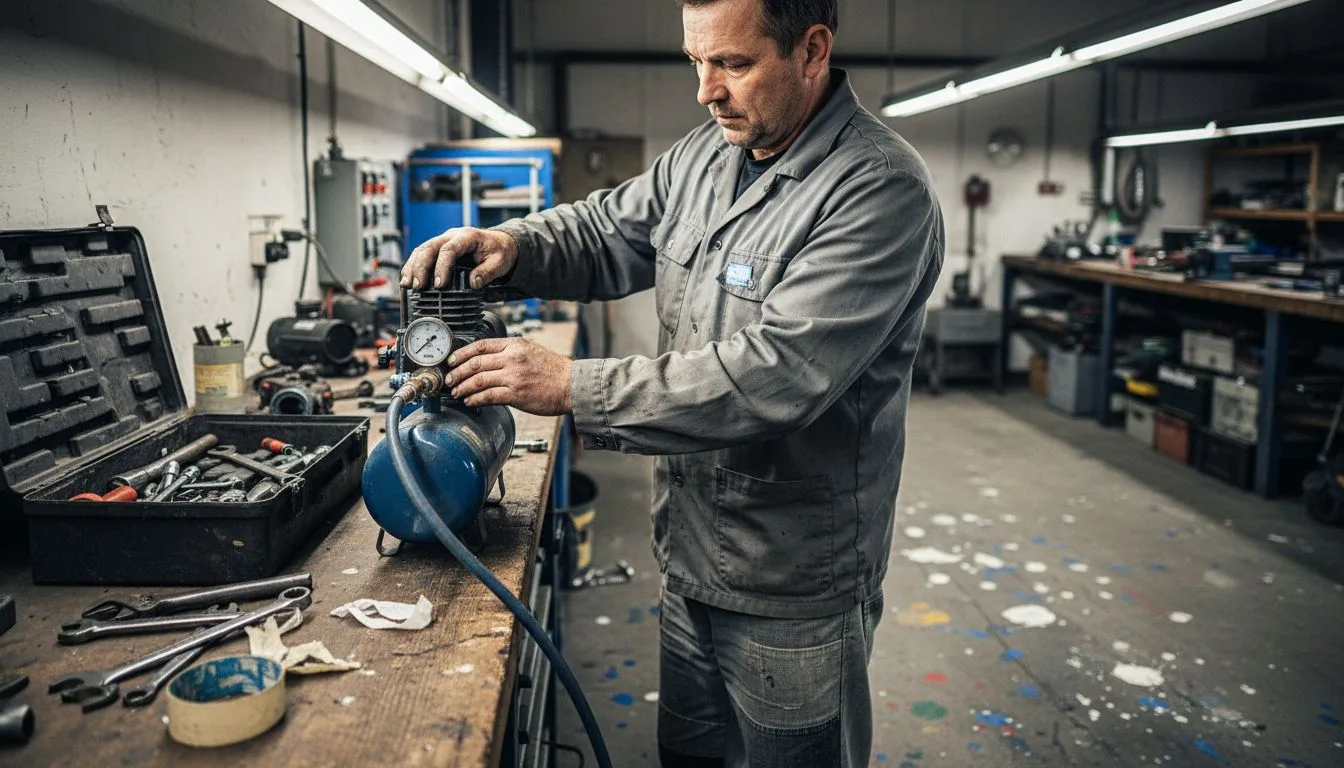
Professional tip: Create a maintenance log with photographic documentation of the critical places before and after maintenance. This documentation will help you follow trends of wear and plan the replacement of components before a fault occurs.
Comparison of various components and their influence on performance and costs
The choice of the right components for a pneumatic system directly influences the operating costs, reliability and efficiency of the whole installation. Quality filters and dryers do require a higher initial investment, but their lower operating costs and longer service life quickly bring this investment back.
Filters differ according to filtration class, pressure loss and capacity. Coarse filters (40 μm) catch solid particles and larger drops of water, fine filters (5 μm) remove aerosols and microfilters (0,01 μm) achieve the highest cleanliness for the food and pharmaceutical industry. Every filtration stage adds a pressure loss, which is why it is important to choose only the necessary stages.
| Type of component | Purchase costs | Operating costs | Efficiency | Suitable use |
|---|---|---|---|---|
| Coarse filter | Low | Very low | Basic protection | First stage behind the compressor |
| Fine filter | Medium | Low | High cleanliness | Protection of tools and valves |
| Refrigeration dryer | Medium | Medium | Dew point +3 °C | Standard industry |
| Adsorption dryer | High | High | Dew point -70 °C | Outdoor applications, sensitive processes |
Cartridges for pulse cleaning of filters significantly influence the energy balance of the system. Nanofiber cartridges offer a lower pressure loss with higher filtration efficiency, which reduces the energy consumption both for the pulses and for the compressor. PTFE membranes provide the best properties for sticky dusts, but require a higher investment.
The pressure parameters must correspond to the specific application:
- Pneumatic tools typically require 6 to 6,5 bar for optimal performance
- Automation valves and cylinders work reliably already at 4 to 5 bar
- Blasting and painting needs a stable 6 to 7 bar for a quality result
- Handling equipment often manages with 3 to 4 bar
Professional tip: When choosing components, count on the total cost of ownership (TCO) over 10 years of operation, not only on the purchase price. Quality components with lower operating costs pay off already during the first three years.
Offer of compressors and accessories
After mastering the theoretical basics and the practical maintenance procedures it is time to choose the suitable equipment for your operation. Screw compressors represent a modern solution for continuous operation with minimal maintenance demands and an excellent energy balance.

Comprehensive treatment of compressed air will ensure the optimal air quality for your applications. Our units meet the standard ISO 8573 and protect your pneumatic components from premature wear. Contact us for expert advice and a system design tailored exactly to your needs.
Frequently asked questions about the operation of pneumatic systems
How often is it necessary to check air leaks?
Carry out a check of the leaks at least once a quarter using an ultrasonic detector. Systematic detection and repair of leaks saves up to 30 % of the costs of compressed air.
What is the most frequent cause of a drop in the performance of a pneumatic system?
Clogged filters and air leaks form 80 % of the problems with performance. Check the pressure-loss indicators on the filters and replace the cartridges when the red zone is reached.
What influence does air quality have on the life of pneumatic components?
Insufficiently treated air shortens the life of the components by 50 to 70 %. Moisture causes corrosion and solid particles cause abrasion of the seals. Observing the cleanliness of the air extends the life up to threefold.
How to set the pressure in the system correctly for maximum efficiency?
Set the lowest pressure at which the applications still work reliably. A reduction to 6 bar saves 7 % of energy, to 5 bar up to 14 %.
What are the basic steps of maintenance of filters and dryers?
Drain the condensate weekly, check the pressure-loss indicators daily and replace the filters when clogged. Dryers require a check of the dew point monthly.