


TL;DR:
- The correct choice of air pressure measurement method affects the reliability and efficiency of pneumatic systems in industry. Electronic sensors with digital outputs offer higher accuracy and integration options compared to mechanical pressure gauges, which are suitable mainly for visual inspections. Modern intelligent sensors enable predictive maintenance and better system management thanks to self-diagnostics and data communication.
The correct choice of air pressure measurement method directly determines how reliably and efficiently your pneumatic system operates. Air pressure measurement options range from simple mechanical pressure gauges to intelligent digital sensors with self-diagnostics and predictive maintenance. A poorly chosen gauge means inaccurate data, higher energy costs, and unnecessary downtime. This guide covers key selection criteria, the main types of pressure measurement instruments, their practical comparison, and specific recommendations for various operating conditions in industry.
Contents
- Criteria for choosing a suitable air pressure measurement method
- Mechanical pressure gauges and their use in industrial applications
- Electronic pressure sensors with digital outputs
- Comparison of the main air pressure measurement methods
- Recommendations for choosing an air pressure measurement method in various situations
- The future of air pressure measurement in industrial automation: smart sensors and predictive maintenance
- How Kompresory-vzduchotechnika.cz helps with air pressure measurement and optimization
- Frequently asked questions
Key Takeaways
| Point | Details |
|---|---|
| Selection according to requirements | Choose the measurement method according to the requirements for accuracy, response speed, and application environment. |
| Modern sensors | Intelligent digital sensors enable precise measurement and predictive maintenance. |
| Calibration and maintenance | Regular calibration and the installation of damping elements extend the service life of measuring devices. |
| Leak detection | Placing pressure gauges at key points helps quickly detect air leaks and save costs. |
Criteria for selecting a suitable air pressure measurement method
Choosing the right measuring device is not just a matter of price. In an industrial environment, technical parameters, environmental conditions, and requirements for integration into control systems are decisive.
Accuracy and measurement range are the starting point for every selection. The sensor should cover the operating range without operating at the limits of its scale. As a general rule: a recommended range of 1.5 times the expected maximum and a safety overload of up to 3 times for applications with pressure spikes. A sensor sized at the limit of its range wears out faster and loses accuracy.
Environmental conditions significantly affect the lifespan of the device. Temperature, humidity, vibration and the presence of aggressive media (oil, condensate, chemicals) determine which type of diaphragm and sensor housing to choose. Devices in unsuitable environments fail sooner than they should.
Key parameters when choosing:
- Operating pressure range: size with a margin of 1.5 to 2 times the working pressure
- Safety overload: minimum 3 times for systems with shocks or pressure surges
- Accuracy class: class 2.5 is sufficient for simple visual checks, class 0.5 or better for process control
- Process medium: aggressive media require stainless steel or PTFE diaphragms
- Output signal: analog 4 to 20 mA for standard applications, digital HART or Modbus for PLC integration
- IP rating: minimum IP65 for industrial environments, IP67 or IP68 for wet workplaces
- Calibration: plan regular checks, at least once a year
Calibration is the point most often underestimated in practice. A sensor may appear functional, but temperature drift or diaphragm wear causes a systematic deviation that only becomes apparent during scrap rate analysis or an energy audit. Detailed information in the guide to pneumatic systems will help you better understand where pressure measurement fits into the overall picture of operations.
Mechanical pressure gauges and their use in industrial applications
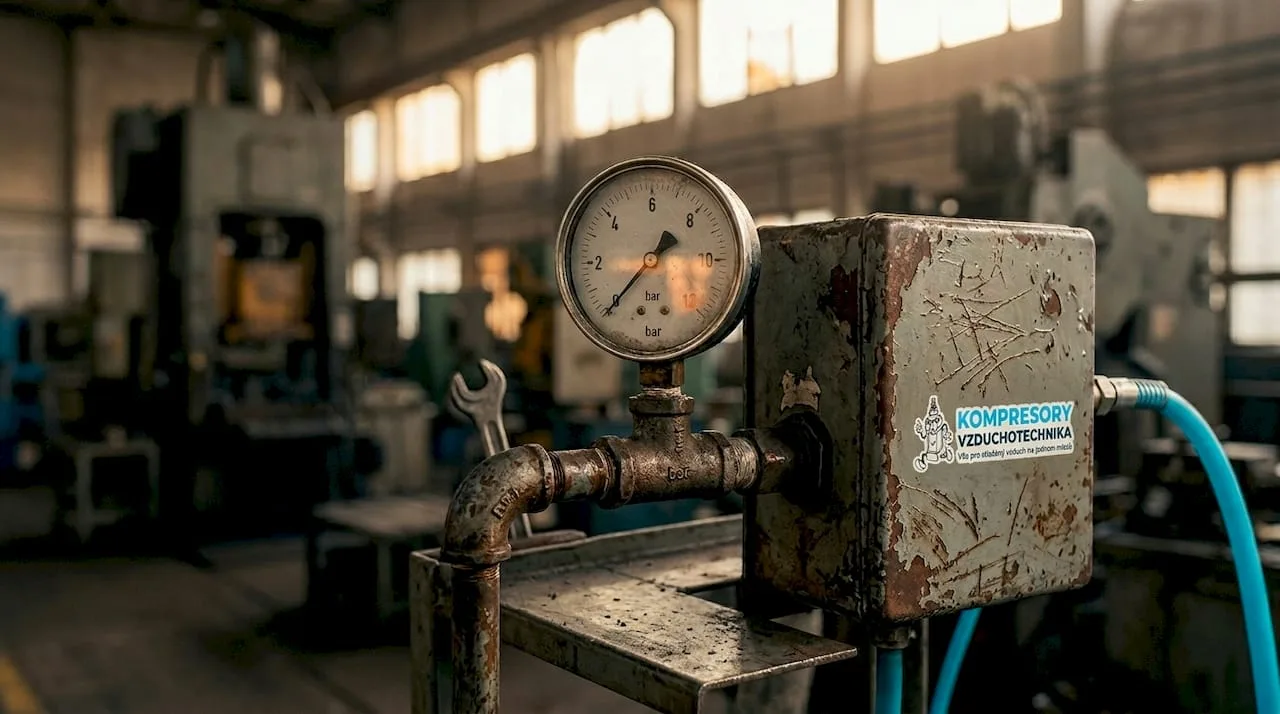
The mechanical pressure gauge with a Bourdon tube has been present in industry for more than 170 years and still has its place. A Bourdon tube is a curved metal tube with an elliptical cross-section that straightens out when pressure increases, moving a pointer on the scale. No electricity, no electronics, direct on-site reading.
Main advantages of mechanical pressure gauges:
- Simplicity and robustness: they work without power supply, withstand shocks and vibrations (glycerin or silicone damping)
- Low acquisition costs: units of hundreds of crowns compared to thousands for electronic sensors
- Immediate reading: local display without the need for a control system
- Long service life in stable conditions without significant shocks or temperature fluctuations
The limitations are equally clear. A mechanical pressure gauge is not suitable for rapid dynamic pressure changes, because the needle cannot track peaks in milliseconds. Accuracy is limited by the instrument's class (typically 1.0 to 2.5%), and if you need to transmit data to a control system, a pressure gauge won't help you without an additional transducer.
In pneumatic systems, install pressure gauges behind key components to identify pressure drops. A drop of more than 0.5 bar between the compressor and the appliance indicates a leak or a clogged filter. Without pressure gauges in the right places, you either won't find the problem, or you'll find it too late.
Professional tip: Always place pressure gauges behind filters, pressure regulators, and distribution blocks. Comparing values at the inlet and outlet of each component will reveal pressure losses before they cause a production outage. Check out our pressure gauges for pressure measurement for an overview of available types and ranges.
The mechanical pressure gauge has not become obsolete. However, it is a tool for local, visual inspection, not the basis for system monitoring.
Electronic pressure sensors with digital outputs
Modern electronic pressure sensors outperform mechanical pressure gauges in accuracy, response speed, and integration options. They work on the principle of piezoresistive or capacitive sensing, where deformation of the diaphragm causes a measurable change in electrical resistance or capacitance.
Key features of electronic sensors:
- Accuracy: class 0.1 to 0.5% of full scale, Siemens sensors achieve an accuracy of 0.25% thanks to stable electronics and maintenance-free operation
- Response speed: up to 5 ms, which enables capturing pressure surges and dynamic events
- Digital communication: HART, Modbus RTU/TCP or IO-Link protocols for direct integration into PLC and DCS systems
- Output signals: 4 to 20 mA, 0 to 10 V or digital output depending on the sensor version
- Self-diagnostics: real-time detection of overload, temperature drift and vibration
Intelligent digital sensors take the measuring function even further. Modern intelligent sensors enable predictive maintenance and detection of drift caused by temperature or vibration, changing a reactive approach to maintenance into a preventive one. Instead of waiting for a failure, the system itself warns that the sensor's parameters are approaching the tolerance limits.
Professional tip: When selecting an electronic sensor for a pneumatic system, verify the compatibility of the communication protocol with your PLC before purchasing. Changing the protocol after installation may require replacing the entire module or adding a converter. You can find an overview of available digital pressure gauges in our offer.
Maintenance-free operation of electronic sensors is an advantage, not a given. The sensor still requires regular calibration and inspection, but the frequency of service interventions is significantly lower than with mechanical instruments.
Comparison of key properties of electronic sensors
| Property | Piezoresistive sensor | Capacitive sensor |
|---|---|---|
| Accuracy | 0.1 to 0.5% | 0.1 to 0.3% |
| Response speed | up to 1 ms | up to 5 ms |
| Temperature compensation | standard | excellent |
| Overload resistance | medium | high |
| Typical use | pneumatics, hydraulics | low-pressure applications, air |
| Price | medium | higher |
Comparison of main air pressure measurement methods
For correct selection, it is necessary to compare air pressure measurement methods objectively, without unnecessarily favoring the more expensive technology where a simpler solution is sufficient.
Clear comparison of three main approaches
| Parameter | Mechanical pressure gauge | Standard electronic sensor | Intelligent digital sensor |
|---|---|---|---|
| Accuracy | 1.0 to 2.5% | 0.25 to 1.0% | 0.1 to 0.25% |
| Response speed | hundreds of ms | 5 to 50 ms | up to 5 ms |
| Digital output | no | 4 to 20 mA | HART, Modbus, IO-Link |
| PLC integration | no | yes (with transmitter) | direct |
| Self-diagnostics | no | limited | full |
| Predictive maintenance | no | no | yes |
| Acquisition costs | low (CZK 200 to 800) | medium (CZK 1,500 to 8,000) | high (CZK 8,000 to 30,000) |
| Maintenance costs | low | low to medium | low (long-term) |
| Service life | 5 to 10 years | 8 to 15 years | 10 to 20 years |
Mechanical pressure gauges win on price and simplicity. They are the right choice for local visual inspection, simple sections of the system, and backup monitoring.
Standard electronic sensors are the workhorse of industrial measurement. They cover most pneumatic applications where data transmission to the control system is needed, but advanced diagnostics is not required.
Smart digital sensors pay off where system downtime means high costs, where continuous monitoring is a safety requirement, or where an extensive network of sensors needs central management.
Key selection principle:
- Do not buy a smart sensor where a mechanical pressure gauge will suffice
- Do not buy a mechanical pressure gauge where you need data in the control system
- Consider the total cost over the life cycle, not just the purchase price
Recommendations for selecting the air pressure measurement method in various situations
An overview of methods is the foundation. However, specific recommendations for your situation are more important. Below are practical guidelines for the most common industrial scenarios.
-
Visual inspection and simple sections of the system: Mechanical pressure gauge with glycerine damping. Suitable for low-risk piping where operators regularly carry out walkarounds. Accuracy class 1.6 is sufficient.
-
Production lines with PLC control: Standard electronic sensor with 4 to 20 mA output or Modbus. Place it behind each pressure regulator and behind the compressor air receiver. Data to the SCADA system ensures an overview of the entire distribution system.
-
Critical applications requiring zero downtime: Intelligent digital sensor with self-diagnostics and HART communication. The predictive function detects a problem weeks before a failure.
-
Environments with pressure surges (press shops, welding shops, packaging lines): Installing a damping device is necessary to protect sensors from damage and maintain long-term reliability. A pressure snubber or capillary in front of the sensor extends its service life several times over.
-
Aggressive environments (condensate, oil, chemicals): Sensor with a stainless steel or PTFE membrane and a minimum protection rating of IP67. Without a resistant membrane, rapid corrosion and measurement errors occur.
Professional tip: Compare air consumption across different shifts or time periods using the air consumption measurement overview. An unusual increase in consumption at the same production level usually indicates a leak that local pressure gauges alone will not reveal.
Calibration must be planned, not reactive. A sensor that has not been calibrated for 3 years can show values with a deviation of 2 to 5% without this being apparent at first glance.
The future of air pressure measurement in industrial automation: smart sensors and predictive maintenance
The pressure measurement sector has undergone a fundamental transformation in recent years. The transition from analog signal to digital communication is not just a technological upgrade. It is a change in the way technical teams approach maintenance and operational reliability.
Modern intelligent sensors are transforming passive measurement into active predictive tools with digital communication and self-diagnostics. This is an important shift in perspective. The sensor is no longer just a "pressure measuring instrument" but becomes a source of data that the control system actively analyzes.
In practice, this means that the pneumatic system administrator receives a warning not after a failure, but weeks or months before it. Calibration drift, increased vibration, temperature anomalies. All these signals can be captured if the sensor has the right functions and is properly integrated.
However, challenges do exist. Implementation complexity increases with the number of sensors and protocols. Industrial networks with dozens or hundreds of measuring points require a clear data architecture, a standardized protocol, and a competent IT or OT team for management. Deployment without a clear data management strategy will deliver chaotic information instead of useful insights.
The second challenge is human. An intelligent sensor generates more data, but that data must be interpreted and acted upon by someone. Without processes for evaluating alerts, predictive maintenance remains just a marketing term on a brochure.
Our recommendation: start by digitizing measurement at critical nodes of the system, not across the entire distribution network at once. Compare data over 3 to 6 months, identify patterns, and only then expand coverage. An overview of continuous pressure regulation and its connection to data measurement is a good starting point for planning.
Investment in intelligent measurement pays off. But only when accompanied by a clear process for utilizing the data that sensors provide.
How Kompresory-vzduchotechnika.cz helps with air pressure measurement and optimization
Selecting the right measurement solution for a pneumatic system requires knowledge of operating conditions, technical requirements, and the available market offerings. Kompresory-vzduchotechnika.cz offers expert consultation in selecting sensors, pressure measuring instruments, and complete monitoring solutions for industrial applications.
Our range includes digital pressure gauges for precise measurement and local display, compressed air treatment units for filtration, regulation, and lubrication of pneumatic circuits, and SCR screw compressors for stable and reliable compressed air supply. Our technical team is available for consultation on selection based on your specific parameters, environmental conditions, and accuracy requirements. Support covers the entire system life cycle, from design through delivery to service and calibration.
Frequently asked questions
How often do pressure sensors in industry need to be calibrated?
Pressure sensors should be calibrated every 12 months in accredited laboratories according to ČSN EN ISO/IEC 17025, to minimize errors caused by temperature drift. In applications with shocks or aggressive media, a shorter interval is advisable, ideally every 6 months.
What advantages do intelligent pressure sensors offer over classic pressure gauges?
Intelligent sensors enable digital communication, self-diagnostics, and predictive maintenance, which increases reliability and operational efficiency compared to mechanical pressure gauges. The result is a reduction in unplanned downtime and better visibility into the condition of the entire pneumatic distribution network.
What does sensor safety overload mean and why is it important?
Safety overload is the maximum pressure a sensor can withstand without permanent damage, with a recommended overload of 3 times the expected maximum protecting the device during pressure surges. A sensor sized without sufficient margin will be damaged or lose calibration after a surge.
How can air leaks in a pneumatic system be detected using pressure measurement?
Pressure gauges placed after key components identify pressure drops above 0.5 bar, which indicate air leaks or clogged filters. Comparing the values at the inlet and outlet of each section of the distribution system locates the problem without the need for extensive diagnostics.
Recommended
- Stepless pressure control: precise regulation in pneumatics - Kompresory-Vzduchotechnika.cz
- Why measure air consumption: savings of up to 35% in energy - Kompresory-Vzduchotechnika.cz
- How fluctuating pressure affects the efficiency of pneumatic systems - Kompresory-Vzduchotechnika.cz
- Measuring technical gases using WIKA pressure gauges