
TL;DR:
- The right choice and maintenance of pressure regulators are key to the reliability and safety of pneumatic systems.
- There are diaphragm, piston and electronic regulators, suitable for different pressures and environments.
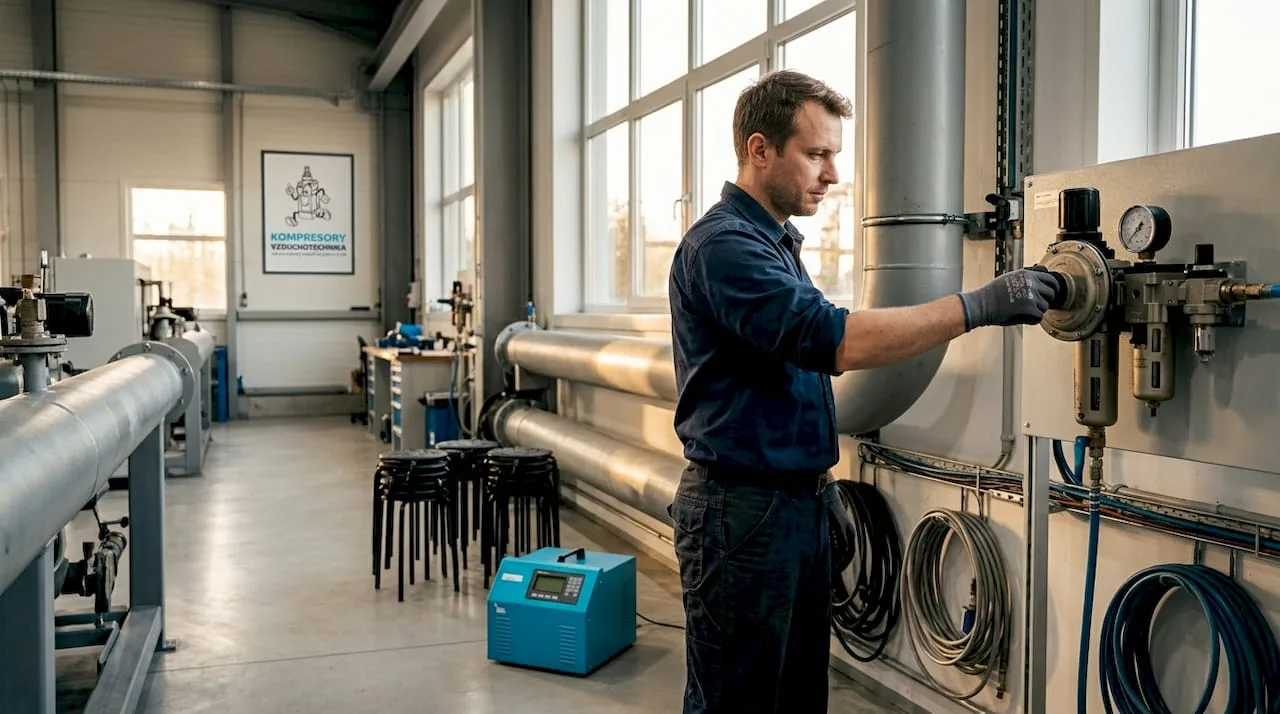
Choosing the right pressure regulator determines the reliability, safety and efficiency of the entire pneumatic system. Applications of pressure regulators range from controlling building HVAC systems through pneumatic tools to precise industrial automation. Each of these areas places different demands on the regulator in terms of working range, material design or required certifications. This overview summarises the key selection criteria, describes the main types of devices and shows how to set up and maintain pressure regulators correctly for long-term operational reliability.
Contents
- Criteria for selecting a pressure regulator for industrial applications
- Main types of pressure regulators and their applications in industry and construction
- Comparison of pressure regulators: technical parameters and certifications
- Practical applications of pressure regulators and recommended setup procedures
- How to choose and use a pressure regulator efficiently: an expert view
- Top pressure control solutions from Kompresory-Vzduchotechnika.cz
- Frequently asked questions
Key Takeaways
| Point | Details |
|---|---|
| Selection by application | The choice of regulator depends on whether air pressure or air flow needs to be controlled. |
| Types of regulators | Diaphragm, piston and electronic regulators differ according to operating conditions and accuracy requirements. |
| Regular maintenance | Weekly, monthly and annual checks and calibrations extend service life and ensure stable operation. |
| Certification and safety | ATEX and hygiene standards are essential for operation in hazardous and clean environments. |
| Installation and flow | Observing the recommended pipe lengths upstream and downstream of the regulator minimises turbulence and measurement errors. |
Criteria for selecting a pressure regulator for industrial applications
When selecting a pressure regulator it is not enough to know only the nominal working pressure of the system. Four groups of parameters are decisive: pressure range, flow range, operating environment and accuracy requirements.
Pressure versus flow. The essential distinction is whether the application requires a constant pressure or a constant flow to be maintained. In HVAC, CAV/VAV and VAP regulators are commonly distinguished, and the selection parameters depend on whether the system needs to stabilise pressure or flow. In industrial applications such as pneumatic presses or chain conveyors, pressure is usually the priority. In the HVAC systems of office buildings, flow control dominates.

Operating environment. Aggressive media (acid vapours, oils, condensate), potentially explosive atmospheres or areas with hygiene requirements call for special designs. ATEX certification applies to explosive atmospheres, while hygiene standards are indispensable for the food or pharmaceutical industry. The choice of the regulator body material, brass versus aluminium versus stainless steel, is therefore governed by the composition of the medium and the operating temperature.
Accuracy and ease of maintenance. For applications such as paint spraying or the control of robotic pneumatic drives, control deviations of only a few per cent are acceptable. By contrast, for inflating tyres or supplying an air ratchet wrench looser tolerances are sufficient. Stepless pressure control is an advantage especially in processes sensitive to fluctuations in gauge pressure.
The key selection criteria at a glance:
- Working pressure range (typically 0.5 to 16 bar for industry)
- Nominal flow rate (in m³/h or l/min depending on the application)
- Control deviation (in % or Pa)
- Body and seal material (brass, aluminium, stainless steel, PTFE seals)
- Certification (ATEX, VDI 6022, EN 1751, REACH)
- Mounting method (flanged, threaded, wafer type)
- Service availability and availability of spare parts
Now that the criteria are clear, let us look at the main types of regulators and their specifics.
Main types of pressure regulators and their applications in industry and construction
There are three main types of regulators: diaphragm, piston and electronic. Each type suits different pressure ranges and operating conditions.
Diaphragm regulators use a flexible diaphragm as the sensing and control element. They are simple in design, relatively inexpensive and suitable for lower working pressures, typically up to 10 bar. They are used in HVAC systems, for controlling pressure in compressed air piping for workshops or for supplying pneumatic tools with lower flow rates. An undeniable advantage is their low weight and the simple replacement of the diaphragm during maintenance.
Piston regulators handle higher pressures, commonly up to 350 bar, and are more resistant to aggressive media. The piston, which acts as the sensing element, is more robust than a diaphragm and copes better with vibration and pressure surges. You will find these regulators in hydraulic and high-pressure pneumatic systems, on industrial compressors or in applications with a fluctuating inlet pressure.
Electronic regulators are the category for precise and automated applications. The pressure is set by the control system (PLC, SCADA) via an analogue or digital signal, and the outlet pressure is continuously measured by a built-in sensor. Typical uses include robotic assembly lines, test benches or cleanrooms where operating data must be documented. The drawback is a higher purchase price and dependence on the power supply and the control system.
Overview of the types and their typical applications:
- Diaphragm regulator: HVAC, workshops, pneumatic tools up to 10 bar
- Piston regulator: high-pressure applications, aggressive media, industrial compressors
- Electronic regulator: automation, robotics, test benches, cleanrooms
- Combined units (FRL): filtration, regulation and lubrication in a single assembly for standard industrial applications
An overview of the available devices, including piston and electronic models, is offered by the types of pressure regulators section with technical parameters.
After introducing the types, it makes sense to compare the basic parameters and the suitability of the individual solutions.
Comparison of pressure regulators: technical parameters and certifications
Making the right decision when selecting a pressure regulator requires a comparison of specific technical data, not just general descriptions. Below is an overview of the key parameters for the three basic types.
| Parameter | Diaphragm | Piston | Electronic |
|---|---|---|---|
| Pressure range | 0.5 to 10 bar | 1 to 350 bar | 0.1 to 10 bar |
| Control accuracy | ±5 to 10 % | ±2 to 8 % | ±0.5 to 2 % |
| Flow range | low to medium | medium to high | low to medium |
| Suitable media | air, neutral gases | air, oils, aggressive media | air, clean gases |
| Certification | EN 1751, REACH | ATEX, PED | ATEX, CE, IECEx |
| Maintenance | simple | medium | requires a specialist |
| Purchase costs | low | medium | high |
Certification in practice. VAV regulators from leading manufacturers hold ATEX and VDI 6022 certification, with a control deviation of only 5 % and the ability to work up to 1,000 Pa. That is relevant especially for HVAC in hospitals, cleanrooms or industrial halls with an increased risk of explosion. ATEX certification is not just a formality: without it, operation in zone 1 or 2 areas under ATEX Directive 2014/34/EU is unlawful and dangerous.
Tightness according to EN 1751. This standard defines four leakage classes for shut-off and control dampers. Class 4 (the strictest) is required in hygienically sensitive applications and when working with media where even a minimal leak affects product quality or worker safety. The effect of control accuracy on system efficiency is crucial here: a badly set or inaccurate regulator causes excessive energy consumption and shortens the service life of pneumatic components.
Professional tip: When selecting a regulator, do not compare only the nominal pressure, but always verify the control accuracy at the minimum and maximum flow. Manufacturers state the accuracy at nominal flow, but in real operation the system works across the whole range. The deviation at low flow can be significantly higher than the data sheet suggests.
An overview of the parameters allows the right decision, and now let us look at common applications and ways of setting regulators.
Practical applications of pressure regulators and recommended setup procedures
Air pressure regulators are present in the vast majority of industrial and construction operations. The specific application determines not only the type of regulator, but also the way it is set and the maintenance intervals.
Typical industrial and construction applications:
- Pneumatic tools (drills, impact wrenches, grinders): pressure setting of 6 to 8 bar according to the tool specification
- Paint spraying: precise control to 1.5 to 4 bar depending on the type of gun and paint
- Tyre inflation in a car service: pressure of 2 to 10 bar with an accuracy of ±0.1 bar
- Control of industrial HVAC (VAV/VAP systems): pressure range of 50 to 1,000 Pa
- Pneumatic drives and cylinders in automation: pressure control of 4 to 8 bar
- Component test benches: electronic control with data documentation
Setting a pressure regulator step by step:
- Check the inlet pressure from the compressor; it must be at least 1 bar higher than the required outlet pressure.
- Release the adjusting screw (on many types it is secured with a lock nut or a cap).
- Turn the adjusting screw to increase the pressure (clockwise) or to reduce it (anticlockwise).
- Watch the reading of the outlet pressure gauge and set the required value at a flow rate corresponding to real operation.
- Lock the adjusting screw with the lock nut or the cap.
- Carry out a functional test at full flow and check the stability of the set pressure.
Maintenance intervals for long-term reliability:
- Weekly checks: visual inspection of seals and joints for leaks, check of vibration and noise
- Monthly maintenance: calibration of the outlet pressure gauge, cleaning of the filter upstream of the regulator, check of the safety valve function
- Annual service: replacement of seals and O-rings, calibration of sensors on electronic regulators, cleaning of the internal channels
- Overhaul: every 3 to 5 years, or when the specified number of operating hours is exceeded
For the correct setting and maintenance of regulators, combined air treatment units are also available, integrating a filter, a regulator and a lubricator into one compact assembly.
Professional tip: Never set a pressure regulator at zero flow (with the system at rest). The outlet pressure under flow tends to be 0.3 to 0.8 bar lower than in a closed system. Setting it without flow leads to insufficient pressure in operation and to reduced performance of tools or drives.
With this information it is possible to select and use a pressure regulator optimally. Now comes the summary and an expert view of choosing the right solution.
How to choose and use a pressure regulator efficiently: an expert view
Most operating problems with pressure regulators do not stem from choosing the wrong type, but from overlooking details during installation and maintenance. Three factors recur most often.
Turbulence and installation distances. Minimum pipe lengths upstream and downstream of the regulator are essential for measurement stability, because turbulence can significantly distort the control results. The standard recommendation is 5 to 10 times the pipe diameter at the inlet and 3 times at the outlet. In practice these distances are underestimated especially during reconstructions of existing piping, where there is no space. The result is chaotic control, increased noise and premature wear of the diaphragm or the piston.
Certifications are not just paper. When selecting a regulator for a specific environment, ATEX certification or the VDI 6022 hygiene standard is a necessary condition, not an optional extra. A regulator without the relevant certification in an environment with an increased risk of explosion or in the cleanroom of a medical facility represents both a safety and a legal risk. Yet the price difference between a certified and an uncertified design is negligible in the context of the total installation costs.
Electronic regulators are underrated. Resistance to electronic regulators in traditional industrial operations is understandable: a higher price, dependence on the power supply, the need for programming. Nevertheless, it is precisely these regulators that allow what mechanical types never will, namely continuous monitoring, remote setting and automatic response to process changes. In an operation with variable compressed air consumption, electronic control can reduce the compressor's energy consumption by 10 to 15 %, because the system does not work needlessly at maximum pressure.
Proactive care protects the investment. Effective servicing of pneumatic systems includes regular cleaning of filters, replacement of seals before they reach the end of their service life and calibration of sensors. A regulator that receives regular care works reliably for 10 years or more. A regulator without maintenance starts causing problems after 3 to 5 years at the latest, with costs for unplanned shutdowns that many times exceed the price of preventive servicing.
Underestimating installation details and postponing maintenance are therefore the most frequent causes of regulator failure, not the wrong choice of regulator. An investment in correct installation and a maintenance plan always pays off faster than it seems.
Top pressure control solutions from Kompresory-Vzduchotechnika.cz
For industrial and construction applications it is essential to have at hand not only a quality regulator, but also a compressor and accessories that meet the requirements of the specific operation. Kompresory-Vzduchotechnika.cz offers a complete range for compressed air, from compressors through air treatment units to regulators.
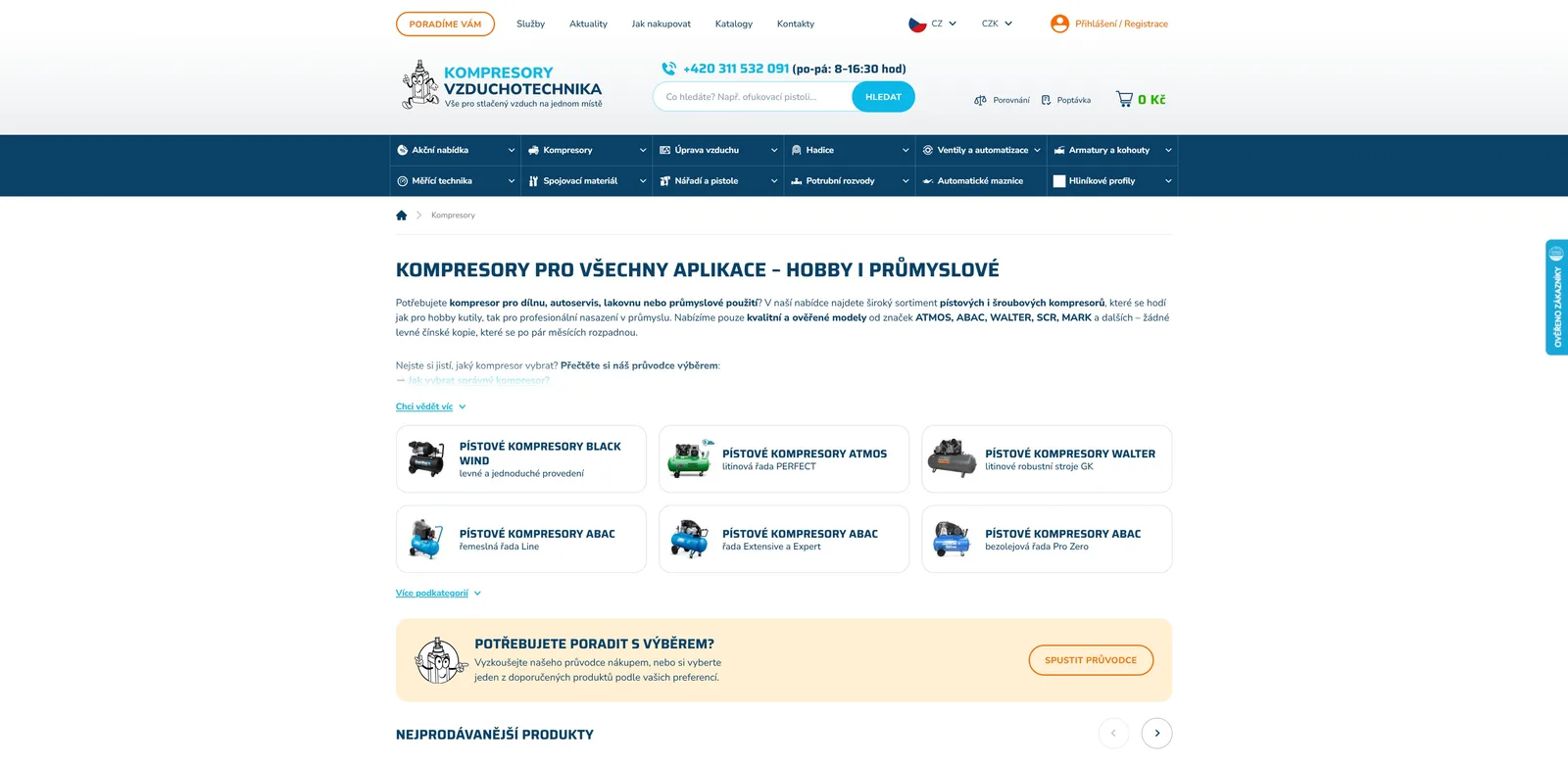
The range includes reliable MARK COMPRESSORS compressors and accessories suitable for industrial as well as construction operating conditions. For compressed air preparation there are air treatment units up to 10 bar that integrate filtration, pressure control and lubrication. Precise pressure regulators in designs for various applications are available with technical documentation and expert support during selection. The Kompresory-Vzduchotechnika.cz team provides consultations for the correct choice of equipment according to the parameters of the specific operation.
Frequently asked questions
What is the difference between a flow regulator (VAV) and a pressure regulator (VAP) in HVAC?
A flow regulator (VAV) maintains a constant air flow regardless of pressure changes in the ducting, whereas a pressure regulator (VAP) stabilises the pressure in the system. The distinction is essential for the correct design of HVAC systems, where CAV/VAV and VAP fulfil different functions according to the project requirements.
How often does maintenance of pressure regulators need to be carried out?
The maintenance schedule includes weekly tightness checks, monthly calibration and cleaning of filters, annual replacement of seals and calibration of sensors, and a general overhaul every 3 to 5 years.
Which certifications are important for pressure regulators in demanding operating environments?
ATEX certification is essential for explosive atmospheres, and the VDI 6022 standard for hygienically sensitive operations. Regulators with ATEX certification also meet a control accuracy with a deviation of up to 5 %, which is a requirement in many industrial applications.
Why is it important to observe the minimum pipe lengths upstream and downstream of the regulator?
Turbulence caused by not observing the distance of 5 to 10 times the pipe diameter at the inlet distorts the pressure measurement and reduces control accuracy, which shortens the service life of the equipment and increases operating costs.
What are the common industrial applications of air pressure regulators?
Pressure regulators are used in pneumatic tools, in paint spraying, in tyre inflation, in HVAC control and in industrial automation. A detailed overview of pneumatic system applications also covers pressure control for motors, drives and special industrial processes.