
TL;DR:
- Neglected pneumatic systems cause outages, damage and high repair costs. Regular servicing and proper preparation ensure reliability and a long service life of the equipment. Professional training and regular maintenance reduce the risk of faults and optimise operating costs.
Neglected pneumatic systems are the direct route to unplanned outages, damaged actuators and needlessly high repair costs. Dirt in the pipework, clogged filters or leaking joints reduce the pressure, increase energy consumption and shorten the service life of the whole installation. Regular cleaning and servicing are not merely recommendations, they are concrete steps that measurably reduce the number of failures in industrial operations and extend the reliability of the systems. This article offers a structured procedure, an overview of the tools, typical mistakes and practical measures directly applicable in your own operating practice.
Contents
- Basic requirements and preparation for servicing pneumatic systems
- Step by step: the procedure for cleaning and servicing a pneumatic system
- The most common mistakes in maintenance and how to avoid them
- Verifying the results of servicing and long-term optimisation
- Why one-off maintenance is not enough: lessons from practice
- Modern tools and solutions for cleaning and servicing pneumatic systems
- Frequently asked questions
Key findings
| Point | Details |
|---|---|
| Regularity is the key | Regular maintenance markedly reduces the risk of outages and costly repairs. |
| Professional training pays off | Trained staff spot faults earlier and carry out servicing more efficiently. |
| Good records | Writing down all the steps and findings helps to optimise the care of the system. |
| The right tools | Using specialised means increases the effectiveness of cleaning and reduces the risk of damage. |
| Preventing mistakes | Knowing and avoiding the common errors saves both time and money. |
Basic requirements and preparation for servicing pneumatic systems
Having emphasised the consequences of neglected maintenance, it is necessary to start from the foundation, that is from proper preparation for the service work. Without the corresponding equipment and safety measures, servicing cannot be carried out correctly or safely.
An overview of the tools and equipment needed
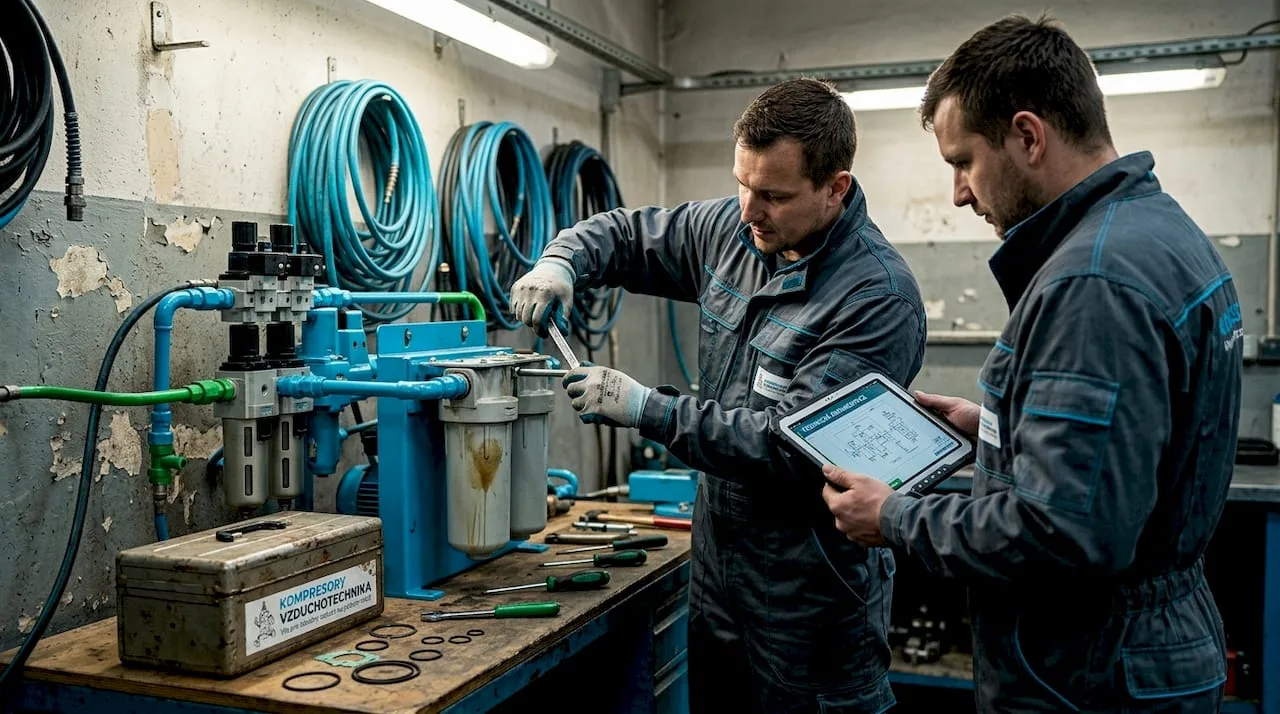
Before starting work, prepare all the tools. Missing equipment during servicing causes needless interruptions to the work and increases the risk that the job will be left incomplete.
| Category | Specific equipment | Note |
|---|---|---|
| Cleaning tools | Air blow gun, industrial vacuum cleaner | For blowing out and vacuuming dirt |
| Fault detection | Ultrasonic leak detector, pressure gauge | Checking tightness and pressure |
| Hand tools | Spanner set, torque wrench, screwdrivers | Removing and refitting components |
| Protective equipment | Safety glasses, gloves, ear defenders | Mandatory PPE when working with compressed air |
| Lubricants | Compressor oil, PTFE tape | Servicing moving parts and joints |
| Documentation | Service record, camera or tablet | Recording the condition before and after servicing |
Planned maintenance and the training of technicians are key to a safe and efficient service process. This principle applies in the automotive industry just as in industrial air handling.

Safety measures before starting work
Working with compressed air requires strict observance of the safety rules in the workplace. Before any service work it is necessary to:
- Disconnect the compressor from the mains and secure it against accidental starting.
- Release the pressure from the whole system, the air receiver and the pipework.
- Check that all valves are closed and the system is depressurised.
- Mark the workplace with warning signs.
- Ensure sufficient ventilation of the space, particularly when working with cleaning agents.
If the service work involves the electrical part of the compressor or the control elements, it is always advisable to call in a certified specialist. Knowledge of the advantages of pneumatic systems and of their technical architecture is a basic condition of safe work.
Professional training of the operator is not an optional item. In operations where servicing is carried out by untrained staff, mistakes occur during dismantling, joints are overtightened or the pressure is set incorrectly, which leads to further faults.
When should you call in an external service? In the case of a fault on the control valve, a fault on a screw compressor (rotary screw compressor) or on discovering structural cracks on the air receiver, specialist work is essential. Basic cleaning, filter replacement and lubricating the moving parts, on the other hand, are tasks a trained in-house operator can manage.
Step by step: the procedure for cleaning and servicing a pneumatic system
After the preparation we move to the specific service steps, with emphasis on the right technique and the prevention of future problems. A system worked on according to this procedure should reach its original operating parameters after servicing.
The service procedure step by step
-
Shutting down the system and checking for zero pressure. Switch off the compressor, close the air supply and vent the air receiver by opening the drain valve. Use a pressure gauge to verify that the pressure in the whole system is zero.
-
Visual inspection of the whole system. Go through the pipework, joints, hoses and fittings. Look for visible damage, corrosion, loosened joints or traces of oil and water leakage.
-
Removing and cleaning the filters. Replace or clean the compressed air filters. A clogged filter increases pressure losses and causes contamination of the air throughout the system. On three-stage filter units (filter, regulator, automatic lubricator) check each element separately.
-
Flushing the pipework and removing the condensate. Open the drain valves at the lowest points of the pipe route and let out the accumulated condensate. On longer pipe routes use a short flow of air to flush the dirt towards the drains.
-
Cleaning the compressor head and the coolers. Using compressed air or an industrial vacuum cleaner, remove dust and dirt from the cooling fins of the compressor. Clogged coolers cause overheating and premature wear.
-
Checking and topping up the oil. On oil-lubricated compressors check the level and the quality of the oil. Dark or cloudy oil must be changed. The oil change interval depends on the manufacturer, usually 500 to 2,000 operating hours.
-
Checking the tightness of the system. Using a leak detector or soapy solution, check all joints, fittings and hoses. Every air leak directly increases energy costs and reduces the available pressure.
-
Checking and calibrating the pressure regulator. Set the control pressure according to the operating requirements and verify its stability under load.
-
Test start and verification of the parameters. After completing the service, start the system and watch the operating pressure, temperature and noise level. A deviation from the standard values signals an overlooked fault.
-
Entry in the service record. Write down the date of the service, the tasks carried out, the faults found and the spare parts used. This record is the basis for future planning.
When installing a pneumatic system step by step, similar principles of documentation are essential from the very beginning. In practice, a system without documentation cannot be serviced in a controlled way.
A comparison of the methods for cleaning pipework and filters
| Cleaning method | Suitability | Advantages | Disadvantages |
|---|---|---|---|
| Blowing with compressed air | Filters, coolers, dry pipework | Fast, without dismantling | Dirt is moved, not removed |
| Industrial vacuum cleaner | Coolers, the area around the compressor | Permanent removal of the dirt | Slower, access required |
| Chemical cleaning | Clogged pipework, condenser | Effective against deposits | Neutralisation required, longer time |
| Mechanical cleaning | Pipework, filters | Permanent result | Dismantling required |
| Replacing the filter element | Air filters | Fastest, reliable | The cost of the part |

Consistently keeping to the service cycles and maintaining the documentation are the basis for preventing reactive and considerably more expensive repairs. This is confirmed by practice in industrial operations across all sectors.
If the tightness check reveals an air leak, it must be dealt with immediately. A detailed procedure is offered by the guide to repairing an air leak on a compressor, which describes the most common places where leaks occur and how to seal them.
Professional tip: Draw up an annual service schedule and set automatic reminders in the equipment management system. Document every service carried out with photographs. Images of the state of the filters or the condenser before and after servicing serve as quick reference material during the next visit and markedly shorten the diagnosis time.
The most common mistakes in maintenance and how to avoid them
After the instructional procedure it is also necessary to pay attention to the typical mistakes that needlessly increase operating costs and cause unplanned outages.
An overview of the most common mistakes in operating practice
-
Neglecting filter replacement. Filters come first in the hierarchy of service tasks, yet they tend to be the most frequently skipped item. A clogged filter increases the power input of the compressor and reduces the output of the whole system.
-
Ignoring small air leaks. A leak 1 mm in diameter at a pressure of 7 bar causes a loss of roughly 1 l/s of compressed air. Over a year that means hundreds of kilowatt-hours of needlessly consumed energy. Small leaks go unrepaired because the operator considers them negligible.
-
Skipping the entry in the service record. Without a record you cannot plan the next service, track the history of faults or make your case in a warranty claim.
-
An incorrect oil change interval. Oil is changed according to operating hours, not according to the date. Systems in intensive operation may reach the service interval in three months, while for seasonal operation it may be twice as long.
-
Running at an unsuitable pressure. Pressure set above the necessary limit increases energy costs and wear. Every 1 bar of excess pressure means roughly 6 to 8% higher energy consumption.
-
Omitting the inspection of flexible hoses. Hoses age, crack and lose their flexibility. A visual inspection of the hoses at every service prevents sudden failures.
-
Incorrect dismantling of actuators and valves. Without the correct procedure, seals or threads get damaged. The result is a new leak or a valve that does not work.
The overview of the most common mistakes when using compressors maps the problems encountered by small workshops and large industrial operations alike. The mistakes recur regularly regardless of the size of the company.
Failing to keep to planned services demonstrably increases the risk of unplanned downtime and costly emergency repairs. Reactive servicing tends on average to be two to three times more expensive than a planned intervention.
The consequences of overlooked minor faults accumulate. A slight air leak, a clogged filter and an overheated cooler are individually manageable problems. If they occur at the same time, they lead to a cascading failure of the compressor and the shutdown of the entire production. Knowing how pneumatics work in practice helps the operator recognise warning signals before they turn into a fault.
Professional tip: Create an internal record of shortcomings. At every service, note not only the tasks carried out but also small deviations from the norm, for example a slight discolouration of the oil, a light dusting of the cooler or a slightly raised temperature. Looking back, these records help to identify recurring weak points in the system and make it possible to eliminate them for good.
Verifying the results of servicing and long-term optimisation
After the warning about the risks arising from mistakes in servicing, the next step is verifying the results and setting up long-term measures for stable operation.
How to verify the quality of the servicing carried out
-
Measuring the operating pressure. After starting the system, measure the pressure at the inlet and outlet points of the pipework. The pressure drop between the compressor and the final point of use must not exceed the value given in the project documentation, usually 0.1 to 0.3 bar.
-
Checking the temperature of the discharge air. The temperature of the air after the compressor should not exceed the values set by the manufacturer. A higher temperature signals a clogged cooler or insufficient lubrication.
-
Noise test. Compare the sound of the compressor before and after servicing. A new noise after servicing means an incorrectly assembled part.
-
Leak test after servicing. Using a detector or soapy solution, go over all the places where the system was dismantled. New joints are the highest-risk place for a leak to arise.
-
Monitoring energy consumption. In the first days after servicing, watch the consumption of the compressor. A drop in consumption of 5 to 15% compared with the state before servicing confirms that the work was successful.
Parameters for regular checking after servicing
| Parameter | Measurement method | Acceptable value | Frequency of checking |
|---|---|---|---|
| Operating pressure | Pressure gauge | According to the regulator setting ±0.2 bar | Daily |
| Discharge temperature | Thermometer or thermal camera | According to the manufacturer, usually below 80 °C | Weekly |
| Moisture content | Dew point meter | According to quality class ISO 8573 | Monthly |
| Oil level | Sight glass or dipstick | Min. and max. mark | Weekly |
| Content of contaminants in the air | Test tubes or analyser | Quality class according to the application | Monthly or after a filter change |
| Energy consumption | Electricity meter | Comparison with the reference state | Monthly |
Trained staff and regular checks demonstrably reduce the risk of repeated faults and extend the intervals between services.
Statistics from practice: Industrial operations that switch from reactive to planned maintenance record a reduction in unplanned outages of 30 to 50% during the first year. Service costs fall on average by 20% thanks to lower consumption of spare parts and shorter repair times.
Linking the service schedule to the company equipment management system (CMMS, a maintenance management system) allows automatic planning of service dates, tracking of the cost of parts and reporting to management. The system immediately gives notice of an approaching service interval or of a deviation in the monitored parameters.
Removing the weak points in a system is a continuous process. After every service, identify the components with the highest frequency of faults and consider upgrading them or replacing them with types that last longer. Systematic optimising the efficiency of the air receiver is part of a comprehensive approach to the long-term running of the system.
Why one-off maintenance is not enough: lessons from practice
The technical procedure is one thing. Organising the regularity is another, and in practice the harder one.
The difference between managed maintenance and reactive servicing is essentially the difference between a planned cost and a surprise cost. Companies that service their systems only after a failure pay not only for the repair itself but also for the production downtime, express delivery of spare parts and overtime for technicians. These hidden costs are rarely visible in financial reporting because they are dispersed across various cost items.
Similar stories come from operations where service documentation is missing. A new technician arrives, the system works, but nobody knows when it was last serviced, what oil is in the compressor or whether the filter was changed last year or three years ago. Sooner or later such a system fails at the least convenient moment, usually in the middle of a production peak or when completing an order with a fixed deadline.
Organisational discipline is what distinguishes efficient operation from reactive servicing. This principle is not just management theory, it is a factual difference measurable in operating hours and in the cost of repairs.
Service models from the automotive industry offer direct inspiration. Hybrid and electric vehicles have strictly defined service intervals, a record exists for every intervention and the system gives notice of the need for a service automatically. Pneumatic systems in industry do not yet reach this level of systematic care in many operations. Yet the technological prerequisites are available: digital hour meters for tracking operating hours, pressure and temperature sensors with a data output and simple CMMS systems for small and medium-sized firms.
The benefit is not only a reduced number of failures. Regular documentation raises the value of the equipment on sale or in an insurance claim. Insurers and auditors value a demonstrable maintenance history. In regulated sectors such as food production or pharmaceuticals, documentation of the quality of the compressed air is in addition a legal requirement.
Pneumatic automation in industry brings a further argument for systematic maintenance. Automated production lines depend directly on the reliability of the compressed air source, and the failure of the compressor means the stoppage of the entire line, not just one workstation.
In summary: one-off servicing removes the acute problem. Regular, documented servicing eliminates problems before they arise. The choice is clear and economically justifiable.
Modern tools and solutions for cleaning and servicing pneumatic systems
To close the article we offer the reader the chance to use solutions and accessories that can make the whole service process even more efficient.
Professional servicing of a pneumatic system starts with the right equipment. Kompresory-vzduchotechnika.cz offers a wide range of products aimed directly at the needs of industrial and construction practice.
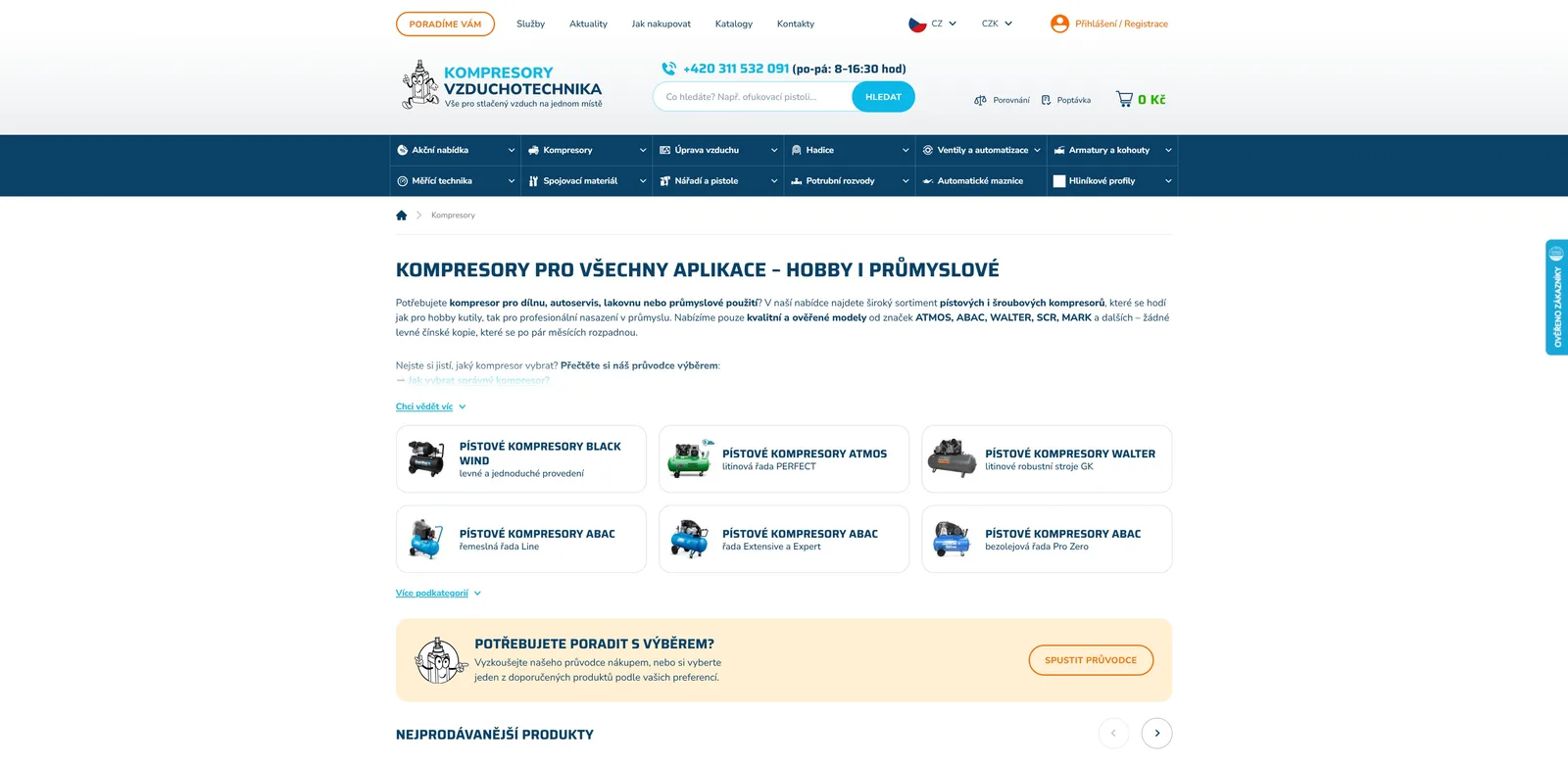
On the website you will find industrial compressors both oil-lubricated and oil-free, air hoses, blow guns and complete pneumatic accessories for servicing and operation. The range also includes filter units, pressure regulators and automatic lubricators for air treatment units. For technicians dealing with servicing in the field, portable compressors with an output matching demanding conditions are available. The team at Kompresory-vzduchotechnika.cz provides expert technical advice on choosing equipment and on dealing with specific service situations. Contact us and we will help set up the optimal service solution for your operation.
Frequently asked questions
How often should a pneumatic system be cleaned and serviced?
Basic cleaning and checking of the system is best carried out at least once a year. In intensive operation a service every 3 to 6 months is recommended, with regular checking forming part of every professional service programme.
Which parts of a pneumatic system are most prone to contamination?
The most sensitive are the filters, the pipework, the valves and the pneumatic actuators, where dirt and condensate settle fastest and cause the greatest operating problems.
How do I tell that the service needs to be carried out earlier?
The signal tends to be a noticeable drop in output or working pressure, an increased noise level from the compressor, higher electricity consumption or a detectable air leak at joints and hoses.
Why is it important to have a professionally trained operator?
Professionally trained staff minimise the risk of incorrect work, of damage to components and of a safety incident. The role of trained technicians is fundamental for preventing inadequate care and for ensuring the correct course of the service.
Recommended
- Installing a pneumatic system: step by step for professionals - Kompresory-Vzduchotechnika.cz
- How to eliminate air leaks: a guide to a 42% energy saving - Kompresory-Vzduchotechnika.cz
- Extend the life of your pneumatics: why lubrication is key - Kompresory-Vzduchotechnika.cz
- How fluctuating pressure affects the efficiency of pneumatic systems - Kompresory-Vzduchotechnika.cz