
TL;DR:
- Recycling compressed air markedly reduces operating costs, water consumption and the environmental burden of industrial systems. Correctly set up technologies make it possible to use the condensate as a valuable source of water and to recover heat, which raises energy efficiency. Implementation requires an audit of the system, the right choice of technologies and regular monitoring for maximum effectiveness and return on investment.
Compressed air systems are among the largest energy costs in industrial operations, yet most companies do not use even a fraction of their real saving potential. Condensate, residual heat and the air itself are routinely sent to waste, although they are valuable by-products. Correctly set up recycling of air and condensate brings a measurable reduction in operating costs, a simpler handling of waste water and a demonstrable reduction in the environmental burden of the operation. This article examines why underestimating recycling does not pay, which technologies are available today and how to implement them step by step.
Contents
- Why recycling compressed air is the key to efficiency
- Methods and technologies for efficient recycling
- Comparing the options: when and what pays off
- Practical tips for implementing recycling in production
- Why recycling compressed air is still underestimated: a view from practice
- Recycling with specialists and leading technologies
- Frequently asked questions
Key findings
| Point | Details |
|---|---|
| Marked savings | Recycling compressed air and condensate fundamentally reduces operating costs. |
| Environmental benefit | Reusing both air and water limits the impact of production on the environment. |
| Easy implementation | Even simple pre-treatment systems bring surprisingly high effectiveness compared with expensive technologies. |
| Practical tips | An audit, monitoring and the right choice of technology make starting recycling in production easier. |
Why recycling compressed air is the key to efficiency
Compressed air is described in industry as the fourth energy, right alongside electricity, gas and water. Even so, a cost analysis of the whole system is carried out only exceptionally. Most operations watch the power input of the compressor but record neither the losses caused by leaks, nor the heat losses, nor the value of the condensate that runs into the drain every day.
Optimising the consumption of compressed air is an area where savings of 20 to 40% of the total energy consumption of the system are genuinely achieved. Recycling is one of the key tools in this process. It is not only about energy. It is also about water, heat and material flows.
The main benefits of recycling compressed air:
- Reduced consumption of electrical energy thanks to the reuse of already compressed air where it is technically possible
- Use of the condensate as a substitute source of clean water with very low mineralisation for selected technological processes
- Recovery of heat from cooling the compressor for heating production halls or warming service water
- Reduction in the amount of waste water and simplification of its disposal in line with legislation
- More stable pressure conditions in the system thanks to the elimination of losses and correct sizing
Condensate as a side stream from compressors can be used as an alternative source of water with very low mineralisation, which makes it a valuable by-product instead of waste.
The environmental dimension of the subject has in recent years become an ever more important criterion for industrial operations. Requirements for ESG reporting, ISO 14001 certification and pressure from customers for sustainability in the supply chain lead companies to reduce water consumption and waste burden actively. Correct compressed air treatment and the recycling of condensate are concrete steps that can be quantified and reported.
Operational reliability is another factor that recycling affects positively. Systems with a regulated condensate drain and effective filtration have a longer service life, fewer failures and lower maintenance costs. Condensate that accumulates in a pneumatic system without proper draining causes corrosion of the pipework, damages tools and shortens the service life of the valves.
Methods and technologies for efficient recycling
Having understood the benefits, it is necessary to know the specific technical solutions. The methods of recycling compressed air and condensate differ in complexity, investment cost and the extent of use. Every operation has different conditions, so the choice of technology is always individual.
The procedure for choosing and implementing recycling technologies:
- An audit of the compressed air system. Mapping the whole system, measuring flows and pressures and identifying losses. Without this foundation no recycling measure can be sized correctly.
- Assessment of the condensate quality. On oil-free compressors the condensate is markedly cleaner than on oil-lubricated ones. The parameters TDS (total dissolved solids) and conductivity are decisive for the choice of further use.
- Choice of the recycling method. The options range from simple pre-treatment of the condensate to complex systems of heat recovery or reverse osmosis.
- Sizing the filtration. Every use of the condensate requires a different level of purity. For technological use in boilers or cooling circuits stricter standards apply than for watering greenery.
- Installation and integration into the existing system. Connecting the recycling elements to the existing infrastructure requires proper design of the drains, tanks and pipe routes.
- Monitoring and regular checking. The quality of the condensate changes over time depending on the operating conditions, the wear of the compressor and seasonal influences.
When an oil-free compressor is used, the condensate can after simple treatment be used, for example, as demineralised water for boilers, and that without energy-intensive technologies such as reverse osmosis or atmospheric water generation (AWG).
Values actually measured in industrial operations show a condensate flow of around 19 l/h at TDS values of roughly 10 mg/L and a conductivity of 0.02 mS/cm. That corresponds to a quality close to distilled water, which is used as standard in industrial processes with high demands on water purity.
Professional tip: Check whether your compressor falls into the category of oil-free machines (class 0 or 1 according to ISO 8573-1). On oil-lubricated compressors the condensate is contaminated with oil and its direct use requires more complex and more expensive cleaning. Investing in an oil-free compressor therefore pays off not only for the quality of the air but also for the value of the condensate. Details of correct filtration according to ISO 8573 are key to meeting hygienic and technological requirements.
Heat recovery is another technology that is markedly underestimated. A compressor generates a considerable amount of heat during operation, and on screw compressors up to 70 to 80% of the power input can be recovered as usable heat. This heat can be used for heating the production hall, warming sanitary water or preheating technological media. The savings of SCR compressors are considerable in this respect, particularly on larger installations with an output above 15 kW.
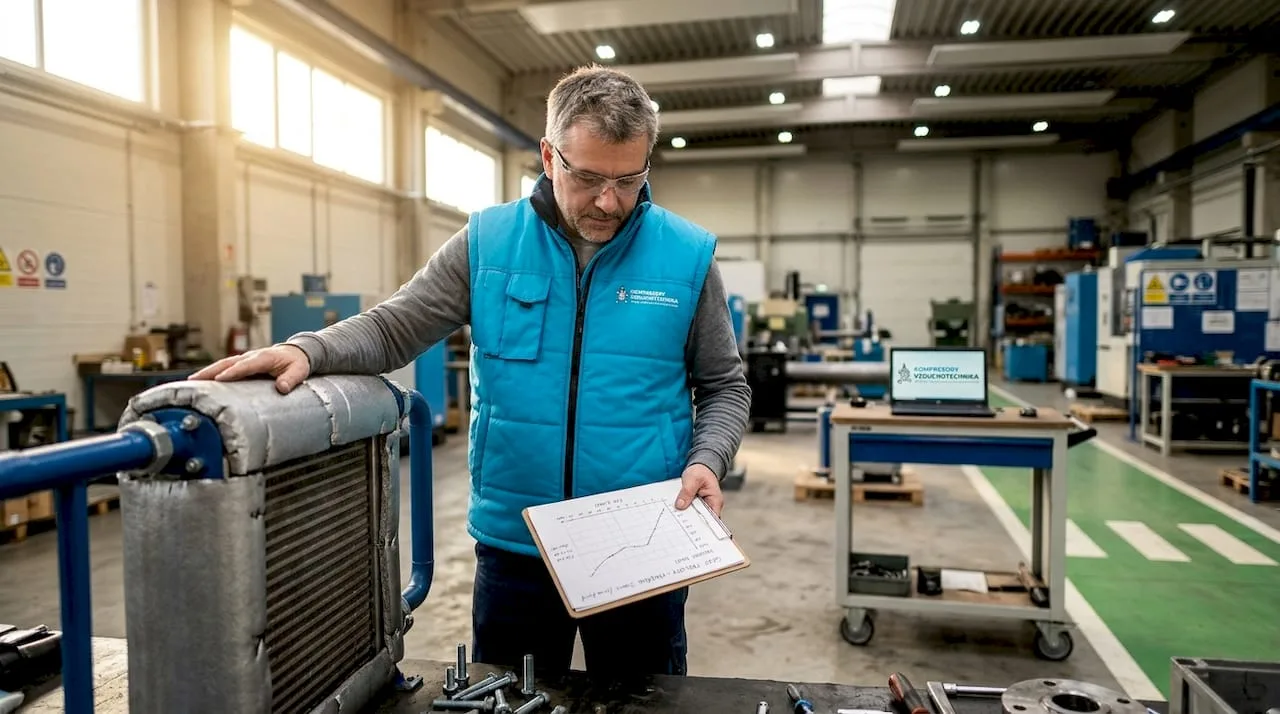
Eliminating air leaks is the basic precondition of any meaningful recycling. If a system loses 20 or more percent of the air volume through leaks in pipework and joints, no sophisticated recycling technology can compensate for that basic inefficiency.
Comparing the options: when and what pays off
Every method of recycling has a different profile of costs, complexity and operating benefit. The following comparison serves for quick orientation when deciding.
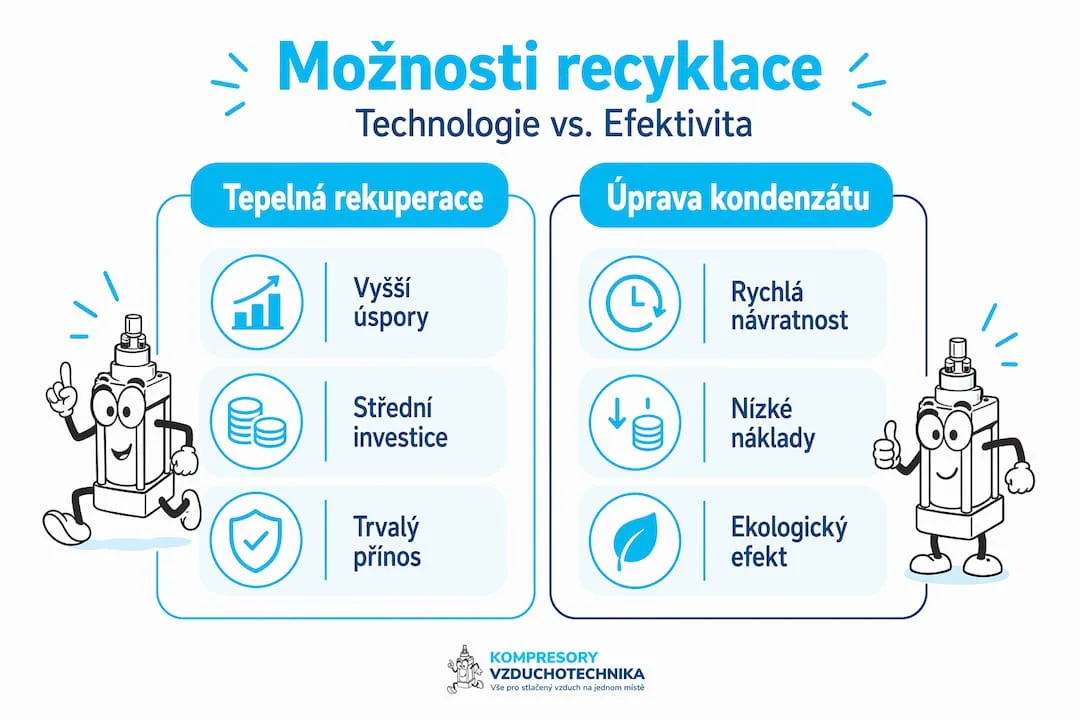
| Method | Investment cost | Operating costs | Environmental benefit | Suitability |
|---|---|---|---|---|
| Heat recovery | Medium (30,000 to 150,000 Kč) | Low | High | Operations above 15 kW, year-round running |
| Condensate recycling (simple pre-treatment) | Low (5,000 to 30,000 Kč) | Very low | Medium to high | Oil-free compressors, suitable for most operations |
| RO system (reverse osmosis) | High (150,000+ Kč) | Medium | Medium | Specific applications with high purity requirements |
| AWG system (atmospheric water generation) | Very high (200,000+ Kč) | High | Low | Specialised applications, not recommended as the primary solution |
| Direct condensate discharge into the drain | None | Cost of disposal | Negative | Unsuitable, legally problematic with oily condensate |
Simple pre-treatment of the condensate is markedly more economical than RO or AWG systems, both in terms of investment and of operating costs. Studies confirm that for most industrial applications with oil-free compressors a filter pre-treatment with activated carbon and microfiltration are enough.
Key criteria for choosing the recycling method:
- Type of compressor: oil-free versus oil-lubricated is a fundamental difference for the use of the condensate
- Volume of condensate: depends on the air flow, the temperature and the humidity of the inlet air
- Intended use: watering, process water, boilers or cooling circuits have different requirements on quality
- Available infrastructure: the possibility of connecting to the existing pipework and tanks
- Legal requirements: handling condensate from oil-lubricated compressors is subject to strict regulation under the waste act and the water act
The overview of the efficiency of air treatment and correct sizing of the systems are the basis for choosing the optimal solution. When planning, it is also worth considering industrial air pipework, because the correct topology of the pipework affects both the quality of the condensate and the availability of points to draw it off.
Heat recovery is a very attractive option from the point of view of the return on investment, particularly for operations with continuous or long daily running of the compressor. At a power input of 22 kW and 16 hours of daily operation, a heat output can be recovered corresponding to the consumption of a small family house over a heating season.
Practical tips for implementing recycling in production
The theory is clear. Practice brings particular challenges that one has to prepare for. Implementing recycling in a production plant cannot be done without a systematic approach and continuous evaluation.
Implementation step by step:
- Starting the audit of the compressed air system. Measuring air leakage by the ultrasonic method is the standard. Typically losses of 15 to 30% of the total volume are revealed, which must be removed before any recycling. Information on how to repair air leaks is available and not technically demanding.
- Installing measuring equipment. Condensate flow meters, temperature sensors and pressure sensors provide the data needed to evaluate the benefits of recycling. Without measurement it is not possible to demonstrate savings or to track the quality of the condensate.
- Choosing and installing condensate drains. Automatic drains with electronic or float control ensure the regular removal of condensate without losses of compressed air. Manual draining is unreliable and causes condensate to accumulate in the system.
- Setting up a collection tank and pre-treatment. For condensate from oil-free compressors a simple collection tank with filtration is enough. A real condensate flow of 19 l/h at low conductivity allows hundreds of litres of clean water to be collected daily in industrial operations.
- Connecting to the point of use. The condensate can be led directly into the boiler tank, the cooling circuit or the system for washing components. The pipe route must be designed with regard to hygienic requirements and material compatibility.
- Setting up quality monitoring. Regular sampling and measurement of TDS, conductivity and pH are mandatory to ensure the safe use of the condensate. The frequency of checks depends on how demanding the application is.
Professional tip: Condensate from an oil-free compressor typically has a lower conductivity than water from the public mains. That makes it a suitable substitute for boilers, where hard water causes limescale to form. Regular analysis of the condensate every three months can demonstrate stable quality and reduce the frequency of chemical treatment of the boiler.
The legal side of implementing condensate recycling is relatively straightforward in the Czech Republic. Condensate from oil-free compressors is not classified as hazardous waste if it meets the set quality parameters. By contrast, condensate from oil-lubricated compressors contains emulsified oil and is subject to Act No. 541/2020 Coll. on waste. Discharging it directly into the drain without pre-treatment is forbidden and the penalties for breaches are substantial.
The safety aspects include the correct marking of collection vessels, documentation of the condensate quality and preventing confusion with drinking water. Colour differentiation of pipework and tanks for condensate in line with the internal standards of the operation is recommended.
Regular checking of the filtration is a condition of maintaining the quality of the condensate. Filter elements become clogged with dust, oil residues and biological contaminants. The replacement intervals depend on the operating conditions, but as a rule fall within the range of three to six months.
Why recycling compressed air is still underestimated: a view from practice
From practical experience with industrial operations it is apparent that the main barrier to implementing recycling is neither technical complexity nor a high investment cost. The barrier is the lack of reliable data on real savings and the missing calculation of the return on investment.
Companies very often know that their compressed air system is not optimal. They know the compressors run unloaded, that the condensate runs off into the waste pit and that the pipework leaks are visible even without measurement. Even so, they do not embark on systematic optimisation. The reason is usually one: nobody in the operation has the time or the brief to analyse this area in detail.
The second widespread error lies in the conviction that recycling is the domain of large companies with extensive investment resources. Practice shows the exact opposite. Small and medium-sized firms with one or two screw compressors are able to achieve measurable savings after a relatively small investment in condensate drains, a collection tank and basic filtration. An outlay in the order of a few thousand crowns can bring annual savings on water and sewerage charges in the order of tens of thousands of crowns.
The real savings, moreover, do not arise only from using the condensate. Heat recovery, eliminating leaks and correct pressure control in the system are many times more effective measures. Optimising compressed air consumption as a whole brings results that no isolated recycling measure achieves on its own.
The best results come from a systemic approach: regular audits, measurement, small adjustments and continuous evaluation. It is not a one-off project but a permanent operating standard. Companies that have set it up this way report a reduction in the cost of compressed air of 25 to 35% compared with the starting state, and that without having to replace the compressors with new machines.
Recycling with specialists and leading technologies
Recycling compressed air and condensate is technically available to operations of every size. The key is the right choice of technology and good advice when designing the system.
At Kompresory-vzduchotechnika.cz we offer not only MARK compressors and SCR screw compressors with high energy efficiency and the option of heat recovery, but also a complete range of air treatment units for filtration, drying and condensate treatment. Our technicians will help design a recycling system exactly for the conditions of your operation, from choosing the condensate drains to sizing the collection tanks. Contact us for technical consultation or use the online range for a quick choice of suitable components.
Frequently asked questions
What are the main advantages of recycling compressed air?
Recycling reduces operating costs, minimises the impact on the environment and raises the energy efficiency of production. Recycling the condensate has a measurable effect on both the budget and the environmental profile of the operation.
Can condensate from oil-free compressors really be used as service water?
Yes, if the condensate meets the parameters of low mineralisation and conductivity and passes through simple pre-treatment. Condensate from oil-free compressors with low TDS and conductivity is suitable, for example, for feeding industrial boilers.
How do you start with recycling compressed air in a production plant?
The best start is an audit of the compressed air system and monitoring of leaks before implementing the recycling systems themselves. Without knowing the real state of the system it is not possible to size it correctly or to choose a suitable technology.
Does recycling compressed air require expensive equipment?
In most cases simpler and cheaper technologies are enough. Simple pre-treatment of the condensate is considerably more economical than demanding RO or AWG systems, while achieving a comparable quality of output water for most industrial applications.
Recommended
- How to eliminate air leaks: a guide to a 42% energy saving - Kompresory-Vzduchotechnika.cz
- How to repair an air leak on a compressor: a 2026 guide - Kompresory-Vzduchotechnika.cz
- Air treatment: maximum efficiency for industry and construction - Kompresory-Vzduchotechnika.cz
- How to optimise compressed air consumption and cut costs in 2026