

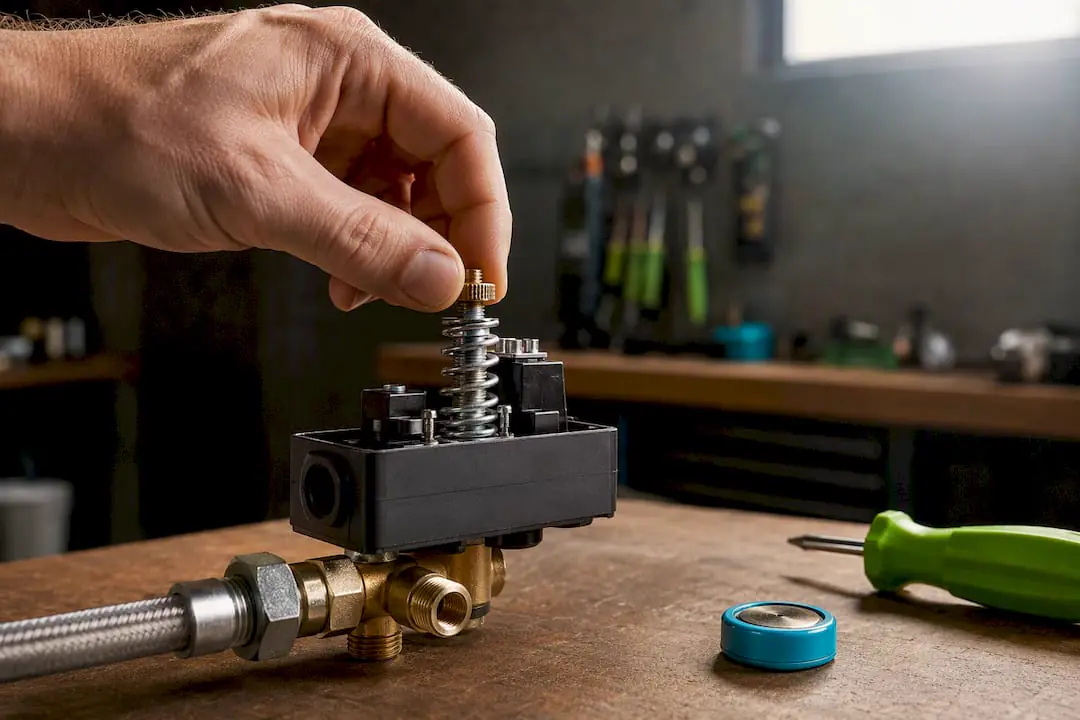
Turn off the power supply, release the pressure from the air tank, and connect a test pressure gauge. First set the cut-in (switching-on) pressure using the main nut, and only then set the differential (the difference between switching on and off) using the differential nut. The minimum hysteresis for mechanical switches is typically at the common physical limit, and a smaller difference cannot be set on most models. After adjustment, perform three to four test cycles and fine-tune if necessary.
In brief:
- The minimum possible differential setting is approximately 0.6 bar, and if more precise regulation is needed, it is necessary to switch to an electronic pressure regulator.
- After adjustment, three to four test cycles must be performed to verify the stability and correctness of the setting, and further fine-tuning must be carried out if necessary.
- The correct sequence is the most important part of the adjustment: first the cut-in pressure is set using the main nut, then the differential nut is adjusted, and the tests will show the actual difference between them.
- Faulty or worn contacts in the switch are a common cause of frequent cycling and can also be the cause even when the mechanical setting is correct.
- Regular inspection and maintenance of the switch, including checking the contacts and springs, extends its service life and reduces the risk of failures.
Contents
- What is a pressure switch and how does it work
- Tools, safety, and preparation before adjustment
- How to set the compressor pressure switch step by step
- Inspection after adjustment and the most common faults
- Maintenance of pressure switches and prevention of other problems
- Why you can rely on this guide
- Editorial perspective: the order of steps matters more than precision
- When adjustment is not enough, equipment and service can help
- Frequently asked questions
What a pressure switch is and how it works
The pressure switch sits between the air tank and the compressor head and determines when the motor runs and when it stops. Inside there is a diaphragm or piston, against which air from the tank pushes. Opposing it acts a spring, whose tension you set using an adjusting nut. When the pressure exceeds the set limit, the diaphragm switches the contacts and the motor turns off. As soon as the pressure drops by a certain difference, the contacts reconnect and the compressor starts up again.
This difference between the cut-out and cut-in pressure is called the differential or hysteresis. Without it, the switch would click practically continuously around a single value, which would destroy the contacts and the motor within a few weeks. That is precisely why the switch is adjusted in two steps, not with a single turn of a screwdriver.

Tools, safety and preparation before adjustment
Before touching the switch cover, disconnect the compressor from the mains and switch off the relevant circuit breaker. Drain the air tank through the drain valve, so that the components are not under pressure that you would be handling blindly. Only then does it make sense to open the cover and move the nuts.
For the adjustment itself you only need a few things:
- a calibrated reference pressure gauge, ideally on a separate branch, not just the one built into the switch,
- a box wrench or flat wrench for the adjustment nuts,
- a screwdriver to remove the cover,
- insulated tools, if you will be working under the cover near live contacts.
While fine-tuning the cycles, you will need to leave the system pressurized and the power on, otherwise you will not find out at what value the switch actually reacts. However, do this only with the cover in place or at least with your hands away from the contacts, and if you are not sure, it is better to leave the fine-tuning to a service technician.
Professional tip: Position the check pressure gauge so that you can see it even while turning the nut. You will save yourself from running back and forth and from incorrect readings caused by recording the value two seconds later than it actually occurred.
The guide to measuring air pressure describes in more detail how to choose and position a suitable instrument.
How to set the compressor pressure switch step by step
Setting the compressor pressure switch has a fixed sequence. If you reverse it, the switch easily gets "out of tune" and you start adjusting from zero. Proceed as follows:
- Remove the switch cover. Underneath it you will find two nuts or screws: the main one (often marked P or "Main"), which determines the cut-in pressure, and the differential one (ΔP or "Diff"), which determines the difference between cut-in and cut-out.
- First set the cut-in pressure using the main nut. Turning clockwise increases the pressure, turning counterclockwise decreases it. Watch the pressure gauge and release air from the tank until the motor starts again at the desired value as the pressure drops.
- Then adjust the differential using the differential nut. Here you determine by how much the pressure must rise above the cut-in value before the switch turns the motor off again. Here too, turning clockwise increases the difference.
- Verify both points by measurement. Let the tank fill up until it switches off, then release air and record at what value the motor starts. The difference between the cut-out and cut-in values is your actual differential.
- If the differential blocks further adjustment of the cut-in pressure, loosen the nut completely and start again from step 2. Trying to tighten both nuts at the same time only results in not knowing which value corresponds to what.
For a typical workshop application, the cut-in and cut-out pressure settings are usually set so that the differential matches the needs of the equipment. For more sensitive tools, where you want more stable pressure, the differential is kept close to the minimum that a mechanical switch can handle.
Minimum hysteresis: on most mechanical pressure switches, the differential cannot be reduced below approximately 0.6 bar. Attempting a smaller difference usually results in the switch not responding to the released air at all, because it is physically at the limit of its mechanism.
If you need a really narrow hysteresis, for example around 0.1 to 0.2 bar for sensitive pneumatic automation, a mechanical switch is not sufficient, and the solution is an electronic pressure regulator. However, this is a different category of device than the classic diaphragm switch described above.
The chosen target value for the cut-in pressure should be based on what you actually need for the job. The relationship between working pressure and tool performance is discussed in the article on the effect of pressure on tools, which will help you estimate whether 6 bar is enough, or whether you need more.

Check after setting and the most common faults
After completing the adjustment, let the compressor run through three to four complete cycles, i.e. filling the tank and releasing it down to the cut-in pressure. Watch the pressure gauge to see if the cut-in and cut-out values repeat stably, and not that they shift by a tenth of a bar with each cycle.
The most common symptoms of an incorrectly set or worn switch:
- Frequent cycling – the motor starts and stops at short intervals because the differential is set too narrow or the spring has lost its elasticity.
- Motor overheating – a consequence of the previous point; the motor does not have time to cool down between cycles, and its service life is significantly shortened.
- Current spikes on startup – repeated frequent starts put more strain on the electrical wiring and the circuit breaker than they are rated for.
- The switch does not respond at all – this is usually due to a stuck spring, corrosion on the contacts, or a mechanical fault inside the switch, not a setting error.
If the problem recurs even after readjusting the differential, check the electrical contacts under the cover. Frequent cycling is often just as commonly caused by worn contacts as by actual incorrect settings, and this is easily mistaken for a "poorly adjusted switch". The connections between cycling, the circuit breaker, and overheating are discussed in more detail in the articles on screw compressor overheating and on a compressor that trips the circuit breaker.
Maintenance of pressure switches and prevention of further problems
A pressure switch does not require complex care, but a few minutes of occasional inspection will save you from having to readjust it again later. Recommended schedule:
- Once every three to six months, check the cover and contacts for corrosion or dust buildup from the workshop.
- At each inspection, try using your hand or a wrench to verify that the adjustment nuts have not seized and that the spring moves freely.
- In humid or dusty environments, consider a shorter inspection interval, as a corrosive environment wears out the switch faster.
If the problem persists even after repeatedly readjusting the differential and the cut-in pressure, and the contacts appear to be in good condition, the switch is probably mechanically worn out and further adjustment will not help. At this point, it is cheaper and more reliable to replace it than to waste time in the workshop with a tool that only holds its setting for a few hours.
Professional tip: It is worth keeping a simple record of when you first adjusted the switch and what values you set. At the next inspection, you will immediately be able to tell whether the values have drifted on their own or whether the problem lies elsewhere. A practical overview of other errors in compressor operation can be found in the article on the most common mistakes when using compressors.
Why you can rely on this guide
The procedure is based on a principle followed by all mechanical switches regardless of manufacturer: first the cut-in pressure, then the differential, never the other way around. The text was written by Zdeněk, technical editor at Kompresory-vzduchotechnika, who has long been involved in the operation and service of compressor systems. If you encounter a non-standard setup or a recurring fault that adjustment does not resolve, consulting technical service will save more time than further blind attempts.
Editor's perspective: the order of steps matters more than precision
Most guides focus on exactly how to turn the nut a quarter turn. But that is a secondary detail. What matters is the order. I have seen descriptions recommending that the differential be set first because "it's a simpler number". It is a simpler number, but it unnecessarily complicates the whole procedure, because the differential is always calculated from the cut-in pressure, not the other way around.
The second thing people underestimate: hysteresis of around 0.6 bar is not a shortcoming of the specific switch you bought. It is a physical limit of the mechanism as such. If you need more precise regulation, the solution is not to look for a "better" mechanical switch, but to switch to electronic regulation. Third, test cycles after adjustment are not a formality at the end. They are the only way to reveal that a problem you attributed to the switch is actually being caused by worn contacts. Anyone who skips this step will keep readjusting over and over and never find out why.
— Zdeněk
When adjustment is not enough, equipment and service can help
If adjusting doesn't suit you or you want certainty of accurate measurement, Kompresory-vzduchotechnika offers calibrated pressure gauges, replacement pressure switches, and expert consultation, without having to book a full day of service for a single nut.
Suitable hoses and accessories to complete the measuring path can be found in the hoses and accessories category. For more complex faults where adjusting the differential doesn't solve the problem, it is faster to have the switch checked than to disassemble it repeatedly just to test it.
Frequently asked questions
How to adjust a pressure switch on a compressor?
Disconnect the compressor from the mains, release the pressure, connect a pressure gauge, and first set the cut-in pressure using the main nut, only then the differential using the differential nut. After adjustment, run several test cycles.
How to regulate the pressure on a compressor?
Operating pressure is controlled via the pressure switch, which switches the motor on and off according to the values set on the main and differential nuts. More precise regulation beyond what a mechanical switch offers is provided by an electronic pressure regulator.
What is the minimum difference between the cut-in and cut-out pressure?
For most mechanical switches, the minimum adjustable differential is around 0.6 bar. Below this threshold, a standard mechanical switch usually cannot be adjusted.
What to do when the differential is blocking further adjustment of the cut-in pressure?
Fully loosen the differential nut and start again from setting the cut-in pressure. Adjusting both nuts at the same time only leads to confusion about which value corresponds to what.
What causes the compressor to cycle frequently after adjustment?
Most often a too narrow differential or worn electrical contacts in the switch. If fine-tuning the differential does not solve the problem, the contacts need to be checked or the switch replaced.