
TL;DR:
- Pneumatic spring cylinders offer a fail-safe function that automatically returns the actuator to a safe position on loss of pressure. This type suits varied industrial applications where safety and reliability are key without the need for an external control signal. When choosing one, the fail-safe position, the optimal spring preload and the technical parameters must be correctly defined according to the specific use.
Pneumatic systems in industry are not limited to piston actuators, which many designers regard as a universal solution. The pneumatic spring cylinder, more precisely a diaphragm actuator with spring return, brings a fundamental difference: a built-in fail-safe function that on loss of pressure automatically returns the actuator to a defined safe position. This article explains the exact working principle, the key technical specifications, a comparison of the design variants, industrial applications and practical criteria for the right choice and installation. The information is intended primarily for engineers and technicians working with industrial pneumatics.
Contents
- The working principle of a pneumatic spring cylinder
- Design specifications and adjustment options
- Applications of pneumatic spring cylinders in industry
- Selection criteria and safety during installation
- Unusual optimisations of spring cylinders: what most designers overlook
- Professional solutions for pneumatic cylinders and compressors
- Frequently asked questions about pneumatic spring cylinders
Key findings
| Point | Details |
|---|---|
| Safety fail-safe | A spring cylinder with a diaphragm ensures automatic return on loss of pressure, which is key for safe industrial applications. |
| A wide range of specifications | Possible parameters – stroke up to 3 m, forces up to 54 kN, for various temperatures and applications. |
| Optimising performance | Setting the spring preload and a multi-spring design allow precise control and a higher force. |
| Use in automation and brakes | The cylinders find application from a valve in production to parking brake systems in lorries. |
| The right choice increases efficiency | Taking the safety and technical criteria into account during installation maximises the service life and reliability of the system. |
The working principle of a pneumatic spring cylinder
Understanding how a diaphragm spring cylinder works starts with the difference from a classic piston actuator. A piston cylinder uses a solid piston moving in a cylinder, with the pressure acting on both sides. A diaphragm actuator works differently: a flexible diaphragm transfers the pressure of the compressed air directly to the actuator stem, and a spring provides the mechanical return to the initial position.
A pneumatic spring cylinder is a single-acting linear diaphragm actuator operated by compressed air, where a spring provides the return force. This definition precisely delimits how this type differs from double-acting piston actuators without a spring.

Fail-safe: how it really works
The working principle is straightforward: compressed air pushes the diaphragm to move forward, for example to open a valve, and the spring returns the actuator to its initial position on loss of pressure. This property is called fail-safe and in industrial practice represents a fundamental safety advantage.
There are two basic fail-safe configurations:
- Fail-close: The spring closes the valve on loss of pressure. Used in systems where the escape of the medium during a power failure constitutes a risk.
- Fail-open: The spring opens the valve on loss of pressure. Used where the flow must be assured even during a fault, for example in cooling circuits.
- Diaphragm design: Lower friction than a piston, faster response, fewer moving parts.
- Piston design: Longer strokes, higher forces, but without inherent fail-safe unless an additional spring is fitted.
- A combination of both principles: In some applications the diaphragm is combined with a small piston to increase the stroke while retaining the fail-safe function.
The key difference: A diaphragm spring cylinder does not need an external control signal to return to the safe position. The spring provides the reset mechanically, without depending on the electrical supply or the control system.
A correct understanding of how pneumatic systems work is a precondition for choosing an actuator efficiently. In practice this means the designer must first define which position is "safe" for the given process, and only then choose the fail-close or fail-open configuration.
A comparison of diaphragm and piston actuators:
| Parameter | Diaphragm actuator | Piston actuator |
|---|---|---|
| Friction | Minimal | Higher (seals) |
| Stroke | Limited (typically up to 150 mm) | A greater range |
| Fail-safe | Natural with the spring | Requires an additional spring |
| Service life | Depends on the diaphragm | Depends on the seals |
| Positional accuracy | High (valves) | High (linear actuators) |
Professional tip: When designing the system, always specify the required fail-safe position as the first parameter. Only then choose the other specifications of the actuator. Swapping the fail-close and fail-open configuration after installation is costly and time-consuming.
Design specifications and adjustment options
Having understood the principle, it is key to know the specific technical parameters and adjustment options that determine whether a given actuator will meet the requirements of a specific application.
Typical specifications of industrial spring cylinders cover a stroke of 140 to 3,000 mm, a working pressure of 20 to 450 kPa, forces of 0.5 to 54 kN and a temperature range from -60 °C to +80 °C. These values correspond to standard industrial actuators for operating valves.
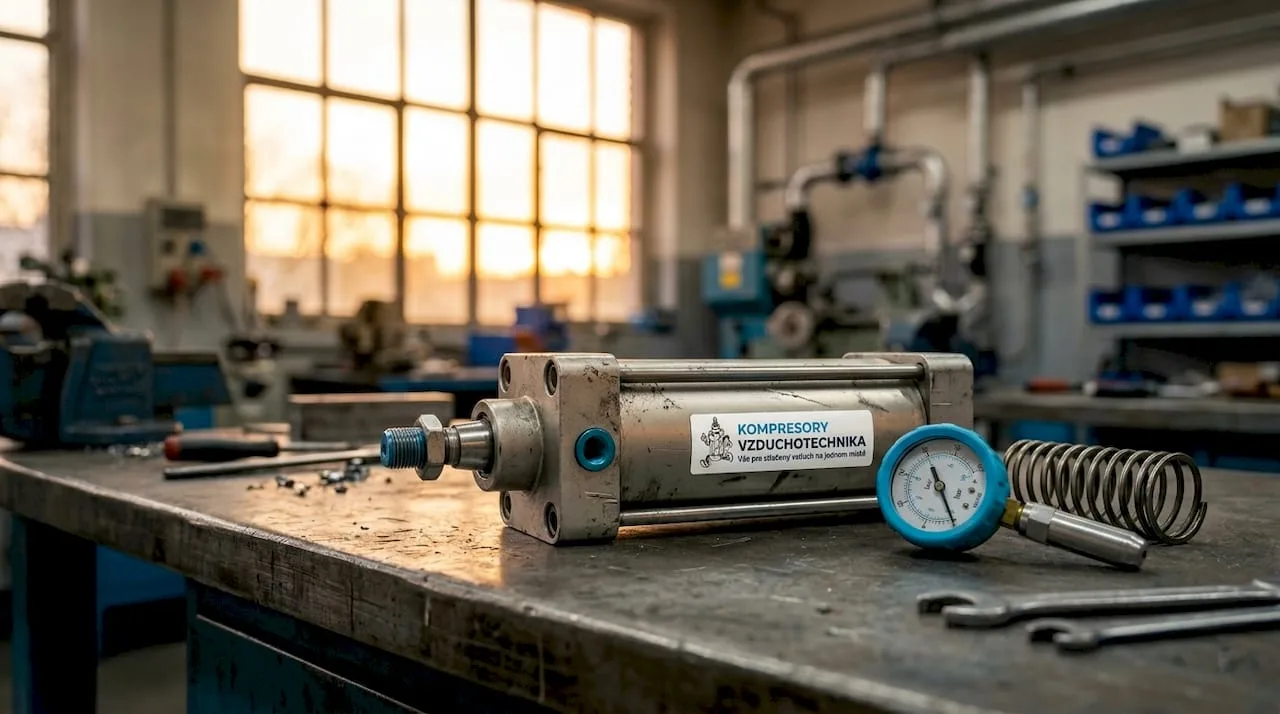
At the other end of the spectrum stand compact units: a small pneumatic cylinder with a return spring reaches a force of 220 N, a stroke of 8 mm and a working pressure of max. 1 bar. These parameters are typical for welding jigs, clamping mechanisms or fine handling.
An overview of the technical parameters
| Parameter | Small cylinders | Medium cylinders | Large actuators |
|---|---|---|---|
| Stroke | up to 30 mm | 30 to 500 mm | 500 to 3,000 mm |
| Force | up to 500 N | 0.5 to 10 kN | 10 to 54 kN |
| Working pressure | up to 1 bar | 0.2 to 4 bar | 0.2 to 4.5 bar |
| Temperature range | 0 °C to +60 °C | -20 °C to +70 °C | -60 °C to +80 °C |
| Typical application | Jigs, welding | Valves, fittings | Industrial shut-off devices |
Adjustment options and optimising performance
Proper precise pressure control is one of the most important factors in optimising a spring cylinder. The specific adjustment options include:
- Spring preload: Setting the initial tension of the spring determines the force needed to start the movement. A higher preload provides a faster and stronger fail-safe return.
- Multi-spring configuration: Combining several springs in one actuator increases the total return force without having to increase the diameter of the actuator.
- Adjustable pressure range: Changing the working pressure of the supply makes it possible to regulate the speed and force of the forward movement.
- Interchangeable diaphragms: Various diaphragm materials (NBR, EPDM, PTFE) for chemically aggressive environments or extreme temperatures.
- Throttle valves: Regulating the air flow for precisely setting the speed of movement.
Professional tip: A multi-spring configuration is not always advantageous. Combining several weaker springs does increase the total force, but it also reduces the progressiveness of the characteristic. For precise positioning, one stronger spring with a precisely defined stiffness tends to be preferable.
The effect of temperature on performance
The temperature range markedly affects the choice of material for both the diaphragm and the spring. A standard NBR diaphragm works reliably in the range from -20 °C to +70 °C. For temperatures below -40 °C it is essential to choose EPDM or special silicone diaphragms. Stainless steel springs allow operation down to -60 °C without loss of properties.
Applications of pneumatic spring cylinders in industry
After the technical parameters it is worth knowing the specific applications and particular cases in real operation. Pneumatic spring cylinders are used in a number of sectors, each of which places different demands on configuration and performance.
Operating industrial valves
The most widespread application is operating industrial valves, particularly valves in the process industry. Actuators of the LP1 series with a side handwheel also allow manual operation during a loss of pressure, which is important during service work. Typical applications include:
- Control valves in the oil and gas industry
- Shut-off valves in chemical plants
- Industrial dampers in systems for distributing air and gases
- Safety shut-off devices in the food industry (FDA materials)
The fail-safe function is critical in these applications. On failure of the control system or of the compressed air, the valve must take up the safe position without any external intervention.
Industrial automation and production processes
Industrial automation uses spring cylinders in applications requiring accurate and repeatable positioning. Assembly lines, clamping jigs, manipulators and sorting systems are typical examples. The advantages of pneumatic systems in these applications include resistance to electromagnetic interference, a high speed of movement and simple maintenance.
Braking systems of lorries
A specific and critical use is spring brake chambers in lorries for the parking brake. In this case the spring holds the brake applied (fail-safe in braking) and the compressed air releases the brake. A loss of air pressure therefore automatically activates the parking brake rather than deactivating it. This is a classic application of the fail-safe principle in a safety-critical system.
An observation from practice: A brake chamber in a lorry must withstand temperatures from -40 °C to +80 °C, corrosion, vibration and hundreds of thousands of cycles. The choice of materials and the design of the spring are therefore critical.
A comparison of applications by requirement
| Application | Fail-safe configuration | Typical force | Priority parameter |
|---|---|---|---|
| Industrial valve | Fail-close | 1 to 20 kN | Reliability, service life |
| Cooling circuit | Fail-open | 0.5 to 5 kN | Speed of response |
| Parking brake | Fail-brake | 10 to 40 kN | Durability, temperature range |
| Welding jig | Fail-release | up to 500 N | Accuracy, repeatability |
| Emergency shut-off | Fail-close | 5 to 54 kN | Reliability during a failure |
The efficiency and safety of pneumatics are closely linked in these applications. The right choice of configuration directly affects the safety of the whole process.
Edge cases and special solutions
Multi-spring configurations for higher forces, adjustable spring tension for accuracy and fail-safe on loss of air are typical requirements in demanding applications. They include, for example:
- Valves in cryogenic systems working below -50 °C
- Actuators in environments with an explosion hazard (Ex zones)
- Systems with a required fail-safe response time below 500 ms
- Actuators in subsea installations or in spaces with high humidity
Fluctuating pressure in pneumatics is another factor that must be taken into account when designing systems for edge cases. Pressure fluctuation in the distribution network can affect the accuracy and reliability of the movement.
Selection criteria and safety during installation
Only after understanding the applications is it possible to move on to specific recommendations for safe selection and installation. A poorly chosen actuator or faulty installation can lead to unexpected failures or safety incidents.
Single-acting versus double-acting actuators
Single-acting actuators with a spring versus double-acting ones without a spring represent a fundamental choice in the design. The spring in a single-acting actuator provides the safety reset, a function a double-acting actuator without an additional spring lacks. A double-acting actuator offers a greater force and more accurate control in both directions, but requires active control for the return movement as well.
The procedure for choosing correctly
- Define the fail-safe position: Fail-close, fail-open or another safe position must be clearly established before choosing the actuator.
- Calculate the force required: Take into account the friction forces of the valve, the differential pressure of the medium and a safety factor (min. 1.3 for industrial applications).
- Determine the stroke: The stroke of the actuator must match the stroke of the valve with a reserve of 10 to 15% to compensate for wear.
- Set the working pressure: The pressure of the compressed air in the network must cover the necessary output of the actuator and at the same time must not exceed the maximum permitted pressure of the diaphragm.
- Check the temperature range: The temperature of the medium, of the surrounding environment and of the compressed air must lie within the range of the actuator specifications.
- Choose the materials: For aggressive media or corrosive environments choose the corresponding materials for the diaphragm, the body and the spring.
Safety during installation and operation
The safe use of pneumatic equipment is a priority in every installation. The key safety requirements include:
- Releasing the pressure before dismantling the actuator or the diaphragm
- Checking the condition of the diaphragm at every planned maintenance (min. 1× a year)
- Verifying the correctness of the fail-safe configuration after every reconfiguration
- Securing the actuator against unintended operation during servicing (LOTO procedures)
- Checking the tightness of the air supply and the fittings before commissioning
Professional tip: The diaphragm is the most frequently worn part of the actuator. Define the preventive replacement interval on the basis of the number of cycles, not only on the basis of calendar time. For valves with a high cycling frequency (more than 10,000 cycles a year) we recommend checking the diaphragm every 6 months.
Choosing hoses and accessories
Choosing pneumatic hoses for the supply to the actuator affects the speed of response and the reliability of the system. The diameter of the hose must match the flow capacity of the actuator. Too thin a hose lengthens the filling time and delays the start of the movement, which can be critical in safety applications requiring a fast response.
The advantages of pneumatic tools and actuators also include low maintenance requirements compared with electric actuators. Even so, regular checking of the filters, the automatic lubricator and the condensers in the compressed air network is essential for a long service life of diaphragm actuators.
Unusual optimisations of spring cylinders: what most designers overlook
After the practical procedures for choosing and installing, it is time for findings you will not come across in ordinary catalogue sheets. This experience comes from practice with industrial installations where standard approaches are not enough.
Most designers, when choosing a spring actuator, pay attention mainly to the maximum force of the spring and the working pressure. That is right, but incomplete. The overlooked parameter is the spring preload, that is the force the spring exerts before the movement even begins. Too low a preload causes the fail-safe return to be slow and uncontrolled. Too high a tension, on the other hand, increases the demands on the working pressure and can cause wear of the diaphragm in the rest position.
The optimal preload usually lies in the range of 15 to 25% of the maximum spring force. This value ensures a fast start of the movement when the pressure drops and at the same time does not load the diaphragm in the operating position. Unfortunately, most catalogues give only the maximum force, not the characteristic over the course of the stroke.
The second overlooked factor is the role of the diaphragm as a control element. A flexible diaphragm does not have a constant stiffness over the whole stroke. At the start of the stroke the diaphragm is looser, at the end of the stroke it tightens. This progressive characteristic can be an advantage (damping the impact in the end position) or a disadvantage (non-linearity of the positioning force). For precise control in pneumatics it is necessary to take this property into account in the calculation.
A third, even less discussed aspect: the combination of springs of different stiffness in one actuator. As standard, manufacturers offer sets of springs of the same stiffness. Combining a weaker inner spring (for fine initial movement) and a stronger outer spring (for the full return force) gives a progressive characteristic that more closely matches the needs of control valves. This option exists, but you will not find it anywhere in the standard catalogue sheets, because it is a matter of bespoke configuration.
Spring fail-safe therefore brings more than safety at the critical moment of a failure. A correctly configured actuator with an optimised preload and a progressive spring characteristic also improves ordinary control accuracy in operation. This is an aspect that a direct comparison with a double-acting actuator without a spring systematically leaves out.
Professional solutions for pneumatic cylinders and compressors
Pneumatic spring cylinders and diaphragm actuators need a reliable and clean source of compressed air. Contamination or fluctuation of the pressure directly affects the service life of the diaphragm and the accuracy of the movement.
At Kompresory-vzduchotechnika.cz we offer complete solutions for industrial pneumatic systems. The choice includes MARK compressors for demanding industrial applications with a requirement for continuous operation, and SCR screw compressors for efficient and quiet running in production plants. The range also includes compressed air treatment units for filtration, drying and pressure control, which are essential for protecting diaphragm actuators. Expert advice for a specific industrial project is available on request through our technical support.
Frequently asked questions about pneumatic spring cylinders
What is the difference between a diaphragm and a piston spring cylinder?
A diaphragm actuator transfers the pressure to the movement through a flexible diaphragm and uses a spring for the fail-safe return, while a piston one has a classic piston with seals and the fail-safe function is provided only by an additional spring.
Why does the spring fail-safe in a cylinder matter?
The fail-safe mechanism ensures that on loss of pressure the actuator automatically returns to the safe position without depending on the control system or the electrical supply.
What are the typical values of stroke and force for industrial spring cylinders?
The stroke tends to be 140 to 3,000 mm, the force from 0.5 to 54 kN depending on the diameter of the actuator, the spring configuration and the working pressure.
Can a spring cylinder be used for vehicle braking systems?
Yes, spring brake chambers are commonly used for parking brakes in lorries, where the spring holds the brake applied and the compressed air releases it.
How do you adjust the spring force for higher control accuracy?
The force and the characteristic can be optimised by setting the spring preload and by combining several springs of different stiffness for a progressive characteristic matching the requirements of the specific control application.
Recommended
- Why use pneumatics: efficiency, speed and safety - Kompresory-Vzduchotechnika.cz
- How pneumatics work: a complete guide for industry 2026
- The advantages of pneumatic systems: why use them in production - Kompresory-Vzduchotechnika.cz
- Stepless pressure control: precise regulation in pneumatics - Kompresory-Vzduchotechnika.cz