

TL;DR:
- Air valves are key elements of pneumatic systems that affect their safety and efficiency.
- The right choice, maintenance and diagnostics of valves prevent failures, increase reliability and reduce repair costs.
Air valves are among the most underestimated components in industrial and construction pneumatic systems. Most technicians deal with the compressor, the pipework or the actuators, but the valves tend to be overlooked until the moment the system fails. A wrongly chosen type of valve or neglected maintenance can, however, cause a sudden pressure surge, contamination of the oil in the pipework or a cascade of failures across the entire production line. This guide systematically explains the functions, types and safety aspects of air valves, and gives specific instructions for both the choice and the day-to-day care.
Contents
- An introduction to the role of air valves in industrial applications
- Types of air valve and their specific functions
- Safety aspects, edge cases and failures of air valves
- Practical selection and maintenance of air valves in operation
- What often gets missed when dealing with valves: a view from practice
- How we can help you with the right choice of valves and systems
- Frequently asked questions
Key findings
| Point | Details |
|---|---|
| The role of valves in control | Valves control the functioning of pneumatic systems and affect both safety and efficiency. |
| Choosing the right type | Different applications require suitable types of valve according to function and actuation. |
| Safety and reliability | Quality valves minimise the risk of failure, leakage or damage to the equipment. |
| Regular maintenance | Regular checking and maintenance extends the service life and reduces operating costs. |
An introduction to the role of air valves in industrial applications
Pneumatic systems work on a simple principle: the compressor compresses the air, the receiver holds it and the pipework distributes it where it is needed. Without valves, however, the whole circuit would be uncontrollable. Air valves are the control elements of compressor and pneumatic circuits, with each type performing a specific function. They can be likened to logic gates in electronics: they control when the air flows, where it flows and at what pressure.
In a typical industrial circuit you will come across several basic categories of valve:
- Directional valves (distribution valves): they switch the air flow to one or more outlets and control the movement of pneumatic cylinders
- Check valves (non-return valves): they allow flow in one direction only and protect the system against reverse flow
- Safety valves (relief valves): they open when the set pressure is exceeded and protect the system against damage
- Control valves: they throttle the flow or the pressure and allow proportional control
- Exhaust valves: they remove air or condensate from pipework and receivers
- Seat valves: robust in construction, suitable for high pressures and aggressive media
Each of these types has its place in the system, and replacing one with another without knowing the function is a typical mistake that leads to operating problems. Understanding the principles of pneumatic systems is therefore a basic condition for choosing valves correctly.
How a valve affects the whole system
A valve does not stand in isolation in a pneumatic circuit. Its setting and performance directly affect the behaviour of the actuators, the speed of movement of the cylinders, the accuracy of positioning and the overall energy efficiency. If, for example, a control valve is set to too low a flow, the cylinder works slowly and the whole production cycle lengthens. Conversely, opening it too far causes uncontrolled movement and wear of the seals.
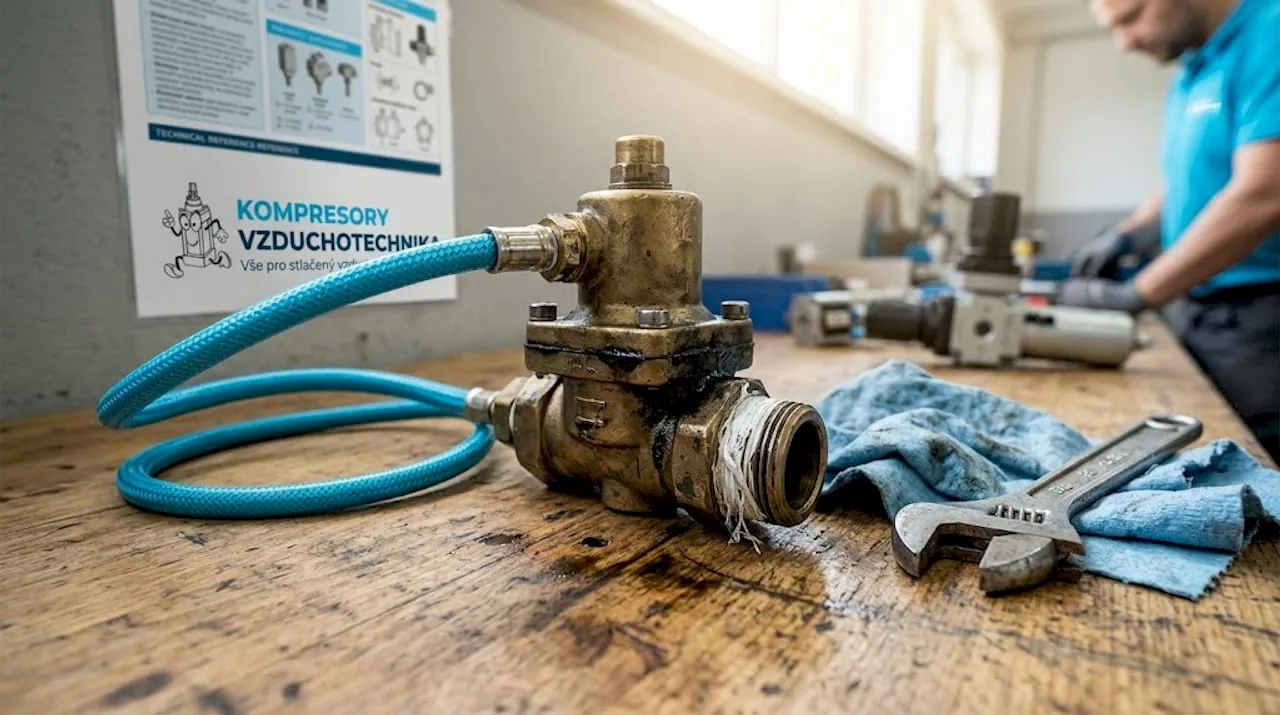
The correct functioning of the air receiver also depends on how the valves are connected into the circuit. We explain more about the mutual relationship between the air receiver and efficiency in a separate article.
| Type of valve | Main function | Typical use |
|---|---|---|
| Directional (5/2) | Switching the flow | Operating double-acting cylinders |
| Check valve | One-way flow | Protecting the compressor on shutdown |
| Safety valve | Limiting the pressure | Protecting receivers and pipework |
| Control (throttle) | Throttling the flow | Setting the speed of actuators |
| Exhaust valve | Discharge of air/condensate | Pipework systems, receivers |
| Proportional | Stepless pressure control | Precise applications, robotics |
Understanding the function of the unloader valve and its relationship to the valves is important particularly in larger industrial installations. The detailed explanation of the function of the unloader valve describes how to get rid of the residual pressure safely after shutting down the system.
Types of air valve and their specific functions
Once we have decoded the basic terms, let us look at them in detail: how the various types of valve differ and what specific task they have in the system.
Control valves convert compressed air into control of the process, their key parameter being the accuracy and repeatability of the setting. Unlike simple shut-off valves, control valves work across a continuous range of opening and thus allow a proportional output.
An overview of the most used types by function:
- Directional valves are the most widespread type in industry. They are designated by a numerical notation: 3/2 means three ports and two positions, 5/2 five ports and two positions. These valves determine where the air flows in each phase of the working cycle.
- Check valves work passively. They open when there is flow in the correct direction and close when reverse flow is attempted. No control signals or energy are needed.
- Relief and safety valves are front-line safety elements. The maximum working pressure is set on them and when it is exceeded they open automatically.
- Control (throttle) valves reduce the cross-section of the pipework and thereby throttle the flow. They are used mainly for setting the speed of movement of pneumatic cylinders.
- Exhaust valves are a specialised type for managing the air in the pipework. Valves are key to venting, routing and safety back-up, and their function in removing air pockets from water pipework markedly reduces the risk of water hammer.
- Proportional valves are the most complex type. Their opening is controlled electronically across a precise range of 0 to 100%, so they allow stepless and repeatable setting of pressure or flow.
A comparison by method of actuation
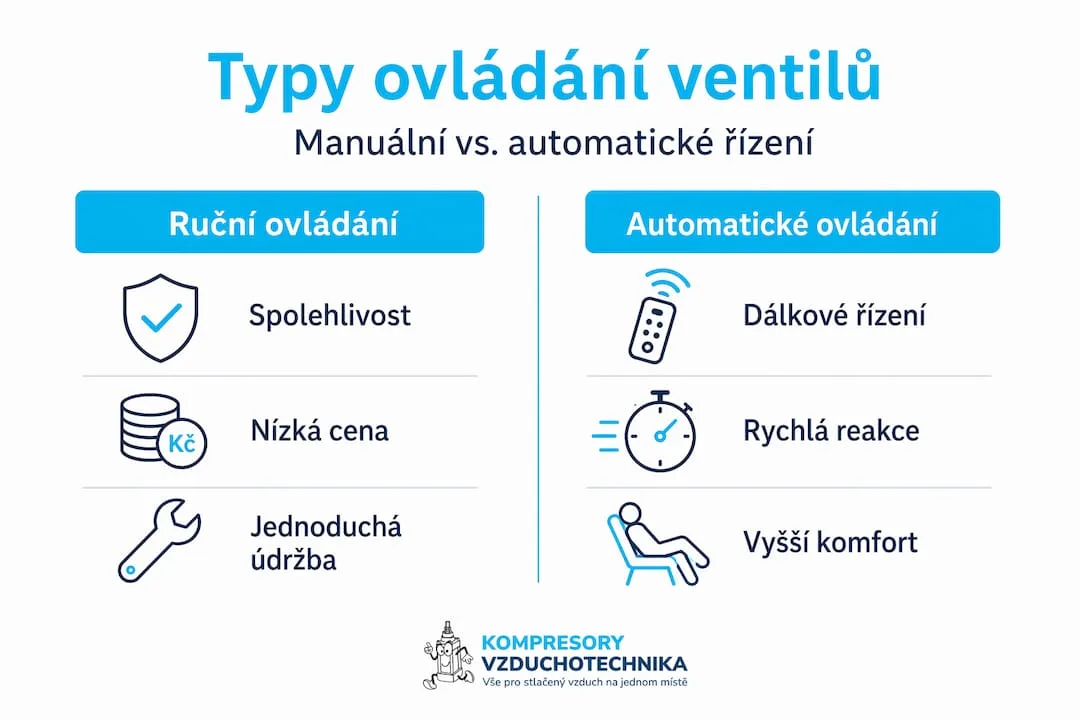
The method of actuating a valve is one of the key selection criteria. The difference between a manual valve, a solenoid and an automatic valve is not only technical but also operational.
| Method of actuation | Advantages | Disadvantages | Typical application |
|---|---|---|---|
| Manual | Reliability, zero energy consumption | Slow switching, dependence on the operator | Service shut-offs, emergency stop |
| Solenoid | Fast switching, easy automation | Energy consumption, sensitivity to voltage | Production lines, PLC systems |
| Pilot (air-operated) | Suitable for explosive environments | More complex connection, requires pilot air | Chemical industry, paint shops |
| Proportional | Stepless control, accuracy | Higher price, complicated parameter setting | Robotics, precision manufacturing |
Professional tip: When choosing a solenoid valve, always verify the protection rating (IP67 or higher) and the nominal supply. Mixing up 24V DC and 230V AC, or the other way round, is one of the most common installation mistakes and causes immediate destruction of the coil.
The effect of working pressure on the functioning of valves tends to be underestimated. A drop or fluctuation of pressure at the inlet causes unstable behaviour of the whole circuit. A detailed analysis of the effect of pressure on valves shows how fluctuating pressure reduces the overall efficiency of the system.
Safety aspects, edge cases and failures of air valves
Besides the basic differences between types of valve, it is necessary to address the risks that arise when they fail or are set up unsuitably. The safety aspect is fundamental in pneumatic systems working with pressures of 6 to 16 bar.
Check valves prevent reverse flow, and their failure leads to the danger of contamination by oil vapours or to uncontrolled reverse movement of the actuators. On shutting down the compressor without a working check valve, air from the receiver can flow back through the compressor and damage it or contaminate the whole pipework.
The most common valve failure scenarios
- A leaking seat: air seeps through the closed valve, the pressure in the system gradually falls even without any draw-off
- A jammed spool: the valve remains in the open or closed position with no possibility of switching, production stops
- Worn seals: rubber or polyurethane seals degrade through contact with oil or high temperature
- Corrosion of the internal parts: moist air without the condensate filtered out causes corrosion, the valve stops sealing
- Blockage by contaminants: solid particles from the pipework or the condensate block the seat or the spool
- An electrical fault on the solenoids: a burnt-out coil or a fault on the connector causes loss of control
Failure of relief valves can lead to overloading and the activation of mechanical safety devices, or in an extreme case to destructive failure of the receiver.
Warning: Cascading failure of valves is a serious problem in industrial practice. A single faulty safety valve that fails to open under excess pressure causes an overload of the pipework. The raised pressure then damages the seals of further valves in the circuit, and that even without any direct mechanical defect on them.
How to recognise a developing fault
Detecting a problem early markedly reduces both the cost of repair and the extent of the resulting damage. The symptoms to focus on:
- Abnormal noise when the valve switches (cracking, whistling)
- Unusually slow movement of the cylinder with no other cause
- An unexpected drop in pressure with the system at rest
- A visible air leak around the valve or the flanges
- A raised temperature of the valve body in operation
The detailed procedure for identifying and repairing compressor check valves describes both the technical functions and the diagnostic procedures.
Professional tip: Keep regular operating records. Record the temperature, pressure and cycle times for each valve separately. A deviation from the norm of 10% or more is a signal for a preventive check, not for waiting for a failure.
The overview of the most common mistakes when running a compressor shows that valve problems make up more than a third of all service calls. The right choice of safety valves and their regular checking are therefore an economically advantageous investment. Another key aspect is eliminating air leaks throughout the system, which directly reduces operating costs and the load on the valves.
Practical selection and maintenance of air valves in operation
With a knowledge of the functional and the safety aspects, one can move on to the practical choice and the correct care of valves in daily operation.
Accurate control of the speed of movement of the cylinders is assured only by the right type of valve. This basic proposition holds across the whole breadth of pneumatic technology: from simple hand tools to fully automated production lines.
Criteria for choosing a valve for a specific application
When choosing a valve it is necessary to define at least these parameters:
- Function: what is the valve to do? Control the direction of flow, regulate the pressure, provide a non-return safeguard?
- Working pressure: the nominal and maximum operating pressure in the application. Most industrial valves work in the range of 0.3 to 16 bar.
- Flow (Kv value): the characteristic value of water flow at a given pressure drop. Too low a Kv causes a pressure loss, too high a one reduces the accuracy of control.
- Medium: dry air, air with oil, air with condensate, an aggressive environment. The materials of the seals differ according to the medium.
- Method of actuation: manual, solenoid, pilot, proportional. Each method has different demands on the supply and the control signals.
- Installation conditions: ambient temperature, vibration, dust or moisture. These factors determine the protection rating required and the material of the body.
- Certification: strict standards apply to pressure vessels and safety valves (PED, ATEX for explosive environments).
A checklist for valve maintenance
Regular maintenance extends the service life of valves and reduces the risk of unplanned outages. The recommended procedure:
- Daily check: visual inspection for air leaks, checking the indication of the solenoids, verifying the movement of the manual override
- Weekly check: measuring the working pressure before and after the valve, checking the mounting and the hoses
- Monthly check: testing the safety valves by opening them manually, checking the seals and the flange joints, cleaning the filters of the air treatment unit (FRL)
- Annual overhaul: complete dismantling and visual inspection of the internal parts, replacement of the rubber seals regardless of their condition, a functional test of the whole circuit in all operating states
- After every repair: verification of the pressure tightness of the whole circuit, checking the function of the automatic elements while simulating an emergency stop
Professional tip: Never replace just one faulty valve without checking the neighbouring elements in the circuit. If one valve has failed, the neighbouring ones are with high probability at the same stage of wear. Preventively replacing a group of valves during one service visit is cheaper than a repeated call-out.
The most common mistakes in selection and installation
Mistakes in choosing valves recur across sectors and have identical patterns:
- Using a control valve instead of a check valve where absolute one-way flow is required
- Fitting a valve with an unsuitable thread standard (metric versus NPT or BSPP)
- An underestimated Kv value causing a pressure loss greater than 0.5 bar at the working point
- Ignoring the temperature range of the seals (standard NBR does not withstand more than 80 °C)
- Using a stainless steel valve in an environment with concentrated acids or alkalis without verifying the chemical resistance
The guide to repairing a leak on a compressor provides a practical step-by-step procedure, usable directly in the operating environment without having to call a service engineer.
What often gets missed when dealing with valves: a view from practice
Now that you know how valves work and what mistakes threaten, let us share findings you will not find in ordinary manuals.
The most common source of failures is not badly designed valves in expensive equipment, but plain mistakes of combination. The technician chooses the right valve for the given pressure and flow, but pays no attention to whether the valve can handle the dynamics of the whole system. In practice this means: the valve withstands the resting state without problems, but under rapid cycling the seal fails much earlier than the manufacturer states.
This problem typically shows up in automated lines with a switching frequency above 60 cycles per minute. A standard valve with a tested service life of 10 million cycles may in such operation last less than 3 months if it works without sufficient lubrication or with an unsuitable viscosity of the oil mist.
The second overlooked factor is saving in the wrong place. Practice shows that industrial operations are very fond of substituting certified safety valves with cheap alternatives without documentation. A short-term saving in the order of hundreds of crowns then turns into a production outage worth tens of thousands of crowns. A safety valve is a front-line safety element, not a place for price optimisation.
The third recurring mistake is a reactive approach to maintenance. Valves are changed only after a failure, not preventively according to an operating plan. Yet systematic analysis of data from production (cycle frequency, temperatures, pressures) can predict the wear of a valve with an accuracy of weeks in advance. Modern industrial systems with pressure sensors and PLC logging have this data available, but it is rarely evaluated in relation to the planned replacement of valves.
A look at the typical mistakes with compressors confirms that the vast majority of failures are preventable in character. It is a matter of combining the right choice, regular checking and a systematic approach to operating data.
The result always matches the approach: an operation with systematic preventive maintenance shows 40 to 60% lower costs for unplanned repairs than an operation without it. This figure is the result of audits of industrial plants across Europe and is not speculation but a measurable reality.
How we can help you with the right choice of valves and systems
The right valve in the right application cannot be chosen from a catalogue alone. It depends on the combination of pressure range, medium, method of actuation, installation environment and the service life required. If you want to minimise outages or operating losses, the right range of valves and expert consultation are essential.
At Kompresory-vzduchotechnika.cz we offer a complete range of pneumatic valves for industrial and construction applications alike. The range includes directional, check, control and safety valves with certification for standard and demanding operating conditions. The range also includes pneumatic tools and accessories. If you are dealing with a whole compressor installation, we will help with choosing compressors exactly according to your technical requirements. Contact our technical team for a specific recommendation and a quotation.
Frequently asked questions
How do you choose the right type of air valve for a specific application?
The decisive factors are the function required (routing, control, safeguard) and the way the system is actuated. The basic types of valve include directional, check, control and exhaust versions, with each type addressing a different operating situation.
What can happen if a check valve in a compressor system fails?
Reverse flow of pressure, contamination by oil vapours or a sudden pressure surge in the pipework may occur. Check valves prevent reverse flow and their failure is among the most serious safety incidents in compressor systems.
What role do exhaust valves play in pipework systems?
Exhaust valves automatically remove air pockets accumulated in the pipework and prevent water hammer or a drop in flow. Exhaust valves ensure the smooth running of the pipework and are a mandatory element on all horizontal sections of industrial pipework longer than 50 metres.
What are the basic procedures for maintaining air valves?
Check the tightness regularly, set the corresponding working pressure and verify the function of the valves during transitional states such as an emergency stop or starting the system after a longer period of inactivity. Replace rubber seals preventively at the annual overhaul, regardless of their apparent condition.
Recommended
- The function of the air receiver: how to increase the efficiency of pneumatic systems - Kompresory-Vzduchotechnika.cz
- Safety valves: function, selection and the right capacity - Kompresory-Vzduchotechnika.cz
- The check valve in compressors: technical function and application - Kompresory-Vzduchotechnika.cz
- The function of the air hose: a 10% increase in tool performance - Kompresory-Vzduchotechnika.cz