
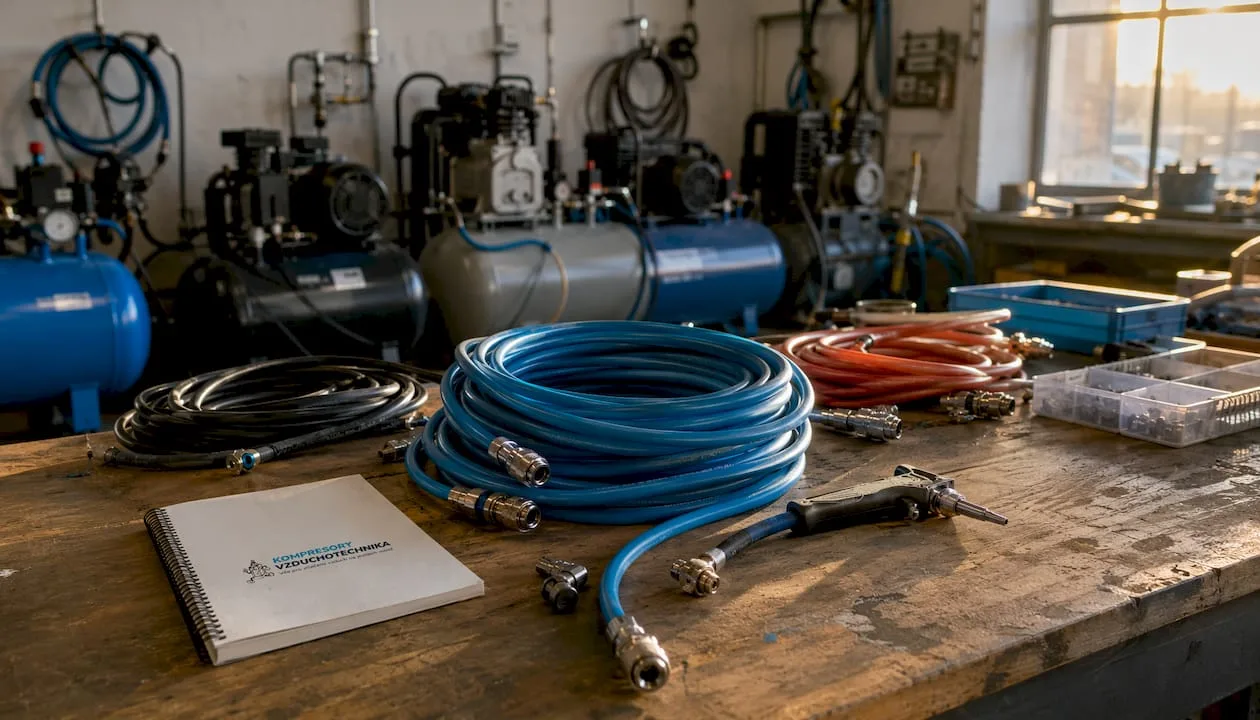
The pressure hose determines the safety, reliability and efficiency of the entire pneumatic system. An unsuitable or damaged hose causes pressure losses, damages tools and, in extreme cases, leads to bursting with a risk of injury to the operator. Before each use, check the label with the working pressure and select the hose according to the STAMP methodology.
The main reasons why hose selection matters:
- Safety: bursting or leakage of medium under pressure endangers the operator and the surroundings
- Pressure losses: an unsuitable diameter or length reduces the available pressure at the tool; incorrect length and diameter can cause pressure losses in the range of 5 to 10%
- Tool protection: stable flow extends the service life of pneumatic tools
- Operational reliability: a quality hose reduces downtime and service costs
Contents
- What is a pressure hose and what are the basic types for workshop and construction use?
- How does a pressure hose affect operational safety?
- How does a pressure hose affect the efficiency and performance of the system?
- What technical parameters determine the correct choice of hose?
- How to choose the right pressure hose step by step (the STAMP methodology)
- How to correctly install, use and maintain a pressure hose?
- How to correctly store pressure hoses?
- What standards and certifications apply to pressure hoses in the Czech Republic and the EU?
- Practical recommendations for three typical operational scenarios
- Key takeaways
- Expert opinion on the selection and maintenance of pressure hoses
- Where can you find the right pressure hose and expert support?
- What documents and technical datasheets should you request from the supplier?
- Frequently asked questions
What is a pressure hose and what are the basic types for workshop and construction use?
A pressure hose is structurally designed to transfer media under pressure, i.e. compressed air, liquids or technical gases. It differs from a suction (extraction) hose in its reinforcement and wall thickness: a suction hose is dimensioned for negative pressure, while a pressure hose is dimensioned for positive pressure. Confusing these two types is one of the most common causes of accidents.
Main types by material and reinforcement:
- Rubber hoses with textile or steel braiding: high abrasion resistance, resistant to oils, solvents and extreme temperatures; suitable for construction and industry
- Polyurethane (PU) hoses: lightweight, flexible, resistant to oils and abrasion; maintain flexibility even at low temperatures (roughly down to around −40 °C), popular in workshop operations
- PTFE hoses: chemical resistance and temperature stability; suitable for aggressive media and high temperatures
- PVC hoses: most affordable, lightweight, but lower resistance and stiffen in cold conditions; only for occasional and less demanding use
- Steel-braided hoses (multi-layer): maximum pressure resistance, maintained flexibility; for high-pressure industrial applications
| Material | Main advantages | Disadvantages | Typical use |
|---|---|---|---|
| Braided rubber | Resistance to abrasion, oils and solvents, flexibility | Higher weight | Construction, industry |
| Polyurethane (PU) | Lightness, flexibility even in cold conditions, resistance to oils and abrasion | Higher price, sensitivity to some chemicals | Workshop, car service |
| PVC | Low price, lightness | Lower resistance, stiffens in cold | Occasional use, lighter tools |
| PTFE | Chemical resistance, high temperatures | Higher price, stiffer | Chemical industry, food industry |
| Steel braid | Highest pressure resistance | Lower flexibility, weight | Industrial high-pressure systems |
Material compatibility with the conveyed medium is essential. Use the hose exclusively for the medium for which it is certified. PTFE, nitrile, or EPDM are chosen where contact with chemicals or high temperatures is likely. Always check the manufacturer's technical data sheet, as pressure resistance decreases with increasing temperature.
How does a pressure hose affect operational safety?
An unsuitable or damaged hose is a direct cause of operational accidents. A hose bursting under pressure releases energy comparable to a gunshot: spraying medium, hose whiplash, or fitting fragments can cause serious injury. Medium leaks also lead to an uncontrolled pressure drop in the system, which endangers the function of other equipment on the line.
Factors that increase the risk of failure:
- Aging and material degradation (UV radiation, ozone, chemicals)
- Abrasion and mechanical damage to the surface (forklifts driving over it, sharp edges)
- Kinking of the hose at a point with a small bend radius
- Exceeding the rated working pressure
- Pressure surges caused by sudden closing of valves or tools
Pressure surges are an underestimated factor in practice. Peak values can briefly exceed the rated pressure several times over and cause material fatigue or immediate hose rupture without sufficient safety margin. Mechanical stress often also leads to micro-damage that is not visible to the naked eye, and the hose may appear fine until it suddenly fails under full pressure.
Checklist for visual and functional inspection before use:
- Hose surface: cracks, cuts, abrasions, bulges, or blisters
- End fittings and fittings: corrosion, deformation, loosening
- Overall length: no unnecessary loops or kinks
- Label: legible working pressure and date of manufacture
- Tightness: no hissing or moisture around the joints
Professional tip: Hidden damage (internal delamination or reinforcement fatigue) is not visible from the outside. Subject hoses older than 5 years or operated under demanding conditions to a pressure test. Set inspection intervals according to the operating load: weekly visual inspection for single-shift operation, daily pre-shift inspection for three-shift operation.

How does a pressure hose affect the efficiency and performance of the system?
A proper hose is a precondition for the full performance of pneumatic tools. The internal diameter (DN) and length of the hose directly determine pressure losses: the smaller the diameter and the longer the hose, the greater the pressure drop between the compressor and the tool. Pneumatic tools designed for 6 bar may, with an unsuitable hose, operate at 4.5–5 bar, which reduces performance, increases wear, and shortens service life. An incorrect length or diameter can reduce the performance of a pneumatic tool by up to 10%.
Impact of parameters on performance:
- Internal diameter: smaller DN = higher flow velocity = greater pressure loss; DN 9–13 mm is sufficient for most workshop tools
- Length: every additional metre adds pressure loss; the ideal length for an auto repair shop is 10–15 m, for hoses over 15 m consider a larger DN
- Poor-quality joints and leaks: cause permanent leaks that the compressor must compensate for by running longer, which increases energy consumption
Approximate diameter selection according to tool:
| Tool type | Recommended internal diameter | Min. pressure | Note |
|---|---|---|---|
| Inflator, blow gun | 6 mm | 6 bar | Light tools, low flow |
| Impact driver, grinder, drill | 8–9 mm | 6.5 bar | Standard tools |
| Impact wrench, sandblasting | 10 mm | 6.5 bar | High-flow tools |
| Painting, heavy grinders | 13 mm | 7 bar | High-performance applications |
A simple example: a DN 6 mm hose with a length of 20 m causes a significantly greater pressure drop than a DN 10 mm hose with a length of 10 m at the same flow rate. The tool at the end of the longer and narrower hose receives less pressure, even though the compressor is operating at full capacity. You can perform a practical check with a pressure gauge at the hose outlet: if the difference between the pressure at the compressor and at the outlet is greater than 0.5 bar, consider a shorter hose or a larger diameter.
Key rule: when designing, allow for a reserve of at least 1–2 bar above the tool's nominal working pressure, so that pressure surges and losses in the line do not limit performance.
A quality hose with a sufficient diameter maintains consistent flow and prevents leaks that would otherwise prolong compressor operation and increase operating costs. If you need a longer reach, it is more advantageous to install a fixed compressed air piping system with outlets than to use a single extremely long hose. For more on selecting a compressor with regard to hose routing, see the guide to selecting an industrial compressor.
What technical parameters determine the correct choice of hose?
The hose label or technical data sheet contains several values that you must be able to read and interpret correctly.
Working pressure, burst pressure, and safety factor:
- WP (Working Pressure / nominal working pressure): the maximum permissible operating pressure at the rated temperature
- BP (Burst Pressure): the pressure at which the hose fails; always significantly higher than WP
- S.F. (Safety Factor): the ratio of BP to WP; typically 3:1 to 4:1 for industrial hoses, and even higher for high-pressure applications
Inner diameter (DN): determines flow rate and pressure losses. A larger DN means lower losses, but higher weight and cost. To select the correct DN, base it on the tool's flow requirements (l/min) and the length of the line.
Temperature range: as temperature increases, the hose's pressure resistance decreases. The WP value on the label applies to the rated temperature (usually 20 °C). When operating at higher temperatures, you must check the derating curve in the manufacturer's technical data sheet.
Bend radius and fittings:
| Parameter | What to monitor | Why it matters |
|---|---|---|
| Minimum bend radius | Value in mm on the label | Kinking below this radius will damage the reinforcement |
| Fitting type | BSP, NPT, metric thread | Compatibility with piping and quick couplers |
| Reinforcement type | Braid vs. spiral | Spiral withstands higher pressure and surges |
| Test pressure | Specified in the technical data sheet | Verification of manufacturing quality |
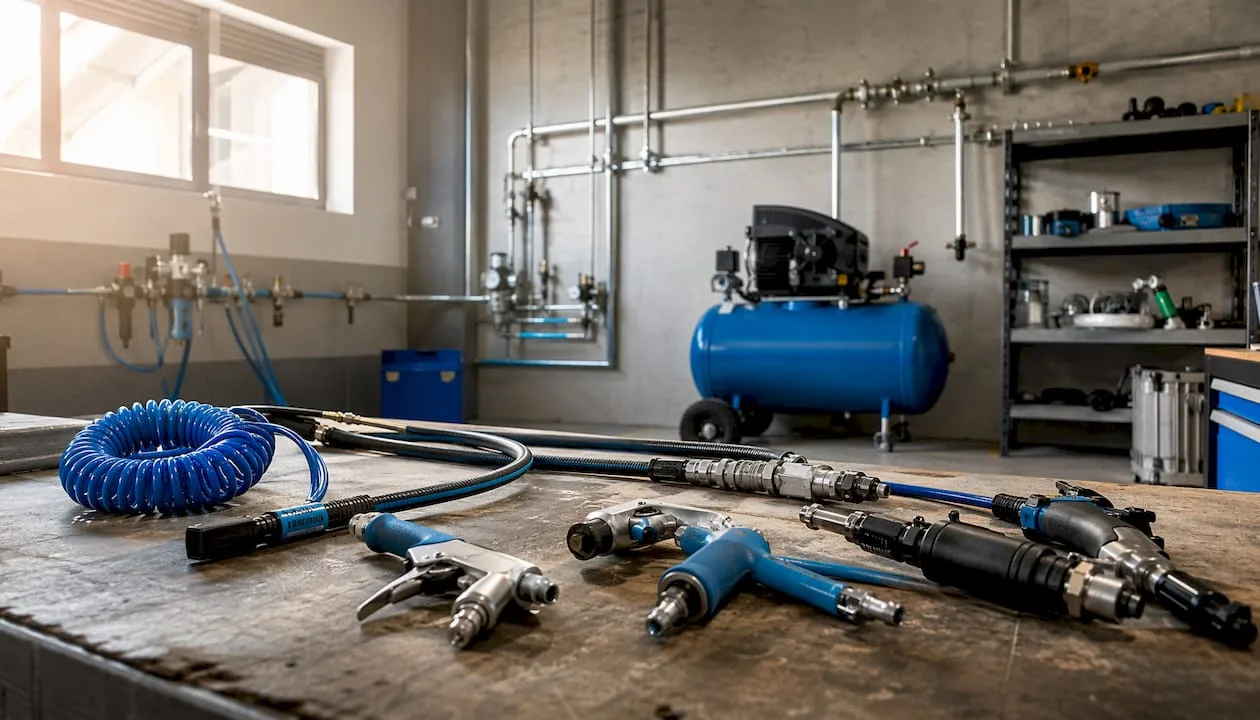
Quick couplings must match the nominal diameter of the hose as well as the working pressure of the system. Industrial and automotive quick coupling standards are not interchangeable; when building a system, choose one standard for the entire installation and adhere to it consistently. Cheap or incompatible couplings are a source of leaks and increased wear of the fittings. Cleanliness of quick couplings and their locking balls has a fundamental effect on the tightness of the whole system and is a common but often overlooked source of leaks.
How to choose the right pressure hose step by step (the STAMP method)
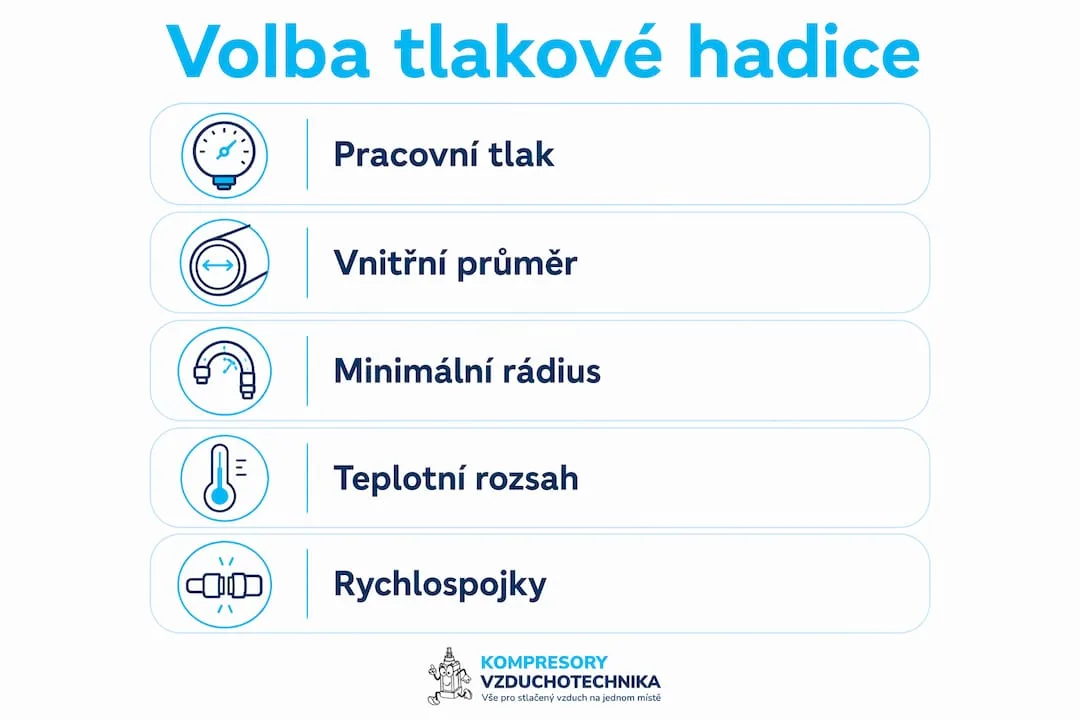
The STAMP method (Size, Temperature, Application, Material, Pressure) provides a systematic procedure that minimizes sizing errors. In practice, it eliminates the most common causes of failure: underestimating pressure surges, incorrect material selection, or an unsuitable diameter.
Selection procedure:
- Size: measure the required flow rate (l/min) and line length; select the DN so that the pressure drop does not exceed the permissible limit
- Temperature: determine the operating temperature range; check the derating in the technical data sheet
- Application: determine the type of medium (air, oil, chemicals, hot water) and mechanical stress (abrasion, bending, pressure surges)
- Material: select a material compatible with the medium and operating conditions (rubber, PU, PTFE, EPDM)
- Pressure: verify the hose's WP against the maximum operating pressure of the system, including a margin for surges
Order checklist:
- Hose length and connector type (BSP, NPT, metric thread)
- Inner diameter (DN) and outer diameter
- Nominal working pressure (WP) and safety factor (S.F.)
- Reinforcement type: braided (lower pressures, higher flexibility) or spiral (high pressure, surges)
- Certifications and manufacturer's test protocol
- Temperature range and media compatibility
Professional tip: Always choose a hose with a nominal working pressure higher than your current operating pressure. Pressure surges caused by sudden closing of valves or tools can briefly exceed the nominal pressure several times over. A safety margin of 30–50% above the operating pressure is standard practice in industrial operation.
For a complete overview of accessories that affect hose selection, see the checklist of accessories for compressors.
How to properly install, use, and maintain a pressure hose?
Proper installation extends the hose's service life and prevents failures. The most common installation mistake is twisting the hose or running it over sharp edges.
Installation procedure:
- Switch off the compressor and release the pressure in the system; never connect or disconnect the hose under pressure
- Check the cleanliness and condition of the fittings and quick couplings before assembly
- Route the hose without unnecessary loops, kinks, or contact with sharp edges; avoid a sharp bend immediately behind the fitting, where the stress is greatest
- Connect the fittings using a torque wrench according to the manufacturer's specification; do not overtighten the threads and use sealing tape on threaded joints
- Gradually increase the pressure and check the joints by listening (hissing) and by touch (moisture)
- Before putting into operation, carry out a pressure test at 1.5 times the operating pressure
- Label the hose with a tag showing the date of installation and the nominal pressure
Principles of correct operation:
- Never exceed the maximum operating pressure of the hose
- Do not drive vehicles or heavy machinery over the hose; in high-traffic areas, use hose protection covers
- Do not pull the hose by the fittings or by the connected tool
- Do not use the hose as a lifting device or rope
- Do not disconnect the hose under pressure without a safety shut-off valve
Professional tip: In workshops with multiple technicians, color-code hoses according to nominal bore or application (e.g., red for larger diameters, blue for smaller ones). This prevents mix-ups and incorrect connections.
Regular inspection intervals:
- Before each shift / use: visual inspection of the surface, end fittings, and connections
- Weekly: leak-tightness check at operating pressure, mounting check
- Monthly (or depending on operating load): pressure test, bend radius check
- Every 6 months: comprehensive check of elasticity, threads, and connection strength
When to replace the hose immediately:
- Visible cracks, bulges, or peeling of the outer cover
- Permanent cross-section deformation caused by improper coiling
- Deformation or corrosion of fittings
- Recurring leaks at connections even after retightening or replacing the connector
- Hoses without a legible label or older than 5 years in demanding service (or exposed to chemicals and UV)
No tape repair or improvised patch is an acceptable solution for pneumatic systems under pressure. The cost of a new hose is always lower than the cost of unplanned downtime or injury.
How to properly store pressure hoses?
The storage method has a fundamental impact on hose service life. Poorly maintained hoses typically have a service life of 1 to 2 years, while properly stored hoses made of the same material last 5 to 8 years. The difference is not in product quality, but in day-to-day handling.
Storage principles:
- Before storage, depressurize the hose, visually inspect it, clean off dirt and oils, and let it dry
- Coil hoses loosely on reels, without overlapping loops and without tension; never store on the ground
- Secure the free end with a hook-and-loop fastener or plastic clip, never with wire or a metal clamp
- Hang on hooks or store on a shelf out of reach of sharp edges; fit protective caps on connectors
- Store in a dry, dark place, away from direct UV radiation and heat sources, recommended temperature 5–25 °C
- Keep hoses separate from oils, lubricants, solvents, and aggressive chemicals
Recommended reel diameter according to hose diameter:
| Hose diameter (mm) | Recommended reel diameter (cm) | Max. length per reel (m) |
|---|---|---|
| 6 | 25 | 50 |
| 8 | 30 | 40 |
| 10 | 35 | 30 |
| 13 | 40 | 20 |
| 16 or more | 45 | 15 |
A reel that is too small causes permanent deformation of the internal cross-section, reduces flow, and weakens the material at bend points. In addition, hoses on reels or hooks do not obstruct walkways and reduce the risk of tripping. Besides extending service life, proper storage also saves the technician time that would otherwise be spent untangling hoses or searching for the correct length in the warehouse.
What standards and certifications apply to pressure hoses in the Czech Republic and the EU?
Pressure hoses placed on the market in the EU must meet the requirements of the relevant European standards and, where applicable, bear the CE marking. Operators in the Czech Republic are required to verify product conformity and retain documentation in case of inspection or an insurance claim.
Key standards for pressure hoses:
- EN ISO 6945: hoses for compressed air; requirements for construction, testing, and marking
- EN ISO 1307: dimensional requirements for rubber and plastic hoses
- EN 14423: hoses for fluid transfer; safety requirements
- CE marking: mandatory for hoses falling under the Pressure Equipment Directive (PED 2014/68/EU) when the specified pressure limits are exceeded
Professional tip: When reading a certificate, verify that the standard applies to the specific type of hose (material, reinforcement, diameter) and that the test pressure corresponds to your operating pressure. A general statement that it "complies with EN standards" without specifying the particular standard and test values is not sufficient.
The operator is responsible for the regular inspection and documentation of hose condition. In the event of an accident caused by neglected maintenance or the use of an unsuitable hose, the insurance company may refuse to pay out. Keep records of inspections and replacements for at least the service life of the equipment.
Practical recommendations for three typical operating scenarios
The specific choice of hose depends on the application. Below are three scenarios with recommended parameters.
Scenario 1: Workshop for pneumatic tools
- Material: polyurethane or rubber hose with textile braiding
- Nominal bore: 9–13 mm depending on the tool's flow requirements
- Working pressure: 8–12 bar; choose a hose with a rated working pressure of at least 15 bar for a safety margin
- Fittings: quick couplings compatible with the workshop standard (BSP 1/4")
- Length: up to 10 m; for longer runs, switch to a nominal bore of 13 mm or more
Scenario 2: Construction spraying work and high wear
- Material: rubber hose with steel braiding or multi-layer hose with a protective jacket
- Reinforcement: steel braiding increases resistance to abrasion when dragged along surfaces
- Working pressure: typically 10–15 bar; check resistance to UV radiation and weather effects
- End fitting protection: use protective sleeves or spiral guards
Scenario 3: Industrial line with frequent pressure surges
- Material: multi-layer hose with steel wire spiral reinforcement
- Spiral reinforcement significantly increases resistance to pressure surges compared to simple braiding
- Working pressure: 15–20 bar and above; safety factor S.F. at least 4:1
- Inspection intervals: daily visual inspection, monthly pressure test
Reference values: for workshop use, allow for a working pressure of 8–12 bar, for industrial applications 15–20 bar and above. A safety margin of 30–50% above the working pressure is standard in demanding operation.
Key takeaways
A properly selected pressure hose protects operators, maintains system performance, and reduces operating costs; an unsuitable or damaged hose is a direct cause of accidents and downtime.
| Point | Details |
|---|---|
| Selection according to STAMP | A systematic procedure eliminates errors in sizing and material mix-ups. |
| Safety factor S.F. | Industrial hoses have an S.F. of 3:1 to 4:1; always check the label or technical data sheet. |
| Pressure surges | Peak values can briefly exceed the rated pressure; choose a reserve of 30–50% above the operating pressure. |
| Storage | A coil with a diameter of 30–45 cm and storage off the ground extends service life from 1–2 years to 5–8 years. |
| Regular inspections | Visual inspection before each shift, pressure test monthly or according to operating load. |
Expert opinion on the selection and maintenance of pressure hoses
The most common mistake I see in operations is not a bad hose. It's the right hose in the wrong place. Technicians select a hose based on price or what they have in stock, instead of basing it on the system's parameters. The result is a hose with too small a diameter, which causes pressure losses, or a hose without a sufficient safety margin, which fails at the first significant pressure surge.
The second overlooked detail isn't the hoses themselves, but the quick couplers and fittings. Dust, metal shavings, or remnants of sealing tape inside the coupler cause leaks that technicians search for in vain on the hose itself. Quick couplers must be regularly cleaned and their retaining balls inspected.
The third underestimated problem is documentation. Operators replace hoses but don't record the date of replacement or the reason. In the event of an accident or insurance claim, they are then unable to prove that they fulfilled their regular maintenance obligations. A simple record sheet with the installation date, nominal pressure, and date of the next inspection takes a minute to complete and can determine the outcome of an insurance claim.
Investing in a hose with a higher nominal pressure, quality fittings, and a reel system pays off faster than it seems. Less downtime, fewer service interventions, lower compressor energy consumption. Hose quality isn't a cost, it's part of the system design.
Where can you find the right pressure hose and expert support?
Kompresory-vzduchotechnika offers a complete range of hoses for compressed air, accessories, and air treatment units for workshops as well as industrial facilities. Before purchase, we provide technical consultation: we help determine the correct DN, material, type of reinforcement, and compatible fittings based on your system's parameters.
For workshops and auto repair shops, we recommend starting with air treatment units, which ensure clean and dry air for both tools and hoses. Industrial facilities with higher pressure requirements will appreciate the range of SCR screw compressors designed for continuous operation. We also provide installation, parameter measurement, and inspections of the entire hose line on site. Contact us with your system's parameters and we will prepare a specific recommendation.
What documents and technical datasheets should you request from the supplier?
Proper documentation is a condition for safe operation and compliance with legal obligations. When ordering a hose, always request:
- Manufacturer's technical datasheet: WP, BP, S.F., temperature range, bend radius, compatible media
- Declaration of Conformity: reference to the specific EN standard and scope of validity
- Test protocol: results of the pressure test from production, test date
- Recommended operating limits and replacement interval: from the manufacturer, not just from the seller
| Document | What to check | How to use |
|---|---|---|
| Technical data sheet | WP, BP, S.F., temperature dependence | Comparison with operating conditions |
| Certificate of conformity | Specific EN standard, scope of validity | Conformity verification for internal audit |
| Test report | Test pressure, date, production batch | Quality documentation for claims or incidents |
| Recommended replacement interval | Years or operating hours | Preventive maintenance planning |
Use these documents when comparing offers from different suppliers: a hose without a technical data sheet or with a generic certificate that does not reference a specific standard does not provide sufficient safety assurance. For internal safety review, archive the documentation together with installation records and regular inspection records.
Frequently asked questions
Which hose should I choose for a workshop compressor?
For workshop use with pneumatic tools, choose a polyurethane or rubber hose with textile braiding, DN 9–13 mm and a nominal working pressure of at least 15 bar. Limit the length to 10 m; for longer runs, switch to a larger diameter.
How can I increase the pressure available at pneumatic tools?
The most effective way is to shorten the hose or increase its internal diameter. Pressure losses increase with length and decrease with diameter; switching from DN 6 mm to DN 10 mm at the same length will significantly reduce the pressure drop between the compressor and the tool.
What pressure can a standard compressor hose withstand?
Standard workshop hoses have a nominal working pressure of 8–12 bar; professional and industrial hoses 15–20 bar and more. The burst pressure (BP) is always significantly higher, typically 3–4 times the WP, but operation above the WP is not permitted.
What is the difference between PU and PVC hoses?
PU hoses feature high flexibility even at low temperatures and resistance to abrasion and oils, suitable for demanding operations. PVC hoses are less flexible and stiffen in cold conditions, but they are more cost-effective for my