
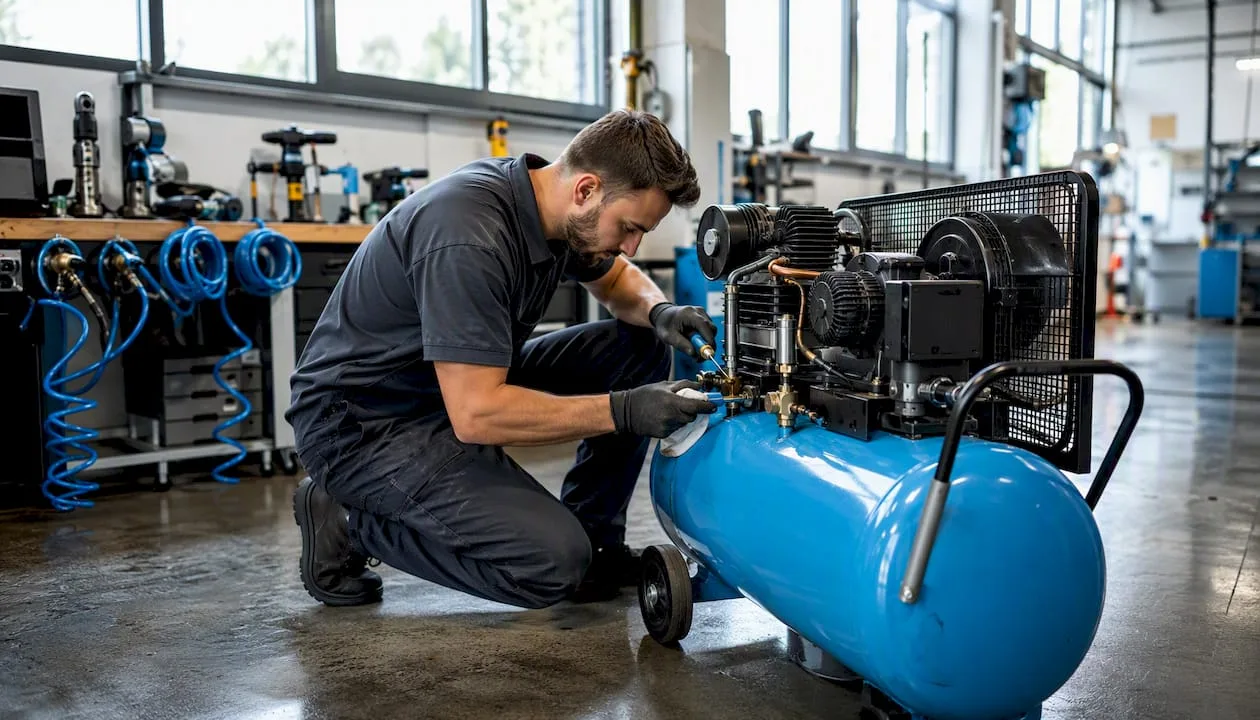
When choosing a compressor, three parameters decide in this order: delivered (FAD) output, working pressure and air tank volume. Everything else follows from these.
What to check when buying a compressor — quick overview:
- FAD output: actual delivered flow in l/min or m³/h at operating pressure
- Working pressure: typically 8–10 bar for a workshop, up to 15 bar for special applications
- Air tank volume: 6–24 l for hobby use, 100 l+ for demanding operation
- Type: oil-lubricated vs. oil-free; portable vs. stationary
- Duty cycle: the percentage of time the compressor may run continuously
- Air quality: filtration, condensate separator, dryer (according to ISO 8573)
- Noise level and mobility: dB value, wheels, tank orientation
- Power input and electrical connection: voltage (230/400 V), maximum power input, circuit protection
- Accessories: pressure gauge, pressure reducing valve, hoses, quick couplers
Always size the compressor with a reasonable margin above the peak consumption of the most powerful tool. A compressor running continuously at the limit of its output wears out faster and has a shorter service life.
Key takeaways
| Point | Details |
|---|---|
| FAD output | Request FAD at 6.2–7 bar; the intake capacity is 30–40% higher than the actual delivered output. |
| Capacity reserve | Size it 30–50% above peak consumption for longer service life and stable pressure. |
| Air tank volume | Hobby use: 24–50 l; car repair shop: 100–200 l; continuous operation: screw compressor. |
| Maintenance and condensate | Drain the condensate regularly; retained water causes tank corrosion. |
| Kompresory-vzduchotechnika | Offers piston and screw compressors, solution design, installation, and non-stop service. |
Contents
- 1. How to read FAD output and calculate what your tools actually need
- 2. What air tank volume to choose according to the method of use
- 3. Working pressure and compatibility with pneumatic tools
- 4. Oil-lubricated or oil-free compressor? Duty cycle and maintenance
- 5. Air quality: filtration, separators, and the ISO 8573 standard
- 6. Noise level, mobility, and operational safety
- 7. Power input and electrical connection
- 8. What accessories must be included with every compressor
- 9. How to size a compressor in practice
- 10. Indicative prices and operating costs
- 11. Checklist before purchase and upon delivery
- Experience from practice: what we recommend most often
1. How to read the free air delivery and calculate what your tools actually need
Free air delivery (FAD) indicates how much air the compressor actually delivers at a given operating pressure. Air delivery is a theoretical value without losses — and this is the value manufacturers state most often. The difference between the two values tends to be significant, because a compressor with a stated air delivery of 300 l/min may actually deliver significantly less air.
In practice, units get mixed up: l/min, m³/h, and CFM (cubic feet per minute). Conversion: 1 CFM ≈ 28.3 l/min; 1 m³/h ≈ 16.7 l/min.
| Tool | Typical consumption (l/min) | Working pressure (bar) |
|---|---|---|
| Pneumatic screwdriver | 100–150 | 6–7 |
| Impact wrench | 150–200 | 6–7 |
| Rivet gun | 80–100 | 6 |
| Spray gun (paint) | 200–400 | 2–4 |
| Pneumatic grinder | 150–300 | 6–7 |
Calculation procedure: Make a list of all your tools with their consumption. Add up the consumption of tools that will be running at the same time. Add an approximately 20% reserve for future expansion or unforeseen use. This gives you the minimum compressor FAD you are looking for.
Example: Impact wrench (200 l/min) + pneumatic grinder (200 l/min) = 400 l/min.
Professional tip: Ask the seller for a FAD table at a specific operating pressure — most commonly 6.2 or 7 bar. This is the only comparable value between different manufacturers.
2. What air tank volume to choose depending on the application
The air tank (pressure vessel) serves two functions: it evens out the pulsed consumption of tools and reduces the number of motor start/stop cycles. The larger the tank, the longer the tools can work without the compressor starting. A too small air tank causes unstable air supply, pressure fluctuations, and increases the strain on the compressor through excessive switching.
- No tank or 6–10 l: inflating tyres, occasional use
- 24–50 l: hobby workshop, occasional grinding or screwing
- 50–100 l: semi-professional workshop, regular use of multiple tools
- 100–270 l and more: car service, small-scale production, continuous operation
A larger air tank does not mean a higher FAD. If the tools consume air faster than the compressor supplies it, even a 500-litre tank will not solve the situation. You need a higher FAD, not just a bigger tank.
| Scenario | Recommended air tank volume |
|---|---|
| Inflating tires, hobby use | 24–50 l |
| Workshop, occasional use | 50–100 l |
| Car service, regular use | 100–200 l |
| Small-scale production, continuous operation | 200 l+ or screw compressor |
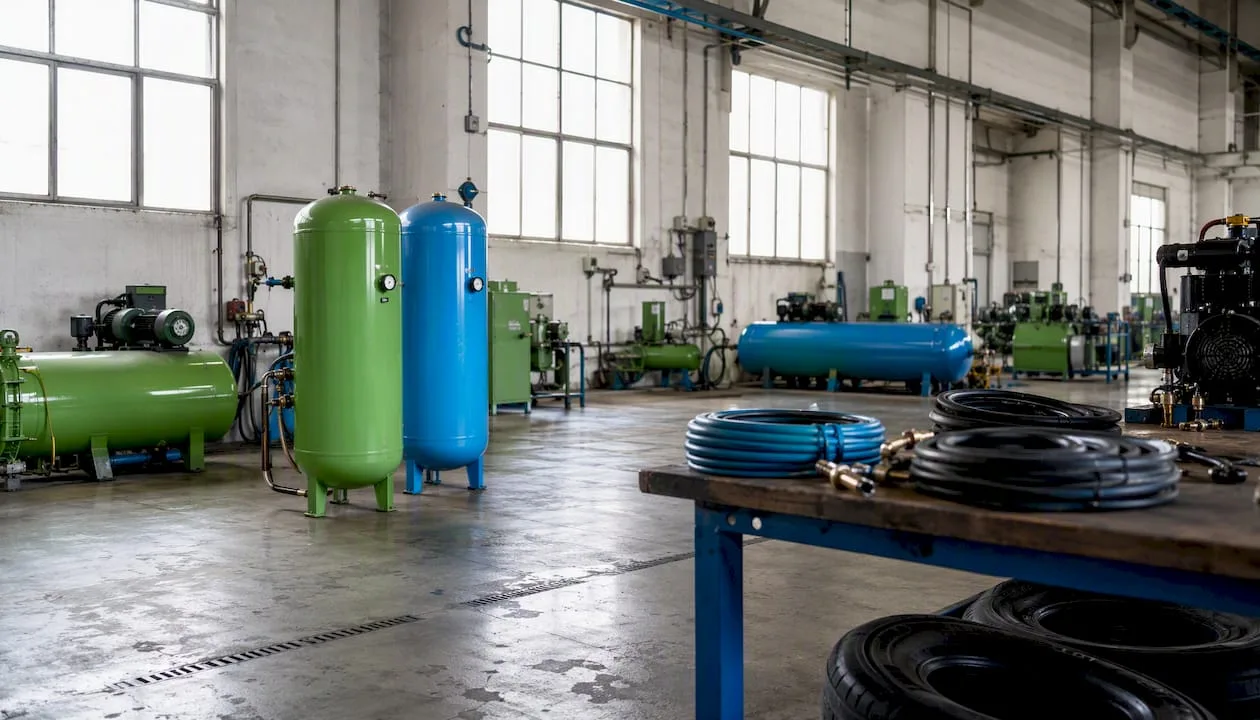
Vertical air receivers save floor space in the workshop; horizontal designs tend to be more stable when mounted on a mobile chassis.
3. Working pressure and compatibility with pneumatic tools
The compressor's working pressure must exceed the maximum required pressure of the tool — with sufficient reserve for the drop during air draw-off. Standard pneumatic tools operate at 6–7 bar (87–102 PSI). Workshop compressors usually reach 8–10 bar, industrial models 12–15 bar.
Compressors are divided into three categories according to discharge pressure:
- Low-pressure: up to 2.5 MPa (25 bar)
- Medium-pressure: up to 10 MPa (100 bar)
- High-pressure: above 10 MPa
- Check the switch-on and switch-off pressure: the compressor switches on at a lower pressure and switches off at a higher pressure; the tool must operate within this entire range.
- A pressure reducing valve (pressure regulator) is a mandatory part of every installation — it sets the output pressure to the value required by the tool.
- A paint spray gun operates at 2–4 bar; an impact wrench requires 6–7 bar. The pressure regulator allows a single compressor to be used for both applications.
- High-pressure compressors (above 15 bar) are designed for special applications: filling pressure cylinders, pneumatic presses. For a regular workshop, they are unnecessary and more expensive to operate.
Professional tip: During a demonstration test, simulate real load with the tool and observe how quickly the pressure in the tank drops and how long it takes to recharge. If the pressure drops below the tool's operating value before the tank is recharged, the compressor is undersized.
4. Oil-lubricated or oil-free compressor? Duty cycle and maintenance
The choice between an oil-lubricated and an oil-free compressor depends on the application, frequency of operation, and air purity requirements. A detailed comparison of screw and piston compressors will help with the decision for specific production conditions.
Oil-free compressor:
- Cleaner air without the risk of oil contamination
- Suitable for painting, food industry, pharmaceuticals, dental practices, electronics
- Lower maintenance requirements, lighter construction, but shorter service life of the compression unit under intensive operation
Oil-lubricated compressor:
- Longer service life and higher reliability under demanding and continuous load
- Higher FAD efficiency at the same power input
- Lower purchase cost
- Requires regular oil changes and level checks
Duty cycle indicates what percentage of the time the compressor may run continuously. A too-small compressor with a low duty cycle in continuous operation overheats, shortens its service life, and increases energy consumption.
Maintenance checklist upon handover and during operation:
- Check the oil level (for oil-lubricated models) before first start-up.
- Drain condensate from the tank before each use or after each shift.
- Check the tightness of connections and hoses visually and by listening.
- Replace the air filter according to the manufacturer's service interval.
- Change the oil after the first 50 operating hours, then according to the schedule.
- Check the functionality of the safety valve once every 3 months.
| Accessory / action | Recommended frequency |
|---|---|
| Air filter (intake) | Check monthly, replace every 3–6 months (more frequently in dusty environments) |
| Oil filter | Replace every 500–1,000 operating hours |
| Coalescing filter | Replace every 2,000–4,000 hours |
| Safety valve | Functional test every 6 months |
| Drain valve | Check daily, clean monthly |
| Pressure gauge | Calibration annually |
| Cooling fan | Cleaning monthly |
Professional tip: Water retained in the tank leads to internal corrosion and weakening of the walls. Drain the condensate regularly — for frequently used compressors, after each shift.
5. Air quality: filtration, separators and the ISO 8573 standard
The ISO 8573 standard defines compressed air purity classes according to three parameters: solid particle content, oil content and moisture. The lower the class number, the cleaner the air. Painting, food industry or pharmaceuticals require strict requirements; for common pneumatic tools in a workshop, standard filtration is sufficient.
- Class 1–2 (ISO 8573): pharmaceutical industry, electronics, food — requires an oil-free compressor or advanced filtration
- Class 3–4: painting, precision assembly — oil separator and dryer
- Class 5–6: standard workshop, pneumatic tools — basic filter and condensate separator
For clean applications, purchasing an oil-free compressor is often simpler and cheaper than installing advanced filtration and an adsorption dryer downstream of an oil-lubricated machine. Oil contamination of air damages painted surfaces, clogs valves and shortens tool service life.
Filtration types:
- Condensate separator (cyclonic or mechanical): the basis of every installation
- Coalescing filter: captures oil aerosols
- Adsorption dryer (with activated carbon or silica gel): for moisture-sensitive applications
- Sterile filter: for the food and pharmaceutical industries
In humid environments (paint shops, food processing plants), a refrigerant or adsorption dryer is a mandatory part of the installation. In dusty operations, such as woodworking or stonemasonry workshops, choose intake filters with higher capture capacity and shorten their replacement intervals; a cyclone separator placed upstream of the intake filter also helps.
6. Noise level, mobility and operational safety
Compressor noise is given in decibels (dB). Hobby models with an oil-free piston run around 60–70 dB; powerful oil-lubricated piston compressors for workshop use reach 85–95 dB. Screw compressors tend to be quieter at the same output.
- A value of 85 dB or more requires the use of hearing protection during continuous operation in an enclosed space.
- A compressor placed in a separate room or outdoor shelter significantly reduces the noise exposure of workers.
- Noise can be further reduced with noise-reducing enclosures and vibration dampers.
- Vertical air receiver saves floor space; suitable for stationary installation in a corner of the workshop.
- Horizontal air receiver with wheels and a handle allows easy transport on a construction site or between workplaces.
- When operating in an enclosed space, ensure sufficient ventilation — the motor needs a supply of cool air and heat dissipation.
7. Power input and electrical connection
The electrical parameters of the compressor determine its compatibility with the existing wiring as well as its operating costs. Before purchasing, verify:
- Voltage: hobby and smaller models run on 230 V, more powerful stationary machines require a three-phase 400 V connection
- Maximum power input and corresponding circuit protection
- Current type and sufficient sizing of the supply cable
For three-phase machines and more demanding installations, consult the connection with an electrician to avoid problems with compatibility and safe installation. An undersized circuit leads to breaker trips, while an oversized one unnecessarily increases costs.
8. What accessories must be part of every compressor
A compressor without the proper accessories is not a functional unit.
Basic accessories:
- Pressure gauge: shows the pressure in the tank and at the outlet; check accuracy upon handover
- Pressure regulator: sets the output pressure for a specific tool
- Safety valve: a mandatory component; automatically releases pressure when the limit is exceeded
- Hose: diameter must match the flow rate; for high-power tools, a minimum internal diameter of 10 mm
- Quick couplers: standardized type (most often EURO or Japanese standard) for compatibility with tools
- Drain valve on the air tank: check its presence and function upon handover
Accessories for higher air quality:
- Oil and condensate separator
- Dryer (refrigerant or adsorption type)
- Fine coalescing filter
When choosing accessories, also think about future workplace expansion — compatible, high-quality components ensure greater system flexibility.
9. How to size a compressor in practice
Sizing is done in three steps:
- Make a list of tools with FAD values (l/min) and operating pressure (bar).
- Determine simultaneous demand: add up the consumption of tools running at the same time.
- Add a 30–50% reserve and choose a compressor with FAD above this value at the operating pressure.
For a car repair shop, account for peaks during impact wrench start-up — these have a short-term consumption significantly higher than continuous demand. A larger FAD reserve and sufficient tank volume are key here.
Professional tip: Ask the supplier for the compressor's technical data sheet with a table of FAD at various pressures. Energy efficiency is not determined solely by motor input power, but by the design of the compression unit — compare the FAD/kW value across multiple machines.
10. Indicative prices and operating costs
The purchase price depends on the type of compressor, power, tank volume, lubrication method, and service availability. Indicative range on the Czech market:
- Hobby piston compressors (up to 50 l, FAD up to 150 l/min): approximately CZK 3,000–8,000
- Semi-professional piston compressors (50–100 l, FAD 150–300 l/min): approximately CZK 8,000–25,000
- Professional piston compressors (100–270 l, FAD 300–600 l/min): approximately CZK 20,000–60,000
- Screw compressors (for continuous industrial operation): from CZK 60,000 and up
Operating costs consist of electricity consumption, service intervals and spare parts. Energy efficiency is measured by the FAD/kW ratio — a higher value means more air for less energy. Compressors with variable speed drive (VSD) achieve energy savings of up to 35–50% compared to fixed-speed machines; the savings are further increased with a properly sized dryer and filters that do not reduce flow through unnecessary resistance.
For a corporate purchase, calculate the total cost of ownership (TCO): purchase price, annual energy consumption, oil and filter costs, service contract and expected service life. The overview of compressors for the workshop will help you compare specific models across individual price classes.
11. Checklist before purchase and upon handover
Before signing the order and during physical handover of the compressor, verify the following points:
- FAD at operating pressure: request the value in the technical data sheet, not just the intake capacity
- Working pressure: meets the requirements of your tools with a margin
- Electrical parameters: voltage, power input and fuse protection match your electrical system
- Functionality of pressure gauges: both indicators (tank and outlet) must be readable and accurate
- Condition of the tank: visual inspection for corrosion, deformation or repairs; for older machines, request a pressure test report
- Presence of a drain valve: must be functional and easily accessible
- Noise level data: compare with the stated value under real load
- Availability of service and spare parts: verify service support, guaranteed parts availability and clarity of service manuals
- Complete accessories: pressure gauge, pressure reducing valve, safety valve, hose, operating and maintenance manual
- Service records: for used machines, request the service book
Professional tip: During the demonstration test, connect a tool and monitor the pressure drop during draw-off and the tank recharge time. If the compressor cannot maintain working pressure under continuous draw-off, it is undersized for your application.
Practical experience: what we recommend most often
During consultations with both DIY users and company purchasers, the same mistake keeps recurring: choosing a compressor based on price or tank size instead of FAD and duty cycle. A small compressor operating in frequent start/stop mode wears out faster and ultimately costs more than a correctly sized machine chosen from the start.
The second common mistake is treating the maintenance checklist as a mere formality. A clogged filter that nobody replaced, or condensate in the tank causing corrosion, are among the most frequent causes of premature failures. The combination of a correctly sized dryer and a coalescing filter can extend the service life of pneumatic tools by more than a third. Useful tip: if power consumption increases but output stays the same, look for a clogged filter or an air leak — this simple correlation reveals the problem before it manifests as a failure.
For a hobby workshop with occasional use, an oil-lubricated piston compressor with a 50–100 l tank and FAD of around 200 l/min is sufficient. For an auto repair shop or small-scale production, we recommend a sizing consultation before purchase — choosing the right type (piston vs. screw) and output will save operating and service costs throughout the machine's entire service life.

Kompresory-vzduchotechnika offers free technical consultation for both business customers and more demanding hobby projects. We supply piston and screw compressors, oil-lubricated and oil-free, portable and stationary — for workshops, auto repair shops, and industrial operations. Our offering also includes compressed air distribution systems, filtration, dryers, pressure vessels and all accessories, as well as turnkey solution design, installation, inspections, energy audits, and 24/7 service.
You can find the complete range of pneumatic products in the pneumatics and hydraulics category. Contact us for a no-obligation consultation on selecting a compressor specifically for your application.