
TL;DR:
- The choice between a piston and a screw compressor depends on the air flow rate and the length of daily operation, with the crossover point being around 15 L/s. Piston compressors are suitable for intermittent operation and low-cost applications, while screw compressors are designed for continuous industrial operation with higher energy efficiency. The total cost of ownership is also an important factor, and its connection with operating conditions determines the economic viability of a specific solution.
A screw compressor is defined as a rotary machine with continuous air flow, while a piston compressor operates cyclically with intermittent discharge. The key criterion when comparing screw and piston compressors is not the motor power or the air tank volume, but the air flow rate and the so-called duty cycle, i.e. the ratio of load time to total operating time. The economic crossover lies at approximately 15 L/s (32 CFM): below this value, a piston compressor for intermittent operation is more advantageous, above it, a screw compressor for continuous demand. This rule applies to workshops, production facilities, and craft businesses that need an objective basis for investment decisions.
1. Comparison of screw and piston compressors: basic principles
A piston compressor compresses air by the movement of a piston in a cylinder. The air is drawn in, compressed, and discharged into the air tank, from which you draw pressure as needed. A screw compressor works differently: two screw-shaped rotors rotate in opposite directions, and the air is continuously compressed along their axis. The result is a smooth, pulsation-free discharge without interruptions.
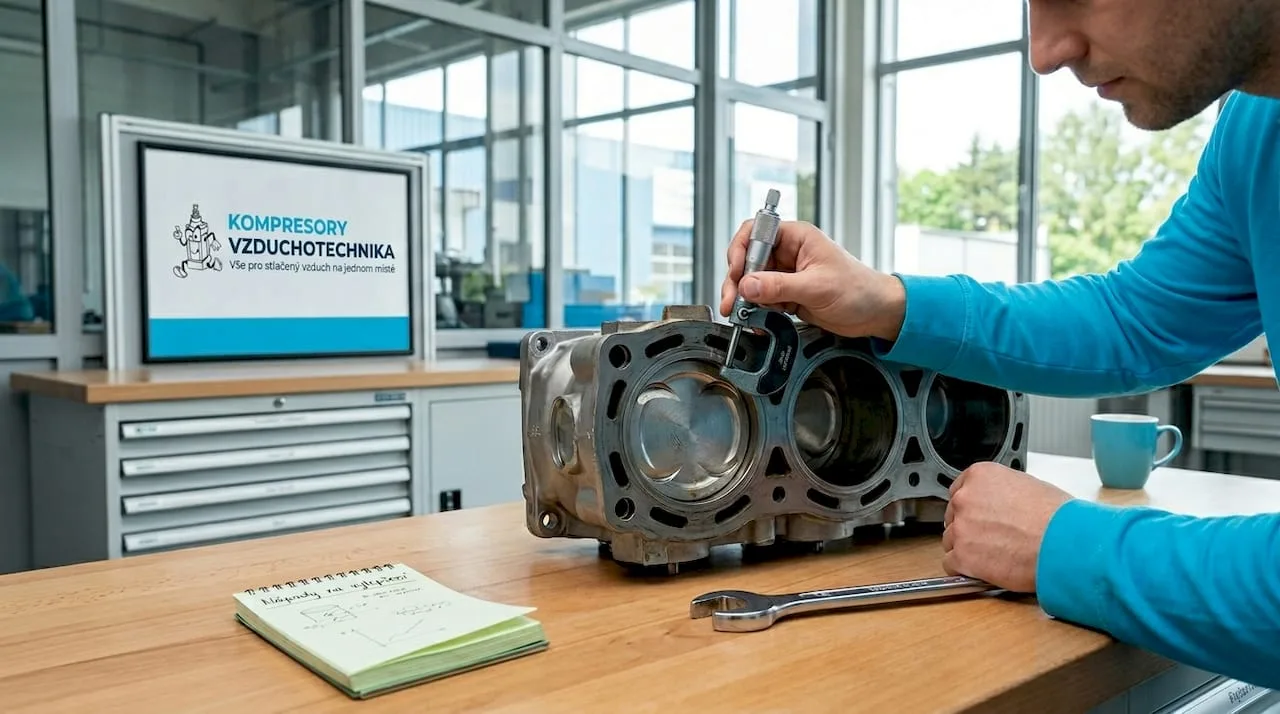
This design distinction directly determines which type is suitable for which operating profile. A piston compressor needs breaks to cool down and refill the air tank. A screw compressor can operate continuously without duty cycle limitations. This characteristic is essential for industrial operations with continuous air demand.
2. Advantages and disadvantages of piston compressors
Piston compressors offer a lower purchase price and a simple design, which facilitates service and repairs. Spare parts such as valves, seals, and piston rings are readily available and affordably priced. For operations with lower utilization intensity, this is an economically rational choice.
Main advantages of piston compressors:
- Lower purchase price compared to screw units of comparable output
- Easy availability of spare parts and service capacity
- Suitability for intermittent operation with a duty cycle of up to 60%
- Possibility of operation without a specialized service technician
- Compact design in smaller models, easy to transport
Main disadvantages of piston compressors:
- Higher noise level, typically 75 to 95 dB(A), which complicates placement in the working environment
- Higher specific energy consumption at full load compared to screw units
- Pulsating air delivery, which can negatively affect sensitive pneumatic tools
- Need for regular replacement of valves and seals during intensive operation
- Limitation to a duty cycle of up to 60%, with risk of overheating and reduced service life if exceeded
A typical operating scenario for a piston compressor includes an auto repair shop with occasional use of pneumatic tools, a carpentry workshop with intermittent air draw, or a small production facility with low hourly air consumption. For hobby and irregular use, piston or oil-free compressors are the standard choice due to lower costs and simple operation.
Professional tip: If a piston compressor regularly operates at or above a 60% duty cycle, it is time to reconsider the choice of type. An overloaded piston compressor generates higher service costs and shortens the machine's service life faster than would correspond to its purchase price.
3. Advantages and disadvantages of screw compressors
Screw compressors are designed for continuous operation. A 100% duty cycle means the machine can work without breaks throughout the entire work shift and beyond, without risk of overheating or mechanical damage. This feature is key for industrial operations with continuous air consumption.
Main advantages of screw compressors:
- Full 100% duty cycle for continuous industrial operation
- Lower noise level, typically 62 to 78 dB(A), allowing placement closer to the workplace
- Lower specific energy consumption at high load
- Smooth, pulsation-free discharge, suitable for precision pneumatic applications
- Longer service intervals, usually 2,000 to 4,000 operating hours
Main disadvantages of screw compressors:
- Significantly higher purchase price compared to piston units
- Servicing requires a specialized technician and more expensive service parts (oil, air and oil filters, oil separator)
- Economic disadvantage at low utilization and intermittent operation
- Higher demands on inlet air quality and regular filtration
Screw compressors dominate in large industrial operations where continuity and energy efficiency are required. Examples include painting in the automotive industry, plastics production, food processing lines, or engineering plants with continuous compressed air demand. For these applications, screw compressors for continuous operation are the standard industrial solution.
Professional tip: When selecting a screw compressor, pay attention to the specific energy consumption value (kW per m³/min or kW per L/s). The difference between an average and a high-quality machine can represent thousands of crowns per year in electricity costs, especially when operating over 2,000 hours per year.
4. Comparison table: technical and economic criteria
A direct comparison of both compressor types shows that the choice is not a matter of quality, but of the operating profile. Energy costs account for 70 to 80% of the total cost of ownership over 10 years of operation. This means that a machine with a lower purchase price can be significantly more expensive in the long term if it operates inefficiently or under unsuitable load.
| Criterion | Piston compressor | Screw compressor |
|---|---|---|
| Duty cycle | Up to 60% | 100 % |
| Noise level | 75 to 95 dB(A) | 62 to 78 dB(A) |
| Purchase price | Lower | Higher |
| Service intervals | Shorter, cheaper items | Longer, more expensive items |
| Energy efficiency | Lower at high load | Higher in continuous operation |
| Suitable use | Intermittent operation, workshops | Industry, continuous demand |
| Service life | 10,000 to 15,000 hours | 40,000 to 80,000 hours |
| 5-year TCO | Lower at low operation | Lower at high operation |
The crossover point at 15 L/s (32 CFM) applies as a rule of thumb. In practice, the number of operating hours per year also matters. Operation above 2,000 hours per year strengthens the advantage of the screw compressor, because higher annual operation increases the savings from lower specific energy consumption. At operation below 500 hours per year, the piston compressor is usually more economically advantageous even at flow rates above the crossover point.
Total maintenance costs over 5 years are usually lower for screw compressors due to less frequent service interventions, even though the price of individual service items is higher. This paradox surprises many operators who decide based solely on the price of the service call-out.
5. When to choose a piston compressor and when a screw compressor?
The choice of the correct compressor type depends on four variables: required air flow, length of daily operation, available budget, and tolerance to noise. The following recommendations are based on operational practice and analysis of total cost of ownership.
-
Piston compressor for a workshop or small-scale operation. If the flow rate does not exceed 15 L/s and the compressor operates less than 4 hours per day, a piston unit will meet the requirements at a lower investment. Car service shops, carpentry workshops, and small production facilities with intermittent consumption are typical examples.
-
Screw compressor for industrial operation. Facilities with a flow rate above 15 L/s or with daily operation time above 6 hours need a screw compressor. Painting, plastics manufacturing, the food industry, and engineering require a continuous and reliable source of compressed air.
-
Piston compressor as a backup unit. Even in facilities with a screw compressor, a piston unit has its place as a backup during planned servicing or unexpected failure. This combination reduces the risk of downtime without the need to invest in a second screw machine.
-
Impact of electricity price on TCO. At an electricity price above CZK 5/kWh and operation above 1,500 hours per year, the energy savings of a screw compressor will show up within 3 years. The TCO calculation should include power input, operating hours, and the current electricity rate. A detailed approach to energy savings is described in a separate guide on the Kompresory-vzduchotechnika website.
-
Two-stage piston compressors as an intermediate option. For facilities with higher pressure (above 10 bar) and medium flow rate, there are two-stage piston compressors, which offer better energy efficiency than single-stage models. They are a suitable alternative where a screw compressor exceeds the budget, but a single-stage piston compressor is not sufficient in terms of performance.
-
Oil-free compressors for specific applications. The food, pharmaceutical, and electronics industries require air without traces of oil. Oil-free screw compressors meet ISO 8573-1 class 0, while oil-free piston compressors are suitable for lower flow rates in the same industries. Choosing the right category of oil-free compressors depends on the required air purity class.
-
Tips for improving the efficiency of both types. Regular inspection of compressed air distribution system tightness reduces losses for both types of compressors. Air leaks in the distribution system can account for 20 to 30% of the compressor's total output. Properly sized distribution systems and regular filter replacement extend the machine's service life and reduce operating costs regardless of compressor type.
Key findings
The decision between a screw and a piston compressor is primarily an economic and operational matter, where TCO analysis, air flow rate, and annual operating hours are key factors.
| Point | Details |
|---|---|
| Flow crossover point | At 15 L/s (32 CFM), the economic advantage shifts in favor of the screw compressor. |
| Duty cycle as the main criterion | A piston compressor can handle up to 60% load, while a screw compressor operates without limitation at 100%. |
| Energy costs dominate TCO | Electricity accounts for 70 to 80% of total costs over 10 years, which is why efficiency is decisive. |
| Service costs over 5 years | Screw compressors are cheaper in terms of overall service, even with higher individual item prices. |
| Backup role of a piston compressor | A piston unit as a backup to a screw compressor economically reduces the risk of downtime. |
Practical experience: what the tables don't tell you
When comparing compressors, I encounter one recurring mistake: operators decide based on purchase price and motor power, but ignore the operating profile. I've seen workshops where a piston compressor operated at 80% duty cycle year after year until it burned out. And I've seen industrial operations where a screw compressor ran two hours a day and its purchase price never paid back in savings.
The most important step before purchasing is to measure the actual air consumption and record how many hours per day the compressor actually operates. This data is more valuable than any catalog sheet. Without it, any comparison is only approximate.
Technological development is pushing the boundaries of both categories. Modern screw compressors with variable frequency drives (VSD) automatically adjust their speed to the current demand and reduce energy consumption at partial load by 20 to 35%. This changes the TCO calculation even for operations with variable consumption, where piston compressors previously came out ahead. If you're planning an investment for more than 5 years, VSD technology is a parameter worth paying attention to.
Service availability is another factor that doesn't show up in tables. A screw compressor requires a specialized technician and original service kits. In regions with limited service networks, a piston compressor may be a more reliable choice simply because its repair can be handled by a local mechanic with common tools.
— Zdeněk
Compressors for your operation: offer from Kompresory-vzduchotechnika
Kompresory-vzduchotechnika offers a complete range of piston and screw compressors for industrial, trade, and professional applications. Whether you're looking for MARK compressors for reliable industrial operation or SCR screw compressors for continuous air consumption, you'll find models on the website sorted by power input, flow rate, and operating profile.
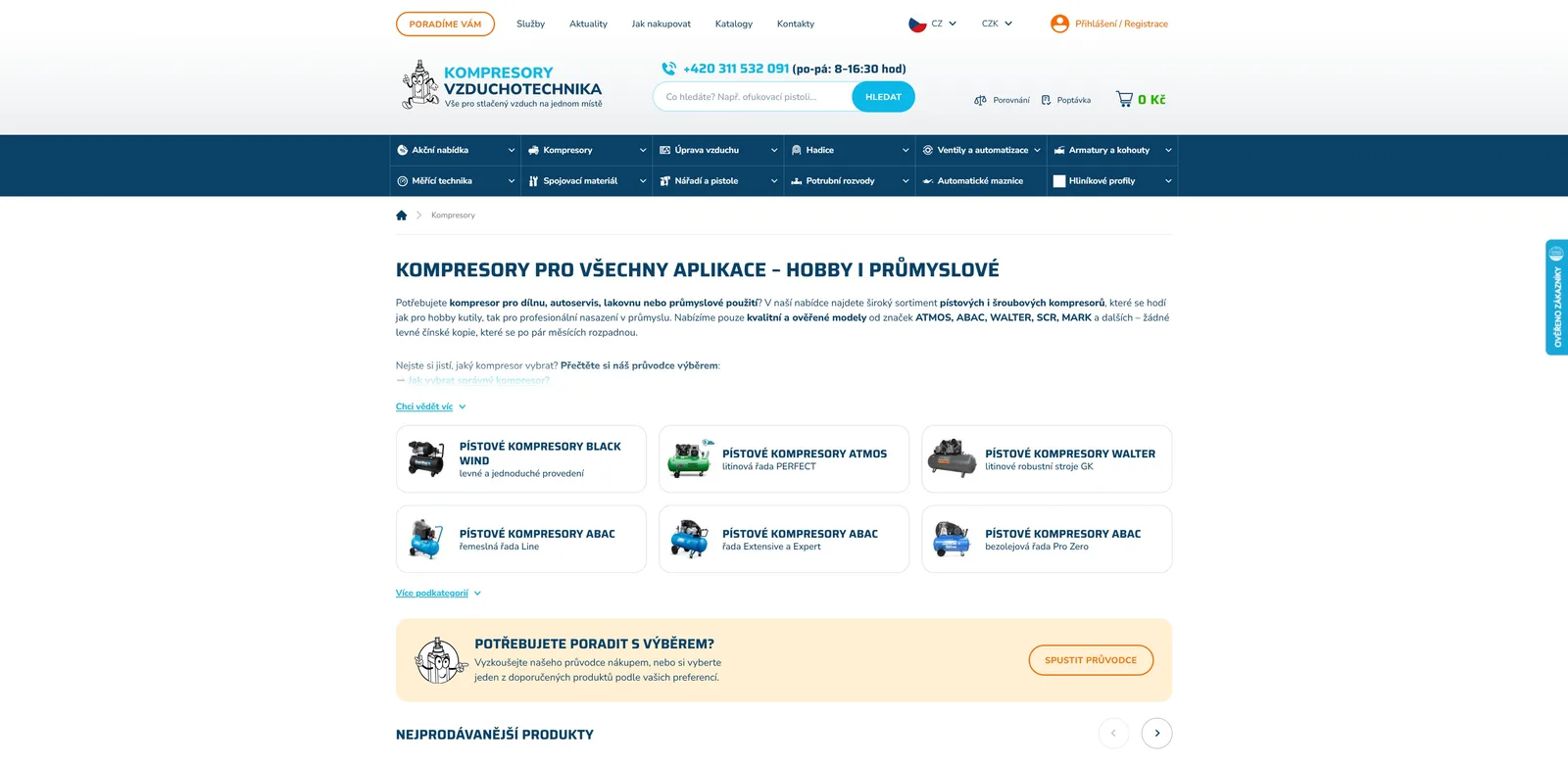
The technical support team at Kompresory-vzduchotechnika will help with TCO calculation, selecting the right model, and sizing compressed air distribution systems. Consultation is available online and by phone. A correctly selected compressor pays for itself in energy and service savings sooner than most operators expect.
FAQ
What is the main difference between a screw compressor and a piston compressor?
A screw compressor operates with continuous air flow and can handle a 100% duty cycle, while a piston compressor operates cyclically and is limited to a duty cycle of up to 60%. This distinction determines which type is suitable for which operating profile.
When is a screw compressor more economical than a piston compressor?
A screw compressor pays off at flow rates above 15 L/s (32 CFM) or at operation exceeding 1,500 to 2,000 hours per year. Energy costs account for 70 to 80% of TCO over 10 years, so the higher efficiency of a screw compressor quickly becomes apparent under intensive operation.
How to choose a compressor for an auto repair shop or a carpentry workshop?
For an auto repair shop or carpentry workshop with intermittent air consumption and operation of up to 4 hours a day, a piston compressor with a duty cycle of up to 60% is sufficient. If operation increases or more pneumatic tools with higher consumption are added, it's time to reconsider the choice in favor of a screw unit.
Are the maintenance costs of a screw compressor really lower?
Total maintenance costs over 5 years are usually lower for screw compressors than for piston compressors, even though individual service items are more expensive. Screw compressors have longer service intervals (2,000 to 4,000 hours), which reduces the total number of service interventions.
Can a piston compressor be used as a backup to a screw compressor?
Yes, using a piston compressor as a backup unit to a screw compressor is an economically efficient solution for industrial operations. The backup ensures production continuity during scheduled maintenance or failure of the main unit, without the need to invest in a second screw machine.
Recommended
- The working principle of the piston compressor for efficient operation - Kompresory-Vzduchotechnika.cz
- Categories of oil-free compressors: How to choose the right type - Kompresory-Vzduchotechnika.cz
- Piston and screw compressors in professional design with 4.0 kW power input
- Two-stage compressor: Higher efficiency for industry 2026