
TL;DR:
- Screw compressors are industrial machines providing continuous, stable air pressure without pulsation. Thanks to low noise levels and long service life, they are suitable for demanding automated operations with high requirements on air quality. Correct sizing and system integration are key to increasing their efficiency and reliability in long-term operation.
A screw compressor is defined as a rotary positive displacement machine that compresses air using two intermeshing screw rotors without direct contact, thereby ensuring a continuous, pulsation-free flow of compressed air. This principle makes it an ideal choice for industrial operations requiring stable pressure throughout the entire work shift. Manufacturers such as Atlas Copco, SCR or MARK Compressors build machines on this principle with power inputs ranging from 4 kW up to hundreds of kilowatts, with each model targeting a different type of operating load. The complete list of advantages of screw compressors includes technical, operational and economic benefits that together justify their dominant position in professional and industrial applications.
1. Permanently stable air pressure without pulsation
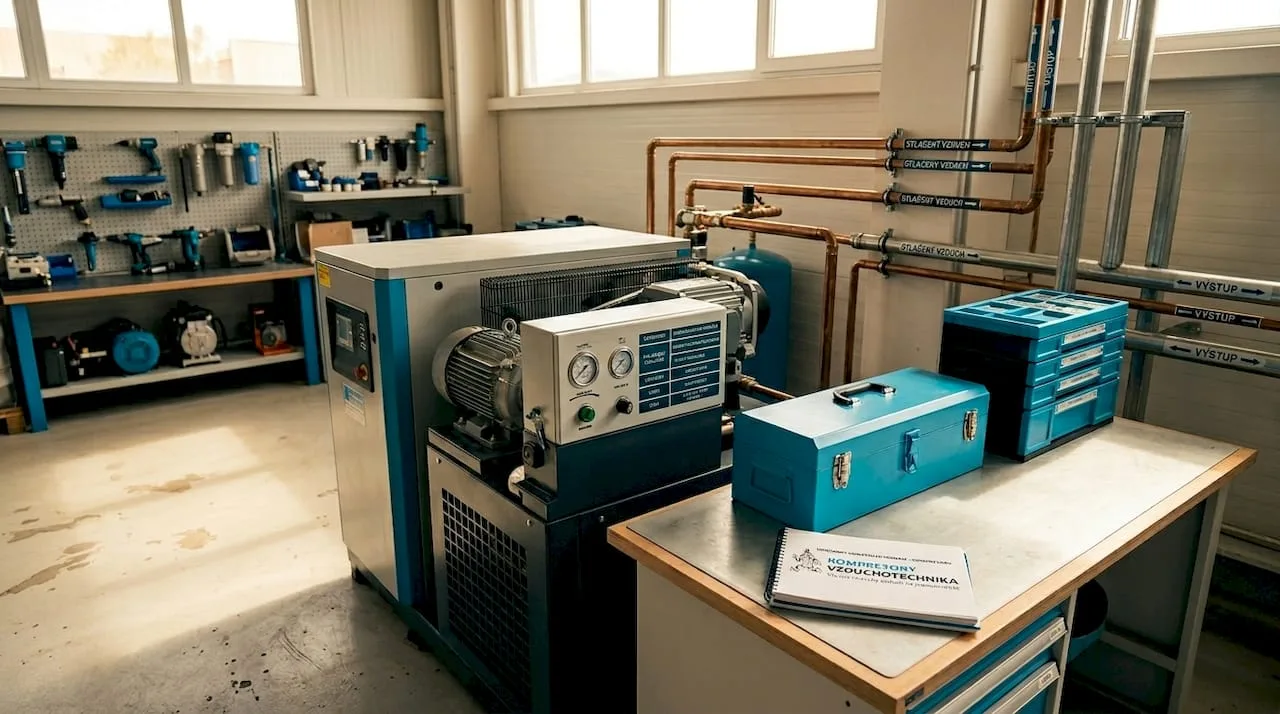
Screw compressors provide permanently stable air pressure thanks to the continuous rotary motion of the screws, unlike piston compressors, where each stroke causes pressure pulsation. This feature is critical for precision industrial applications, such as paint shops, CNC machining centres or pneumatic assembly lines, where pressure fluctuations directly affect output quality. Stable pressure reduces the rejection rate and extends the service life of pneumatic tools and valves. For technicians responsible for production quality, this is one of the most important parameters when selecting a compressed air source.
2. Low noise and minimal vibration
Lower noise levels and reduced vibration are a direct consequence of the rotary principle without impacts. A typical screw compressor operates in the range of 60 to 75 dB(A), while a comparable piston model reaches 80 to 95 dB(A). This difference means that a screw compressor can be placed directly in the production hall or workshop without the need for sound insulation or a separate compressor room. Lower vibration also reduces mechanical stress on piping systems and connections, which extends their service life and reduces the frequency of service interventions.
Professional tip: If you are planning to place the compressor in a space where employees work, check the sound pressure level value in dB(A) at a distance of 1 metre from the machine. This value is standardly stated in the technical data sheet of each model.
3. Capability of continuous operation without overheating
Screw compressors are designed for continuous operation with a 100% duty cycle, which lower-class piston compressors do not allow. Piston machines require pauses for cooling, typically operating at a 60 to 70% duty cycle, otherwise there is a risk of overheating and damage to piston rings or valves. The screw airend is cooled by oil or air depending on the design, with thermal management integrated directly into the system. For three-shift operations or automated production lines where the compressor must not stop, this feature is crucial.
4. Lower mechanical wear and longer service life
The rotating screws do not touch each other, so there is no direct mechanical contact between the moving parts of the compression airend. Screw compressors achieve a service life of over 20 years with proper maintenance, especially in demanding industrial environments. Regular oil changes and bearing inspections are the main service tasks, with intervals typically of 2,000 to 4,000 operating hours depending on the model and manufacturer. This service life significantly exceeds the average service life of piston compressors in similarly demanding operation, which directly translates into the overall cost of ownership of the machine.
5. Energy efficiency under long-term load
Screw compressors excel in energy savings during continuous operation and provide better output control than piston models. This energy efficiency leads to reduced operating costs, which is a decisive factor in industrial applications with high compressed air consumption. Modern screw compressors with a variable frequency drive (VFD) adjust the motor speed to the current air consumption, thereby eliminating losses during partial load. A detailed comparison of energy consumption and savings options is described in the energy savings guide, which shows that energy costs account for up to 70% of the total costs of operating a compressor over its lifetime.
Professional tip: When calculating the return on investment for a screw compressor with VFD, include in the calculation not only the purchase price but also the annual electricity costs for the planned number of operating hours. The difference compared to a compressor without regulation is often noticeable in industrial operation within three years.
6. Compatibility with CNC technologies and automation
Screw compressors are compatible with modern CNC technologies and automation systems, which increases their value in modern production facilities. Stable pressure and air cleanliness are a prerequisite for the reliable operation of pneumatic actuators, clamping fixtures and handling systems in automated lines. Manufacturing plants using industrial robots or Fanuc, Siemens or Heidenhain machining centers standardly specify a screw compressor as the source of compressed air. Integration of the compressor into the production control system via Modbus or Profibus is a standard feature in premium models.
7. Lower maintenance costs compared to piston compressors
A comparison of noise levels, service life and regular maintenance shows a significant advantage of screw compressors in lower vibrations and greater reliability, with lower mechanical wear directly translating into lower operating costs. Piston compressors require regular replacement of piston rings, valves and seals, which are more prone to wear under high load. A screw compressor in typical industrial operation requires servicing once or twice a year, while a comparable piston machine under the same load requires significantly more frequent service interventions. A lower frequency of service shutdowns means higher machine availability and fewer unplanned production outages.
8. Correct sizing as a precondition for realizing the benefits
The advantages of screw compressors are fully realized only with the correct choice of equipment size and configuration. An undersized compressor cannot cover peak air consumption, leading to pressure fluctuations and production outages. An oversized machine, on the other hand, operates at low load, under which screw compressors without VFD regulation lose their energy advantage. Correct sizing requires an analysis of average and peak air consumption, the required working pressure and the length of the distribution piping.
Key parameters for sizing include:
- Air flow rate (l/min or m³/h) at rated pressure
- Working pressure (bar) corresponding to the needs of the connected equipment
- Duty cycle and peak demands during a shift
- Length and diameter of pipe distribution affecting pressure losses
- Air quality requirements (purity class according to ISO 8573)
Separating the benefits of the screw airend itself from the benefits of the entire compressor station is essential. Stable flow, minimal pulsation and continuous operation are characteristics of the screw airend. Reliability and air quality throughout the plant are the result of a properly designed compressor station including a dryer, filters and correctly sized distribution.
9. System integration: dryer, filtration and pressure regulation
Screw compressors with a properly set up dryer and filters significantly reduce the risk of damage to pneumatic components and increase the reliability of operation. The overall improvement in air quality extends the service life of pneumatic tools, valves and actuators connected to the distribution system. A refrigerant or adsorption dryer removes moisture that would otherwise cause corrosion in the piping and damage sensitive pneumatic components. Coalescing filters capture oil aerosols and solid particles, with the purity class of the outlet air required to match the specific application's requirements.
System integration of the compressor station includes the following components:
- Refrigerant or adsorption dryer for moisture removal
- Pre-filter and coalescing filter for capturing oil and solid particles
- Air tank for leveling out pressure peaks and reducing the number of starts
- Pressure regulator for setting the working pressure in the distribution system
- Flow and consumption meter for monitoring operating metrics
10. Operational and Economic Benefits in Industrial Conditions
Screw compressors bring specific economic benefits in industrial operations that can be quantified and tracked as key metrics for compressor rooms. Lower energy consumption, longer service intervals, and higher machine availability translate directly into operating costs. Examples of industrial applications where these benefits are most pronounced:
- Paint shops and surface treatment require dry and clean oil-free air, where screw compressors with filtration meet ISO 8573-1 class 1 or 2.
- Engineering and machining operations with CNC centers need stable pressure for workpiece clamping and tool cooling.
- Food industry uses oil-free screw compressors, where air comes into contact with the product.
- Automotive industry deploys screw compressors for assembly lines, welding robots, and paint booths.
- Construction and infrastructure projects use mobile screw compressors for pneumatic hammers and drilling rigs.
- Textile and paper industry needs continuous airflow for weaving looms and pneumatic conveyors.
Proper sizing is key to utilizing the full potential of screw compressors in each of these applications. An undersized machine causes pressure fluctuations and production downtime, eliminating the economic benefits for which the compressor was acquired.
11. Comparison of Screw and Piston Compressors: When to Choose Which Type
When selecting a compressor, budget and planned load must be considered, as screw compressors have a higher acquisition price but lower long-term operating costs. Piston compressors are more suitable for smaller workshops or occasional use, where the higher investment in a screw machine would not be economically justified. A detailed technical comparison of both types is offered by an overview of piston and screw compressors with a power input of 4.0 kW, which shows specific differences in parameters.
| Parameter | Screw compressor | Piston compressor |
|---|---|---|
| Duty cycle | 100% (continuous operation) | 60 to 70% (breaks required) |
| Noise level | 60 to 75 dB(A) | 80 to 95 dB(A) |
| Purchase price | Higher | Lower |
| Operating costs | Lower at high load | Higher during continuous operation |
| Lifespan | Over 20 years with proper maintenance | 10 to 15 years in demanding operation |
| Suitability for VFD control | Yes, standard function | Limited or none |
| Typical use | Industry, manufacturing, automation | Workshops, service operations, occasional use |
Professional tip: The threshold for economic justification of a screw compressor is generally an operating load exceeding 4 hours per day or a requirement for continuous operation. Below this threshold, a piston compressor may be a more economically advantageous choice.
The advantages of rotary screw compressors are fully realized in operations with high and continuous air consumption. For seasonal or irregular use, an economic analysis should be carried out, taking into account both acquisition costs and the expected energy and service costs over the entire lifetime of the machine. The two-stage design, described in the overview of two-stage compressors for industry, offers a further increase in efficiency for operations with pressure above 10 bar.
Key Takeaways
A screw compressor is more economically and technically advantageous than a piston compressor for industrial operation with continuous load, but only with proper sizing and system integration.
| Point | Details |
|---|---|
| Stable pressure and continuous operation | The screw block ensures pulsation-free airflow suitable for CNC and automation. |
| Energy efficiency with VFD | The frequency converter reduces energy consumption at partial load and shortens the return on investment. |
| Proper sizing is a prerequisite | An undersized compressor causes production downtime and eliminates the economic benefits. |
| System integration increases reliability | A dryer, filters and an air tank are an essential part of the compressor station, not optional accessories. |
| Lifespan of over 20 years | Regular oil changes and bearing checks are key to the long-term reliability of the machine. |
Practical experience: what determines the success of deploying a screw compressor
Over years of working with industrial compression systems, I have found that the biggest mistakes are not made when choosing a brand or model, but when sizing and designing the entire compressed air station. I see it repeatedly: a facility invests in a quality screw compressor but forgets about the dryer or underestimates the diameter of the distribution piping. The result is condensate in the piping, damaged pneumatic valves, and complaints about a compressor that is actually functioning correctly.
The second typical mistake is overestimating average air consumption without taking peak demands into account. A compressor sized for the average cannot cope with peaks, pressure drops, and production comes to a halt. An air tank of the correct size solves this problem without the need to purchase a larger compressor.
In my experience, the operations that work best are those where the technician responsible for the compressor room monitors key metrics: working pressure, discharge temperature, oil consumption, and the number of starts per hour. These values reveal problems before they cause an unplanned shutdown. A screw compressor is a reliable machine, but reliability is not a given. It is the result of proper design, regular maintenance, and an informed operation.
— Zdeněk
Screw compressors and accessories at Kompresory-vzduchotechnika
Kompresory-vzduchotechnika offers a complete range of screw compressors for industrial use, from compact units for smaller operations to powerful machines for continuous three-shift operation.
Available in the range are SCR screw compressors with oil injection for demanding industrial operations and MARK compressors with complete accessories including dryers, filters, and air tanks. The technical team at Kompresory-vzduchotechnika provides expert advice in selecting the right model, helps with sizing the compressed air station, and ensures service support throughout the lifetime of the machine. Contact us for a non-binding consultation or browse the current offer directly on the website.
FAQ
What is the main advantage of a screw compressor over a piston compressor?
A screw compressor provides a continuous and pulsation-free flow of compressed air with a 100% duty cycle, while a piston compressor requires pauses for cooling and causes pressure pulsations. This feature is crucial for industrial applications with continuous air consumption.
How long does a screw compressor last with proper maintenance?
Screw compressors achieve a service life of over 20 years in demanding industrial conditions with regular oil changes and bearing inspections at the prescribed service intervals. The key is adherence to the manufacturer's service schedule and monitoring of the machine's operating parameters.
When is an investment in a screw compressor with a frequency inverter worthwhile?
Investment in a compressor with VFD control is economically justified in operations with variable air consumption, where the machine operates at partial load for a significant portion of the operating time. Energy savings compared to a compressor without regulation reach tens of percent of annual electricity costs in such operation.
Is an air dryer necessary for every screw compressor?
A dryer is essential in all applications where air comes into contact with pneumatic components, tools, or products sensitive to moisture. Without a dryer, condensate in the piping causes corrosion, damages valves, and shortens the service life of pneumatic accessories.
What are the most important metrics for monitoring compressor room operation?
Key metrics for compressor rooms include working pressure, oil discharge temperature, oil consumption, number of starts per hour, and the dew point of the outlet air. Regular monitoring of these values enables early detection of problems before an unplanned shutdown.