
SCR Screw Compressors: Technology for the cheapest air
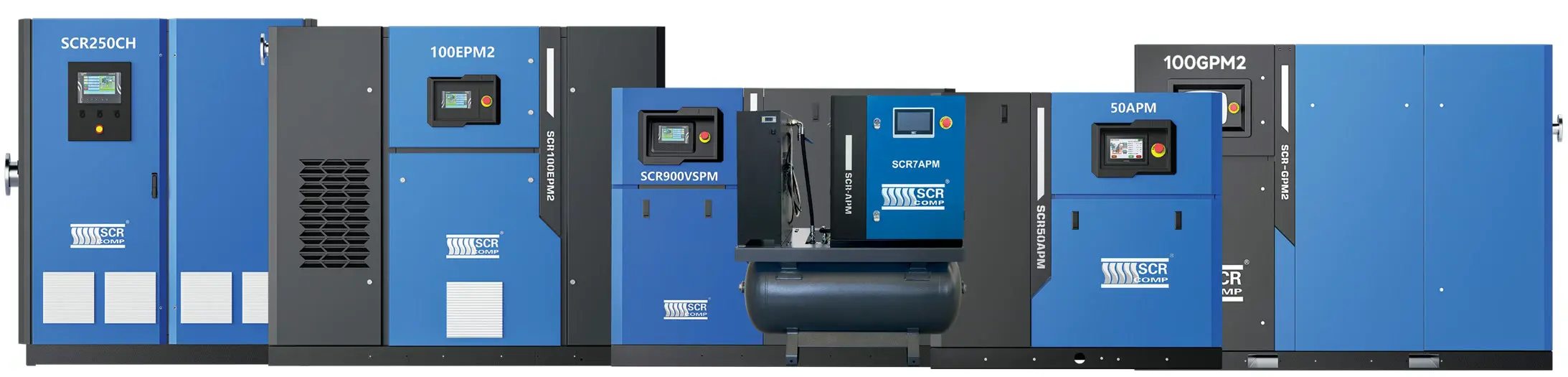 8 SCR series
SCR builds its compressors around a single figure — what a cubic metre of air costs over the whole time the machine runs. The programme has eight series from 2.2 to 280 kW: oil-free scroll units for a doctor’s surgery, compact screw machines for the workshop and two-stage cabinets for plants that never stop. This page does not explain why a screw compressor — the overview of screw compressors is there for that. It is about which SCR series to take.
Before you start choosing, answer four questions
Each one narrows down what the previous one left — after the fourth answer you are usually left with two of the eight series.
How much air do you use?
A compressor is chosen by litres per minute, not by kilowatts. Add up the consumption of the tools and machines that can run at the same time and put a reserve on top for leaks in the pipework. The SCR programme covers 200 to 60,000 l/min, so the first question rules most of the series out straight away.
Does the demand fluctuate through the shift?
When the consumption changes — everything runs for a while, then nothing — a variable-speed drive pays off: the machine holds the pressure with its speed instead of cycling empty. With an even demand at full output, fixed speed is cheaper to buy and uses just as much.
May the air meet oil?
Food production, beverages, pharmaceuticals, medicine, electronics and paint shops need air that oil has no way of getting into. Only the oil-free series can do that — the XA scroll in small volumes and the G/GV screw in large ones. Filtration behind an oil-lubricated machine is a substitute, not the same thing.
How many hours a day will it run?
On one shift the purchase price decides. On two and three shifts the electricity bill outgrows it so far that two-stage compression and an IE4 motor with permanent magnets pay off — the higher series, that is. The difference is not counted in years, but in months of running.
Eight series and what sets them apart
The series are ordered by motor rating, which is the way a machine is really chosen. Each one says what kind of plant it is built for.
SCR-XA
2.2 – 29.6 kW · 200 – 3,520 l/min — Oil-free air in small quantities. A doctor’s surgery, a laboratory, a small paint shop or a food line — anywhere the air meets the product and there must not be a trace of oil in it. Two scrolls compress it without ever touching each other, so there is no lubricant in the compression chamber at all. The output is set by switching individual blocks in and out, not by a variable-speed drive.
SCR-APM Mini
3.7 – 5.5 kW · 320 – 696 l/min — The smallest screw machine for the workshop. A car workshop, a joinery, a smaller assembly shop. It replaces a piston compressor where its stop-start running is no longer enough, but a large cabinet would be a waste. Also sold as an assembly with an air receiver and a dryer in one frame.
SCR-APM Maxi
7.5 – 15 kW · 950 – 2,000 l/min — Workshop and smaller production. A typical engineering workshop or an assembly line taking around a thousand litres a minute. The same technology as the Mini, only one size up — and with assemblies that carry filtration besides the air receiver and the dryer.
SCR-PM2 run-out
7.5 – 15 kW · 950 – 2,000 l/min — Run-out of the previous generation. The predecessor of the APM Maxi series in the same power band. The machines are new and complete, it is only the rest of the stock that is being sold off — so it pays to compare the price with the Maxi before you decide.
SCR-EPM
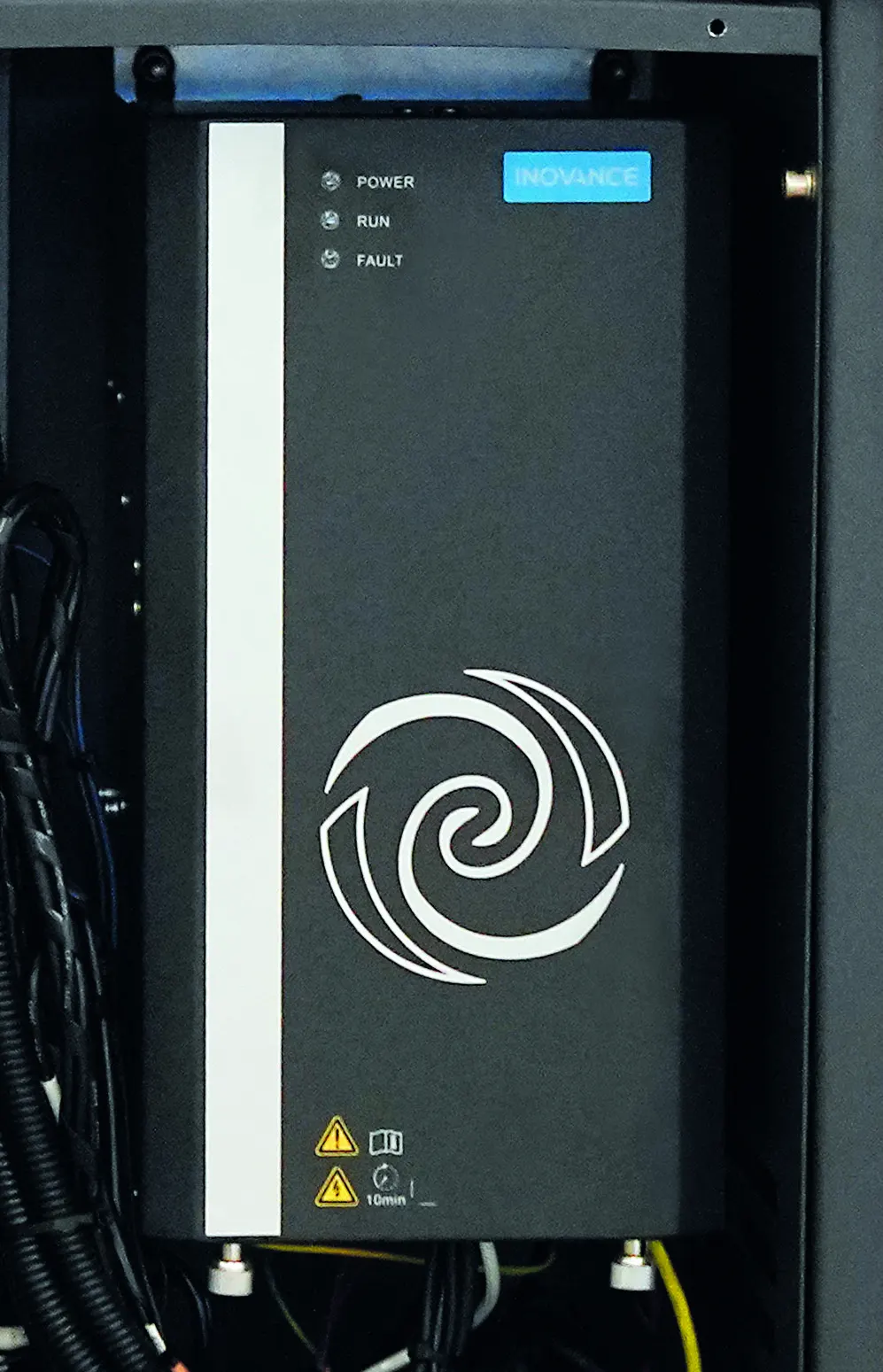
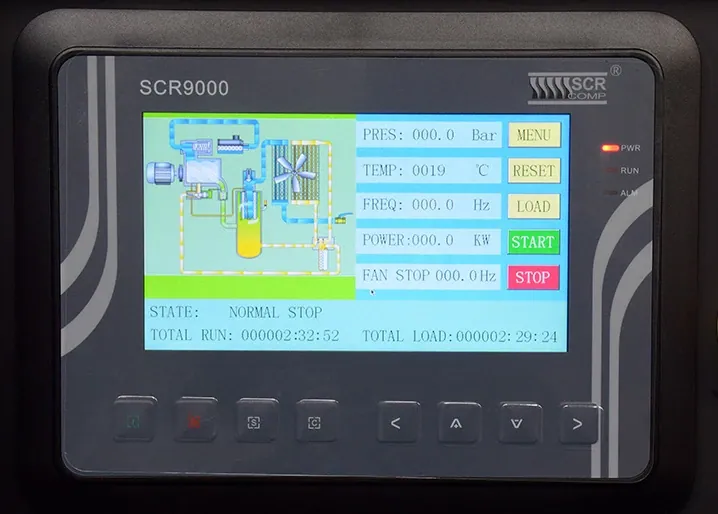
15 – 45 kW · 2,300 – 9,500 l/min — Production on two shifts. The middle band, where the energy already counts. Direct drive without belts, an IE4 motor with permanent magnets and a variable-speed drive that holds the pressure in the system instead of cycling empty. The SCR9000 controller can run a weekly schedule.
SCR-G / GV
37 – 280 kW · 5,700 – 47,000 l/min — Oil-free air in quantity. Food production, beverages, pharmaceuticals, electronics, glassworks — plants that need air without oil in volumes a scroll machine cannot cover. Two screw stages with no lubrication in the compression chamber, cooled by air or by water. The GV version has a variable-speed drive on top of that.
SCR-EPM2
55 – 160 kW · 10,000 – 33,500 l/min — Large industrial plant. The main machine of the compressor room in a production plant. A new generation in an anthracite finish, a variable-speed drive with vector control and controlled speed on the cooling fan as well — so the power input falls with the load twice over.
SCR-H / HPM
132 – 280 kW · 28,500 – 60,000 l/min — Continuous duty, the lowest specific consumption. The most powerful machines in the range, for plants that never stop — laser cutting, textiles, power generation, large metalworking. The air is compressed in two stages with intercooling, so the same cubic metre costs less electricity. The only series that also does 12.5 bar.
| A comparison of the eight SCR series | ||||||
|---|---|---|---|---|---|---|
| Series | Rating (kW) | Output (l/min) | Pressure (bar) | Lubrication | Speed control | Typical role |
| SCR-XA | 2.2 – 29.6 | 200 – 3,520 | 7 – 10 | oil-free | in steps, by blocks | Oil-free air in small quantities |
| SCR-APM Mini | 3.7 – 5.5 | 320 – 696 | 10 | oil-lubricated | variable-speed drive | The smallest screw machine for the workshop |
| SCR-APM Maxi | 7.5 – 15 | 950 – 2,000 | 10 | oil-lubricated | variable-speed drive | Workshop and smaller production |
| SCR-PM2 | 7.5 – 15 | 950 – 2,000 | 10 | oil-lubricated | variable-speed drive | Run-out of the previous generation |
| SCR-EPM | 15 – 45 | 2,300 – 9,500 | 7 – 10 | oil-lubricated | variable-speed drive | Production on two shifts |
| SCR-G / GV | 37 – 280 | 5,700 – 47,000 | 7 – 10 | oil-free | G fixed speed, GV variable-speed drive | Oil-free air in quantity |
| SCR-EPM2 | 55 – 160 | 10,000 – 33,500 | 7 – 10 | oil-lubricated | variable-speed drive | Large industrial plant |
| SCR-H / HPM | 132 – 280 | 28,500 – 60,000 | 7 – 12.5 | oil-lubricated | H fixed speed, HPM variable-speed drive | Continuous duty, the lowest specific consumption |
The output is the rated volume flow to ISO 1217; on machines with a variable-speed drive it is the upper limit of the control range. The exact figures for a particular model are given with the product.
#showmore#
Which series for which plant
The overview is a shortcut, not a rule — borderline cases are settled by working the demand out. If your plant is not in the table, or if it fits two rows at once, write to us.
| Which series for which plant | ||
|---|---|---|
| Plant | What decides | Series |
| Dental surgery, laboratory, small paint shop | oil-free air in small quantities | SCR-XA |
| Car workshop, joinery, smaller assembly shop | 300 – 700 l/min, one shift | SCR-APM Mini |
| Engineering workshop, assembly line | around 1,000 – 2,000 l/min | SCR-APM Maxi |
| Production on two shifts | fluctuating demand, 15 – 45 kW | SCR-EPM |
| Compressor room of a production plant | main machine 55 – 160 kW | SCR-EPM2 |
| Food production, beverages, pharmaceuticals, electronics | oil-free air from 5,700 l/min | SCR-G / GV |
| Laser cutting, textiles, power generation | continuous duty 132 – 280 kW | SCR-H / HPM |
| Glassworks, cement plant | a large amount of air at a low pressure | low-pressure versions on request |
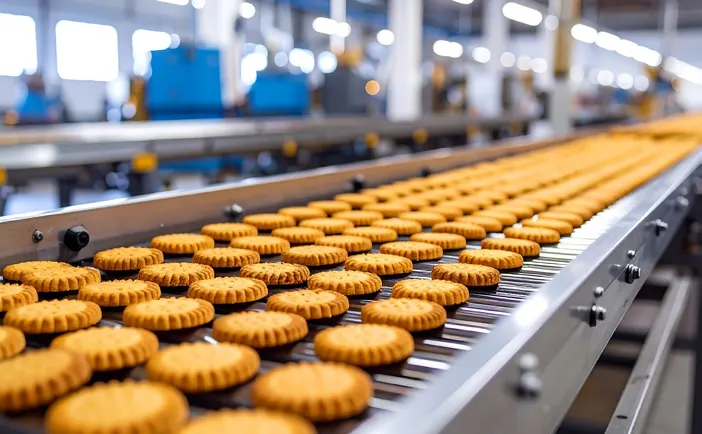
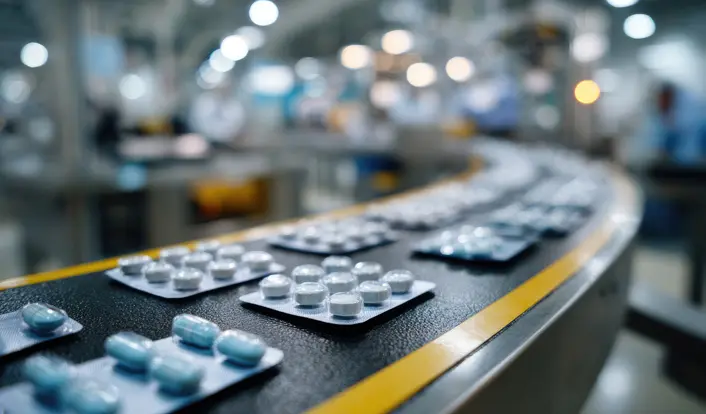
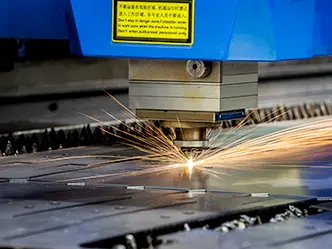
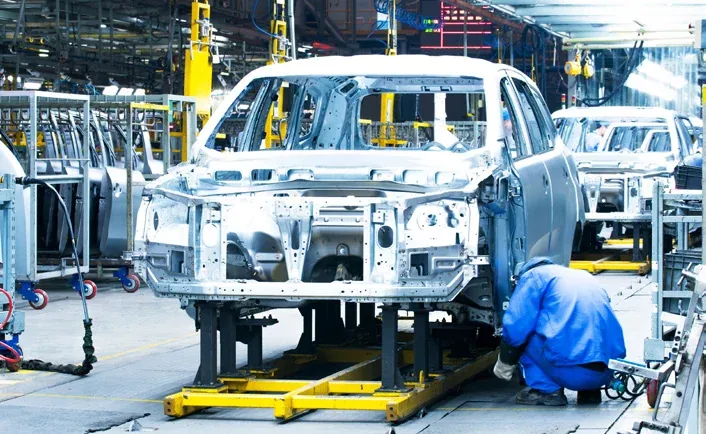
The industries that come to us most often


Five technologies the saving rests on
Most SCR series are fitted with them, and the higher up the programme, the more of them the machine carries. They are what makes the difference between a compressor that is cheap to buy and a compressor that is cheap to run.
- Two-stage compression — the air is compressed in two goes with intercooling, so the same cubic metre costs less electricity than on a single-stage machine.
- Direct 1:1 drive — the block sits on the motor with no belts and no gearbox, so nothing is lost in the transmission and nothing is spent on tensioning and changing belts.
- IE4 motors with permanent magnets — they hold a high efficiency at part load as well, which is exactly where an ordinary asynchronous motor falls away.
- Motor cooling by oil or by liquid — the winding temperature stays low, which spares the insulation and the bearings and holds the efficiency for the whole life of the machine.
- Speed control of the motor and of the fan — the speed follows the actual consumption, so a machine that happens to be running at a third is not cooled flat out.
How a screw compressor works
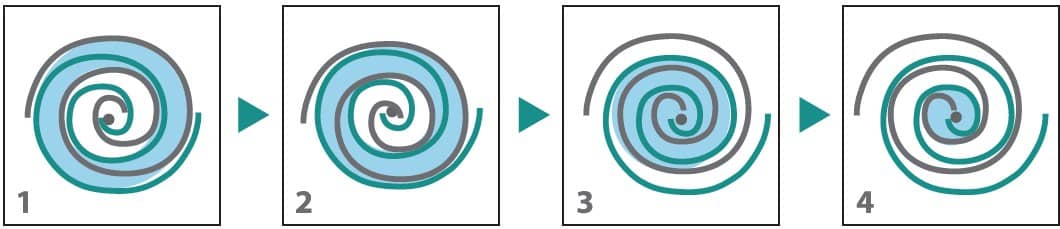
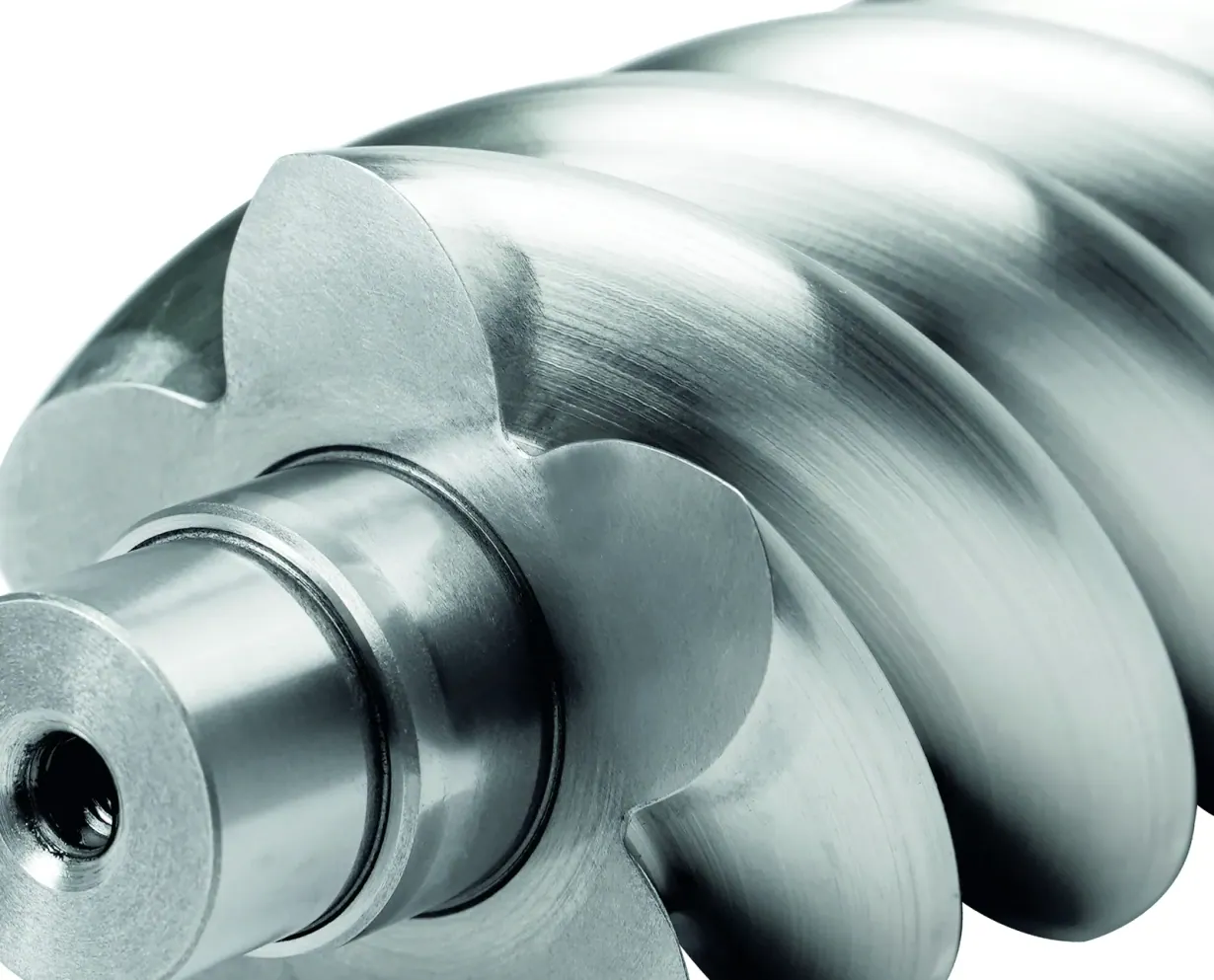
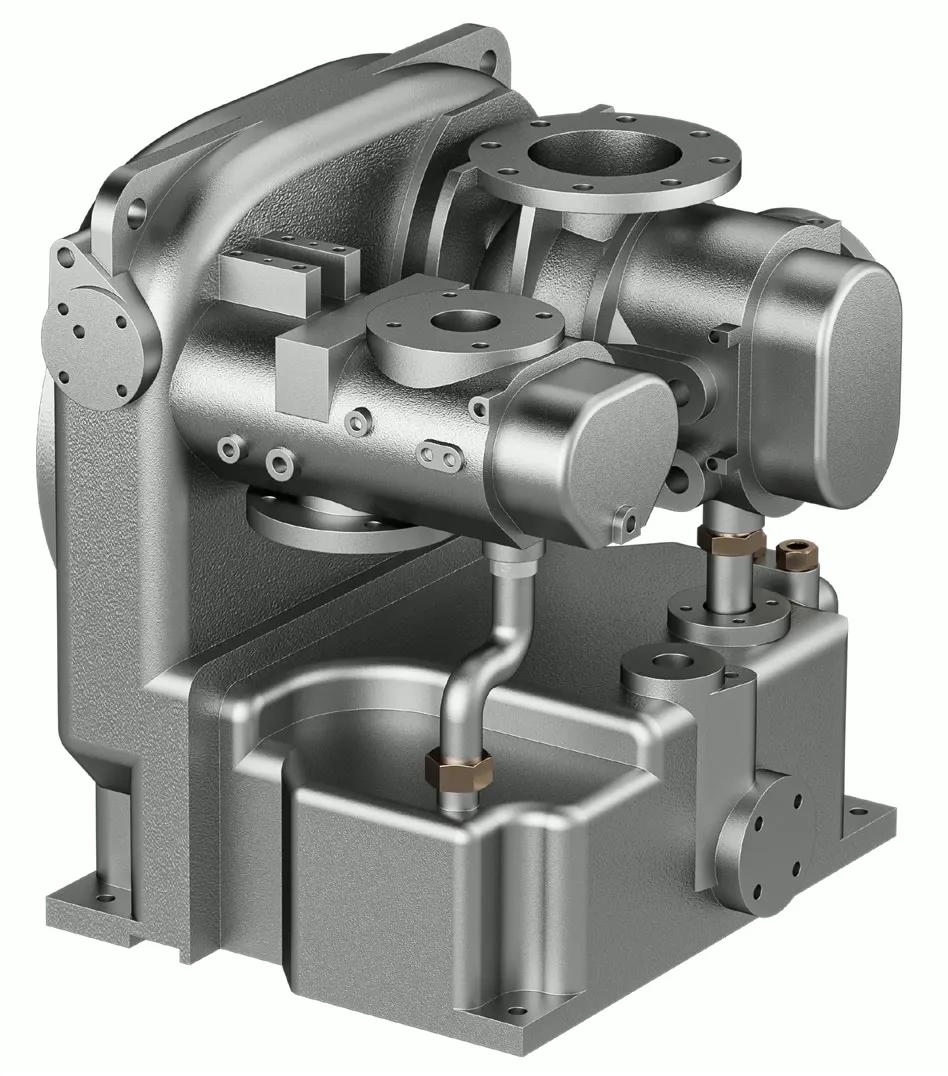
A pair of rotors turns against each other and the space between their teeth shrinks steadily on the way from the intake to the outlet — that is what compresses the air, with no valves, no pulsation and no breaks. It is why a screw machine takes the continuous running that would cook a piston compressor. A scroll compressor does the same thing differently: pockets of air travel between a fixed and an orbiting scroll towards the centre and shrink on the way. It is gone into in more detail in the advice section.
There is more to it than the compressor
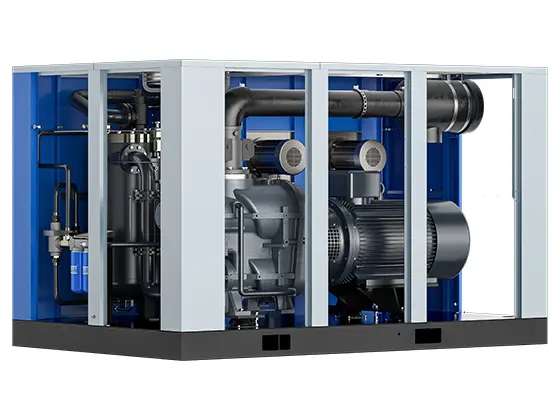
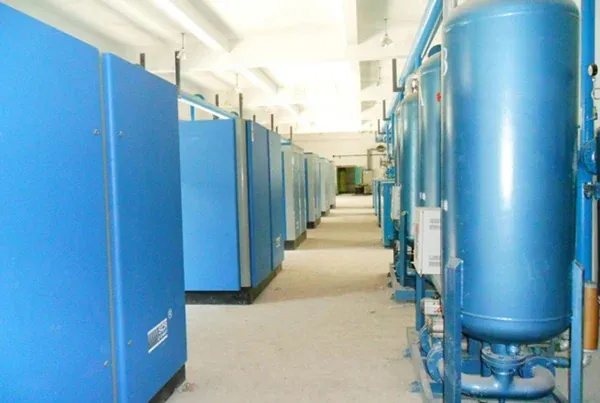
The machine on its own makes air, but it is the rest of the compressor room that makes it usable. An air receiver evens out the peaks, so that the compressor does not switch on at every draw. Drying removes the water that would otherwise condense in the pipework and in the tools. Filtration tunes the purity to what the air is for. The pipework decides how much pressure you lose on the way. On the smaller series the air receiver and the dryer can be bought in one frame with the compressor; on the large ones the compressor room is put together to measure.
Ventilek advises
Do not buy a compressor by the kilowatts on the plate. What decides is how many litres a minute the machine gives at your pressure and how much it takes to do it — and on two machines with the same motor that can easily differ by a quarter. In a multi-shift plant the purchase price is only a fraction of what the compressor will cost you in the end; the rest is electricity. If you are not sure, send us your demand and your running hours and we will work it out for you.
Common questions about choosing
- Is a variable-speed drive worth it, or is fixed speed enough?
- It comes down to whether the demand fluctuates. A fixed-speed machine can only run and unload — and an unloaded machine still takes roughly a third of its power. When a plant has peaks and lulls, a variable-speed drive takes that idle running away. When a line runs evenly at full output, the VSD has nothing to save and all that is left of it is the higher purchase price. Most SCR series have a VSD as standard; on the G and H series you choose between the version with one and the version without.
- What is the difference between oil-free and filtered air?
- On an oil-lubricated compressor the oil is right there in the compression chamber and filtration behind the machine reduces what is left of it. On an oil-free machine the oil has no way of getting into the compressed air, because there is none in the chamber. For plants where the air meets food, a medicine or a painted surface, that is the difference between a precaution and a certainty.
- Why two-stage compression?
- Compressing air in one go from atmosphere to ten bar means a high outlet temperature, and a loss with it. Split it into two stages with a cooler in between and the same cubic metre uses less energy. That is why the most powerful series have it, where the saving is multiplied by the hours worked.
- How many bar should I choose?
- Most air tools and machines manage on 7 or 8 bar. Every extra bar costs roughly 7% of the power input, so buying pressure “just in case” does not pay. Ten bar makes sense on long pipe runs and with machines that reduce the pressure themselves; 12.5 bar is done by one series only — the SCR-H.
- Do I need anything else besides the compressor?
- Almost always an air receiver, so that the machine does not switch on at every draw, and drying, so that water does not condense in the pipework. On the smaller series both can be bought in one frame with the compressor; on the large ones they are dealt with separately, to suit the compressor room.
- Does more kW mean more air?
- Only within one series. Between series it does not — a two-stage machine makes more air from the same power input than a single-stage one, and an oil-free machine makes less, because it compresses without a lubricated sealing film. So compare litres per minute at a given pressure, not kilowatts.
The ranges given apply to the whole SCR programme; individual models differ. The output figures come from the manufacturer’s data and the flow measurement follows ISO 1217. Prices of the large machines depend on the particular assembly and version, which is why they are given on request.
-
 SCR-APM Mini Compressors
-
SCR-APM Maxi compressors
-
SCR-PM2 compressors
-
SCR-EPM compressors
-
SCR-EPM2 compressors
-
Spiral SCR-XA
-
Oil-free screw SCR-G
-
Two-stage screw SCR-H


Bestsellers


Product sorting
List of products

A twenty-litre canister of genuine SCR lubricant. The usual choice for one screw machine in a workshop or plant.

Innovative and economical small screw compressor for up to 50% energy savings. Maximum output 2 000 l/min at 10 bar. Continuous speed control by frequency converter, direct 1:1...

Innovative and economical small screw compressor for up to 50% energy savings. Maximum output 950 l/min at 10 bar. Continuous speed control by frequency converter, direct 1:1...


The most powerful 3-in-1 package without filtration — 696 l/min, dryer and 200 l receiver. Twice the entry 3 kW on the same footprint.

The middle 4-in-1 package with a 270 litre receiver. A range of 800–1,500 l/min covers a plant with several draw-off points, and the air is class 2-4-2.

A 4-in-1 package with a 500 litre vessel. The same compressor as the 270 version but with nearly twice the air reserve — for plants with bursty demand.

The highest output in the range in the shorter package. Two thousand litres a minute, but only 1,517 mm long — for plants short of space in the compressor room.

The strongest 4-in-1 package with a 500 litre receiver. Compressor, vessel, refrigeration dryer and pre-filter on one frame — class 2-4-2 air without assembling components piece...

The smallest and quietest 4-in-1 package. Compressor, 270 l receiver, refrigeration dryer and pre-filter on one frame — a finished source of class 2-4-2 air at 66 dB(A).

The middle 8-in-1 package. To the 270 l receiver, dryer and pre-filter it adds a micro-filter, an activated-carbon filter and a condensate separator — the air exceeds class 1-4-1.

An 8-in-1 package with a 500 litre vessel. The cleanest air plus a large reserve — for plants that draw in bursts and cannot have oil in the air.

The top of the range. Highest output, largest vessel and the fullest equipment — two thousand litres a minute, 500 l of reserve and air that exceeds class 1-4-1.

The smallest machine in the top equipment level. To the 4-in-1 package it adds a micro-filter, an activated-carbon filter, zero-loss drains and a separator — the air exceeds...

The middle bare machine of the range. It controls from 800 to 1,500 l/min and takes a footprint of 900 × 820 mm. For plants that handle the receiver and air treatment centrally.

The smallest and quietest machine in the range. It controls from 600 to 950 l/min at 66 dB(A) and takes up only 890 × 720 mm — four decibels less and a smaller footprint than...

The smallest machine at the top equipment level. It turns down to 130 l/min and up to 320, yet does everything the larger assemblies do — two-stage filtration, automatic...

The middle machine at the top equipment level. A 200–510 l/min range covers a workshop with several stations, and adds two-stage filtration, automatic condensate drainage and a...

The top equipment level and the largest machine. To the 3-in-1 assembly it adds two-stage filtration and automatic condensate handling — class 1-4-1 air to ISO 8573-1 and a...

The SCR-2/10XA is an oil-free scroll compressor with a free air delivery of 200 l/min (12 Nm³/h) at 10 bar and a total power input of 2.2 kW. The air is compressed by a single...

The SCR-4/10XA is an oil-free scroll compressor with a free air delivery of 350 l/min (21 Nm³/h) at 10 bar and a total power input of 3.7 kW. The air is compressed by a single...

The SCR-7/10XA is an oil-free scroll compressor with a free air delivery of 700 l/min (42 Nm³/h) at 10 bar and a total power input of 7.4 kW. The air is compressed by 2 scroll...


The SCR-22/7XA is an oil-free scroll compressor with a free air delivery of 2,620 l/min (157.2 Nm³/h) at 7 bar and a total power input of 22.2 kW. The air is compressed by 6...

The SCR-30/7XA is an oil-free scroll compressor with a free air delivery of 3,520 l/min (211.2 Nm³/h) at 7 bar and a total power input of 29.6 kW. The air is compressed by 8...

The SCR-22/10XA is an oil-free scroll compressor with a free air delivery of 2,100 l/min (126 Nm³/h) at 10 bar and a total power input of 22.2 kW. The air is compressed by 6...

The SCR-30/10XA is an oil-free scroll compressor with a free air delivery of 2,800 l/min (168 Nm³/h) at 10 bar and a total power input of 29.6 kW. The air is compressed by 8...


The entry screw compressor of the range, without a receiver. 320 l/min at ten bar, 180 kg and a footprint of just 0.39 m² — for a workshop that already has a receiver.

The most powerful machine that still fits the smaller of the large frames. 19,000 l/min at eight bar, 2,050 kg — above it come 850 kg and a new frame.


