
SCR-EPM2 Rotary Screw Compressors: Maximum Efficiency for Industry
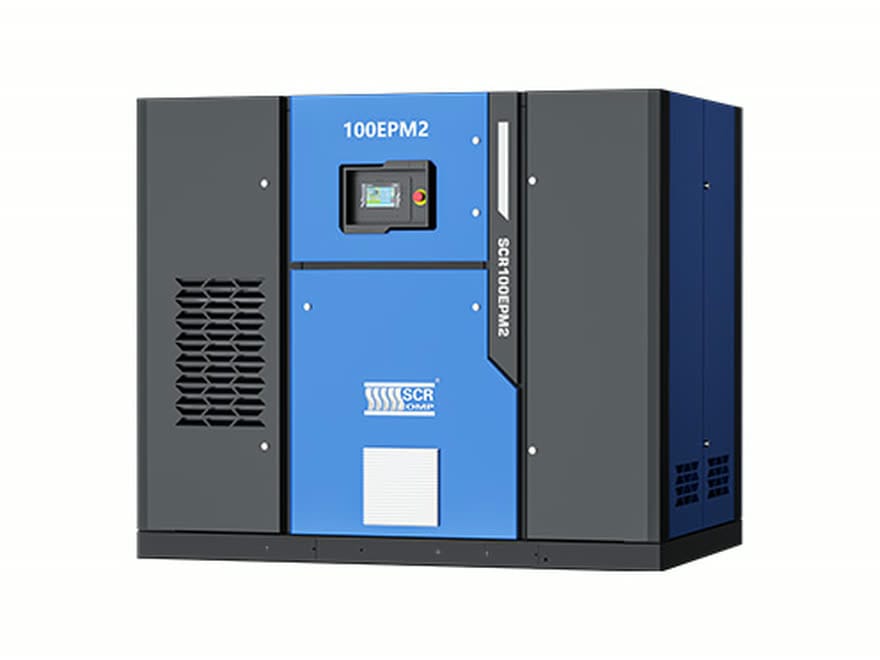 New generation
The EPM2 is the range for plants where compressed air is not an auxiliary utility but part of production itself. Seven power classes from 55 to 160 kW, delivery of up to 33,500 l/min and a flanged outlet from DN 50 to DN 80 — here you are not buying a compressor, you are building a compressor room.
A permanent magnet motor above IE4 level, direct drive through a taper coupling with no belts or gearbox, and an inverter that holds pressure to within ±0.1 bar. The new airend raises efficiency by up to 16 % and is engineered for 20 years.
Smaller machines from 15 kW are covered by the sister EPM range; the full brand overview is in the SCR brand overview.
What sets the EPM2 apart
At this size, what you mostly pay for is electricity
A 110 kW machine running three shifts puts more energy through it in a year than the machine itself costs. That is why an EPM2 is not judged on purchase price but on lifetime cost — and with the new airend that life is twenty years. Every percent of efficiency is felt differently here than on a small machine.
You set the pressure on the machine
Seven, eight and ten bar are all covered by the same machine — what differs is the setting and how much air it delivers at that pressure. That is why all three share the same dimensions and weight. And since an extra bar costs roughly 7 % in energy, on a 150 kW machine that is a figure you can see in the budget.
A bearingless, oil-cooled motor
Permanent magnets, a closed oil circuit, IP65 protection. Efficiency exceeds the IE4 requirements and saves 5 to 6 % against IE2 motors. The PM motor design contains no bearings — on a machine that runs continuously, that removes an entire maintenance item and the downtime that goes with it.
A start-up that will not bring the supply down
The inverter ramps the machine up softly and the starting current never exceeds the rated value. On a machine drawing 170 amps, the difference against a conventional start that pulls eight times that through the supply is decisive — it often determines whether there is anywhere to connect the machine at all.
A cascade of sixteen machines with no master panel
The SCR9000 controller shares the load across up to 16 compressors on its own, with no separate control cabinet. Plants of this size almost never install a single machine — they build a set where one holds the base load and the others come in as demand rises.


Choosing the right machine
| SCR-EPM2 rotary screw compressors — all 21 versions | |||||||
|---|---|---|---|---|---|---|---|
| Order code | Motor power | Pressure | Free air delivery (l/min) | Outlet | Dimensions L × W × H (mm) | Weight | Noise level |
| SCR-55/7EPM2 | 55 kW | 7 bar | 3,500 – 12,500 | DN 50 | 1,900 × 1,350 × 1,650 | 1,550 kg | 76 dB(A) |
| SCR-55/8EPM2 | 8 bar | 3,000 – 11,500 | |||||
| SCR-55/10EPM2 | 10 bar | 2,600 – 10,500 | |||||
| SCR-63/7EPM2 | 63 kW | 7 bar | 4,000 – 14,000 | DN 50 | 1,900 × 1,350 × 1,650 | 1,650 kg | 76 dB(A) |
| SCR-63/8EPM2 | 8 bar | 3,600 – 13,000 | |||||
| SCR-63/10EPM2 | 10 bar | 3,200 – 12,000 | |||||
| SCR-75/7EPM2 | 75 kW | 7 bar | 3,800 – 16,300 | DN 65 | 2,280 × 1,500 × 1,950 | 2,010 kg | 78 dB(A) |
| SCR-75/8EPM2 | 8 bar | 3,600 – 16,000 | |||||
| SCR-75/10EPM2 | 10 bar | 2,900 – 13,700 | |||||
| SCR-90/7EPM2 | 90 kW | 7 bar | 5,100 – 20,000 | DN 65 | 2,280 × 1,500 × 1,950 | 2,050 kg | 78 dB(A) |
| SCR-90/8EPM2 | 8 bar | 5,000 – 19,000 | |||||
| SCR-90/10EPM2 | 10 bar | 4,000 – 16,500 | |||||
| SCR-110/7EPM2 | 110 kW | 7 bar | 7,400 – 24,500 | DN 80 | 2,800 × 1,750 × 1,690 | 2,900 kg | 78 dB(A) |
| SCR-110/8EPM2 | 8 bar | 7,200 – 24,000 | |||||
| SCR-110/10EPM2 | 10 bar | 6,300 – 21,000 | |||||
| SCR-132/7EPM2 | 132 kW | 7 bar | 8,300 – 30,000 | DN 80 | 2,700 × 1,650 × 2,150 | 3,050 kg | 78 dB(A) |
| SCR-132/8EPM2 | 8 bar | 7,500 – 28,000 | |||||
| SCR-132/10EPM2 | 10 bar | 6,500 – 23,000 | |||||
| SCR-160/7EPM2 | 160 kW | 7 bar | 9,300 – 33,500 | DN 80 | 2,700 × 1,650 × 2,150 | 3,150 kg | 78 dB(A) |
| SCR-160/8EPM2 | 8 bar | 8,800 – 31,000 | |||||
| SCR-160/10EPM2 | 10 bar | 7,600 – 27,000 | |||||
Each power rating has three rows — it is one and the same machine at three pressure settings, which is why the dimensions, weight and noise level are identical. The pair of figures under free air delivery marks the band the inverter regulates across.
#showmore#
Where the savings come from
A compressor is one of the largest single consumers of electricity in industry, and at this size that goes double. There is little point quoting the saving as a sum of money — the rate per kWh moves and the figure would be useless within a year. Everything below is therefore given as a percentage, into which you can put your own price.
up to 40 % — against throttle valve control
The older method of regulation lets the machine run at full speed and blows off the excess. The inverter reduces speed instead. On a 160 kW machine, forty percent is a difference that pays back the whole investment before the warranty runs out.
≈ 7 % — for every unnecessary bar
Pressure one bar higher than the pipework needs costs about seven percent of consumption. On a hundred kilowatts running continuously, that alone is an item in the hundreds of thousands a year.
5–6 % — PM motor against IE2
The difference between a permanent magnet motor and the ordinary asynchronous motor used as standard on inverter-driven machines.
The three savings add up and run in every operating hour. At this size a fourth one joins them, which you will not find in any table: waste heat. A 150 kW machine heats the compressor room by itself, and in continuous operation putting that heat to use is the single largest saving after the inverter.

What is inside
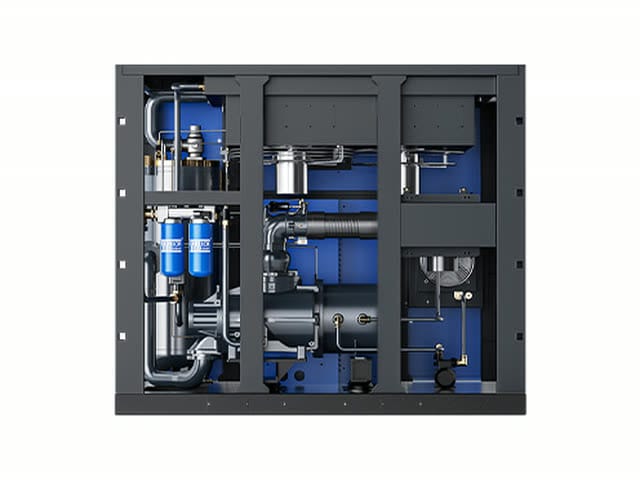
The airend is new, with a redesigned rotor profile developed in Japan, multi-point oil injection and optimised ports. That yields up to 16 % better efficiency than the previous generation and a service life of over 100,000 operating hours.
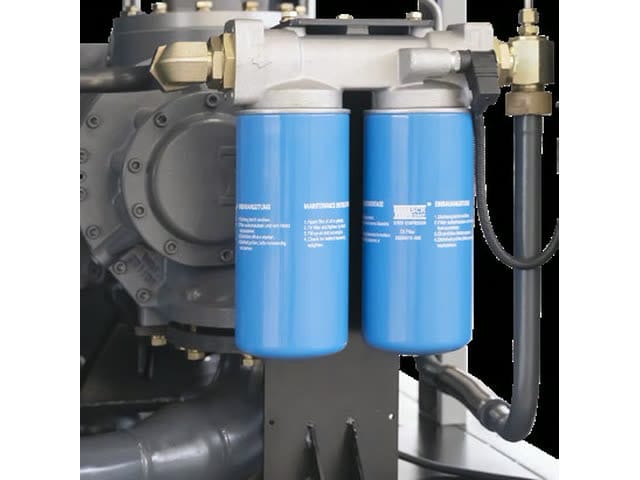
Air is drawn in through a nanofilter with 99.9 % retention, the oil is cleaned by a 0.1 µm filter and an oversized separator keeps residual oil below 3 ppm. The internal pipework is all steel — on a machine expected to run for years without a stop, a rubber hose is the weak link.



Operation, monitoring and cascade
The SCR9000 controller has a colour touchscreen with a graphical schematic of the machine, an operating log, a service schedule and protection against overload, power failure and phase imbalance. It connects to remote monitoring over RS485.
In a multi-machine installation what matters is that the controller handles sequencing of up to sixteen compressors with no master panel. That saves not only the cabinet but the design work and the wiring — and above all it means the set can be extended without reworking the control system.
What the machine demands of the building
With the EPM2 you are choosing not only a compressor but a compressor room. The smallest machine in the range weighs 1.5 tonnes, the largest 3.2 tonnes, and the ventilation required runs from 15,600 to 30,000 m³ of air per hour. The outlet is flanged, DN 50 to DN 80, so the pipework starts somewhere different than on smaller machines.
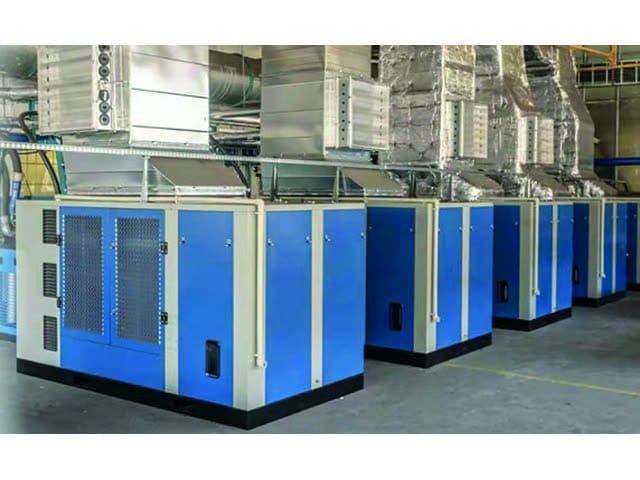

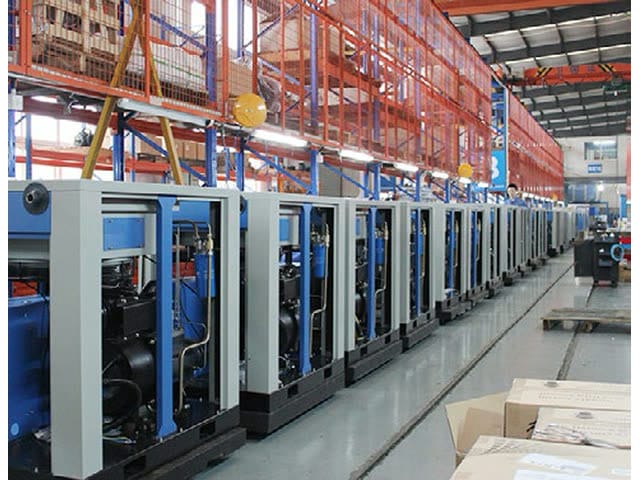
That is precisely why a set is usually made up of several machines: a smaller one holds the base load, a larger one comes in at peak, and when one is taken out for service, production does not stop. The controller handles the split on its own.
Who the EPM2 is for
Continuous operation
The more operating hours, the sooner the higher purchase price comes back. On machines above 55 kW the payback is counted in months rather than years — but only when the machine is actually running.
Demand that varies through the day and between shifts
The inverter regulates across 25 to 100 % of speed, with the manufacturer recommending the 60–100 % output band. Where demand fluctuates, this is exactly the job the range is built for.
Limited connected capacity
A soft start within the rated current is often decisive at this size. A conventional start would pull eight times that through the supply, and in many plants it simply could not be done.
Installations meant to grow
A cascade of up to sixteen machines with no master panel means you can start with two and add more as production grows — with no rework of the control system.
Ventilek recommends
On a 150 kW machine you are not buying a compressor, you are buying the next twenty years of electricity. At this size the purchase price is a fraction of what the machine will put through it. Before you start comparing price lists, have the consumption worked out — the difference is usually an order of magnitude larger than the difference in price.
Frequently asked questions
- Is the EPM2 really one machine for 7, 8 and 10 bar?
- Yes. All three pressure versions share the same dimensions, weight and connection — what differs is the setting and how much air they deliver at that pressure. We will go through how the pressure is set when the machine is handed over.
- How much space and ventilation does a machine like this need?
- From 1,900 × 1,350 mm and 15,600 m³/h on the 55 kW up to 2,700 × 1,650 mm and 30,000 m³/h on the 160 kW. The exact figures for each machine are in the table above and on its own page — a designer needs them before the price.
- Is one large machine better than two smaller ones?
- Almost always two smaller ones. One holds the base load, the second comes in at peak, neither runs half-loaded, and production does not stop for service. The controller sequences them itself, up to sixteen units. We are happy to work it out for your own demand profile.
- Can the waste heat be used?
- At this size it is almost always worth it — the compressor produces heat you would otherwise vent outside. In continuous operation it is the single largest saving after the inverter itself. We do the calculation across the country.
- What else is needed besides the compressor?
- An air receiver from the air receivers, a dryer and filtration from the air dryers, and pipework to match. Because the inverter smooths demand itself, a smaller receiver will do than a fixed-speed machine would want.
- I need less than 55 kW.
- Below this output the SCR-EPM range takes over, with 15 to 45 kW. The design and the controller are the same; the size and the connection differ.
Free air delivery figures correspond to measurement to ISO 1217, Annex C, always at the stated pressure. The noise figure applies at one metre from the machine enclosure. Machines are supplied for 400 V / 50 Hz. The manufacturer reserves the right to make design changes.


Product sorting
List of products

Genuine high quality mineral oil for SCR screw compressors in a 20 l canister. For oil change of SCR brand screw compressors - Shanghai Screw Compressor Co., Ltd

The most powerful machine that still fits the smaller of the large frames. 19,000 l/min at eight bar, 2,050 kg — above it come 850 kg and a new frame.

Genuine high quality mineral oil for SCR screw compressors in a 5 l canister. For oil change of SCR brand screw compressors - Shanghai Screw Compressor Co., Ltd

The most powerful machine in the range that fits under a low ceiling — the enclosure is 1,690 mm tall. 21,000 l/min at ten bar, regulation from 6,300.

The smallest pressure penalty in the whole range: eight bar costs only 500 l/min against seven. 24,000 l/min, DN 80 outlet, weight 2,900 kg.

The backbone of a large compressor room — 28,000 l/min at eight bar holds the base demand while smaller machines come in at the peaks. The controller sequences up to sixteen.

The highest delivery the range will give at normal industrial pressure: 31,000 l/min. Same frame as the 132 kW, only 100 kg heavier.

The lowest enclosure of the large machines — 1,690 mm, 460 mm less than the 132 kW. Into a low compressor room it often fits as the only one. 24,500 l/min.

The first machine in the range to pass thirty cubic metres a minute: 30,000 l/min. It weighs 3,050 kg, stands 2,150 mm tall and needs 25,000 m³/h of ventilation.

The top of the EPM2 range — 33,500 l/min, over thirty-three cubic metres of air a minute from a single enclosure. It needs 30,000 m³/h, twice what the 55 kW asks.

The most expensive pressure tax in the range: ten bar costs 23 % of the air here. It gives 23,000 l/min, but at seven bar that would be 7,000 l/min more.

The most powerful machine in the range at ten bar — 27,000 l/min. It never drops below 7,600 l/min, so it wants steady demand or a substantial receiver.

Genuine high quality mineral oil for SCR screw compressors in 209 l drum. For oil change of SCR brand screw compressors - Shanghai Screw Compressor Co., Ltd

The lowest power in the range at the highest pressure. 10,500 l/min at ten bar with regulation down to 2,600 — it copes with a weak night-time demand.

The entry machine of the range, set to seven bar. Up to 12,500 l/min with regulation from 3,500 — the first compressor that asks for a room of its own.

The 55 kW at eight bar, the most common combination in its class. 11,500 l/min at the pressure most industrial pipework is sized for.

At ten bar it gives 12,000 l/min, almost what the 55 kW gives at seven. A pressure loss of only 14 %, the least of any ten-bar machine in the range.

The same frame and footprint as the 55 kW, but 1,500 l/min more. 14,000 l/min at seven bar and the smallest pressure penalty in the lower half of the range.

It comes down further than any other machine in the range — to 21 % of output, or 2,900 l/min. At ten bar it delivers 13,700 l/min.

The widest regulation in the whole range — from 3,800 to 16,300 l/min on one machine. It opens the second frame of the range, with a DN 65 outlet.

An eight-bar setting that costs only 300 l/min against seven — the smallest pressure penalty in the lower half of the range. 16,000 l/min, weight 2,010 kg.

The 90 kW at ten bar gives 16,500 l/min, exactly what the 75 kW gives at eight. Regulation from 4,000, ventilation 17,500 m³/h.

A round twenty cubic metres a minute: 20,000 l/min at seven bar. Same frame as the 75 kW and only 40 kg heavier — the cheapest output in the range.

The last machine in the range with a DN 50 outlet — above it the pipework goes to DN 65. 13,000 l/min at eight bar, regulation from 3,600.