
SCR-EPM screw compressors: efficient air production
 New generation
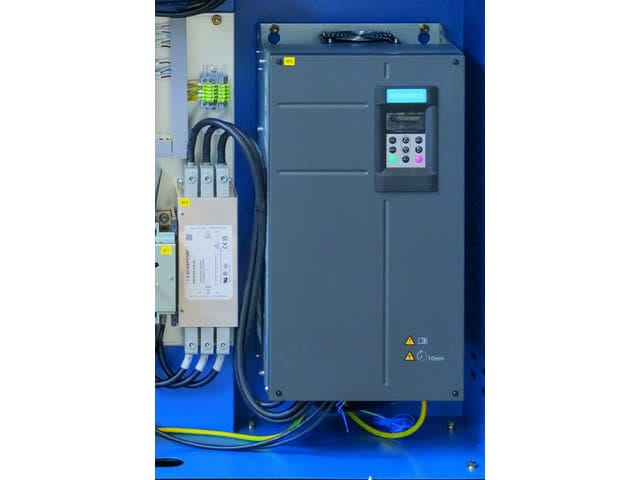
The SCR-EPM range is built for plants where the compressor runs every day and its consumption shows on the electricity bill. Six power classes from 15 to 45 kW, a permanent magnet motor above IE4, direct drive without belts or gearbox, and an inverter that holds pressure to within ±0.1 bar.
The machines have been through a generation change: an all-new airend raises efficiency by up to 16 % and is designed for 20 years of operation. The inverter now also drives the cooling fan, so when the machine does not need cooling, the fan does not run.
If you are after a smaller machine or a different brand, start from the overview of screw compressors. This page covers the EPM range only.
What sets EPM apart
You pick the pressure at the machine
Seven, eight and ten bar are all covered by the same machine — what differs is the setting and how much air it delivers at that pressure. That is why all three share the same dimensions, weight and price. Each extra bar costs roughly 7 % in energy, so it pays not to overshoot.
A motor without bearings
Permanent magnets, oil cooling in a closed loop, IP65 protection. Efficiency exceeds the IE4 requirement and saves 5 to 6 % against ordinary IE2 motors. The PM motor has no bearings — one whole maintenance item disappears.
Direct drive by taper connection
The motor rotor sits straight on the airend shaft. No belts, no gearbox, no coupling, so zero transmission loss and nothing to align. Belt replacement and tensioning, which elsewhere brings out a service engineer, is gone as well.
Starting without hitting the supply
The inverter ramps the machine up softly and the starting current never exceeds the rated value. A conventional direct-on-line or star-delta start pulls eight to ten times that through the supply. It shows on the breakers and on the agreed capacity charge.
Cascade without a master panel
The SCR9000 controller with a seven-inch touch display can sequence up to 16 compressors without a separate master cabinet. Add a weekly timer with breaks, service history and pre-alarms before a fault occurs.

Which machine to choose
| SCR-EPM screw compressors — all 18 versions | |||||||
|---|---|---|---|---|---|---|---|
| Order code | Motor power | Pressure | Free air delivery (l/min) | Outlet | Dimensions L × W × H (mm) | Weight | Noise |
| SCR-15/7EPM | 15 kW | 7 bar | 750 – 3,000 | R 1" | 1,200 × 800 × 1,100 | 480 kg | 66 dB(A) |
| SCR-15/8EPM | 8 bar | 730 – 2,900 | |||||
| SCR-15/10EPM | 10 bar | 580 – 2,300 | |||||
| SCR-18/7EPM | 18.5 kW | 7 bar | 1,300 – 3,700 | R 1" | 1,200 × 800 × 1,100 | 480 kg | 66 dB(A) |
| SCR-18/8EPM | 8 bar | 1,100 – 3,500 | |||||
| SCR-18/10EPM | 10 bar | 1,000 – 2,900 | |||||
| SCR-22/7EPM | 22 kW | 7 bar | 1,100 – 4,100 | R 1" | 1,200 × 800 × 1,100 | 560 kg | 66 dB(A) |
| SCR-22/8EPM | 8 bar | 1,200 – 4,000 | |||||
| SCR-22/10EPM | 10 bar | 1,100 – 3,500 | |||||
| SCR-30/7EPM | 30 kW | 7 bar | 1,700 – 6,200 | R 1½" | 1,300 × 1,000 × 1,370 | 830 kg | 68 dB(A) |
| SCR-30/8EPM | 8 bar | 1,600 – 6,100 | |||||
| SCR-30/10EPM | 10 bar | 1,300 – 5,200 | |||||
| SCR-37/7EPM | 37 kW | 7 bar | 1,650 – 7,400 | R 1½" | 1,530 × 1,100 × 1,370 | 850 kg | 70 dB(A) |
| SCR-37/8EPM | 8 bar | 1,600 – 7,350 | |||||
| SCR-37/10EPM | 10 bar | 2,300 – 6,500 | |||||
| SCR-45/7EPM | 45 kW | 7 bar | 2,500 – 9,500 | R 1½" | 1,530 × 1,100 × 1,370 | 890 kg | 72 dB(A) |
| SCR-45/8EPM | 8 bar | 2,400 – 9,400 | |||||
| SCR-45/10EPM | 10 bar | 3,000 – 8,000 | |||||
The three rows under each power rating are the same machine at three pressure settings — which is why they share dimensions, weight and noise level. Delivery is given as the range of continuous speed control, measured to ISO 1217.
#showmore#
Where the savings come from
In industry a compressor is one of the largest single electricity consumers. There is no point quoting savings in currency — the rate per kWh moves constantly and the figure would be worthless in a year. Everything below is therefore in per cent; put in your own rate.
up to 40 % — against discharge valve control
The most common older method of regulation: the machine runs flat out and the surplus is blown off. The inverter reduces speed instead. The manufacturer quotes savings of up to 40 % against that arrangement.
≈ 7 % — for every unnecessary bar
A set pressure one bar above what the pipework needs costs roughly seven per cent in consumption. On a machine running three shifts it shows immediately.
5–6 % — PM motor against IE2
The difference between a permanent magnet motor and the ordinary IE2 induction motor used as standard on inverter-driven machines.
The three savings add up and every one of them runs in every operating hour. That is why the figure that matters on a compressor is not the purchase price but the cost over its life — and with the new airend that is 20 years, or more than 100,000 operating hours.

What is inside
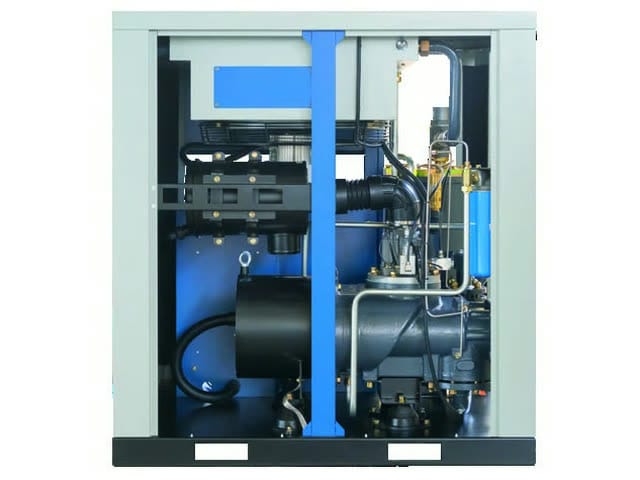
The airend is new, with a redesigned rotor profile developed in Japan, multi-point oil injection and optimised inlet and outlet ports. That is exactly where the up to 16 % better efficiency against the previous generation comes from.
Air is drawn in through a nano-scale filter with 99.9 % efficiency and a blockage indicator; the oil is cleaned by a 0.1 µm filter. The separator is oversized and keeps oil carry-over in the air below 3 ppm. Internal pipework is all steel — no rubber hoses to age and burst.


Operation and monitoring
The SCR9000 unit has a colour touch display with a graphical diagram of the machine, an operating log, a service plan and protection against overload, phase loss and imbalance.
The machine holds constant pressure to within ±0.1 bar and a constant oil temperature around 81 °C, which is the best point for lubrication and at the same time an insurance against a high-temperature trip. RS485 allows connection to remote monitoring.
Where EPM works
The EPM range has no built-in receiver — it is meant for a plant room alongside a separate vessel, dryer and filtration. Its place follows from that: concrete batching plants, engineering works, production halls and anywhere the air does not drive a single machine but a whole distribution system.

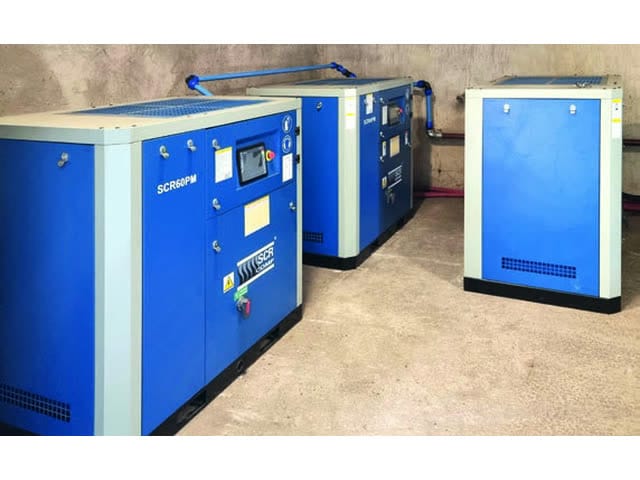
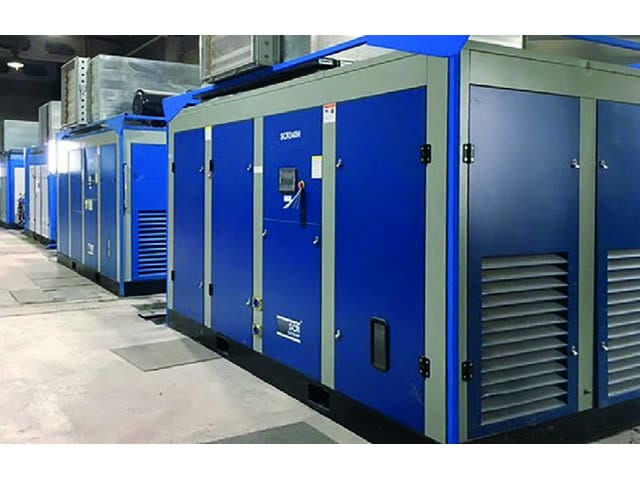
In plant rooms machines are often combined — the smaller one holds the base load, the larger one comes in at peak. That is exactly what the controller can share out by itself, without a master panel.
Who EPM makes sense for
When the compressor runs in shifts
The more operating hours, the sooner the higher purchase price comes back. On single-shift operation with short draws the difference is harder to find.
When air demand fluctuates
The inverter has a range of 25 to 100 % speed. The manufacturer recommends running the machine in the 60–100 % output band — that is where it is most economical. If demand varies between shifts or during the day, this is exactly that job.
When starting currents are a problem
A soft start up to rated current suits sites where the capacity charge is expensive or where a conventional start would trip the breakers.
When you need more than one machine
Up to sixteen compressors can run in cascade without a master panel — the controllers share the work themselves, with no separate cabinet. It works out cheaper than one oversized machine running at half throttle.
Ventilek advises
Do not buy a bar you will only ever look at on the gauge. Every bar above what the pipework actually needs costs roughly seven per cent in consumption. Before you order, measure what pressure you really have to run — and whether seven bar will do instead of ten.
Frequently asked questions
- Is the SCR-EPM really one machine for 7, 8 and 10 bar?
- Yes. All three pressure versions have identical dimensions, weight, connection and price — what differs is the setting and how much air they deliver at that pressure. We will give you the exact setting procedure with the order.
- How much will I save against an old compressor?
- It depends on what you are replacing and how the machine runs. Against discharge valve control the manufacturer quotes up to 40 %, the PM motor itself adds 5 to 6 % over IE2, and every bar you drop the pressure by another 7 % or so. We will work it out on your figures.
- Does the EPM need an air receiver?
- Yes, the machine comes without a vessel. You will find receivers among air receivers; we will size one to your demand. An inverter machine needs a smaller vessel than a fixed-speed one.
- What about maintenance?
- Belt tensioning and replacement are gone, and so is motor bearing maintenance — the PM motor has none. Filters, oil and the separator remain. A maintenance schedule can be downloaded with every machine and we provide service across the country.
- Can the compressor be rented?
- Yes. Under the SCRent scheme the machine is rented for five years and the instalments are a direct company cost, so depreciation does not apply to them. You do not have to release the whole amount at once.
- What if I need more than 45 kW?
- Above that output the SCR-EPM2 range takes over, from 55 to 160 kW. Below 15 kW, take a look at the SCR-APM Maxi range.
Free air delivery is measured to ISO 1217 (Annex C) and stated for the given pressure. Noise is quoted at 1 m from the machine. Standard supply is 400 V / 50 Hz. The manufacturer reserves the right to change the design.
Bestsellers


Product sorting
List of products

Genuine high quality mineral oil for SCR screw compressors in a 20 l canister. For oil change of SCR brand screw compressors - Shanghai Screw Compressor Co., Ltd

Genuine high quality mineral oil for SCR screw compressors in a 5 l canister. For oil change of SCR brand screw compressors - Shanghai Screw Compressor Co., Ltd

Genuine high quality mineral oil for SCR screw compressors in 209 l drum. For oil change of SCR brand screw compressors - Shanghai Screw Compressor Co., Ltd

The smallest machine in the range at the highest pressure. 2,300 l/min at ten bar, an enclosure of 1,200 × 800 mm and 66 dB(A) — for a workshop where people work alongside it.

The way into the EPM range. Fifteen kilowatts gives 3,000 l/min at seven bar, and the inverter takes it down to 750 — a quarter of its output.

The 15 kW at eight bar, 2,900 l/min. The extra bar costs only 100 l/min here, the smallest difference anywhere in the range.

Ten bar from the 18.5 kW: 2,900 l/min, exactly what the 15 kW gives at eight. Same enclosure, same 66 dB(A).

The 18.5 kW in the same enclosure as the 15 kW, but 700 l/min stronger: 3,700 l/min at seven bar, still only 480 kg.

Eight bar and 3,500 l/min in a 1,200 × 800 mm enclosure. Regulation from 1,100 l/min, so the machine serves the workshop even on a single air tool.

Ten bar and 3,500 l/min, the last machine in the range with an R 1" outlet. Above it the pipework is sized for R 1½".

The most powerful machine in the range’s small enclosure. 4,100 l/min at seven bar, 560 kg — 80 more than the 18.5 kW, but not a centimetre more.

The 22 kW at eight bar gives 4,000 l/min. The usual choice where compressed air drives several machines at once.

The 30 kW at ten bar gives 5,200 l/min and regulates from 1,300 — down to a quarter of its output, the lowest of any ten-bar machine in the range.

Here the range’s second enclosure begins — 1,300 × 1,000 × 1,370 mm and an R 1½" outlet. The 30 kW gives 6,200 l/min at seven bar, half again what the 22 kW gives.

Eight bar from the 30 kW: 6,100 l/min, only 100 less than at seven. Weight 830 kg, noise level 68 dB(A).

Ten bar from the 37 kW: 6,500 l/min. The regulation floor here is 2,300 l/min, higher than on the seven-bar version — it wants steadier demand.

The 37 kW shares its enclosure with the 45 kW but runs 2 dB(A) quieter. 7,400 l/min at seven bar, 850 kg.

Eight bar and 7,350 l/min — only 50 l/min less than at seven, the smallest pressure penalty in the upper half of the range.

The most powerful machine in the range at ten bar, 8,000 l/min. It will not drop below 3,000 l/min, so it belongs where air is drawn continuously.

The top of the EPM range. Nine and a half thousand litres a minute at seven bar, regulation from 2,500 and ventilation of 9,000 m³/h.

The highest delivery in the range at normal industrial pressure: 9,400 l/min. Enclosure 1,530 × 1,100 mm, weight 890 kg, 72 dB(A).