
TL;DR:
- The choice of a compressor should be based on its parameters, not on the price.
- Different designs have specific uses; piston compressors suit a workshop, screw compressors continuous operation.
- The right choice depends on the specific use, the output, the noise level and the maintenance, not on a universal model.
Choosing the right small compressor troubles thousands of users a year. One model suits for pneumatic tools in a car workshop, another painting in a home workshop and a completely different one carrying around a building site. Overpaying for output you do not need or compromising on reliability are mistakes you can easily avoid: by knowing the specific parameters and having an overview of proven types. That is exactly what this article offers. You will find selection criteria, an overview of the designs and comparison tables for professionals in construction, in car workshops and for home DIYers.
Contents
- How to choose a small compressor: 5 main criteria
- Types of small compressor and their main uses
- A list of recommended small compressors by practical use
- The big comparison of small compressors: which is best for your needs?
- Why there is no single small compressor for everyone – a view from practice
- Choose your ideal compressor – practical solutions and accessories
- Frequently asked questions about small compressors
Key takeaways
| Point | Details |
|---|---|
| Mind the type of use | The right choice of compressor depends on whether you need it in a workshop, at home or on a building site. |
| Compare the main parameters | The most essential are volume, output, noise level and maintenance demands. |
| The universal compressor does not exist | Always choose a model according to specific needs and the situation, not just according to price. |
| Comparison tables save time | Clear tables make it easier to decide between models. |
| Do not forget the accessories | With the right accessories you get the most out of every compressor. |
How to choose a small compressor: 5 main criteria
Choosing the right small compressor starts with the parameters, not with the price. The price is the result, not the starting point. Different models differ in tank volume, output, noise level and efficiency, and it is exactly these differences that decide whether a model suits a particular use.
Here are the key criteria ordered by importance when choosing:
-
Air receiver (tank) volume. For intermittent operation, such as inflating tyres or occasional screwing, a tank of 6 to 24 litres is enough. For continuous work with pneumatic tools, painting or grinding you need at least 50 litres, ideally more. Small compressors with a tank up to 25 litres are excellent for transport, but they do not allow long uninterrupted working cycles.
-
Motor power input and working pressure. The power input says how much electrical energy the motor consumes. The output (given in l/min or m³/h) says how much air the compressor actually delivers. For most pneumatic tools in a workshop or on a building site you need at least 150 l/min. The working pressure most often falls in the range of 8 to 10 bar. Beware of the figure „maximum pressure" versus „working pressure" – in practice the working pressure is the relevant one.
-
Noise level. It is given in decibels (dB). Below 60 dB the compressor is suitable for enclosed spaces, flats or work in residential areas. Standard piston compressors without sound insulation reach 80 to 90 dB, which matches the noise of a circular saw. For a workshop with no neighbours that is no problem, for a block of flats it is. Always check whether the manufacturer states a measured or only an estimated noise level.
-
Maintenance demands. Oil-lubricated compressors require regular oil changes and level checks, but they tend to have a longer service life. Oil-free models need less maintenance, but their piston blocks wear faster under intensive operation. When choosing, it is worth verifying the availability of spare parts and the service network for the brand. An overview of the most common mistakes when choosing a compressor shows that neglecting the service demands is one of the main causes of disappointment after purchase.
-
Availability of accessories. Hoses, quick couplings, pressure regulators, pressure gauges, condensate separators. These components must be compatible with the compressor you buy. Verify the connector standards and the diameter of the air outlets before purchase.
It is worth checking whether the model offers thermal motor protection and an easily accessible wheel or handle for transport. Different rules apply to two-stage compressors with higher output than to simple portable models.
Professional tip: Prefer models with built-in motor overload protection and with a firmly attached handle or wheels for easy handling. You will save on repairs and on your back.
Now that we know what to watch for when choosing, we will look at the specific types and their uses.
Types of small compressor and their main uses
The type of compressor fundamentally affects its suitability for the specific needs of a workshop, a car service or a household. Every design variant has its strengths and limits, which show up in real operation.
„The right type of compressor is half the success of efficient work."
Piston compressors are the most widespread category in the small machine segment. They work on the principle of a piston mechanism that compresses air into a tank. They suit intermittent operation, that is workshops, car services, building sites and the household. They are affordable, easy to repair and available across a wide output range. The drawback is the higher noise level of standard models without sound insulation.
Screw compressors work on a different principle: two screw rotors compress the air continuously. The advantage is quiet operation, low wear and suitability for continuous running. The drawback is a markedly higher purchase price and larger dimensions. For small workshops or home DIYers they are needlessly expensive, but for car services with continuous operation they are more advantageous.
Overview by design:
- Oil-lubricated piston compressors: Longer service life, suited to intensive operation, they need regular oil changes. Ideal for construction companies and professional car services.
- Oil-free piston compressors: They need no oil in the piston block, the air is cleaner, suited where oil would be a problem (paint shop, food industry). Shorter service life at maximum load.
- Sound-insulated piston compressors: A special design with an acoustic cabinet or dampers. Noise level below 60 dB. Suited to households, doctors, dentists, art studios.
- Mini compressors for transport: Very small models with a tank of 6 to 12 litres, weight under 15 kg. Intended for field work, inflating, work with guns for small repairs.
- Diaphragm and turbine mini compressors: They are used for very specific applications, for example for spraying air or as an air source for divers. Unsuitable for construction and automotive.
The efficiency of electric compressors depends on matching the type to the specific task. An oil-free compressor in a car service where pneumatic impact wrenches run all day wears out quickly. An oil-lubricated model in a paint shop, on the other hand, spoils the surfaces. Choosing the type is not a matter of preference but of technical necessity.
We have an idea of the parameters and the design differences; now let us focus on specific models.
A list of recommended small compressors by practical use
The choice of a specific model depends on the combination of output, noise level, weight and price. Below is a table with an overview of typical categories of small compressors and their basic parameters for quick orientation.
| Model / type | Type | Power input (W) | Noise level (dB) | Tank volume (l) | Recommended use |
|---|---|---|---|---|---|
| Oil-free mini (6 l) | Oil-free piston | 750 | 68 | 6 | Inflating, small jobs |
| Standard piston (24 l) | Oil-lubricated piston | 1500 | 82 | 24 | Workshop, pneumatic tools |
| Sound-insulated (24 l) | Sound-insulated piston | 1100 | 58 | 24 | Household, enclosed spaces |
| Professional piston (50 l) | Oil-lubricated piston | 2200 | 85 | 50 | Construction, car service |
| Small screw | Screw | 2200 | 65 | without tank | Continuous operation, service |
| Mini portable (8 l) | Oil-free piston | 900 | 72 | 8 | Field work, building site |
A closer look at the main categories:
Oil-free mini compressor (6 to 10 l)
- Advantages: Low weight (6 to 12 kg), no oil maintenance, clean air, easy transport
- Drawbacks: Low output, unsuitable for continuous operation, shorter service life of the piston block
- Typical use: Inflating wheels, balls, mattresses; guns for small painting jobs; minor pneumatic work
Standard oil-lubricated piston compressor (24 to 50 l)
- Advantages: Good price-to-output ratio, robust construction, long service life, available spare parts
- Drawbacks: Higher noise level, regular oil changes, higher weight
- Typical use: Workshop, car service, painting, pneumatic tools
Sound-insulated piston compressor
For some compressors, quietness and easy moving can be the key. Quiet piston compressors of the ABAC Silent range are an example of models designed for enclosed spaces where a noise level above 65 dB is not acceptable.
- Advantages: Noise level 55 to 62 dB, suitable for a household or surgeries, good output up to 1500 W
- Drawbacks: Higher purchase price than standard piston models
- Typical use: Home workshop, flat, surgery, creative studio, hobby users
Professional oil-lubricated piston compressor (50 l and more)
Whether this model pays off depends on the the practical use of compressors. Construction companies and car services use it for impact wrenches, air grinders, guns and compression work.
- Advantages: High output, large capacity, reliable in intensive operation
- Drawbacks: Higher weight (over 30 kg), noisier, regular maintenance required
- Typical use: Car service, small construction company, forge workshop, joiners
Professional tip: If you carry the compressor to the job every day, watch the weight first of all. A model with wheels and a folding handle in the 50 l category saves your back and your time. For construction work in the field, look for a robust version with air filter protection.
The big comparison of small compressors: which is best for your needs?
After the overview of the individual categories comes the comparison that helps with the final decision. Below is a table comparing the key operating parameters by way of use.
| Parameter | Oil-free mini | Standard piston | Sound-insulated piston | Professional 50 l | Small screw |
|---|---|---|---|---|---|
| Noise level (dB) | 68 to 72 | 80 to 88 | 55 to 62 | 82 to 90 | 62 to 68 |
| Weight (kg) | 6 to 14 | 18 to 28 | 20 to 30 | 30 to 55 | 35 to 60 |
| Tank volume (l) | 6 to 12 | 24 to 50 | 24 to 50 | 50 to 100 | without tank |
| Suitable for | Household, field | Workshop, car service | Household, enclosed spaces | Building site, professional service | Continuous operation |
| Maintenance demands | Low | Medium | Medium | Higher | Higher |
When to use which model:
- Household and hobby: Sound-insulated or oil-free mini. The key is low noise and easy storage.
- Car service: Standard oil-lubricated piston 50 l or screw. High output and reliability in daily operation are needed.
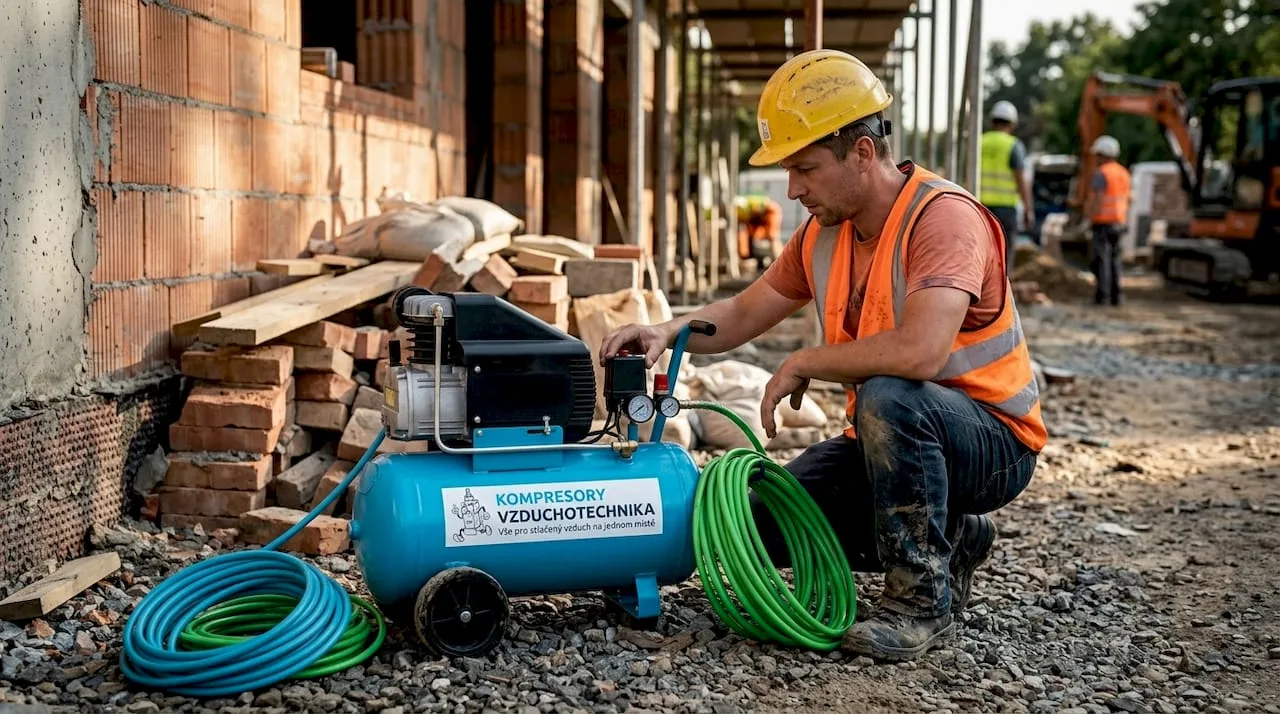
- Building site and field: Mini portable or professional piston 50 l with wheels. Robustness and mobility are the key.
- Paint shop: An oil-free model only. Oily air contaminates the paint surface.
For intensive use in a workshop we recommend more robust models, for work at home rather lighter and compact variants. Energy savings in operation is a topic with intensively used compressors that translates directly into a company costs.
Top 3 mistakes when choosing and using a small compressor:
-
Underestimated output. The most common mistake: the user buys a mini compressor for the household and then forces it to drive a pneumatic impact wrench in a car service. The result is overheating, a shortened service life and frustration. Every model has its limit and it must not be exceeded.
-
Ignoring the noise level. Many users deal with noise only after the purchase, when the neighbours start complaining or when they realise in a closed workshop that it cannot be done without hearing protection. The noise level is as important as the output when choosing.
-
Neglected draining of the air receiver. Condensate (water) builds up in the tank during every operation. If it is not drained regularly, it causes corrosion of the tank, contamination of the air and, in the worse case, a reduction in the strength of the vessel. Common mistakes in use include exactly this neglected draining as one of the main problems in operation.
After the thorough comparison it is time to sum up how to make the right decision and what to avoid.
Why there is no single small compressor for everyone – a view from practice
In practice the same scenario repeats: the user is looking for a „universal small compressor that can do everything". The result is usually a compromise that does nothing properly. Focusing on the needs of practice markedly increases user satisfaction and extends the service life of the equipment. This experience is confirmed both in workshop experience and in customer reviews.
A builder who carries the compressor onto scaffolding every day needs a weight under 20 kg and a robust version. Quietness and air purity do not interest him. A home DIYer in a block of flats, on the other hand, needs the quietest possible model, even at the price of lower output or a higher price. For a car service, reliability across an eight-hour shift is key, not portability.
A false „universal" model is a compressor for nobody. It has average output, average noise, average portability. In every category it ends up behind a more specialised model. That is exactly why the catalogues of reputable manufacturers do not contain one „all-in-one" model, but dozens of variants.
„The best compressor is the one that matches your practice, not the table values."
Experienced service technicians and site foremen confirm that an investment in a correctly chosen model comes back in a longer service life, lower service costs and work without needless compromises. The choice of a compressor should start with the question „what exactly will I be doing?“, not „how much do I want to spend?” The price is then simply the result of the right choice, not its guide.
Choose your ideal compressor – practical solutions and accessories
At Kompresory-vzduchotechnika.cz you will find a clearly arranged range of small compressors for every use: from portable mini models through sound-insulated piston compressors to professional machines for construction and car services.
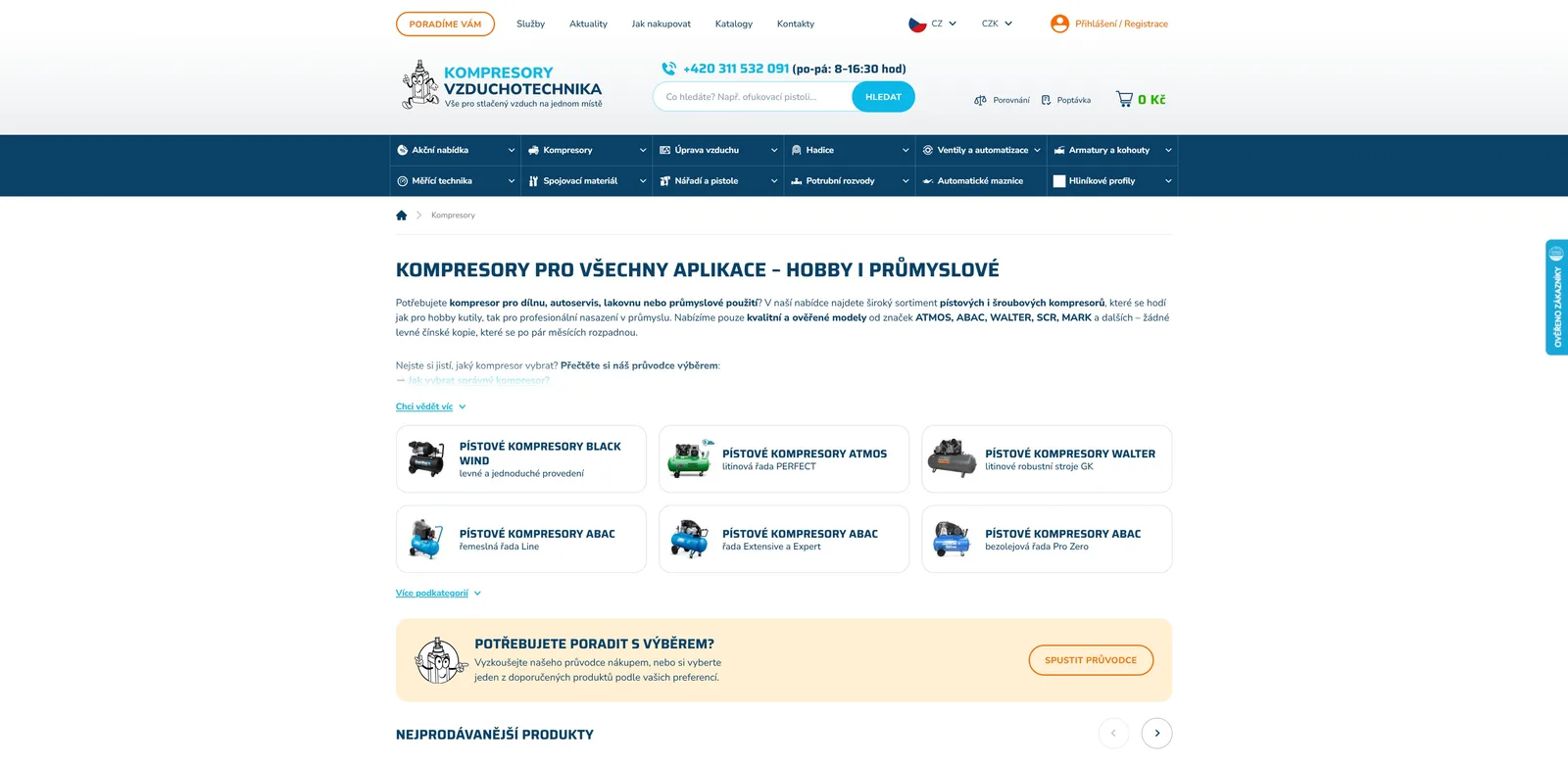
The category of piston and screw compressors contains models with detailed technical sheets and specifications of output, noise level and weight. For quiet operation in enclosed spaces we recommend looking at the ABAC Silent section with sound-insulated models below 60 dB. The offer also includes complete accessories: air hoses, quick couplings, regulators, condensate separators, spray guns and spare parts. Technical support is available both for the choice and for service questions. Choose a model according to your specific needs and send an enquiry directly on the website.
Frequently asked questions about small compressors
Which small compressor is the quietest for home use?
The quietest option is offered by sound-insulated piston compressors, for example the ABAC Silent range with a noise level below 60 dB, which is suitable even for blocks of flats.
What should you watch for when choosing a small compressor for a workshop?
Watch above all the output in l/min, the tank volume and the robustness of the construction, because compressors intended for home use are not enough for intensive operation in a workshop.
Can the same small compressor be used in the car industry and for work at home?
It depends on the specific model and the requirements: the type of compressor decides its suitability for a given operation, and universal models tend to be a compromise, not the optimum solution for both cases.
How often does a small compressor need servicing?
For most models it is enough to check according to the manufacturer recommendations, but intensive operation in a car service or on a building site requires more frequent service intervals and regular draining of the air receiver after every use.
Recommended
- Examples of compressor use: a guide for workshop and production - Kompresory-Vzduchotechnika.cz
- Two-stage compressor: higher efficiency for industry 2026
- Avoid the most common mistakes when using compressors - Kompresory-Vzduchotechnika.cz
- ✅ Compressors – a wide choice of piston and screw compressors