

TL;DR:
- Knowing the internal principle of a piston compressor is essential for efficient operation and for preventing problems. Correct maintenance, choosing the right type and following the safety rules extend its service life and reduce costs. Chosen and cared for correctly, it is a reliable and economical option in an industrial setting.
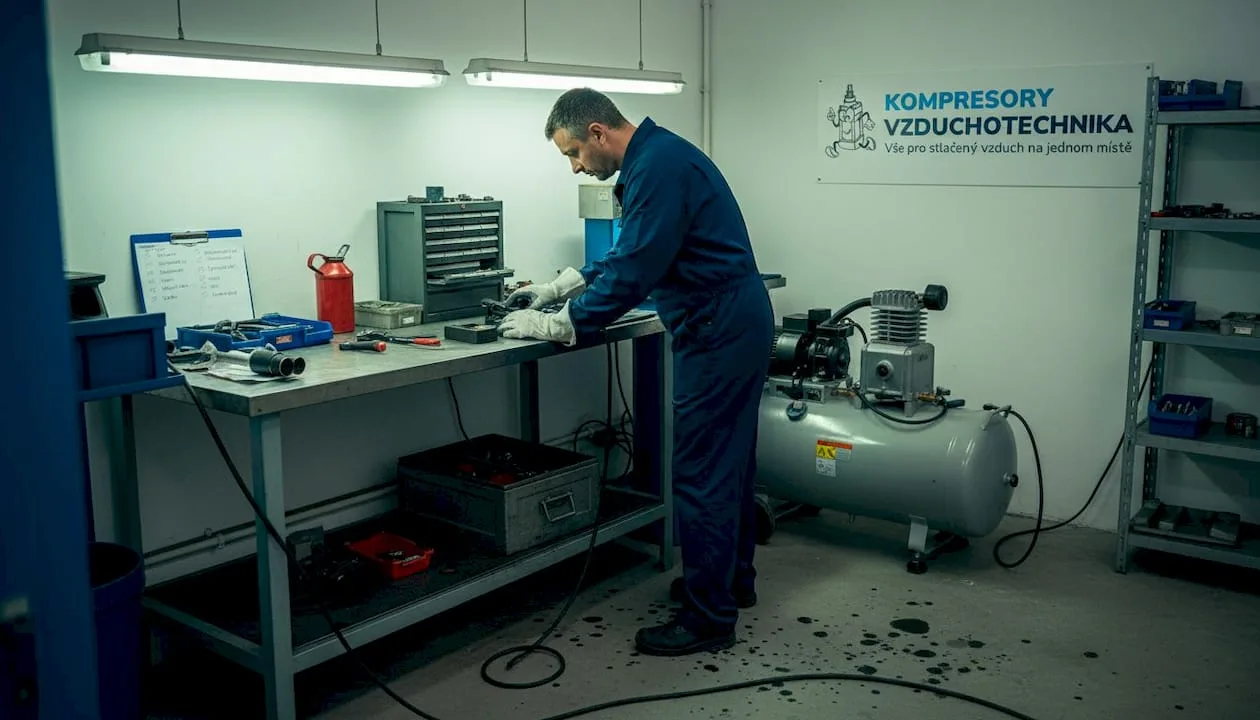
Knowing the output, the pressure and the air receiver volume of a compressor is not enough. If you do not understand how a piston compressor actually works inside, you will only react to problems instead of preventing them. A correct understanding of the working cycle, of valve function and of the mechanics of compression directly affects how efficiently you use the machine, how you set it up and how long it serves you reliably. This article breaks down how a piston compressor works step by step, compares it with the alternatives and shows where the most common operating mistakes lie.
Contents
- The basics of piston compressors and their role in industry
- How a piston compressor works, step by step
- Comparing piston and screw compressors
- Maintenance, operating mistakes and safety of piston compressors
- What really matters when choosing and running a piston compressor
- How we can help with choosing and servicing a piston compressor
- Frequently asked questions
Key takeaways
| Point | Details |
|---|---|
| Understanding the principle | Knowing how a piston compressor works brings higher efficiency, stable output and a longer service life of the equipment. |
| Comparing the types | Piston compressors are ideal for intermittent operation, screw compressors for continuous load. |
| Preventing mistakes | Following correct maintenance and operating parameters prevents costly failures. |
| Practical use | The right choice and operation of a compressor markedly affect production efficiency and workplace safety. |
The basics of piston compressors and their role in industry
To begin with, it is important to understand the significance and the usual areas of use of piston compressors. Piston compressors are among the oldest and most widespread types of machine for compressing air. They work on the principle of positive displacement, where a moving piston mechanically reduces the volume of gas in a closed space. Alongside them there are screw, scroll, vane and turbo compressors, each with its own typical area of use. The definition of a stationary compressor clearly defines where the piston design dominates and where other technologies take over.
Piston compressors are used across a whole range of industrial sectors. You will find them in car workshops, engineering plants, construction, the food industry or chemical production. Their advantages are a relatively low purchase price, simple design and the availability of spare parts. The specific use of a compressor in practice includes driving pneumatic tools, painting, filling cylinders or cleaning with compressed air.
| Parameter | Piston compressor | Screw compressor | Scroll compressor |
|---|---|---|---|
| Principle | Positive displacement by a piston | Positive displacement by screws | Spiral compression |
| Operating cycle | Intermittent | Continuous | Continuous |
| Pressure range | Up to 15 bar (and above) | 6 to 13 bar | 4 to 8 bar |
| Noise level | Higher | Lower | Very low |
| Purchase price | Low | Medium to high | High |
| Suitable for | Workshops, construction, repairs | Industrial production, continuous operation | Laboratories, medicine |
Key advantages of piston compressors in industry:
- High pressure at the outlet, typically 8 to 15 bar, and more in special versions
- Availability of service and spare parts practically anywhere in the country
- Low purchase price compared with screw or scroll compressors of the same output
- Flexibility of operation under intermittent load without loss of efficiency
- Robust construction suited to demanding operating conditions
The main limitations of piston compressors are a higher noise level, higher operating temperatures and limited suitability for continuous operation. The duty cycle of standard piston compressors is usually 60 to 70 %, which means the machine needs breaks to cool down.
How a piston compressor works, step by step
Having clarified the general significance, it is time to dive into the mechanical cycle of the piston compressor itself. The working cycle is the basis for understanding all the operating properties of the machine. Each cycle consists of four clearly defined phases that repeat with every stroke of the piston.
The four phases of the working cycle:
- Intake (suction): The piston moves down (or out of the cylinder, depending on the orientation). This increases the cylinder volume and creates a vacuum. The suction valve opens and air from the surroundings flows into the cylinder. The discharge valve stays closed.
- Compression: The piston reverses and begins to move back. The suction valve closes. The air is trapped in the decreasing cylinder volume and starts to be compressed. The pressure rises according to Boyle law: halving the volume roughly doubles the pressure (at constant temperature).
- Discharge: The air pressure in the piston reaches a value higher than the pressure in the air receiver. The discharge valve opens and the compressed air is pushed into the pipework or the air receiver.
- Expansion of the clearance volume: After the discharge valve closes, a small amount of compressed air remains in the cylinder (the clearance volume). This air expands during the return movement of the piston before the suction valve opens for a new cycle. The size of the clearance volume directly affects the volumetric efficiency of the compressor.
The role of the key components:
- Cylinder: The closed space in which compression takes place. The material, the tolerances and the cooling of the cylinder determine the thermal and pressure limits of the machine.
- Piston: The moving element that changes the cylinder volume. The piston rings provide sealing and carry heat away into the cylinder walls.
- Connecting rod and crankshaft: They convert the rotary motion of the electric motor into the linear motion of the piston. The quality of the connecting rod bearings is crucial to the service life of the machine.
- Suction and discharge valve: One-way valves control the air flow. They are the most heavily stressed components of the compressor, performing thousands of cycles per minute.
Examples of piston compressors in use show how great an influence a correct understanding of the working cycle has on choosing the right machine for a given application. The correct function of the check valve is essential both for protecting the air receiver and for the overall efficiency of the system.
Physically, the compression of air follows the laws of thermodynamics. In real operation the compression is polytropic, that is neither purely isothermal nor adiabatic. The temperature of the compressed air rises markedly. In a single-stage compressor at a pressure of 8 bar the temperature at the cylinder outlet can reach 160 to 200 °C. That is why two-stage compressors are energetically advantageous at higher pressures, since intercooling lowers the air temperature before the second compression stage.

Professional tip: If the discharge temperature of the compressor permanently exceeds the values stated by the manufacturer, the first diagnostic step is to check the condition of the suction and discharge valves. Damaged or blocked valves cause overheating and markedly reduce volumetric efficiency. Replacing the valves is cheaper than repairing damaged piston rings or the cylinder.
Comparing piston and screw compressors
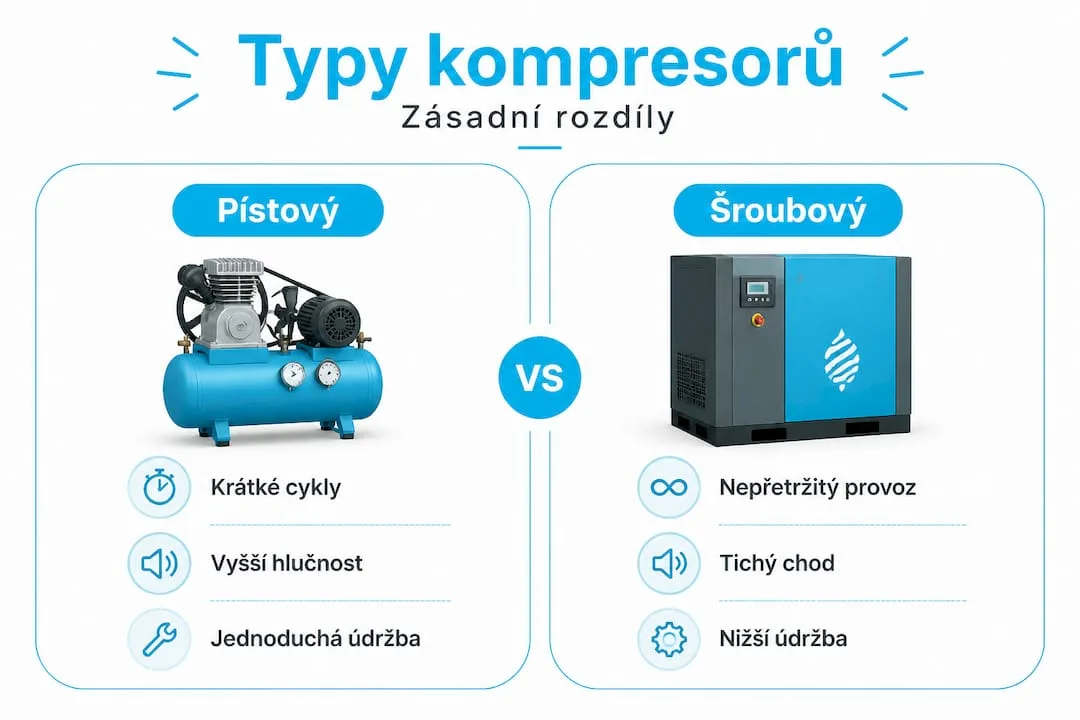
Once you know how a piston compressor works, it is essential to know how it differs from the most common alternative. A screw compressor works on an entirely different principle: the air is compressed by two intermeshing screw rotors, with the volume of the space between them gradually decreasing. The result is a continuous flow of compressed air free of pulsation.
| Criterion | Piston compressor | Screw compressor |
|---|---|---|
| Compression principle | Reciprocating, intermittent | Rotary, continuous |
| Suitable duty cycle | Up to 70 % | 100 % |
| Energy efficiency in continuous operation | Lower | Higher |
| Purchase cost | Lower | Higher |
| Long-term operating costs | Comparable or higher | Lower at full load |
| Noise level | Higher (75 to 85 dB) | Lower (65 to 75 dB) |
| Achievable pressure | Up to 40 bar (special) | Standard up to 13 bar |
| Typical service life | 10,000 to 15,000 hours | 40,000 to 80,000 hours |
The efficiency of two-stage and screw compressors shows that in operations with continuous air consumption for over 70 % of the running time, a screw compressor is economically more advantageous despite its higher purchase price.
The key number: Studies of operating costs show that when a compressor is used for more than 70 % of the running time, the energy costs make up as much as 70 to 80 % of the total life-cycle cost of the equipment. Choosing the right type of compressor is therefore primarily an economic, not a technical decision.
When to choose a piston compressor:
- Intermittent operation with a lower duty cycle (workshops, car services, service operations)
- High operating pressure above 13 bar, where screw compressors have technical limits
- A limited budget for the purchase price with less critical operating costs
- Backup or reserve capacity in case the main compressor fails
- Mobile or construction use, where resistance to outdoor conditions matters
When to choose a screw compressor:
- Continuous operation in production plants with a duty cycle of 80 to 100 %
- A requirement for low noise in an office or laboratory environment
- Large volume flows of air at medium pressure (6 to 10 bar)
- Automated operation with remote control and monitoring of parameters
Professional piston and screw compressors with a power input from 4 kW cover a large part of industrial applications in workshops and light production. The choice should always start from an analysis of the actual air consumption, not from assumptions.
Maintenance, operating mistakes and safety of piston compressors
Maintenance and safety are a firm part of everyday practice. Bad habits markedly shorten the service life of a compressor and can lead to breakdowns or workplace accidents. The most common mistakes when using a compressor cover a whole range of omissions, from trivial to systematic.
The most common operating and maintenance mistakes:
- Neglecting the oil change: The oil in an oil-lubricated compressor degrades with heat and becomes contaminated. Exceeding the service interval (typically 500 operating hours or once a year) leads to wear of the bearings and the cylinder.
- Neglected air filter maintenance: A clogged filter increases the resistance on the intake, reduces output and raises energy consumption. Filters must be cleaned or replaced according to the manufacturer instructions.
- Failing to drain the condensate from the air receiver: Condensate accumulates in the tank and causes corrosion. An air receiver without regular draining loses volume, and there is a risk of the tank wall being breached.
- Overloading the compressor beyond the permitted duty cycle: Piston compressors need breaks to cool down. Permanent operation without breaks leads to overheating and damage to the valves and piston rings.
- Poor sizing of the compressor for the given application: A compressor that is too small works constantly at the limit of its capability. One that is too large causes frequent short cycles (so-called short running), which is equally harmful.
- Ignoring leaks in the air distribution: Air escaping from pipework and joints means a direct loss of energy. Losses of 20 to 30 % of the total flow are no exception in neglected operations.
Essential safety measures:
- Regular inspection and certification of the pressure vessel (the air receiver) in line with the applicable legislation. Every air receiver above a defined volume is subject to regular pressure vessel inspections.
- Checking the function of the safety valve. The safety valve must open correctly at the set pressure and must not be mechanically blocked or plugged.
- Never adjust the setting of the pressure switch outside the range permitted by the manufacturer.
- Use only approved hoses and couplings certified for the given working pressure.
- Follow the safety rules for working with a compressor applicable to automotive and industrial operations.
Professional tip: Introducing a simple service log markedly extends the service life of a compressor. Record the date, the running hours and the maintenance performed at every service operation. In the case of recurring faults, the log allows a quick diagnosis of the cause and saves service costs.
„Regular preventive maintenance of a piston compressor reduces the risk of unplanned downtime and extends the mean time between failures (MTBF) by up to 40 % compared with reactive maintenance carried out only when a fault occurs."
Measures to extend service life:
- Placing the compressor in a clean, well-ventilated space (not outdoors without protection)
- Fitting an oil and water separator downstream of the air receiver for cleaner air in the distribution
- Checking the tension of the drive belt every 250 operating hours
- Regular cleaning of the cooler (air or water) to maintain thermal performance
- Checking the condition of the piston rings and valves at every major service (roughly 2,000 hours)
What really matters when choosing and running a piston compressor
In an industrial setting the piston compressor is sometimes dismissed as “outdated technology.” That is a technical error. Piston technology has a clearly defined application window and within it is reliable, efficient and economically advantageous. The problem arises when a piston compressor is run outside this window, typically under constant full load or without any maintenance at all.
Engineers in the field repeatedly encounter cases where the compressor was chosen according to catalogue parameters rather than the actual consumption profile. A compressor sized for peak output but run at a 90% duty cycle fails prematurely. Conversely, a machine that exactly matches the real operating conditions works without problems for many years.
Another neglected factor is air quality. For pneumatic tools in a car workshop, standard filtered air with oil is enough. For paint shops, the food industry or the pneumatics of control systems, air treatment is necessary (filtration, drying, possibly an oil-free compressor). Confusing these categories leads to damaged equipment or contamination of the product.
Energy saving on compressors is an area where many operations still lose money needlessly. Yet the basic measures are simple: repairing air leaks regularly, sizing the compressor capacity correctly and setting the working pressure to the lowest value at which the application still works reliably. Every bar of unnecessary excess pressure represents roughly 6 to 8 % of additional energy consumption by the compressor.
A piston compressor, correctly chosen, correctly installed and regularly maintained, is no less valuable a choice than more expensive alternatives. Its simplicity is a strength, not a weakness. The transparent mechanism allows easy diagnosis, a technically competent worker can handle the service without specialisation, and spare parts are both available and affordable. These are qualities that have a very concrete value in industrial practice.
How we can help with choosing and servicing a piston compressor
If you are considering an investment in a new compressor or need a solution matched precisely to your operating conditions, the range at Kompresory-vzduchotechnika.cz covers the whole spectrum of needs.
The range includes piston compressors for workshops and heavy industry, SCR screw compressors for continuous operation, pneumatic accessories, hoses and air receivers. Part of the offer is expert technical advice: we will help you analyse your consumption profile, propose the right output and pressure, and recommend the matching accessories. The whole the range of compressors and the advice are available online or through direct contact with the expert team. Whether you are looking for a new machine, spare parts or technical information, you will find them in one place.
Frequently asked questions
What is the main difference between a piston and a screw compressor?
A piston compressor works on the principle of compressing air with a piston in a cylinder, while a screw compressor uses rotating screw rotors and is better suited to continuous operation. A more detailed comparison of the two types also covers the two-stage design for higher pressures.
What should you watch out for when maintaining a piston compressor?
The emphasis is on regular oil changes, a clean air filter, draining the condensate from the air receiver and checking the valves. A detailed overview is covered by the principles of correct maintenance, including the most common operating mistakes.
When does a piston compressor make sense and when is a screw compressor better?
A piston compressor suits intermittent operation and shorter working cycles, while a screw compressor is ideal for long-term continuous running with a duty cycle above 80 %. An overview of specific applications is offered by piston and screw compressors in professional versions.
How does air compression work in a piston compressor?
The piston moves inside the cylinder; on the downward stroke it draws air in through the suction valve, and on the return stroke it compresses the air into a smaller volume, which is pushed through the discharge valve into the air receiver. The specific working cycle of the compressor follows the thermodynamic laws of positive displacement.
What are the most common mistakes in operating piston compressors?
The most common mistakes are neglecting regular maintenance, running beyond the permitted duty cycle and sizing the machine incorrectly for the given application. The complete list with the consequences is described in the overview of operating mistakes on the Kompresory-vzduchotechnika.cz blog.
Recommended
- What compressor output means: key factors and efficient use - Kompresory-Vzduchotechnika.cz
- Definition of a stationary compressor and its industrial use - Kompresory-Vzduchotechnika.cz
- Two-stage compressor: higher efficiency for industry 2026
- What is an electric compressor and how it improves efficiency - Kompresory-Vzduchotechnika.cz