
TL;DR:
- Compressor noise markedly affects the working environment, concentration and health of employees. Quiet compressors improve efficiency and communication and reduce the risk of workplace stress and accidents. When choosing one, the declared noise level, the design and correct installation matter, so that the workplace really is quiet.
Compressor noise is one of the factors professionals in industry and construction have long underestimated. Yet the difference between 85 dB and 65 dB at the workplace is not only about comfort, but about the ability to concentrate, to communicate and to deliver consistent performance across the whole shift. This article shows why quiet compressors are not a luxury for offices but a practical tool for every workshop, hall and building site. It gives an overview of the key selection criteria, technical solutions and specific comparisons that help with the decision.
Contents
- Why compressor noise matters in industry and construction
- The main factors in choosing a quiet compressor
- Comparison: loud versus quiet compressors
- Technical routes to quiet operation
- What most companies overlook when choosing a quiet compressor
- Solutions and recommendations for quiet compressors and accessories
- Frequently asked questions about quiet compressor operation
Key takeaways
| Point | Details |
|---|---|
| Quiet operation increases efficiency | Lower noise leads to better concentration and higher productivity across the whole working shift. |
| Effect on employee health | Longer exposure to noise damages hearing and the overall wellbeing of the team. |
| The right choice means savings | Choosing a quiet compressor together with quality accessories brings long-term cost savings. |
| Investment in technology pays off | Modern screw and electric compressors combine a low noise level with energy efficiency. |
Why compressor noise matters in industry and construction
Running a compressor in the enclosed space of a hall or workshop generates continuous noise that affects every worker present. At first sight it seems to be a side effect. In reality compressor noise has a negative effect on the working climate and the efficiency of the whole team.
Long-term exposure to noise above 80 dB causes fatigue, reduces the ability to concentrate and increases the number of mistakes. This is not theory. Workers in a noisy environment call out more information, lose time repeating instructions and achieve worse results in demanding operations such as welding, milling or painting. The risk of a workplace accident rises because warning signals and instructions are heard less clearly.
Health risks of a noisy workplace:
- Permanent hearing damage from repeated exposure above 85 dB
- Raised stress and cortisol levels, exhaustion after the shift
- Impaired coordination and reaction time under monotonous noise load
- Psychological strain that only shows up after months of operation
A workplace with a noise level above 85 dB requires hearing protection by law. But where protectors must be worn, effective verbal communication is almost entirely lost.
Quiet compressors solve this problem directly at the source. Instead of damping the noise at the individual worker, they protect the whole workplace. Workers can communicate naturally, hear warnings and instructions without protectors and stay more focused. The result shows in production quality, in fewer mistakes and in the overall atmosphere.
Note that even modern two-stage compressors now have design features that reduce noise while keeping performance high. At the same time the special sound-insulated ABAC compressors of the Silent series show that quietness and reliability go hand in hand in piston machines too. Overlooked mistakes in working with the compressor often amplify the noise further, for instance through poor installation or unsuitable positioning.
Professional tip: Consider workplace noise already at the planning stage. Placing the compressor outside the working area, in a separate or adjacent room, reduces noise exposure markedly without investing in a more expensive model.
The main factors in choosing a quiet compressor
Once it is clear why noise matters, the practical question arrives: what should you actually choose a quiet compressor by? The choice of compressor is decided by not only the output, but also the noise level, the drive type and the way it is installed.
Manufacturers state dB values in their catalogues, but take care. These values are often measured under ideal conditions, at a certain distance and without reflecting surfaces. A real workplace with concrete walls and metal racks looks entirely different. That is why it is important to ask about the measurement conditions and to compare models under identical conditions.
Key criteria when choosing a quiet compressor:
- Declared noise level in dB under standardised measurement conditions. Look for models below 70 dB for enclosed spaces.
- Design and sound insulation. Sound-insulated enclosures, damping panels and a special motor mounting reduce the transfer of vibration.
- Drive type. Screw compressors run more quietly than piston compressors at comparable output. Electric compressors without a combustion engine are quieter and safer in enclosed spaces.
- Output in relation to needs. An overloaded compressor works harder and louder. A correctly sized machine runs in an easier regime and generates less noise.
- Air receiver and method of storage. A larger air receiver allows longer intervals between compressor cycles, so the machine runs less often.
- Method of installation and positioning. Even a quiet compressor in a resonating enclosure or on a hard floor without damping pads generates excessive noise.
- Service and availability of spare parts. A worn bearing or a clogged filter increase the noise of the equipment over time.
The practical use of compressors ranges from car paints through pneumatic tools to industrial assembly lines. Each of these environments places different demands on the noise level and on the output. A closer look at the practical use of compressors in various sectors shows how the requirements differ and where quietness plays the greatest role.
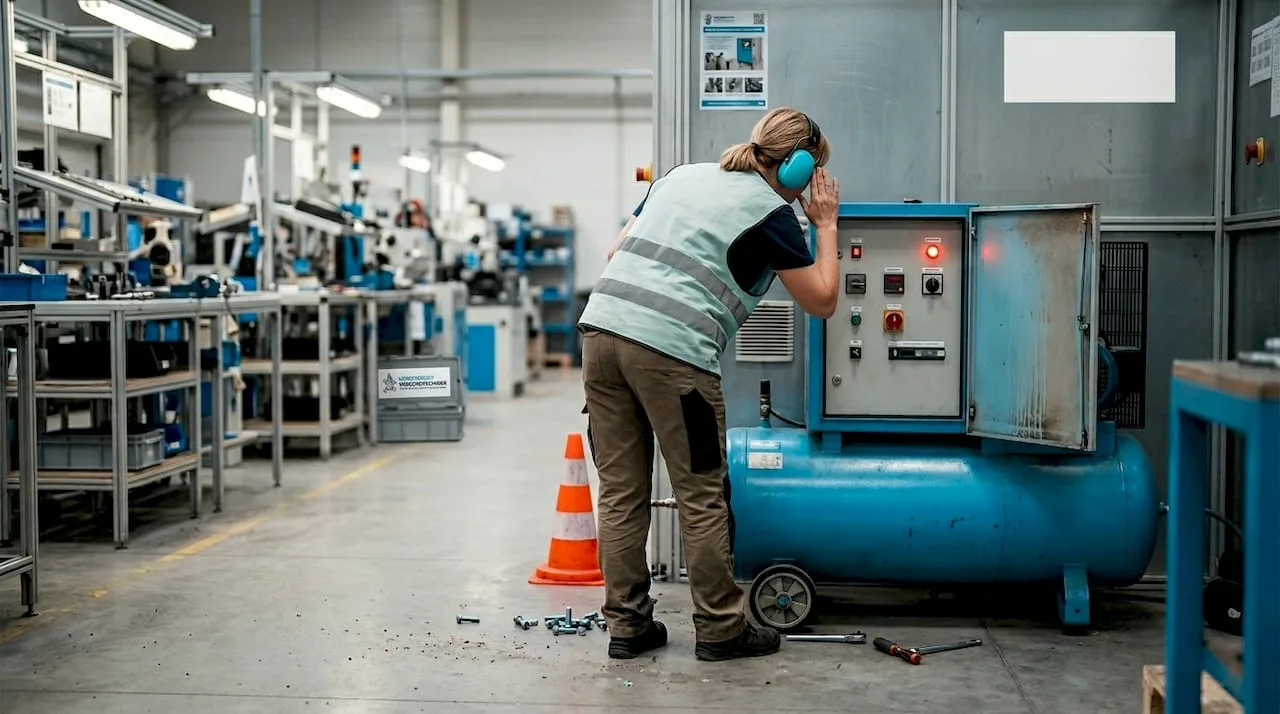
Do not forget the aspect of safety when working with a compressor either. A loud machine masks warnings, the vibration that signals a fault and the voices of colleagues. Workplace safety and quiet operation naturally go together.
Professional tip: When purchasing, ask for the measured noise level directly from the manufacturer or distributor, at rated output and at a distance of 1 metre. Catalogue values measured at 7 metres or in a hemi-anechoic chamber are not relevant to a decision about installation in a workshop.
Comparison: loud versus quiet compressors
An overview of the parameters helps to understand where quiet models really excel and where their benefit is clearest. Modern designs allow a marked reduction of noise without compromising output.
| Parameter | Loud compressor | Quiet compressor |
|---|---|---|
| Noise level | 85 to 100 dB | 58 to 70 dB |
| Design | Open piston compressor | Sound-insulated piston or screw compressor |
| Suitability for enclosed spaces | Limited, PPE required | Yes, without hearing protection |
| Purchase price | Lower | Higher by 20 to 50 % |
| Operating costs | Higher (wear, energy) | Lower with the right choice |
| Communication at the workplace | Limited | Normal |
| Risk of hearing damage | High in continuous operation | Minimal |
| Service life | Shorter when overloaded | Longer with correct sizing |
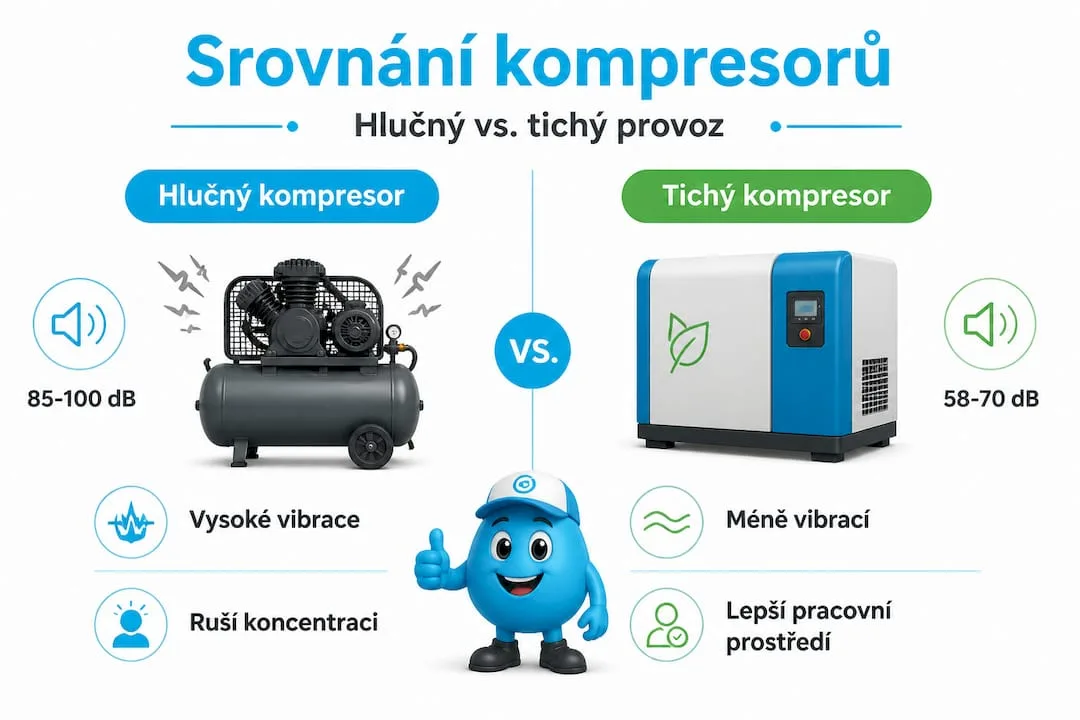
The table makes it clear that a quiet compressor brings savings in several areas at once. Less noise means fewer occupational illnesses, shorter reaction times to warnings and fewer stoppages caused by worker fatigue.
What to take into account when comparing models:
- Noise 10 dB higher does not mean twice as loud a sound, but subjectively roughly twice as intense a perception. The move from 85 to 70 dB is therefore very marked.
- Quiet compressors of the ABAC Silent range reach values of around 59 to 68 dB while being built for continuous industrial operation.
- The higher purchase price of a quiet model is usually offset by lower spending on PPE, health care and the replacement of worn parts.
- Always verify the information with the manufacturer or a reputable distributor, not only from leaflet material.
Purchase costs are only one side of the equation. The real economics of operation include energy consumption, service costs, availability of spare parts and the impact of noise on employee performance. Taken as a whole, quiet compressors come out more favourably than the price list alone would suggest.
Technical routes to quiet operation
Reducing compressor noise is neither an accident nor a marketing trick. Behind it stand specific technical solutions that can be applied both to new equipment and when modernising an existing fleet. Energy savings and quiet operation are delivered by modern screw and electric compressors.
The design of the sound-insulated enclosure is the foundation of modern quiet compressors. Internal damping panels, absorbing materials and separate chambers for the motor and the compressor head reduce sound escaping. Vibration is damped by rubber pads and special mountings of the unit. The result is a machine that works at full output but absorbs most of the noise before it gets out.
Screw compressors are inherently quieter than piston compressors. Rotating screws without an impulsive compression cycle generate more even and lower noise. Modern screw machines with a frequency converter also adapt their speed to the current demand, so they do not run at full output unnecessarily. That reduces both noise and energy consumption. More about saving energy with a compressor shows what this efficiency looks like in practice.
Electric compressors eliminate the combustion engine as a source of noise and emissions. For enclosed spaces they are the standard. The effect of an electric compressor shows not only in the noise level but also in the operating costs.
| Technology | Typical noise level | Main advantage | Suitability |
|---|---|---|---|
| Standard piston compressor | 85 to 100 dB | Lower purchase price | Outdoors, building site |
| Sound-insulated piston compressor | 59 to 72 dB | Compact quiet solution | Workshop, service, garage |
| Screw compressor | 62 to 75 dB | Smooth quiet operation | Industry, production, paint shop |
| Screw compressor with frequency converter | 58 to 68 dB | Energy saving plus quietness | Demanding production, continuous operation |
| Oil-free electric compressor | 55 to 68 dB | Clean air, quietness | Food industry, laboratories, medicine |
Modernising older equipment is a realistic option for operators who cannot invest in a new machine straight away. Fitting acoustic covers, replacing worn bearings, adding an anti-vibration pad and regular maintenance of valves and filters can reduce noise by 5 to 10 dB. This does not replace a modern sound-insulated machine, but it improves the situation considerably.
Regular maintenance is the cheapest form of noise reduction. Worn bearings, clogged filters and contamination in the suction valve increase both noise and energy consumption. Preventive service keeps the machine within optimum parameters.
An investment in a quiet and efficient compressor pays back within two to four years. The key roles are played by energy savings, lower spending on PPE and the longer service life of the machine thanks to the calmer operating regime. The savings from an SCR compressor in industrial use in particular show that quiet operation and economical operation go hand in hand.
What most companies overlook when choosing a quiet compressor
After the technical overview comes the practical truth from the field. Companies invest in a quiet compressor, but the result disappoints. On paper the machine shows 65 dB, yet at the workplace it does not sound like it. Where is the problem?
Most often in the installation and in the distribution system. The compressor itself may be quiet. But if it stands directly on a concrete floor without damping pads, the whole structure of the hall vibrates. If the air lines are rigid and fixed firmly to the walls, the vibration is transmitted throughout the building. In these cases the noise does not come from the machine but from the surrounding infrastructure, which resonates.
The second overlooked factor is operating costs over time. Buying a quiet compressor is the right step. Without regular maintenance, however, efficiency falls and noise grows. A clogged filter raises the power draw, a worn bearing generates new noise, a stiff valve causes impacts. The result matches an 85 dB machine even though it met every requirement on the day of installation.
The third neglected aspect is the air distribution system as a whole. Correctly sized pipework with a minimum of sharp bends, a suitable distance from the walls and quality air preparation units prevent turbulence, which itself generates noise. Undersized pipework increases the flow velocity of the air and with it the noise in the distribution, independently of the compressor itself.
Companies also underestimate the most common compressor mistakes in the area of installation. A poor choice of position, an unsuitable machine foundation or the absence of a noise barrier are recurring problems, even though solving them is cheap.
Professional tip: Before buying a new compressor, have an installation design drawn up by a specialist. The overall result in workplace quietness depends 30 to 40 % on the method of installation and the distribution system, not only on the parameters of the machine itself. The investment in expert consultation pays back faster than replacing a badly positioned unit.
The resulting quiet at the workplace is not the product of a single item. It is the result of a comprehensive approach: a correctly chosen machine, correct installation, regular maintenance and thoughtful placement within the operating space. Companies that plan this whole in advance achieve real quiet at the workplace. Companies that buy a quiet machine and put it anywhere are then disappointed.
Solutions and recommendations for quiet compressors and accessories
Choosing the right compressor for a quiet and efficient workplace need not be a complicated process if you have an overview of the available options.
At Kompresory-vzduchotechnika.cz you will find a complete range, from sound-insulated piston models to modern SCR screw compressors with a frequency converter, which combine quiet operation with marked energy savings. To optimise the whole system we also recommend adding quality compressed air preparation units to the installation; they contribute to stable pressure, reduce turbulence in the distribution and extend the service life of pneumatic tools. Expert advice on model choice and installation design is available as well.
Frequently asked questions about quiet compressor operation
What standards apply to the noise level of industrial compressors?
Most industrial compressors have a stated noise level in the range of 60 to 95 dB, while quiet models reach even less than 70 dB. The ČSN EN ISO 2151 standard sets the methodology for measuring compressor noise so that results are comparable.
Can I convert an older loud compressor to quiet operation?
Yes, the noise level can be reduced with insulating panels or by modernising the built-in components, but the effect depends on the type of equipment. The most effective measures are anti-vibration pads, acoustic covers and the replacement of worn rotating parts.
Does an investment in a quiet compressor pay off in the long term?
An investment in a quiet compressor saves costs linked to employee health and maintenance, and quiet, economical compressors bring long-term operating savings. The payback typically falls between two and four years depending on the intensity of operation.
Which compressor is the quietest for a small workshop?
Electric compressors or special sound-insulated models with a noise level well below 70 dB are considered the quietest. Modern designs allow a marked reduction of noise without compromising output, as the models of the ABAC Silent range show.
Recommended
- How the electric motor affects compressor performance and reliability
- Avoid the most common mistakes when using compressors - Kompresory-Vzduchotechnika.cz
- What is an electric compressor and how it improves efficiency - Kompresory-Vzduchotechnika.cz
- Two-stage compressor: higher efficiency for industry 2026