
TL;DR:
- The right choice of spare parts depends on the compressor type, operating conditions and component quality.
- Regular maintenance and timely replacement cut energy costs and minimise unplanned downtime.
- It is important to choose original or certified alternative parts to preserve safety and reliability.
Choosing the right spare part for a compressor decides whether the machine runs reliably and economically or causes unplanned downtime and needless cost. A badly chosen part not only fails to solve the problem, it can accelerate wear on downstream components, raise energy consumption or compromise operational safety. This article offers a structured overview of the selection criteria, the main part categories, a comparison of specific types and recommendations for different compressor types and operating situations. The aim is to give technicians a clear basis for every spare-part purchase.
Contents
- Key criteria for choosing compressor spare parts
- Main categories of spare parts: overview and function
- Comparing selected spare parts: advantages and drawbacks
- Recommendations by compressor type and application
- Long-term practice versus catalogue selection: what really works in compressor maintenance
- Where to buy and how to make choosing spare parts easier
- Frequently asked questions about compressor spare parts
Key takeaways
| Point | Details |
|---|---|
| Precise part selection | The compressor type and the operating regime determine the right list of spare parts. |
| Comparison makes the choice easier | Comparison tables show the main differences and advantages of each option at a glance. |
| Regular inspection extends service life | Planned service and timely replacement reduce the risk of failure. |
| The investment pays off | Quality parts increase the efficiency and reliability of the equipment. |
Key criteria for choosing compressor spare parts
Choosing a spare part always starts from the specific machine, not from the catalogue. The machine parameters, its manufacturer and the operating conditions are the basis of any decision. Without this information there is a risk that the purchased part will not be compatible, will have a shorter service life or will reduce the performance of the whole system.
Key criteria for the right choice:
- Compressor type and manufacturer. Piston, screw, diaphragm and vane compressors have different design requirements. An original part from the manufacturer guarantees an exact match in dimensions and material composition.
- Operating pressure and volume. Every part has a defined working pressure range. A seal or valve rated for 8 bar must not be used in a system working at 12 or 16 bar.
- Compatibility with the existing system. Dimensions, threads, connection port diameters and electrical parameters must exactly match the current configuration.
- Component quality and service life. The seal material (NBR, PTFE, silicone), the bearing class or the permeability of the filter medium directly affect the replacement interval and the operating costs.
- Availability and price of parts. Readily available parts from established manufacturers reduce the risk of downtime. Very cheap spare parts without a technical specification usually prove expensive over the whole life cycle.
- Safety and certification requirements. Components in industrial operation must meet the requirements of the relevant standards (CE, ISO, PED) and must not be confused with parts intended for lower pressure classes.
Saving energy with a compressor is one of the main reasons for replacing the right parts regularly. Worn or unsuitable components increase the power draw of the machine and lengthen the time needed to fill the air receiver, which shows up directly on the electricity bill. Regular preventive replacement of correctly chosen parts therefore pays off even when the machine still appears to work.
Another factor technicians sometimes underestimate are common maintenance mistakes such as fitting a part without checking the tightening torque, using an unsuitable lubricant or confusing seals with similar but dimensionally different alternatives.
Professional tip: Before ordering a spare part, always check the serial number and the year of manufacture of the compressor. Manufacturers change individual design elements during production, and older and newer versions of the same model may use components of different dimensions.
When judging whether a part is suitable, the planned load in the coming operating period matters too. If the machine faces intensive use, it is not sensible to fit a part at the end of its declared service life just because it still technically complies.
Main categories of spare parts: overview and function
Once the selection criteria are set, it is natural to introduce the individual groups of spare parts that are most often replaced or worn. Each category has a specific function in the operation of the compressor and calls for a different approach to selection and replacement.
Pistons, cylinders and seals
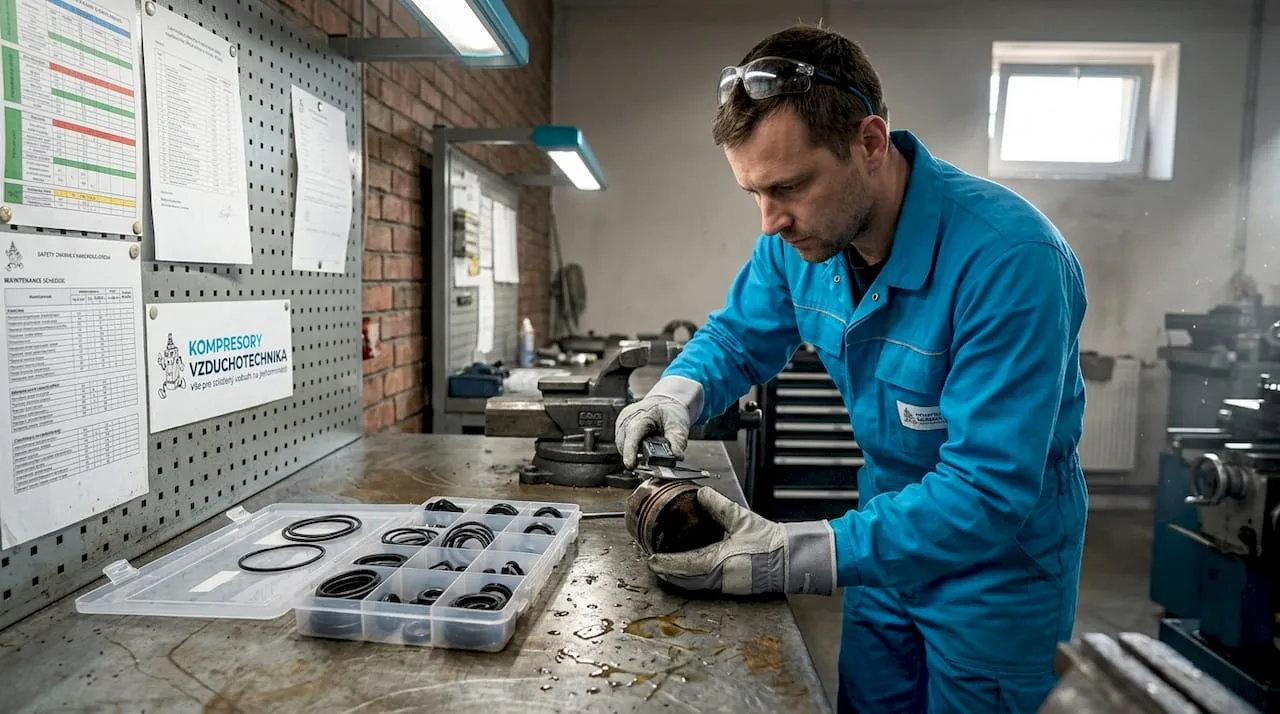
The piston group is the heart of every piston compressor. Pistons and cylinders are exposed to high mechanical stress, heat and pressure. Wear shows up as falling output, higher oil consumption or oil carried into the compressed air. Seals of the piston group should be replaced preventively at every overhaul, regardless of their visual condition.
Air and oil filters
Filtration is a critical element for the service life of the compressor and of the pneumatic tools downstream. The air filter captures contaminants in the intake air and prevents abrasion of the internal components. The oil filter keeps the lubricant clean and extends the oil change interval. A clogged filter increases resistance and therefore the power draw of the machine.
Valves and seals
Suction and discharge valves are the most frequently replaced component in piston compressors. A damaged valve causes air to flow back, markedly reduces efficiency and can lead to overheating. In screw compressors the critical points are the minimum pressure valves and safety relief valves.
Oil fills and separators
The correct viscosity and composition of the compressor oil affects lubrication, tightness and heat removal. The oil-air separator is crucial in oil-lubricated compressors for the quality of the output air. A clogged separator increases the residual oil content in the compressed air and causes problems in the pneumatic system downstream.
Electrical components
The role of the electric motor in a compressor is fundamental to the overall reliability of the system. Electrical spare parts include pressure switches, capacitors, contactors, relays and the electric motors themselves. A fault in the pressure switch or the capacitor can mean the compressor does not start at all or does not switch off.
Overview of spare part categories and their typical replacement intervals:
| Part category | Typical replacement interval | Main sign of wear | Effect on operation |
|---|---|---|---|
| Air filter | 500 hours or 6 months | Higher power draw, noise | Reduced efficiency |
| Oil filter | 500 hours or annually | Cloudy oil | Damage to lubrication |
| Compression valves | 2,000 hours | Pressure drop, overheating | Marked loss of output |
| Piston group seals | 4,000 hours | Oil at the outlet | Contamination of the air |
| Oil separator | 2,000 hours | Oil in the compressed air | Contamination of the system |
| Pressure switch | As required | Failure to start, overpressure | Safety risk |
| Electric motor | As required | Overheating, vibration | Machine outage |
For staff looking after several machines of various compressor types, it is worth keeping a clear service log for each unit separately. Records of part replacements, operating hours and oil consumption make planning preventive maintenance far easier and reduce the risk of an unexpected outage.
The most frequently replaced parts in industrial operation:
- Air and oil filters (highest replacement frequency)
- Suction and discharge valves in piston compressors
- Seals and O-rings at high-pressure points
- Oil separators in oil-lubricated screw compressors
- Air hoses and quick couplings in the distribution network
The right compressed air kit affects the efficiency and service life of the machine, especially when the compressor drives pneumatic tools or spray guns. Poor-quality hoses or unsuitable quick couplings cause leaks and put unnecessary load on the compressor.
Comparing selected spare parts: advantages and drawbacks
After the basic orientation in the categories, comparing common parts helps with the specific purchasing decision. Not all components are equal in terms of selection; it depends on the specific application, the operating pressure and the frequency of use.
Filter elements
Filters are available in various filtration classes. Standard filters capture solid particles, coalescing filters trap oil droplets and activated carbon removes odours and vapours. For industrial operation where the air is fed to painting or food applications, ISO 8573-1 filtration class class 1 or 2 is required.
Advantages of standard filter elements:
- Low purchase price
- Easy availability from several manufacturers
- Suitable for general industrial applications
Drawbacks:
- Insufficient for sensitive applications
- Shorter service interval in a contaminated environment
Valves: original versus alternative
Original discharge or suction valves from the compressor manufacturer guarantee an exact match with the design parameters. Alternative valves from specialised spare part manufacturers can be functionally comparable provided they meet identical dimensional and pressure parameters. Certification and the exact specification of the maximum working pressure are decisive.
Hoses and quick couplings
Operating pressure, diameter, length and hose material are parameters that must not be underestimated. PVC hoses are inexpensive but stiffen at low temperatures. Polyurethane hoses are more flexible and more resistant to abrasion. For high-temperature environments or aggressive media, neoprene or PTFE hoses are suitable.
Miniature air preparation units allow precise control of the air parameters and minimise wear on the other parts. Fitting a pressure regulator, a condensate separator and an automatic lubricator upstream of every pneumatic tool or consumer markedly extends the service life of the downstream components.
Comparison of hose types for compressed air:
| Hose type | Maximum pressure | Temperature range | Flexibility | Price |
|---|---|---|---|---|
| PVC | up to 15 bar | 0 to +60 °C | Medium | Low |
| Polyurethane | up to 12 bar | -40 to +60 °C | High | Medium |
| Rubberised fabric | up to 20 bar | -20 to +80 °C | Low | Medium |
| PTFE | up to 40 bar | -60 to +200 °C | Low | High |
| Neoprene | up to 20 bar | -20 to +100 °C | Medium | Medium |
When to reach for an original part and when for an alternative:
Original parts are always recommended for safety components (safety valves, pressure switches) and for warranty repairs. Quality alternative parts from certified manufacturers are acceptable for standard consumable components such as filters, O-rings or hoses, provided they meet the compressor manufacturer specifications.
Professional tip: When choosing an alternative valve, always check the maximum working pressure, the valve plate material and the overall dimensions. A deviation of only tenths of a millimetre in valve plate thickness can cause malfunction or premature failure.
Equipment with the advantages of two-stage compressors is subject to stricter demands on the tightness of the intercooling and on the quality of the seals between stages. Here the use of original parts or verified alternatives is essential to maintain optimum performance.
When repairing an air leak, the exact point of the leak must always be identified before any parts are replaced. Replacing seals without locating the cause of the leak leads to recurring problems and needless cost.
Recommendations by compressor type and application
After comparing specific parts it is time to focus on specific application situations and add expert recommendations. The compressor type and the way it is used fundamentally determine which spare parts take priority and how their replacement frequency differs.
Piston compressors
Piston compressors are simple in design and spare parts are usually easy to obtain. The most frequently replaced components are the valves (suction and discharge), the piston group seals and the air filter. For single-phase workshop machines running up to 4 hours a day, a valve inspection interval of every 1,500 operating hours is recommended.
Screw compressors
Screw compressors require careful attention to oil management. In screw compressors the regular replacement of seals is essential to keep the system tight. The screw pair itself has a very long service life (usually 40,000 hours and more), but the filter and oil elements require regular replacement.
Recommended procedure for choosing spare parts by application:
- Identify the type and model of the compressor. Record the serial number, the year of manufacture and the basic technical parameters (power input, max. pressure, air receiver volume).
- Establish the current operating hours. Compare them with the recommended replacement intervals in the service manual.
- Check the availability of original parts. If the original is not available, verify the technical specification of the alternative.
- Assess how demanding the operation is. Three-shift industrial operation requires the service intervals to be shortened by 20 to 30 percent compared with the manufacturer recommendation.
- Consider the safety aspects. Always replace components with a safety function using certified parts.
- Compare the total cost. A cheaper part with a shorter service life need not be economical once the labour time for fitting is included.
Safety note: Replacement of safety valves, pressure switches and electrical components must always be carried out by an authorised person and in accordance with the applicable safety regulations. Unprofessional fitting of safety elements can result in serious injury or damage to the equipment.
For industrial workshops and service centres it is advisable to keep a minimum stock of the most frequently replaced parts. This includes air and oil filters for every compressor type in operation, a set of seals and at least one complete valve set for each key machine.
Compressor service and maintenance as a systematic activity markedly reduces the total operating costs. The reactive approach, replacing parts only after a failure, is always more expensive than planned preventive replacement.
When deciding on a part for a specific application it is also important to take the operating environment into account. Compressors in a dusty or humid environment require shorter replacement intervals for the filter elements. In an environment with corrosive vapours the condition of the seals and the electrical components must be checked more frequently than the standard service plan specifies.
Long-term practice versus catalogue selection: what really works in compressor maintenance
Catalogue parameters provide the basis for selection, but experience from long-term operation brings information you will not find in a catalogue. A machine working three shifts in heavy dust wears differently from an identical model in a clean warehouse on an eight-hour working day. The declared replacement intervals come from the manufacturer test conditions, not from the specific workplace.
Practice shows that operators who keep detailed records of every part replacement and follow the development of energy consumption over time can anticipate the need to replace components before a visible fault appears. An increase in power draw of 8 to 10 percent under the same load is usually the first signal that filters or valves need service, even when they show no mechanical damage yet.
Another aspect the catalogue does not capture is the influence of the way the compressor is controlled on the service life of the parts. A machine that is repeatedly started and stopped in short cycles wears out switching and electrical elements far faster than a machine working in long stable cycles. This factor must be taken into account when choosing a pressure switch or a soft starter.
Experience also shows that the most common maintenance mistakes are not related to a poor choice of the part itself, but to fitting it incorrectly or to overlooking the accompanying components. Replacing a valve without checking the condition of the valve seat means the new part will wear at the same rate as the original one.
The question of original versus alternative is less black and white in practice than it seems. A quality alternative part from a specialised spare part manufacturer with a long tradition can be more reliable than an original part from a current production series that has changed subcontractor. The key indicator is always the available technical documentation, the certification and the feedback from other operators of the same equipment.
Recommendation from practice: invest in quality for parts with a safety function and for components with high replacement costs (screw pair, electric motor). For consumable parts with a short replacement interval (filters, O-rings, hoses), price optimisation is a sensible strategy provided the technical specifications are met.
Where to buy and how to make choosing spare parts easier
Choosing the right spare part does not end with the technical decision; it continues with the question of availability and a reliable source of supply.
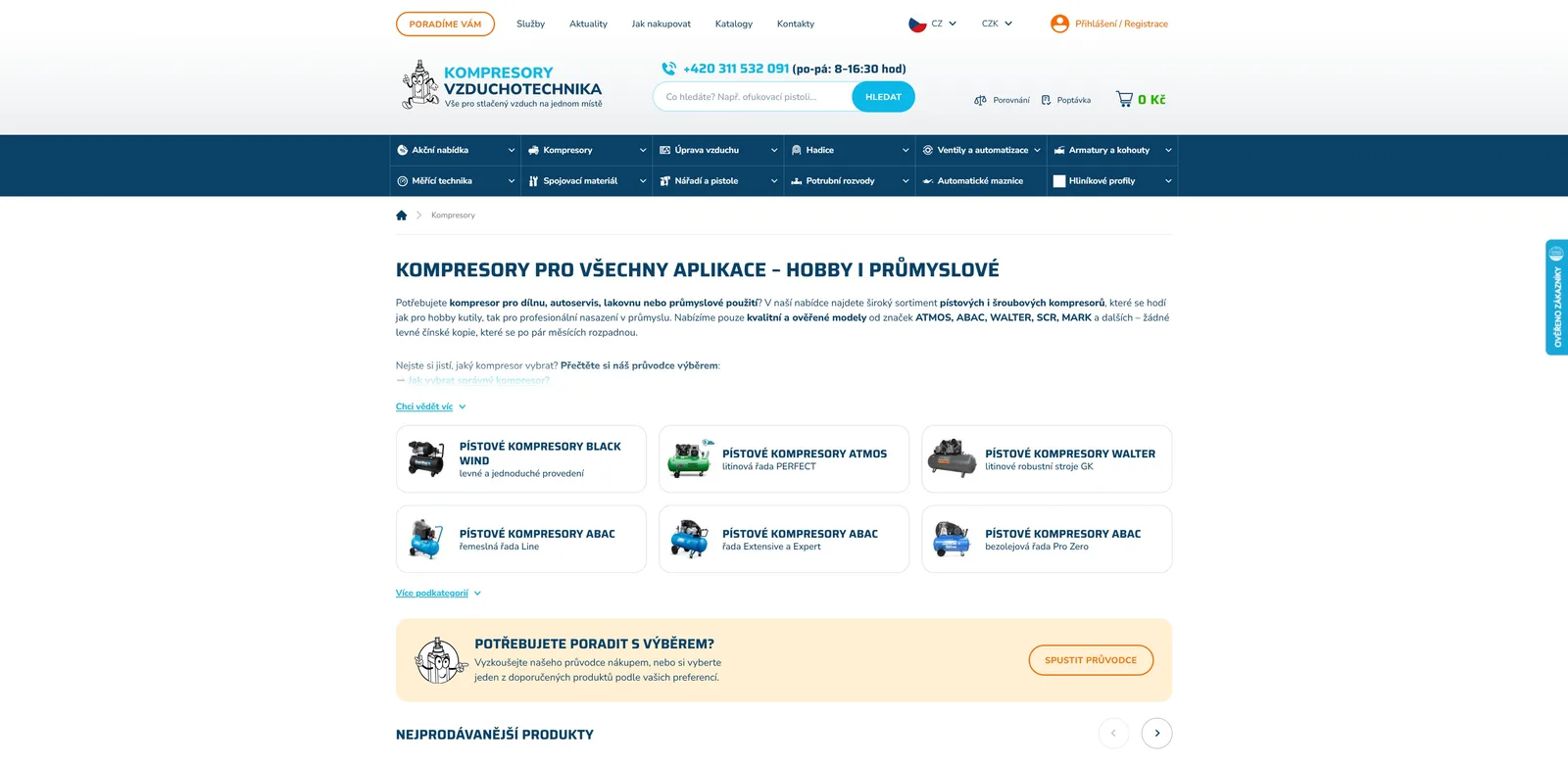
At Kompresory-vzduchotechnika.cz you will find a complete range of pneumatic and hydraulic parts for various compressor types, filter elements, seals, hoses, quick couplings and accessories. The range covers spare parts for piston and screw compressors as well as complete compressed air sets and air tools for workshops and industrial operation. The selection can be filtered by equipment type, working pressure or parameters. Technical support is available if needed to verify the compatibility of a part with a specific compressor model. Reliable availability and fast delivery shorten downtime and minimise the cost of unplanned repairs.
Frequently asked questions about compressor spare parts
How do I know when a specific compressor part needs replacing?
Most often from reduced efficiency, unusual noise or higher energy consumption. A higher power draw of the compressor is a direct signal to inspect and replace the key parts; regular inspection according to the service manual is the basis of preventive maintenance.
Are alternative parts as reliable as the original?
Quality alternative parts from certified manufacturers can offer comparable reliability, but it is always necessary to verify the exact technical specification, the certification and the experience of other operators with the same equipment.
Are there risks in using incorrect spare parts?
Using unsuitable parts leads to increased wear on the other components, higher operating costs and, in the case of safety elements, can present a direct safety risk to the operator.
What factors influence the service life of spare parts?
Service life is influenced by the quality of the materials, correct fitting, the level of load in operation and the conditions of the working environment. The type and output of the compressor are further key factors that directly determine the demands placed on the components used.
Recommended
- Avoid the most common mistakes when using compressors - Kompresory-Vzduchotechnika.cz
- What is an electric compressor and how it improves efficiency - Kompresory-Vzduchotechnika.cz
- Saving energy with a compressor: expert guide 2026 - Kompresory-Vzduchotechnika.cz
- How the electric motor affects compressor performance and reliability