

TL;DR:
- Neglecting air quality shortens equipment life and pushes maintenance costs up.
- The treatment process covers cleaning, drying and conditioning the air to suit specific needs.
- Regular checks and the right choice of technology are key to efficient, reliable operation.
Most pneumatic equipment failures and shortened service intervals share one common denominator: neglected air quality. Yet air treatment is the process of cleaning, drying and conditioning air to secure its quality in industrial, pneumatic and HVAC systems. This article explains what air treatment actually involves, which technologies are used in practice and where operating teams most often go wrong. Written for technicians and managers who want concrete answers, not general recommendations.
Contents
- What air treatment is and why it matters
- The main processes and components of air treatment
- Air treatment in practice: pneumatics vs. HVAC
- Edge cases: when the standard is not enough and what to watch
- Editorial view: what companies most often forget about air treatment
- How to get air treatment right in your company
- Frequently asked questions about air treatment
Key Takeaways
| Point | Details |
|---|---|
| Air treatment protects your equipment | The right level of filtration and drying prevents failures, extends service life and saves money. |
| Choose the solution to match the application | Different operating regimes need different air treatment – in pneumatics it is about cleanliness, in HVAC about comfort and efficiency. |
| Do not ignore edge cases | Special operating conditions call for more sophisticated filters, materials and maintenance regimes. |
| The ISO standard as the foundation | Multi-stage filtration to ISO 8573 is the cornerstone of reliability in industry. |
What air treatment is and why it matters
Air treatment in industry is not just an optional compressor accessory. It is a set of technologies and procedures whose purpose is to make sure the air entering machines, tools or buildings meets the required parameters. In pneumatics this means compressed air free of moisture, solid particles and oil aerosols. In HVAC it means controlling the temperature, humidity and cleanliness of the air supplied to buildings.
Air treatment is the process of cleaning, drying and conditioning air to secure its quality in industrial, pneumatic and HVAC systems. This definition applies to both fields, although the specific technologies and required parameters differ fundamentally.
The main benefits of properly configured air treatment:
- Longer equipment service life, by tens of percent, thanks to the elimination of moisture and contaminants
- Fewer failures of pneumatic components, valves and seals
- Energy savings by limiting air leaks and optimising pressure losses
- More consistent production quality wherever the air comes into direct contact with the product (food, pharmaceuticals)
- Comfort and hygiene in office and production areas
Neglecting air treatment does not cause an immediate breakdown, but it gradually degrades the entire pneumatic system. The cost of repairs and downtime is usually many times higher than the investment in the right equipment.
While in HVAC systems air quality shows up primarily in the comfort of staff and in energy consumption, in pneumatics it has a direct impact on production uptime. Every technician or maintenance manager should be clear about what their system requires and what it is actually getting.
The main processes and components of air treatment
We have defined the term. Now let us look at the specific treatment technologies and at which equipment to use in which cases. In pneumatic systems, compressed air treatment covers the removal of moisture (dryers) and of solid particles and oil (filters) in line with ISO 8573. This standard defines air purity classes and sets the maximum permissible content of solid particles, water and oil.
The basic compressed air treatment sequence:
- Pre-filtration at the compressor inlet: capturing coarse contaminants from the ambient air
- Compression of the air: compression raises the relative humidity and the concentration of contaminants
- Cooling and condensate separation: the first stage of water removal
- Fine filtration (5 microns and below): capturing solid particles and oil aerosols
- Air drying: lowering the dew point to suit the application
- Activated carbon filter (where necessary): removing residual oil and odours
- Pressure regulation before distribution: stable pressure at every point of use
Multi-stage filtration to ISO 8573 is the industry standard. Refrigeration dryers are sufficient for general production applications; critical applications in electronics or pharmaceuticals require adsorption dryers with a dew point down to minus 70 degrees Celsius.
A comparison of the main air treatment components
| Component | Function | Typical use | Maintenance interval |
|---|---|---|---|
| Mechanical filter (5 µm) | Capturing solid particles | General pneumatics | Every 2,000 hours |
| Coalescing filter (0.01 µm) | Removing oil aerosols | Food industry, paint shops | Every 2,000 hours |
| Refrigeration dryer | Dew point +3 °C | Manufacturing, car service shops | Annual service |
| Adsorption dryer | Dew point down to minus 70 °C | Electronics, pharmaceuticals | Adsorbent replacement |
| Membrane dryer | Dew point minus 10 to minus 40 °C | Remote sites, low maintenance | Minimal |
| Condensate separator | Draining water from the pipework | Every system | Quarterly check |
Types of filtration system are always chosen according to the specific application, pressure, flow rate and required purity class. The mistake happens the moment a single filter type is fitted across the whole system without analysing the real requirements.
Professional tip: Always combine at least two stages of filtration: a coalescing filter downstream of the refrigeration dryer will capture the residual aerosols the dryer cannot remove. For moisture removal in systems with a fluctuating ambient temperature, choose an adsorption dryer with automatic control of the regeneration cycles.
Air treatment in practice: pneumatics vs. HVAC
We have been through the technologies. Now let us look in practical terms at when and how air treatment is used in each field and where the key differences lie.
In HVAC systems, treatment covers filtration, heating or cooling, humidity control and distribution in the AHU (air handling unit). The primary goal is comfort and air quality for the people in the building.
In pneumatics the priority is different. Air cleanliness directly determines the service life of tools, valves, cylinders and seals. Pneumatics focused on cleanliness deliver savings of up to 42 %, while HVAC systems with heat recovery reach up to 90 % energy efficiency.
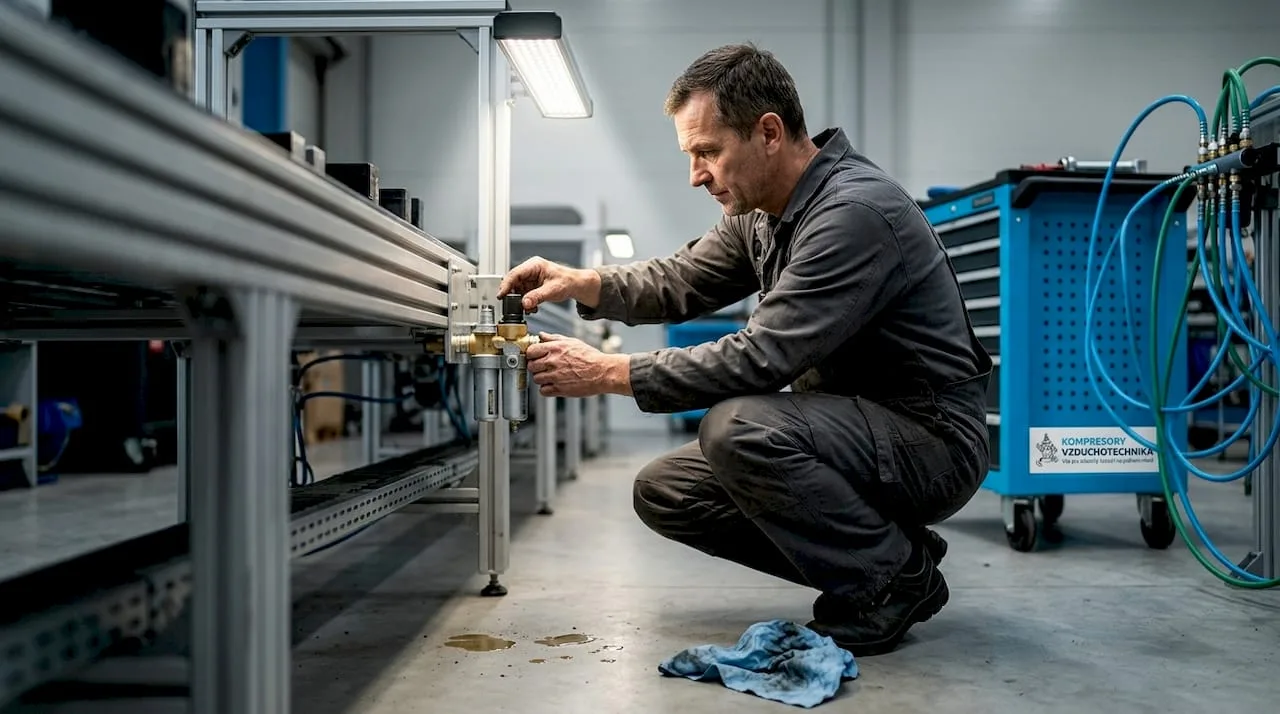
Key parameters: pneumatics vs. HVAC
| Parameter | Pneumatics | HVAC |
|---|---|---|
| Main goal | Air cleanliness, equipment protection | Comfort, temperature, humidity |
| Standards | ISO 8573, ISO 12500 | EN 13779, ASHRAE |
| Critical parameter | Dew point, oil and particle content | Temperature, relative humidity |
| Energy | Pressure, flow rate, losses | Heat balance, heat recovery |
| Examples of use | Production lines, CNC, paint shops | Office buildings, hospitals |
| Typical failures | Pipework corrosion, seal wear | Mould, Legionella, dust |
Companies most often go wrong on one specific point: they fail to match the air purity class to the real requirements of the application. They fit a refrigeration dryer where an adsorption dryer is needed, or conversely invest in expensive technology where a standard solution would do.
A critical application in pneumatics is any process where moisture or contaminants cause unplanned downtime or damage the product. Identifying these points in the system is the first step towards effective air treatment.
The efficiency of pneumatic systems depends not only on compressor output, but to a large extent on the quality of the treated air. Underestimating this factor leads to premature component replacement and unnecessary costs.
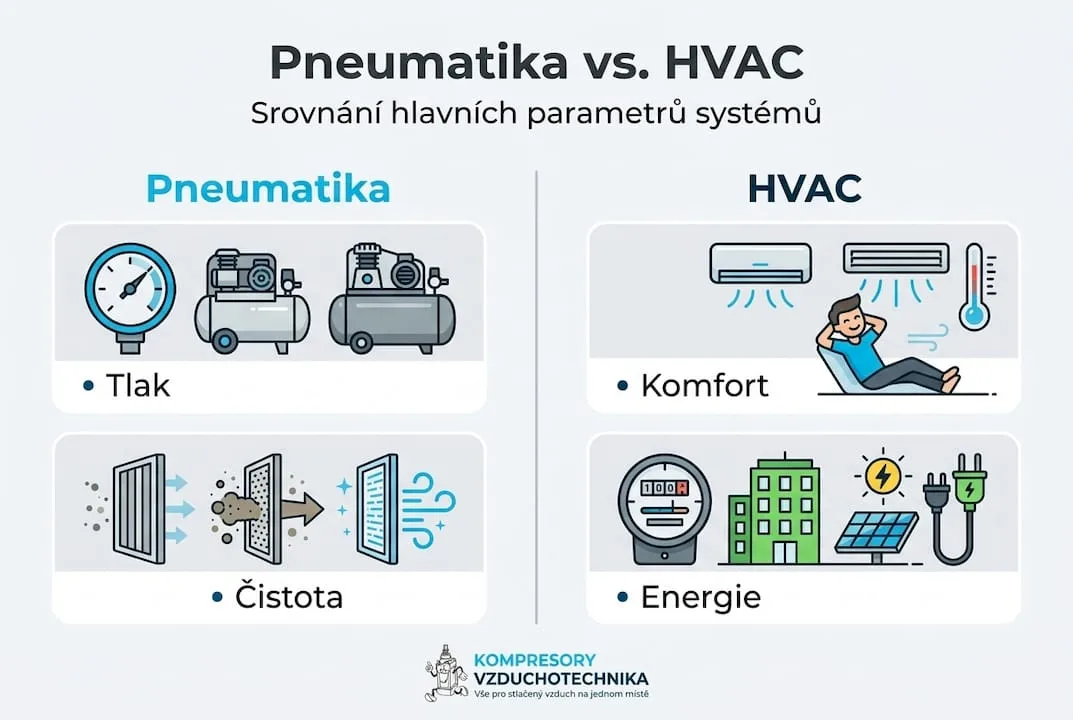
Real-world examples illustrate the difference clearly. A painting robot requires air of ISO 8573-1:2001 class 1 for oil, otherwise the surface finish is ruined. An air handling unit in a hospital needs precise control of relative humidity within the 40 to 60 % range so that micro-organisms do not multiply. Both situations call for air treatment, but with entirely different technologies and parameters.
Edge cases: when the standard is not enough and what to watch
Understanding the differences across the usual applications makes it possible to recognise the limits and the special situations that need extra attention. High temperatures above 80 degrees Celsius call for HNBR or FKM seals. Rodless cylinders need adjustable cushioning for speeds above 300 mm/s. Membrane dryers are ideal for operation with minimal maintenance or for remote sites without permanent supervision.
The most common edge cases in practice:
- High-temperature environments (foundries, paint shops, furnaces): standard NBR seals fail, so FKM or PTFE materials are required
- Outdoor installations in freezing climates: condensate freezes in the pipework, so heating tapes or heated separators are required
- Low flow with fluctuating demand: refrigeration dryers work inefficiently below 30 % of the nominal flow rate
- Food and pharmaceutical industry: requirements for ISO 8573 class 0 air for oil call for a combination of adsorption drying and a sterile filter
- Mobile applications (construction machinery, portable compressors): vibration and dusty environments shorten filter life, so service intervals have to be shortened
Professional tip: For unattended operation, choose a membrane dryer with automatic condensate drainage and an electronic control system. Membrane technology needs no moving parts and no electrical power for the drying process itself, so reliability is markedly higher than with unattended rotary or adsorption alternatives.
Maintenance managers should introduce regular dew point monitoring directly in the distribution network, not only downstream of the dryer. The dew point at the dryer outlet and the dew point at the last point of use can differ by 10 to 15 degrees Celsius because of heat gains from around the pipework. In practice this difference causes water to condense inside the machines themselves.
Proper filtration in production is not just a technical matter. It has a direct impact on the health and safety of staff in areas where the air circulates or where pneumatic tools blow air into the working space.
Choosing a dryer for edge case applications always starts with an analysis of three parameters: the maximum temperature at the dryer inlet, the minimum temperature at the point of use and the maximum permissible dew point for the given application. Only then is the technology chosen, not the other way round.
Editorial view: what companies most often forget about air treatment
Experience from hundreds of industrial and construction businesses reveals one recurring pattern. The compressor investment is made correctly, the technology is chosen with care, but air treatment is handled as a second-rate item. The filter is bought once and replacing the element is put off indefinitely.
The result is predictable. A clogged filter increases pressure losses, the compressor consumes more energy and the outlet pressure drops all the same. Yet the business does not see the direct link between an exhausted filter element and an 8 to 12 % rise in electricity consumption. This invisible cost is usually higher than a complete service of the filtration system.
Optimising compressed air systems in industry and construction means giving priority to compressed air treatment: in pneumatics to prevent failures and save energy, in HVAC for comfort and heat recovery. Even so, most businesses tackle these areas reactively, that is only after a failure, rather than preventively.
The second recurring problem is incorrectly set pressure on the filter regulators. Technicians set the pressure once during installation and after that nobody changes it. Yet a change in the production programme, the addition of a new machine or seasonal swings in ambient temperature may call for the whole pressure network to be reset. Improving air quality is not a one-off exercise, but an ongoing process.
Our recommendation is based on data: introduce a quarterly audit of the entire air treatment system. Check the pressure drop across the filters (more than 0.3 bar signals that the element needs replacing), monitor the dew point downstream of the dryer and test the oil content in the distribution network. These three indicators can flag up any critical situation in time, before it shows up as a failure or downtime.
How to get air treatment right in your company
You know the technologies and you know where companies go wrong. Now it comes down to specific steps and the right equipment for your operation.
At Kompresory-vzduchotechnika.cz you will find a complete range for air treatment. Air treatment units up to 10 bar cover the requirements of most industrial and construction operations, from simple filtration to multi-stage assemblies with automatic condensate drainage. For more demanding operations with high flow rates or critical air purity requirements we recommend screw compressors. Take a look at the range of MARK compressors or SCR screw compressors, which are designed for reliable industrial operation. Do you need an individual solution designed for your particular system? Contact our technical team.
Frequently asked questions about air treatment
What are the main types of air treatment equipment?
The basic equipment comprises filters (mechanical and coalescing), dryers (refrigeration, adsorption and membrane) and water or oil separators. The specific combination depends on the purity class to ISO 8573 and on the requirements of the application.
When do I need a special air treatment solution?
Non-standard situations arise at high temperatures above 80 °C, where minimal maintenance is required, or at extreme speeds in pneumatics. In these cases special seal materials or membrane dryers have to be chosen.
Is air treatment in HVAC as demanding as in pneumatics?
HVAC treatment focuses more on comfort and energy efficiency, whereas in pneumatics air cleanliness is critical for the service life of the machines. Pneumatics achieve savings of up to 42 % with the right air treatment, while HVAC systems with heat recovery reach up to 90 % efficiency.
What happens if compressed air treatment is neglected?
Contaminated air significantly shortens equipment service life and increases both the failure rate and operating costs. As the definition of the air treatment process states, without proper cleaning, drying and conditioning the quality of air in industrial systems cannot be guaranteed.
Recommended
- How to optimise compressed air consumption and cut costs in 2026
- How to eliminate air leaks: a guide to 42% energy savings - Kompresory-Vzduchotechnika.cz
- The role of the air receiver: how to boost the efficiency of pneumatic systems - Kompresory-Vzduchotechnika.cz
- Fixing air leaks step by step: an effective route to savings - Kompresory-Vzduchotechnika.cz