


TL;DR:
- A stationary compressor is a permanently installed device intended for continuous industrial operation.
- The right choice and maintenance are the key to efficiency, reliability and a long service life of the equipment.
- Modern compressors make integration into Industry 4.0 possible and improve the competitiveness of a business.
Stationary compressors form the backbone of the pneumatic infrastructure in modern industrial plants. Yet in practice we encounter a recurring error: many technical staff describe as an “industrial compressor" any device which compresses air, regardless of whether it is permanently installed or portable. This seemingly small terminological confusion has a direct impact on the choice of equipment, the dimensioning of compressed air distribution and the overall efficiency of the plant. In this article you will find a precise definition of a stationary compressor, an overview of its functions, specific industrial applications and practical recommendations for choice and maintenance.
Contents
- What a stationary compressor is: the basic definition and distinction
- The main functions and principles of stationary compressors
- The key applications of stationary compressors in industry
- Choice, maintenance and efficient operation of a stationary compressor
- Why underestimating stationary compressors holds back production innovation
- Top products and services for your plant
- Most frequent questions
Key findings
| Point | Details |
|---|---|
| A precise definition of the equipment | A stationary compressor is a device permanently installed for continuous operation in industry. |
| Key applications | Stationary compressors find use from production to automotive and the energy sector. |
| The importance of correct maintenance | Regular service and a suitable choice extend the service life and efficiency. |
| The difference from mobile ones | Unlike mobile types, stationary ones are intended for permanent installation. |
What a stationary compressor is: the basic definition and distinction
A stationary compressor is an industrial device intended for permanent installation in one place. As a rule it is firmly anchored to the floor or a base plate, connected to fixed distribution of compressed air and connected to an electrical or other energy source. It is not assumed that it will need to be moved. Conversely, a mobile compressor is designed so that it can easily be transported between workplaces, either on wheels or on a chassis.
A precise definition and technical distinction of compressors is key for the right choice in production plants. Confusing these categories leads in practice to undersizing of the installation, unnecessary operating losses and in the worse case to repeated faults.
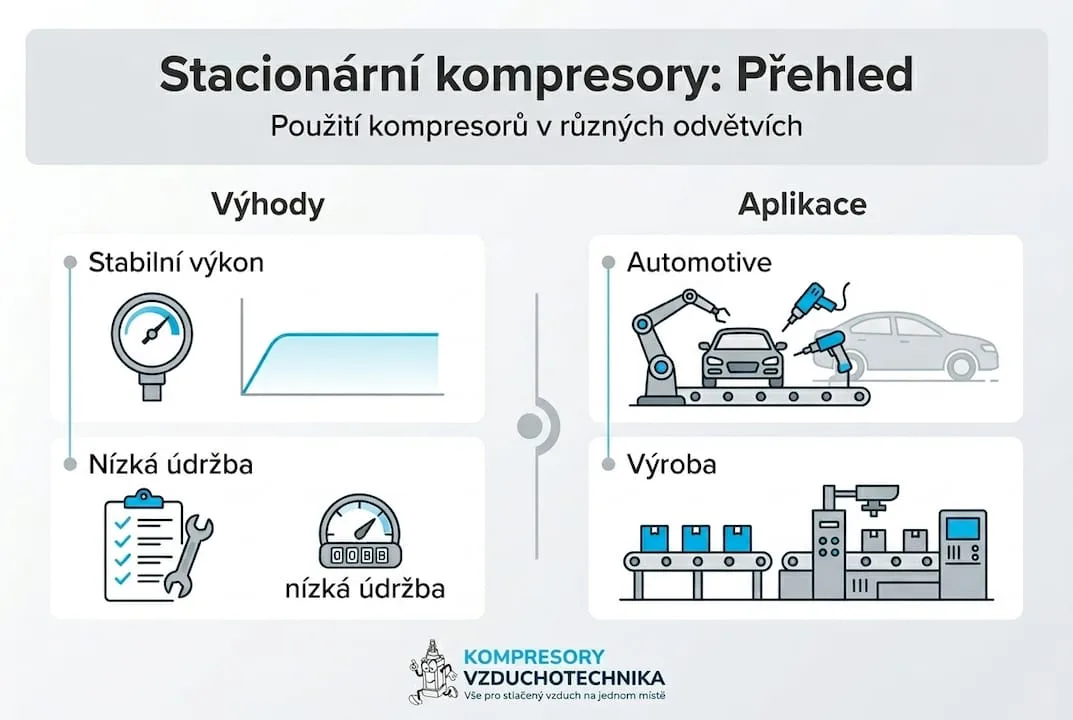
The key parameters of a stationary compressor
Stationary compressors are characterised by several technical parameters which distinguish them from portable solutions:
- Power input (kW): Stationary compressors usually have an output from 2.2 kW up to hundreds of kW, while portable models rarely exceed 7.5 kW.
- Air receiver (l): An integrated receiver with a volume of 90 to 5 000 litres ensures a stable pressure in the network.
- Working pressure (bar): As standard 8 to 13 bar, with special applications even more.
- Flow of air (l/min or m³/h): Dimensioning is carried out according to the actual consumption of the connected consumers.
A comparison of a stationary and a mobile compressor
| Parameter | Stationary compressor | Mobile compressor |
|---|---|---|
| Placement | Permanent installation | Portable, movable |
| Output | 2.2 kW and more | Typically up to 7.5 kW |
| Air receiver | Large (90 l+) | Small or none |
| Continuous operation | Yes, throughout the shift | Limited |
| Connection to distribution | Fixed piping | Hose or portable network |
| Typical use | Production plants, paint shops | Building sites, service in the field |
A stationary compressor is not just a “big compressor." It is a systemic part of the industrial infrastructure, designed for permanent, reliable and repeated performance under defined conditions.
A stationary solution is the ideal choice everywhere where a stable and continuous supply of compressed air is needed, where a constant power supply is ensured and where the costs of purchase and installation are balanced by long-term operational reliability. Typically these are production plants, car paint shops, food lines or compressor stations in the energy sector.
At the same time it holds that placing a compressor in the wrong category when buying or designing is one of the most frequent reasons why an installation does not achieve the assumed output from the start. That is why knowing the definition is a basic precondition of expert work in this field. For applications with high demands on output and pressure two-stage compressors are also suitable, which achieve a higher efficiency when compressing to higher pressures.
The main functions and principles of stationary compressors
You know what a stationary compressor is – now let us look at what it can do and how it works in practice.
The basic function of every stationary compressor is the compression of air from atmospheric pressure to the working pressure needed for the specific application. This compressed air is then stored in the air receiver and distributed through fixed piping to the individual consumers, such as pneumatic machines, tools, valves or spray guns.
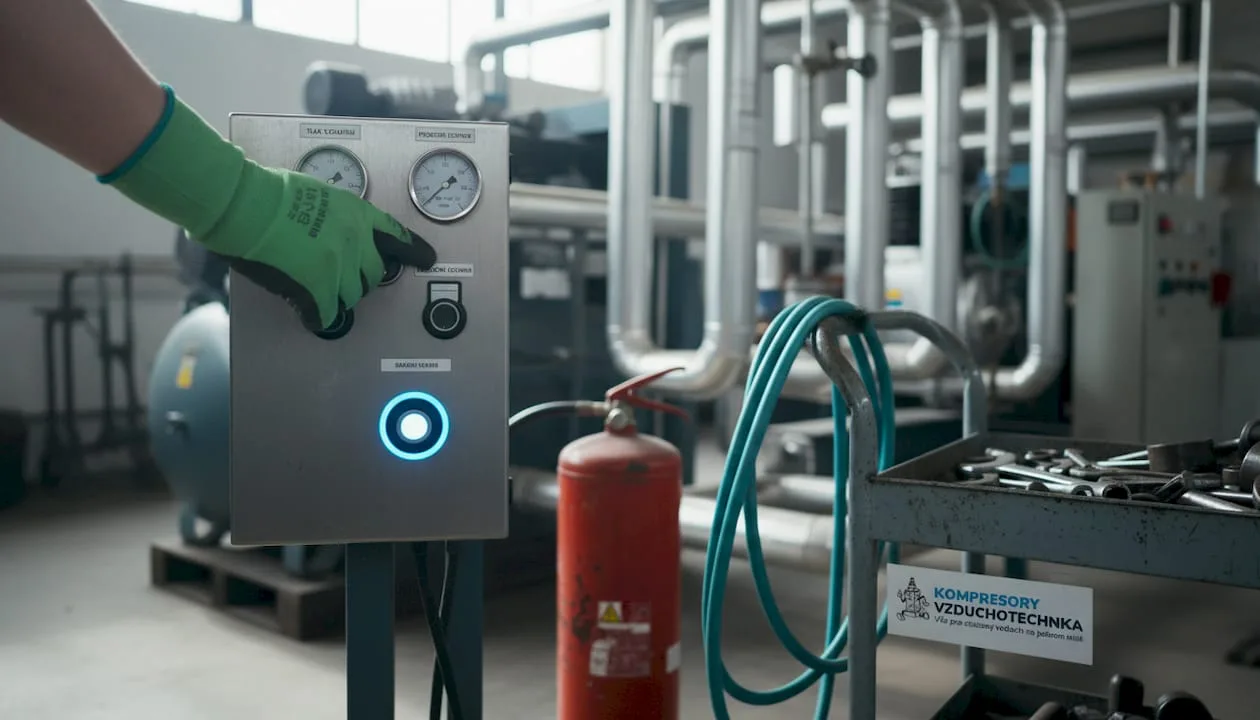
In production plants stationary compressors have a key function in supplying pneumatic pressure for various processes. Their ability to maintain a constant pressure in the network even with variable consumption is fundamental for the continuity of production.
Types of mechanism in stationary compressors
Stationary compressors use three main types of mechanism:
- Piston compressors: The classic principle, where a piston moving in a cylinder compresses the air. They are robust, easy to service and suitable for intermittent operation. The simple construction means a lower purchase price.
- Screw compressors: The air is compressed using two intermeshing screw rotors. This mechanism makes continuous operation without interruption, a low noise level and a high energy efficiency possible. They are preferred in applications with consumption throughout the shift.
- Spiral (scroll) compressors: They use two eccentrically moving spirals. They are considerably quieter, suitable for clean air without oil and find application in laboratory and food plants.
Continuous operation as the decisive factor
With stationary compressors the so-called duty cycle, given in percent, is a key parameter. Piston compressors have a duty cycle of typically 60 to 80 %, screw ones manage 100 %. That means that a screw compressor can work continuously, without the need for an interruption to cool down.
Professional tip: If your plant requires a continuous supply of compressed air, such as a painting line or automated assembly, a screw compressor is the right choice. A piston compressor would soon be overloaded in such a plant, and that would lead to premature wear.
The influence of a stationary compressor on operating efficiency cannot be underestimated. A correctly dimensioned and installed compressor reduces energy losses, maintains a stable pressure and minimises downtime. Conversely, an undersized compressor works at the limit of its possibilities, its service life is shortened and the costs of service and consumed energy increase.
The key applications of stationary compressors in industry
When you know the main principles, it is time to understand how broad the spectrum of applications in production practice is.
Stationary compressors are today standard equipment in a whole range of industrial sectors. Every sector places specific requirements on compressors, both in terms of output and in terms of the quality of the compressed air.
An overview of industrial applications
| Sector | Typical application | Requirement on the air |
|---|---|---|
| Manufacturing industry | Pneumatic tools, automatic machines | Dry, filtered air |
| Food industry | Packaging, filling, transport | Oil-free air, class 1 |
| Automotive | Paint shops, assembly, presses | Dry air, high flow |
| Energy sector | Regulating valves, cleaning | Constant pressure, high reliability |
| Mechanical engineering | Machining centres, CNC machines | Filtered and dry air |
Specific examples of use by sector
The manufacturing industry relies on compressed air for driving pneumatic tools, automated vices, air cylinders and sorters. A stationary compressor here supplies the whole production hall through a ring network of piping.
The food industry requires oil-free compressed air, because the air comes into direct contact with the products or packaging materials. Here compressors with certification of air quality and additional filters for eliminating moisture, odours and micro-organisms are necessary.
Automotive is a sector with some of the strictest requirements. The safety rules in automotive include not only the parameters of the compressor, but also the safety of the operator, the quality of the air for paint shops and the accuracy of pressure for assembly fixtures. The technical requirements differ depending on the application in the specific sector, from the food industry to automotive.
The energy sector uses compressed air for controlling regulating valves, pneumatic drives and the regular cleaning of equipment. The reliability of the compressor is critical here, because an outage of the air supply can result in the shutdown of a whole technological node.
The procedure for integrating a compressor into a plant
The correct integration of a stationary compressor into the production process includes these steps:
- Analysis of the consumption of air: Measure or estimate the total flow of all the consumers in l/min or m³/h.
- Choice of the working pressure: Determine the maximum pressure which the most demanding consumer requires.
- Dimensioning of the air receiver: The receiver should cover the peak consumption and dampen pressure surges in the network.
- Design of the distribution: The pipe network must minimise pressure losses, corrosion and condensation of moisture.
- Installation of the treatment units: Filters, dryers and oil separators protect the consumers as well as the products.
Choice, maintenance and efficient operation of a stationary compressor
Once you know what you need the compressor for, focus on the right choice and regular care.
The choice of a stationary compressor is a complex decision which will influence the operating costs for many years ahead. It is not enough to compare only the purchase price. What matters are the total life cycle costs of the equipment, that is the sum of the purchase price, the costs of energy, service and possible downtime.
Key criteria of choice
- Type of mechanism: Piston for intermittent operation, screw for continuous.
- Output and flow: Dimensioning with a reserve of 20 to 30 % above the measured consumption.
- Class of air purity: According to the standard ISO 8573 choose the class corresponding to the application.
- Energy efficiency: Follow the parameter of specific output (kW per m³/min). The right choice of compressor is fundamental for energy saving and operational efficiency.
- Noise level (dB): Important especially with installation near workplaces or offices.
- Availability of spare parts and the service network: Key for minimising downtime.
Preventive maintenance as a guarantee of reliability
Regular service significantly extends the service life of the equipment and reduces the risk of faults. A plan of preventive maintenance should include:
- Checking and replacing the oil and air filters at the intervals recommended by the manufacturer.
- Checking the level of oil and changing it according to operating hours.
- Cleaning the cooling fins and checking the flow of cooling air.
- Checking the safety valves and their function.
- Inspection of the seals, hoses and joints to reveal leaks of air.
Professional tip: A leak of compressed air with a diameter of 1 mm at a pressure of 7 bar represents a loss of approximately 1.5 m³/h. Over a year of operation that can, depending on the price of energy, mean a cost in the order of thousands of crowns. A regular check of the distribution with a leak detector always pays off.
We also recommend paying attention to the most frequent mistakes in maintenance, such as neglecting the replacement of filters, operation without sufficient cooling or overloading the compressor beyond its nominal output. These mistakes are responsible for the majority of premature faults in plants where the service plan is underestimated. The topic of energy saving in the context of compressors is appropriate to address systematically, ideally with the help of an energy audit of the whole compressed air network.
Why underestimating stationary compressors holds back production innovation
From the point of view of a specialist who works with compressed air and pneumatics daily, one recurring pattern is apparent: managers and designers approach the compressor as a supporting, unimportant element of the infrastructure. Investment goes into new CNC machines, robotic cells and control systems, while the compressor station remains unchanged for twenty years.
The result is predictable. New machines require a higher flow and a more stable pressure, the old compressor is not enough, and the whole expensive automation project does not achieve the planned productivity. Yet a correctly dimensioned and modern screw compressor with a frequency converter could reduce energy consumption by 20 to 35 % compared with an outdated piston machine.
A stationary compressor is not a cost item, it is a key means of production. Modern compressors with integrated sensors, remote monitoring and adaptive flow control are today a direct part of Industry 4.0. Their integration into the production information system makes predictive service and the optimisation of energy consumption in real time possible. That is a benefit which cannot be replaced in any other way.
The decision about a compressor should be strategic, not operational. A look at higher efficiency in industry shows that the choice of the right compressor has a measurable impact on the overall competitiveness of a plant.
Top products and services for your plant
Are you looking for a reliable stationary compressor for your plant? Kompresory-vzduchotechnika.cz offers proven solutions for industry, automotive and the food industry.
In the offer you will find stationary MARK compressors with outputs for small as well as large plants, including piston and screw models with an integrated air receiver. Furthermore a wide range of pneumatic tools for connection to stationary distribution and air treatment units for filtration, pressure regulation and the drainage of condensate are available. An expert team is available for technical advice and help with the choice of the optimal solution according to specific operating requirements.
Most frequent questions
What is the main difference between a stationary and a mobile compressor?
A stationary compressor is a permanently installed device intended for long-term and continuous operation, while a mobile compressor can easily be moved between workplaces. The differences in the use and installation of the individual types are key for production efficiency.
In which industrial areas are stationary compressors used most often?
Most often they find their use in production plants, automotive, the food industry and the energy sector. Stationary compressors have a wide application in various sectors of industry.
What are the main advantages of regular maintenance of a stationary compressor?
Regular maintenance extends the service life of the equipment, increases operational reliability and reduces the risk of faults. Service is key for the long-term reliability of compressors in demanding industrial conditions.
Which mechanism is the most common in stationary compressors?
In stationary compressors screw and piston mechanisms are the most widespread. The division of the mechanisms of compressors by type and principle of operation determines the suitability for specific operating conditions.
Recommended
- Two-stage compressor: higher efficiency for industry 2026
- Decompressor: a key function in industrial pneumatics - Kompresory-Vzduchotechnika.cz
- What an electric compressor is and how it will improve the efficiency of a plant - Kompresory-Vzduchotechnika.cz
- Energy saving with a compressor: an expert guide 2026 - Kompresory-Vzduchotechnika.cz